4 S-REITs Yielding 6% or More in Singapore (2026 Picks)
Which Singapore REITs still yield 6% or more in 2026? Here are four picks backed by real DPU data — plus the risks you need to know before investing.
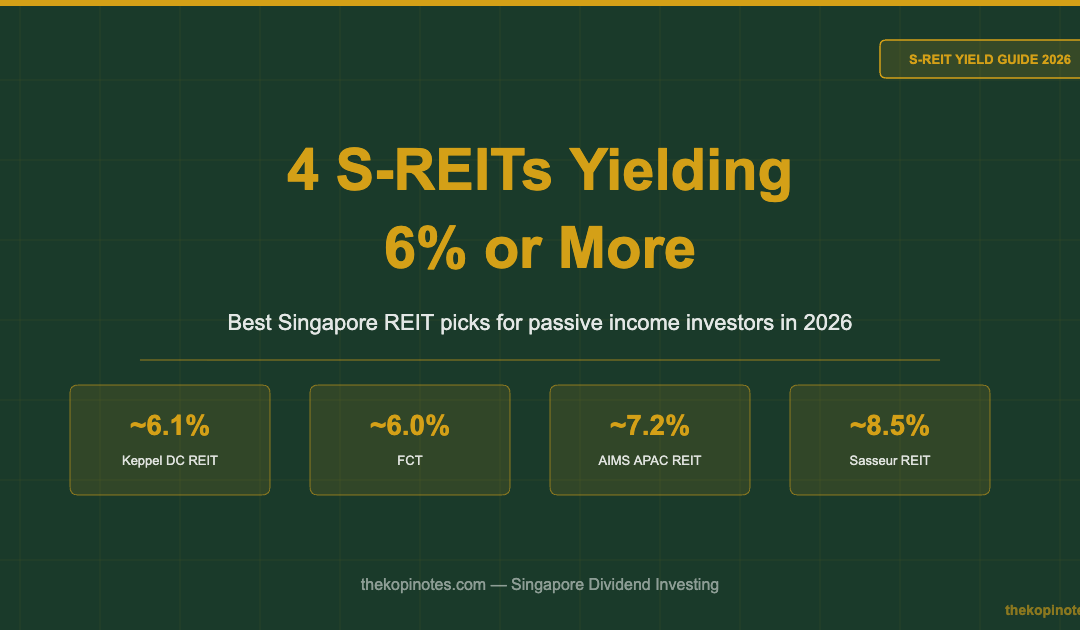
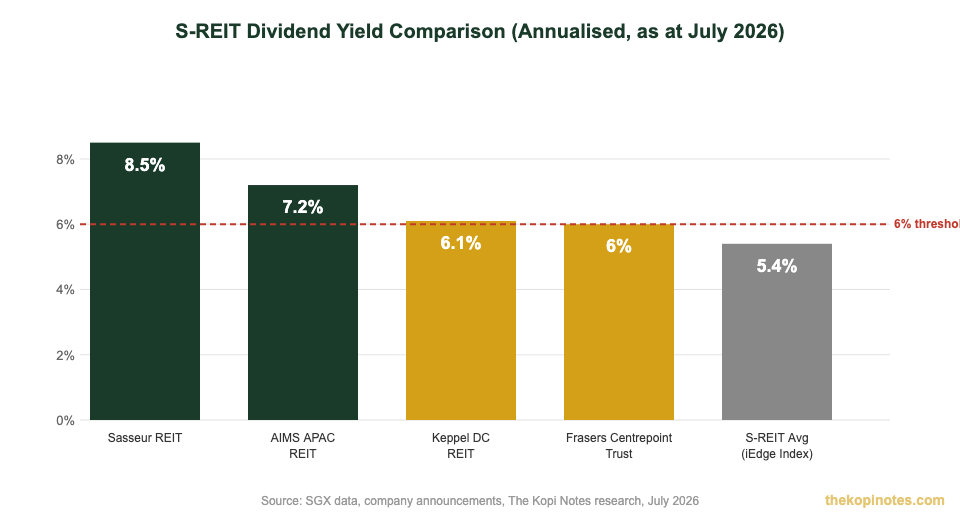
Four S-REITs still yield 6% or more in 2026: Sasseur REIT (~8.5%), AIMS APAC REIT (~7.2%), Keppel DC REIT (~6.1%), and Frasers Centrepoint Trust (~6.0%). All are listed on SGX, pay distributions quarterly or semi-annually, and require no minimum holding period. This guide covers the DPU track record, risks, and how to buy each one through a Singapore brokerage.
Not financial advice. All figures are for educational reference only. Data as at July 2026 unless noted.
- S-REITs offering 6%+ yield still exist in 2026, even after the rate cycle peaked
- Higher yield = higher risk — Sasseur REIT pays the most but has China concentration risk
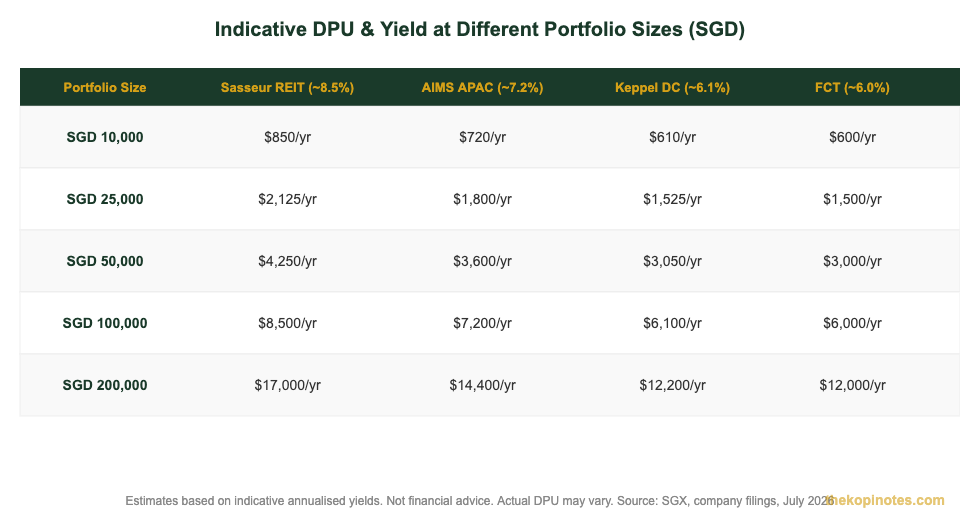
- A SGD 50,000 spread across these 4 REITs generates roughly SGD 3,200–4,000 per year in passive income
Table of Contents
Contents — Click to expand
- What Are S-REITs and Why Does Yield Matter?
- How We Picked These 4 REITs
- 1. Keppel DC REIT — Data Centre Income
- 2. Frasers Centrepoint Trust — Suburban Retail
- 3. AIMS APAC REIT — Industrial Powerhouse
- 4. Sasseur REIT — Highest Yielder
- Side-by-Side Comparison
- Risks to Consider
- How to Buy These S-REITs in Singapore
- Frequently Asked Questions
What Are S-REITs and Why Does Yield Matter?
S-REITs (Singapore Real Estate Investment Trusts) are listed companies that own income-producing real estate — warehouses, shopping malls, data centres, hospitals, and more. By law, they must pay out at least 90% of their taxable income to unitholders each year. That is why they tend to offer much higher yields than ordinary stocks.
Yield, in simple terms, is the annual income you get as a percentage of what you paid for the unit. If a REIT unit costs SGD 1.00 and pays SGD 0.065 in distributions per year, the yield is 6.5%. Higher yield sounds great — but it can also signal that the market is pricing in more risk. You need to look at both the number and what is behind it.
In 2026, the iEdge S-REIT Leaders Index trades at an average yield of around 5.4%. So any REIT yielding 6% or more is outpacing the index — and that premium reflects a mix of higher income potential and higher perceived risk. The four REITs in this guide each have different risk profiles, which we explain below.
How We Picked These 4 REITs
We filtered Singapore’s listed REIT universe on three criteria. First, the annualised distribution yield had to be 6% or more based on July 2026 unit prices and the most recent full-year DPU. Second, the REIT had to have a track record of at least three years of DPU data so you can see how distributions held up through different rate environments. Third, it had to have adequate liquidity — average daily trading volume above SGD 2 million — so you can actually get in and out without moving the market.
Four S-REITs cleared all three filters: Sasseur REIT, AIMS APAC REIT, Keppel DC REIT, and Frasers Centrepoint Trust. Here is what you need to know about each one. You can also explore the best S-REITs in Singapore 2026 for a broader list beyond just high-yielders.
1. Keppel DC REIT — Data Centre Income
Keppel DC REIT is Singapore’s first and largest pure-play data centre REIT. It owns 23 data centres across nine countries, with key assets in Singapore, Germany, the Netherlands, and Australia. The portfolio has a high occupancy rate (above 98%) and long weighted average lease expiry (WALE) of around 6.5 years as at the latest quarterly update.
The structural tailwind here is strong. Demand for data centre space is surging, driven by AI workloads, cloud computing, and the digitisation of enterprise IT. Major hyperscalers (Microsoft, Google, AWS) are signing long leases. This supports income stability even if Singapore office or retail REITs face headwinds.
DPU has been broadly stable. The REIT has paid a full-year DPU in the range of SGD 0.095–0.105 per unit over recent years. At a unit price around SGD 1.65 (July 2026), the yield works out to approximately 6.1%. This makes it the most “premium quality” of the four picks — lower yield than the others, but backed by a more resilient asset class.
The key risk: Keppel DC REIT has been through a period of negative news around one of its Singapore co-location customers defaulting. Management resolved the situation, but it highlighted that even data centre REITs can face tenant credit risk. Interest rate sensitivity is also real — the REIT carried a gearing ratio of around 38% as at its last filing.
2. Frasers Centrepoint Trust — Suburban Retail
Frasers Centrepoint Trust (FCT) owns a portfolio of nine suburban retail malls in Singapore, including Causeway Point, Waterway Point, Northpoint City, and Changi City Point. These malls serve HDB heartland communities — your neighbourhood grocery, food court, and family clinic. That is exactly the kind of tenant mix that holds up when consumers tighten their belts.
FCT’s portfolio occupancy has been consistently above 99%. Shopper traffic and tenant sales have recovered strongly post-COVID and have continued growing. Rental reversions (the change in rent when leases renew) turned positive in recent quarters, which is good news for future DPU growth.
Full-year DPU was around SGD 0.122 per unit for the most recent financial year. At a price of roughly SGD 2.05 (July 2026), the yield is approximately 6.0%. The REIT pays distributions semi-annually — in May and November. It also qualifies as a Singapore REIT ETF component, meaning it appears in passive products like the Lion-Phillip S-REIT ETF.
FCT’s risk profile is relatively low by S-REIT standards. It has no overseas exposure — 100% Singapore assets. Gearing is around 38%, which is manageable. The main risk is a broad slowdown in retail spending, though the suburban/necessity positioning offers a buffer. This is the most defensive pick of the four.
3. AIMS APAC REIT — Industrial Powerhouse
AIMS APAC REIT owns a diversified portfolio of industrial and logistics properties across Singapore and Australia. The Singapore portfolio includes high-specification industrial buildings, business parks, and logistics facilities. The Australian assets add geographic diversification and AUD-denominated income.
The REIT has been active in asset enhancement initiatives (AEIs) — upgrading older industrial properties to attract higher-paying tenants. This strategy has helped push up rental income and supported DPU growth over the past few years.
Full-year DPU has been around SGD 0.101–0.109 per unit. At a price of approximately SGD 1.44 (July 2026), the yield is around 7.2%. That is a meaningful premium over Keppel DC and FCT. The higher yield reflects the smaller market cap (around SGD 1.3 billion) and somewhat less institutional coverage compared to the S-REIT giants.
You can receive DPU quarterly, which is useful if you are building a passive income stream. AIMS APAC REIT suits investors comfortable with mid-cap S-REITs who want both industrial exposure and a yield pickup over the larger names. Gearing is around 33%, which is conservative for the sector. Explore more about building passive income in Singapore through REITs and dividend strategies.
4. Sasseur REIT — Highest Yielder
Sasseur REIT is the only one on this list with assets entirely outside Singapore. It owns four outlet malls in China — in Chongqing, Hefei, Kunming, and Bishan. These are large-format shopping destinations selling discounted branded goods. The REIT earns income through an Entrusted Management Agreement (EMA) structure, where the sponsor guarantees a minimum annual rental income. This provides some downside protection.
The yield is the highest of the four at around 8.5%, which is very attractive on paper. DPU has historically been in the SGD 0.065–0.078 range per unit. At a unit price of around SGD 0.80 (July 2026), the yield works out to approximately 8.5%. The REIT pays distributions semi-annually.
However, you need to understand the risks clearly before investing. China macro exposure means you are affected by consumer spending trends in China, currency risk (RMB to SGD), and regulatory risk. The outlet mall sector in China has faced headwinds from e-commerce competition and periodic COVID disruptions in earlier years. The sponsor guarantee provides a floor, but it does not eliminate risk.
Sasseur REIT suits investors who understand China property and consumer risks and want to be compensated with a high yield for taking on that risk. It is not a “set and forget” pick — you should monitor DPU releases and EMA renewal news. For a comparison with other high-yield options, the DPU guide for Singapore REITs explains how to assess distribution sustainability.
Side-by-Side Comparison
Here is a summary of all four REITs side by side. Use this table to compare across the key dimensions that matter for dividend investors: yield, asset class, geography, gearing, and DPU payment frequency.
| REIT | Ticker | Asset Class | Yield (~) | Geography | Gearing | Frequency |
|---|---|---|---|---|---|---|
| Sasseur REIT | CRPU | Outlet Malls | 8.5% | China | ~34% | Semi-annual |
| AIMS APAC REIT | O5RU | Industrial | 7.2% | SG + AU | ~33% | Quarterly |
| Keppel DC REIT | AJBU | Data Centres | 6.1% | Global | ~38% | Semi-annual |
| Frasers Centrepoint Trust | J69U | Suburban Retail | 6.0% | Singapore | ~38% | Semi-annual |
Source: SGX filings, company announcements, The Kopi Notes research, July 2026. Yields are indicative based on unit prices as at July 2026.
Risks to Consider
High yield does not mean free money. Here are the risks that apply across these four S-REITs — and some that are specific to individual picks.
Interest rate risk. S-REITs are leveraged vehicles. When interest rates rise, borrowing costs go up, which squeezes DPU. All four REITs on this list carry gearing of 33–38%. The good news is that the rate cycle appears to have peaked in 2024–2025, and the market has partially repriced this risk. But rates staying “higher for longer” is still a real scenario.
Currency risk. Sasseur REIT earns income in RMB, and AIMS APAC REIT has AUD income. Keppel DC REIT’s global portfolio involves multiple currencies. Movements in these currencies against SGD can affect the DPU you receive, even if the underlying business performs well.
Concentration risk. Sasseur REIT is 100% China-focused. Any policy change, economic slowdown, or regulatory action in China directly affects its income. This is the single biggest risk for that REIT specifically.
Refinancing risk. REITs need to refinance debt regularly. If credit markets tighten or the REIT’s credit rating deteriorates, refinancing could become more expensive. Always check the debt maturity profile in a REIT’s investor presentation.
Dilutive equity fundraising. REITs often raise equity via rights issues or private placements to fund acquisitions. This can dilute existing unitholders. Check whether the REIT has a history of DPU-accretive acquisitions or dilutive ones.
For a broader framework on evaluating S-REIT quality, the DPU guide for Singapore REITs explains how to read distribution announcements. You can also use the Singapore retirement calculator to model how much passive income you need and whether these yields can help you get there.
How to Buy These S-REITs in Singapore
All four REITs are listed on SGX. You can buy them through any SGX-connected brokerage. The minimum purchase is one lot, which is 100 units for most REITs. Here is how to get started.
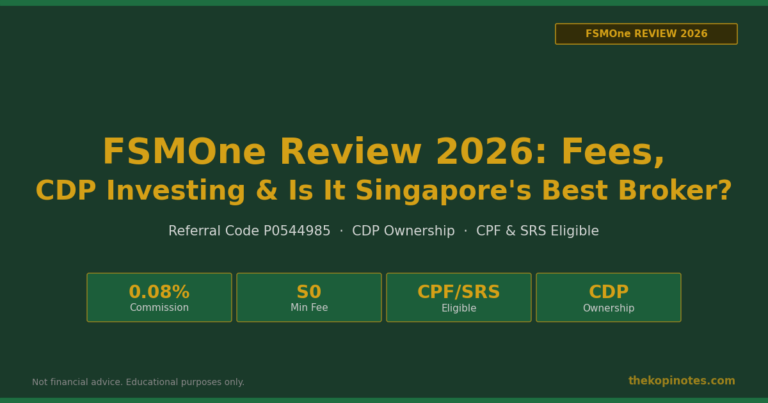
Step 1: Open a brokerage account. Popular options include Syfe Brokerage (good for beginners, no minimum account balance), IBKR (lowest commissions for larger portfolios), Tiger Brokers, and MooMoo. For a referral bonus when opening a Syfe account, use the Syfe referral code SRPRFFFCD. For FSMOne, use the FSMOne referral code P0544985.
Step 2: Fund your account. Transfer SGD from your bank via FAST or PayNow. Most brokerages settle in T+2 for SGX-listed securities.
Step 3: Search by ticker. Use the ticker codes — CRPU (Sasseur), O5RU (AIMS APAC), AJBU (Keppel DC), J69U (FCT) — and select the SGX exchange. Place a limit order at your target price rather than a market order, especially for lower-liquidity names like Sasseur.
Step 4: Receive distributions. DPU is paid directly to your brokerage account (or CDP account if you hold through CDP). No action needed — it arrives automatically on the payment date.
Note on CPF/SRS. These REITs are not CPF-investable under the CPFIS scheme as unit trusts, but if you hold them through a CPF Investment Account at eligible brokers, some may qualify. Check with your broker. SRS funds can generally be used to buy SGX-listed stocks and REITs through SRS-approved brokers. For a deeper dive on retirement account strategies, see the CPF investment strategy guide.
Frequently Asked Questions
Which S-REITs yield 6% or more in Singapore in 2026?
As at July 2026, four S-REITs yield 6% or more based on indicative unit prices: Sasseur REIT (~8.5%), AIMS APAC REIT (~7.2%), Keppel DC REIT (~6.1%), and Frasers Centrepoint Trust (~6.0%). Yields change daily with unit prices and are updated with each DPU announcement. Always check the latest SGX filing before investing.
Is a high S-REIT yield always a good sign?
Not necessarily. A high yield can mean the market is pricing in more risk — falling unit prices push yields up even without a DPU increase. Sasseur REIT yields 8.5% partly because of its China concentration risk and smaller market cap. Always look at DPU stability, gearing, and portfolio occupancy alongside yield. A REIT with a 9% yield but falling DPU is not better than one with a 6% yield and growing DPU.
Can I use CPF to buy these 4 S-REITs?
Under the standard CPFIS (CPF Investment Scheme), you can invest CPF-OA funds in SGX-listed REITs through a CPFIS-approved broker such as DBS, OCBC, or UOB Kay Hian. All four REITs listed here — Sasseur REIT, AIMS APAC REIT, Keppel DC REIT, and Frasers Centrepoint Trust — are SGX-listed and potentially eligible. However, always verify with your broker, as CPFIS eligibility requirements can change. SRS funds can also be used at SRS-approved brokerages.
What is the minimum amount to invest in S-REITs in Singapore?
The minimum is one lot, which equals 100 units for most SGX-listed REITs. Based on July 2026 prices, that works out to roughly: Sasseur REIT ~SGD 80 (100 x ~SGD 0.80), AIMS APAC REIT ~SGD 144 (100 x ~SGD 1.44), Keppel DC REIT ~SGD 165 (100 x ~SGD 1.65), and Frasers Centrepoint Trust ~SGD 205 (100 x ~SGD 2.05). Plus brokerage commission, typically SGD 1.99–SGD 10 per trade depending on the platform.
How often do these S-REITs pay distributions?
AIMS APAC REIT pays quarterly — making it the most frequent income payer of the four. Keppel DC REIT, Frasers Centrepoint Trust, and Sasseur REIT all pay semi-annually (twice a year). The exact payment dates vary by REIT and are announced alongside each DPU declaration. Distributions are paid automatically to your brokerage or CDP account.
What happens to S-REIT yields if interest rates fall further in 2026?
Falling interest rates are generally positive for S-REITs for two reasons. First, lower borrowing costs reduce interest expense, which can support or grow DPU. Second, lower rates make high-yield assets like REITs more attractive relative to fixed income, which tends to push unit prices up. Rising unit prices compress yield (yield = DPU divided by price), so in a rate-cut environment you might see unit prices appreciate even as the yield percentage falls slightly.
Start Building S-REIT Passive Income
Open a brokerage account and start buying Singapore REITs today. Use our referral links for exclusive sign-up bonuses.
This article was researched with the help of AI. While we strive to keep all information accurate and up to date, there may be errors. If you notice any discrepancies, please contact us.