FTAW & ALLW vs VWRA: Should Singapore Investors Switch to Cheaper Global ETFs? (2026)
Two brand-new FTSE All-World ETFs just launched — and they cost 45% less than VWRA. Here’s the full breakdown for Singapore investors.
Two new global ETFs — the iShares FTSE All-World ETF (FTAW) and the Xtrackers FTSE All-World ETF (ALLW) — have launched on the London Stock Exchange in 2026, both tracking the same FTSE All-World Index as VWRA but at a lower Total Expense Ratio (TER) of 0.12% versus VWRA’s 0.22%. However, their tiny fund sizes, lack of Regular Savings Plan (RSP) support, and unproven track records mean most Singapore investors should stick with VWRA for now.
Not financial advice. All figures are for educational reference only. Data as at June 2026 unless noted.
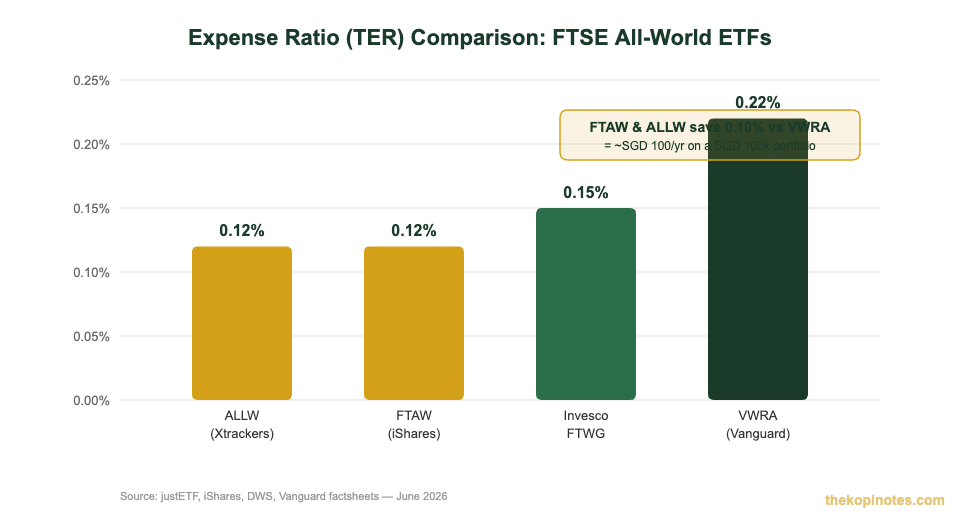
- FTAW and ALLW both charge 0.12% p.a. — almost half the cost of VWRA’s 0.22%. On a SGD 100,000 portfolio, that saves you about SGD 100 per year.
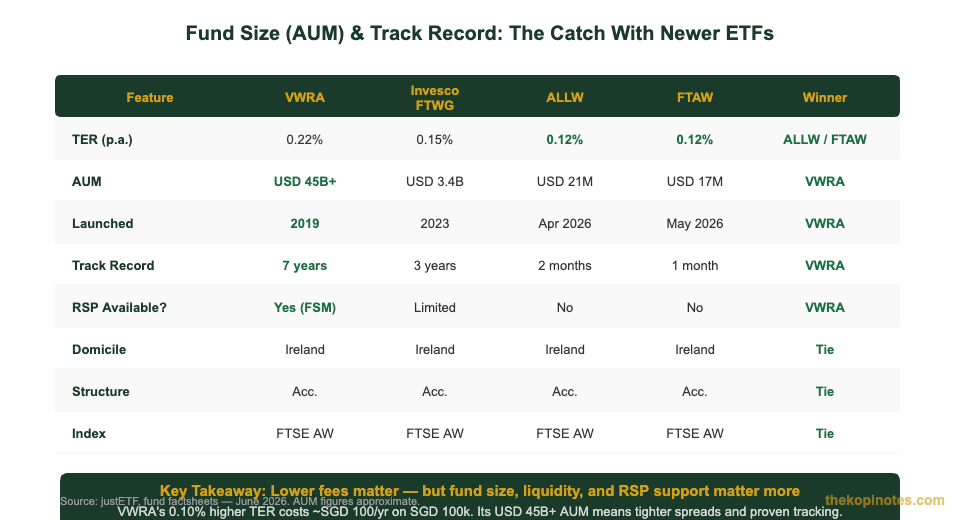
- The catch: both funds are brand new (launched April–May 2026), have tiny AUM under USD 25 million each, and aren’t available on FSMOne’s RSP. You also can’t assess tracking error yet.
- For most Singapore investors, VWRA remains the better choice today. Revisit FTAW and ALLW in 12–18 months once they’ve built up size and track record.
📹 Watch the full analysis:
Video by Tim Talks Money — “2 New Global ETFs Every Singapore Investor Should Know About”
Table of Contents
Contents — Click to expand
What Are FTAW and ALLW?
If you’ve been investing in global ETFs from Singapore, you’ve almost certainly heard of VWRA — Vanguard’s FTSE All-World UCITS ETF. It’s been the default “one-ETF portfolio” for Singapore investors for years. However, two new challengers have arrived in 2026.
The iShares FTSE All-World UCITS ETF (FTAW) launched on 7 May 2026. It’s managed by BlackRock (the world’s largest asset manager) and charges a TER of 0.12% per year. Like VWRA, it tracks the FTSE All-World Index, is domiciled in Ireland, and uses an accumulating structure — meaning dividends are automatically reinvested.
The Xtrackers FTSE All-World UCITS ETF (ALLW) launched slightly earlier on 8 April 2026. It’s managed by DWS (Deutsche Bank’s asset management arm) and also charges 0.12% per year. Same index, same Ireland domicile, same accumulating structure.
Both ETFs are listed on the London Stock Exchange (LSE), Euronext Amsterdam, and XETRA — the same exchanges where Singapore investors typically buy their Ireland-domiciled ETFs through brokers like Interactive Brokers or moomoo Singapore.
In short, FTAW and ALLW are near-identical products to VWRA. The only real difference? They’re cheaper. But as we’ll see, that’s not the whole story.
Key Differences at a Glance
On paper, all three ETFs look almost identical. They track the same 4,000+ stocks across developed and emerging markets, they’re all Ireland-domiciled (which means the same 15% withholding tax rate on US dividends under the Ireland–US tax treaty), and they’re all accumulating. Here’s how they compare:
| Feature | VWRA (Vanguard) | FTAW (iShares) | ALLW (Xtrackers) |
|---|---|---|---|
| TER | 0.22% | 0.12% | 0.12% |
| AUM | USD 45B+ | USD ~19M | USD ~23M |
| Launch Date | 2019 | May 2026 | Apr 2026 |
| Index | FTSE All-World | FTSE All-World | FTSE All-World |
| Domicile | Ireland | Ireland | Ireland |
| Structure | Accumulating | Accumulating | Accumulating |
| Replication | Sampling | Sampling | Sampling |
| US Dividend WHT | 15% | 15% | 15% |
| US Estate Tax | None | None | None |
Source: justETF, iShares, DWS, Vanguard fund factsheets — June 2026
The tax structure is identical across all three. Because they’re all Ireland-domiciled UCITS ETFs, Singapore investors enjoy the same benefits: 15% withholding tax on US dividends (versus 30% for US-domiciled ETFs like VT), no US estate tax exposure, and no capital gains tax in Singapore.
Fee Comparison: How Much Do You Actually Save?
The headline selling point is clear: FTAW and ALLW charge 0.12% per year, while VWRA charges 0.22%. That’s a 0.10 percentage point difference. But what does that actually mean in dollar terms?
Let’s break it down for typical Singapore investor portfolio sizes:
| Portfolio Size (SGD) | VWRA Cost (0.22%) | FTAW/ALLW Cost (0.12%) | Annual Savings |
|---|---|---|---|
| SGD 10,000 | SGD 22 | SGD 12 | SGD 10 |
| SGD 50,000 | SGD 110 | SGD 60 | SGD 50 |
| SGD 100,000 | SGD 220 | SGD 120 | SGD 100 |
| SGD 500,000 | SGD 1,100 | SGD 600 | SGD 500 |
Source: TKN calculation based on published TER figures, June 2026
For most Singapore investors building a portfolio in the SGD 10,000 to SGD 100,000 range, the annual savings are between SGD 10 and SGD 100. That’s real money over a 20–30 year investment horizon — compounded, the 0.10% TER difference could mean thousands of dollars more at retirement. Use our Singapore retirement calculator to model how fee differences compound over your timeline.
However, TER is only one part of the total cost of ownership. Transaction costs, bid-ask spreads, and tracking error also matter — and this is where VWRA’s size advantage kicks in.
Availability and RSP Issues for Singapore Investors
Here’s where things get tricky for Singapore investors. One of the most popular ways to buy VWRA is through FSMOne’s Regular Savings Plan (RSP), which lets you invest a fixed amount every month with low minimum amounts and no commission.
As at June 2026, neither FTAW nor ALLW is available on FSMOne’s RSP platform. That’s a dealbreaker for many Singapore investors who rely on dollar-cost averaging through monthly RSP contributions.
Both ETFs are available on Interactive Brokers (IBKR), where you can buy them manually on the LSE. However, you’ll need to place individual orders each time — there’s no automated monthly buying like FSMOne’s RSP.
For investors using Syfe or robo-advisors, these new ETFs aren’t in their fund universe either. Syfe’s brokerage and portfolio options still centre on VWRA and similar established funds.
The practical reality is this: even if FTAW and ALLW are cheaper, the friction of buying them manually every month — versus the set-and-forget convenience of VWRA via FSMOne RSP — makes them harder to stick with. And for long-term wealth building, consistency matters more than saving 0.10% on fees.
The Catch: Why Lower Fees Aren’t Everything
Tim from Tim Talks Money raised several important points in his video analysis. The fee difference is real, but there are bigger concerns:
1. Tiny fund sizes. VWRA has over USD 45 billion in assets under management. FTAW has about USD 19 million. ALLW has about USD 23 million. That’s a difference of roughly 2,000x. Why does this matter? Larger funds typically have tighter bid-ask spreads (meaning you pay less when buying and selling), better tracking of the underlying index, and lower risk of fund closure.
2. No track record. VWRA has been around since 2019 — seven years of data showing how well it tracks the FTSE All-World Index. FTAW has existed for about six weeks. ALLW for about two months. You can’t assess tracking error, tracking difference, or how the fund behaves during market stress without a track record.
3. Wider bid-ask spreads. Because of their small size, FTAW and ALLW may have wider bid-ask spreads than VWRA. For a Singapore investor buying on the LSE through IBKR, a wider spread could easily wipe out the 0.10% TER savings — especially on smaller orders. That said, spreads typically narrow as a fund grows.
4. Securities lending. Some ETF providers use securities lending to offset costs and improve returns. VWRA does this and passes some of the income back to investors. It’s unclear whether FTAW and ALLW will generate meaningful securities lending income at their current size.
The Invesco FTSE All-World ETF (FTWG), which launched in 2023 with a 0.15% TER, is a useful reference point. It’s grown to about USD 3.4 billion in AUM — respectable, but still a fraction of VWRA. It took almost three years to reach that size. FTAW and ALLW will likely follow a similar slow-growth trajectory.
Should You Switch From VWRA?
This is the question every Singapore VWRA investor is asking. The short answer: probably not yet.
If you’re already invested in VWRA, selling your existing holdings to buy FTAW or ALLW would trigger transaction costs (IBKR commissions, FX conversion fees, bid-ask spreads on both the sell and buy sides). Those switching costs would likely exceed several years’ worth of TER savings. You’d need to hold the cheaper ETF for years just to break even on the switch.
If you’re using FSMOne RSP for VWRA, there’s no reason to switch. The convenience and discipline of automated monthly investing far outweigh a 0.10% fee difference. If you’re building a passive income portfolio in Singapore, consistency is your biggest edge.
If you’re starting fresh with a lump sum on IBKR, and you’re comfortable with a brand-new fund, then FTAW or ALLW could make sense. You’d save on fees from day one with no switching costs. However, you’d be taking on the risks of a small, unproven fund.
Who Should Consider FTAW or ALLW?
These new ETFs aren’t for everyone. Here’s a practical breakdown:
FTAW or ALLW might suit you if:
- You’re a new investor starting from scratch on IBKR with no existing VWRA position
- You invest in lump sums rather than monthly RSP contributions
- Your portfolio is large enough (SGD 200k+) that 0.10% savings is meaningful
- You’re comfortable being an early adopter and don’t mind limited track record data
- You understand that you may need to switch again if the fund doesn’t attract enough AUM
Stick with VWRA if:
- You use FSMOne’s RSP for automated monthly investing
- You value a proven 7-year track record and USD 45B+ in AUM
- Your portfolio is under SGD 100k (the fee savings are minimal)
- You want the peace of mind that comes with the world’s second-largest ETF provider
- You don’t want to worry about fund closure risk
It’s also worth noting that Vanguard has historically reduced fees over time as competition increases. VWRA’s TER dropped from 0.25% to 0.22% in recent years. The launch of FTAW and ALLW may push Vanguard to cut fees further — so VWRA investors could benefit from this competition without switching at all.
The Bigger Picture: ETF Fee Wars Are Good for Investors
Whether you buy FTAW, ALLW, or stick with VWRA, the real story here is that competition is driving global ETF costs down. For Singapore investors, this is excellent news.
Five years ago, the cheapest way to get global equity exposure through an Ireland-domiciled ETF was VWRA at 0.22%. Today, you have multiple options at 0.12%–0.15%. That’s a 45% fee reduction in just a few years.
If you’re exploring which brokerage account to open in Singapore for ETF investing, IBKR remains the most cost-effective option for buying LSE-listed ETFs. For beginners who prefer simplicity, the Endowus or Syfe platforms offer managed portfolios that include similar global equity exposure — though at higher total costs.
The bottom line? Don’t let the fee comparison distract you from what matters most: getting invested, staying invested, and adding to your portfolio regularly. Whether you pay 0.12% or 0.22% per year, you’re still getting global diversification across 4,000+ stocks for pennies on the dollar. That’s the real win.
Not financial advice. The Kopi Notes may earn referral fees from some platforms mentioned. All data as at June 2026.
Frequently Asked Questions
What is the difference between FTAW, ALLW, and VWRA?
All three ETFs track the same FTSE All-World Index and are Ireland-domiciled accumulating UCITS ETFs. The main difference is cost: FTAW (iShares) and ALLW (Xtrackers) charge a TER of 0.12% per year, while VWRA (Vanguard) charges 0.22%. However, VWRA has a much longer track record (since 2019) and over USD 45 billion in assets, compared to under USD 25 million for each of the newer funds.
Can I buy FTAW or ALLW through FSMOne in Singapore?
As at June 2026, neither FTAW nor ALLW is available on FSMOne’s Regular Savings Plan (RSP). You can buy them through Interactive Brokers (IBKR) on the London Stock Exchange. FSMOne may add them in the future as the funds grow, but there is no confirmed timeline.
Should I sell my VWRA and switch to FTAW or ALLW?
For most Singapore investors, switching is not recommended. Selling VWRA and buying FTAW or ALLW would incur transaction costs (brokerage commissions, FX fees, bid-ask spreads on both trades) that could exceed several years of TER savings. The 0.10% annual fee difference saves about SGD 100 per year on a SGD 100,000 portfolio — not enough to justify switching costs for most investors.
Is FTAW or ALLW safer than VWRA for Singapore investors?
All three ETFs carry the same underlying market risk since they track the same index. However, VWRA is considered more established due to its massive AUM (USD 45B+) and 7-year track record. Small, new funds like FTAW and ALLW carry a higher risk of fund closure if they fail to attract sufficient assets, though closure would mean your money is returned — not lost.
How much do I save per year with FTAW or ALLW compared to VWRA?
The TER difference is 0.10% per year (0.12% vs 0.22%). On a SGD 50,000 portfolio, you’d save approximately SGD 50 per year. On SGD 100,000, you’d save about SGD 100 per year. On SGD 500,000, the savings grow to about SGD 500 per year. Over a 20–30 year investment horizon, these savings compound and can add up to several thousand dollars.
Are FTAW and ALLW eligible for CPF or SRS investment in Singapore?
No. Like VWRA, FTAW and ALLW are not CPF-investable because they are listed on the LSE, not the SGX. However, they may be eligible for SRS investment if purchased through an SRS-linked brokerage account. Check with your broker (e.g. IBKR or Saxo) for SRS compatibility. For CPF investment options, see our CPF investment strategy guide.
Will Vanguard reduce VWRA's fees in response to FTAW and ALLW?
It’s possible. Vanguard has a history of reducing ETF fees over time, and VWRA’s TER has already dropped from 0.25% to 0.22% in recent years. The launch of cheaper competitors like FTAW, ALLW, and Invesco’s FTWG (0.15%) could accelerate further fee cuts. If Vanguard matches or approaches 0.12%, there would be even less reason to switch away from VWRA.
Which is better for a new Singapore investor starting from scratch — VWRA, FTAW, or ALLW?
For most new investors, VWRA remains the best starting point. It has the deepest liquidity, widest broker availability (including FSMOne RSP), and a proven track record. If you’re an experienced investor using IBKR and investing lump sums, FTAW or ALLW could save you fees from day one. However, the convenience of VWRA via RSP — which enforces disciplined monthly investing — is worth more than 0.10% in fees for most beginners.
Ready to Start Investing in Global ETFs?
Open a brokerage account and start building your global portfolio today. Use our referral links for exclusive sign-up bonuses.
This article was researched with the help of AI. While we strive to keep all information accurate and up to date, there may be errors. If you notice any discrepancies, please contact us.