Medisave Limit 2026: ISP Claim Rejected? Your Step-by-Step Fallback Guide
What to do when your Integrated Shield Plan won’t pay — and how MediSave and MediShield Life cover the gap.
Your Integrated Shield Plan (ISP) rejected your hospital claim — now what? In Singapore, over 90% of ISP claims are approved, but when one isn’t, many policyholders don’t realise that the MediShield Life portion of their bill is still processed automatically by CPF Board. Your MediSave account (capped at a 2026 Basic Healthcare Sum of $79,000) also serves as a fallback to pay deductibles, co-insurance, and eligible hospital charges within CPF withdrawal limits.
Not financial advice. All figures are for educational reference only. Data verified as at 24 October 2026. Sources: CPF Board, MOH Singapore, Life Insurance Association Singapore.
Why ISP Claims Get Rejected in Singapore
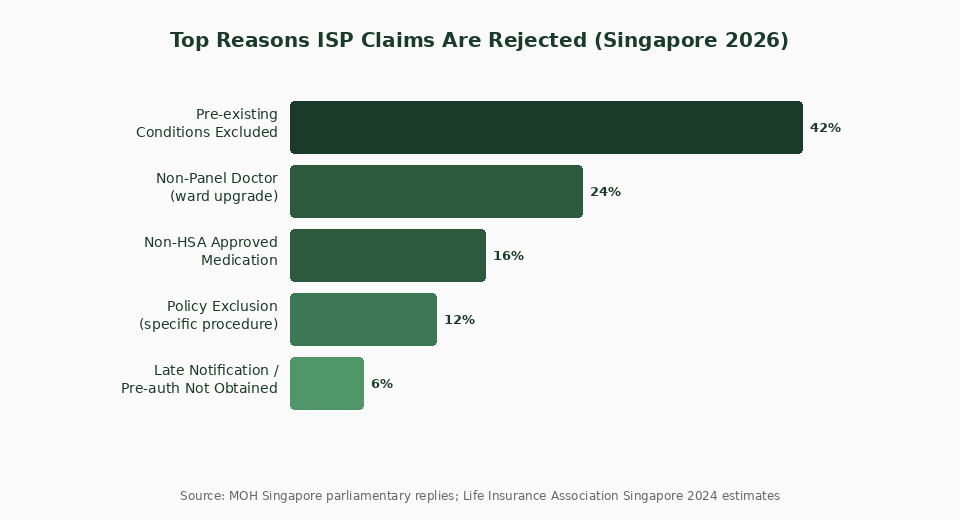
According to MOH’s most recently published data, more than 90% of ISP claims submitted in Singapore are approved. But that still leaves a meaningful minority that get rejected or only partially paid — and if you’re in that group, the experience can be stressful and confusing.
ISP insurers in Singapore can reject claims for several distinct reasons. Understanding which category your rejection falls into determines your next step — and which fallback resource you can draw on.
Pre-Existing Conditions
The most common reason for ISP claim rejection is a pre-existing condition that was excluded from your policy at underwriting. If you had a history of, say, heart disease or a prior knee injury, your insurer may have offered you cover with an exclusion for related treatment. When a claim arises from that excluded condition, it is legitimately rejected under the policy’s terms. In this scenario, the MediShield Life base component may still pay — see the next section.
Non-HSA Approved Medication
Singapore ISPs generally cover medications approved by the Health Sciences Authority (HSA) and listed on the MOH Standard Drug List. If your treating doctor prescribed a drug that falls outside these lists — common in oncology, rare diseases, or overseas treatments — your insurer may reject or cap the medication portion of the claim. This is one of the more opaque rejection reasons, since patients rarely know a drug’s formulary status in advance.
Non-Panel Doctor or Ward Upgrade
Many ISP riders provide better coverage when you use your insurer’s panel of doctors and hospitals. If you chose a non-panel specialist or upgraded your ward class above the tier your ISP covers (e.g. Class A when your ISP only covers Class B1), your insurer may reject the claim or apply co-insurance as if the panel ward had been used. The gap between what the insurer pays and your actual bill falls to you — and to MediSave.
Specific Procedure Exclusions
Some ISPs exclude specific procedures — cosmetic surgery, dental, certain fertility treatments, and experimental procedures. If your hospitalisation included an excluded procedure, the insurer may reject that component while still processing the rest. Always check your policy’s exclusion list before a planned admission.
Late Notification or Missing Pre-Authorisation
Some ISPs require pre-authorisation for planned admissions, especially for non-emergency procedures at private hospitals. Failing to notify your insurer in advance — or missing the required timeframe — can result in partial or full rejection. This is largely an administrative rejection and may be worth appealing (see below).
| Rejection Reason | MediShield Life Still Pays? | MediSave Can Cover Gap? |
|---|---|---|
| Pre-existing condition exclusion | Yes (usually) | Yes, within daily limits |
| Non-HSA medication | No (for that item) | Generally no |
| Non-panel doctor / ward upgrade | Yes (at covered tier) | Yes, for remaining balance |
| Specific procedure exclusion | No (for excluded item) | No (if MediSave also excludes) |
| Late notification / missing pre-auth | Yes (usually) | Yes, for remaining balance |
Source: MOH Singapore parliamentary replies; Life Insurance Association Singapore. Data based on 2019–2022 claims statistics.
The MediShield Life Fallback: What Still Covers You
Here’s the key fact many Singaporeans don’t know: when your ISP rejects a claim, CPF Board independently processes your MediShield Life portion. This is because MediShield Life sits underneath every Integrated Shield Plan — it’s the mandatory base layer, administered by CPF Board, not by your private insurer. Your ISP insurer’s decision to reject does not automatically void the MediShield Life coverage you’ve been paying into your whole working life.
This means that even if AIA, Prudential, NTUC Income, Great Eastern, Singlife, or HSBC Life rejects your ISP claim, CPF Board will still assess whether your hospitalisation is eligible for MediShield Life benefits. The MediShield Life payment will apply against the MediShield Life claim limits — typically covering Class B2 and C restructured hospital stays — and then any remaining balance is your responsibility, payable via MediSave or cash.
For those who were admitted to a private hospital or upgraded to Class A/B1, note that MediShield Life claim limits are calibrated for restructured hospitals. This means the payout from MediShield Life on a $20,000 private hospital bill may only be a few thousand dollars. The larger share of the bill still lands on you when your ISP rejects — which is where MediSave comes in.
For a full breakdown of how ISP riders interact with your MediShield Life base coverage — and what the 2026 rider changes mean for your exposure — see our detailed guide on the ISP legacy rider transition to 2028.
Step-by-Step: What To Do After Your ISP Claim Is Rejected
Receiving a rejection notice can feel overwhelming — especially when you’re still recovering from hospitalisation. Here’s a clear sequence to follow:
Step 1: Read the rejection letter carefully. Your insurer must tell you why the claim was rejected. The reason determines your options. Identify whether it’s a clinical decision (e.g. treatment deemed not medically necessary, excluded condition) or an administrative one (e.g. late notification, missing documents).
Step 2: Contact CPF Board to confirm MediShield Life processing. Call CPF’s MediShield Life helpline (1800-222-2888) or check your CPF Statement online. CPF Board processes the MediShield Life portion separately — confirm whether a payment has been or will be made against your hospitalisation claim.
Step 3: Check your MediSave balance and daily withdrawal limits. Even if your ISP rejects, you can use MediSave to pay the remaining hospitalisation bill, within the applicable limits (see the MediSave 2026 section below). The hospital’s medical social worker can help you structure the payment if needed.
Step 4: File a formal written appeal with your insurer. If you believe the rejection is wrong — especially for clinical or documentation reasons — write a formal appeal within the timeframe stated in your policy (typically 30–90 days from the rejection date). Include your doctor’s medical report, supporting test results, and any correspondence.
Step 5: Escalate to CCRP or FIDReC if needed. If your insurer upholds the rejection after your internal appeal, you have two independent escalation channels. For clinical disputes (e.g. “treatment was not medically necessary”), use the Clinical Claims Resolution Process (CCRP), which involves independent clinical experts. For non-clinical disputes (e.g. policy interpretation, administrative failures), file with the Financial Industry Disputes Resolution Centre (FIDReC).
Step 6: Apply for MediFund if you face financial hardship. If the rejected bill creates genuine financial hardship that MediSave cannot fully cover, apply for MediFund through a medical social worker at the hospital. MediFund is a safety net for Singapore citizens who struggle to pay subsidised healthcare bills.
For a comprehensive guide to making an ISP claim from start to finish, including what documents to prepare before a planned admission, see our guide on how MediSave and your ISP cover private hospital bills.
MediSave 2026: Your Key Numbers
When your ISP falls short — whether due to rejection, a coverage gap, or a deductible you must pay — MediSave is your first line of defence. But MediSave has rules. Here’s what matters for 2026:
Basic Healthcare Sum (BHS) 2026: $79,000
The Basic Healthcare Sum is the maximum balance your MediSave account can hold before CPF redirects excess contributions elsewhere. As of 1 January 2026, the BHS is $79,000 for members aged 65 and below. This is not a spending limit — it’s a savings cap. You can spend from your MediSave regardless of whether your balance is above or below the BHS, subject to the withdrawal rules below.
ISP Base Premium: Additional Withdrawal Limit (AWL)
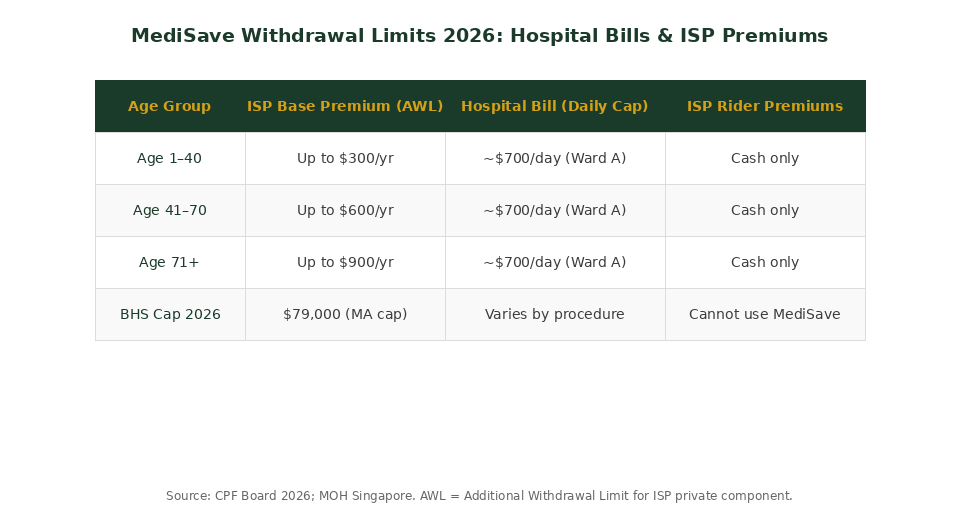
Your MediSave can pay the private component of your ISP premium (the amount on top of the mandatory MediShield Life premium), but only up to the Additional Withdrawal Limit (AWL) set by CPF Board. The AWL is age-based:
| Age Next Birthday | AWL (ISP Base Premium) | ISP Rider Premiums |
|---|---|---|
| 1–40 | $300 per year | Cash only — cannot use MediSave |
| 41–70 | $600 per year | Cash only — cannot use MediSave |
| 71 and above | $900 per year | Cash only — cannot use MediSave |
Source: CPF Board 2026. AWL applies to the ISP base premium only. Rider premiums (including the optional co-payment rider) must be paid in cash or via GIRO from a bank account. MediShield Life premiums are deducted separately from MediSave.
The most important implication: if your ISP claim is rejected and your rider premium just renewed, you’ll still need to pay that out of cash. MediSave does not cover rider premiums under any circumstances.
MediSave for Hospital Bills After Rejection
When your ISP rejects and you need to pay the hospital bill directly, MediSave can be used for eligible hospital charges — including ward fees, surgical fees, and approved drugs — subject to daily and procedure-specific limits. For inpatient treatment at a restructured or private hospital, MediSave daily limits depend on ward class and the type of care. Your hospital’s billing department will advise on what can be processed via MediSave versus what must be paid in cash.
Importantly, the 2026 MediSave limit changes also affect how much you can draw for ISP deductibles. Under the April 2026 rider rule changes, new ISP rider holders must pay their minimum deductible ($1,500–$3,500 depending on ward class and age) before their rider kicks in — and this deductible can be paid via MediSave.
How to Appeal an ISP Rejection: CCRP vs FIDReC
Singapore has two independent channels for resolving ISP claim disputes. Which one you use depends on the nature of your dispute:
Clinical Claims Resolution Process (CCRP)
The CCRP handles disputes where the core issue is clinical — for example, your insurer says a procedure was not “medically necessary” but your doctor disagrees. The process involves an independent panel of senior clinicians who review the medical evidence and provide a binding determination. The CCRP is specifically designed for healthcare insurance and understands the nuances of treatment protocols, hospital documentation, and clinical coding.
To use the CCRP, you must first exhaust your insurer’s internal appeals process. Once you have a final rejection from the internal process, file with the CCRP. Your doctor’s letter of support, discharge summary, and operation notes are critical documents.
Financial Industry Disputes Resolution Centre (FIDReC)
FIDReC handles disputes that are primarily about policy interpretation rather than clinical decisions — for example, an argument over whether a condition is “pre-existing” as defined in your policy, whether late notification should void coverage, or whether a treatment falls within your ISP’s covered procedures list. FIDReC adjudicates based on the policy contract and relevant law.
FIDReC cases are handled by trained adjudicators and, for larger claims, mediators and adjudicators with legal backgrounds. Filing is free for policyholders for most cases. Note that FIDReC decisions are binding on the insurer (up to the applicable claim cap) but not on you — you can still pursue legal action if unsatisfied.
Whichever route you take, document everything from the start: keep copies of your rejection letter, all medical records related to the claim, and all written correspondence with your insurer. Time limits apply — check your policy and the relevant body’s website for current filing deadlines.
Rejection Prevention Checklist
The best fallback strategy is not needing one. Here are the practical steps to minimise the risk of ISP claim rejection before you’re ever hospitalised:
- Declare all pre-existing conditions honestly at underwriting. Non-disclosure can void your entire policy, not just the relevant claim. If you have exclusions from underwriting, know exactly what they are and plan accordingly — consider a supplementary CI plan to fill gaps.
- Use your ISP insurer’s panel of doctors and hospitals for planned admissions. Panel doctors ensure coverage under the relevant rider tier. If you have a strong preference for a specific specialist, check their panel status before booking.
- Call your insurer before a planned admission for a pre-authorisation reference number. Even if your ISP doesn’t formally require pre-auth, having a record that you notified the insurer protects you against late-notification rejections.
- Confirm that any medications prescribed are on your insurer’s formulary — especially for higher-cost treatments. Your insurer’s customer service line or your hospital’s pharmacy can check this.
- Know your ISP’s specific exclusions list — not just the generic category descriptions, but the actual wording in your policy. Common surprises include certain types of cancer treatment protocols, psychiatric conditions (see our guide on MediSave for mental health in Singapore), and long-term rehabilitation stays.
- Keep your MediSave balance healthy as a buffer. Even if your ISP claim is fully approved, deductibles and co-payments apply — and since April 2026 rider changes introduced minimum co-payments, more of your bill is landing on MediSave than before.
For more on how the ISP rider landscape changed in 2026 and what real-world claims now cost under the new structure, read our analysis of ISP rider real costs in 2026.
Frequently Asked Questions
If my ISP rejects my claim, does MediShield Life still pay anything?
How long do I have to appeal an ISP claim rejection?
Can I use MediSave to pay the rejected hospital bill?
What is the MediSave BHS limit in 2026?
Can MediSave pay my ISP rider premium after my claim is rejected?
What is CCRP and when should I use it?
Does the April 2026 ISP rider change affect claim rejection rates?
Get Free Insurance Advice
Speak with a licensed insurance advisor. No obligation, no cost.
By submitting this form, you agree to our Privacy Policy.
This article was researched with the help of AI. While we strive to keep all information accurate and up to date, there may be errors. If you notice any discrepancies, please contact us.