Endowment Plan Partial Withdrawal Singapore 2026: Can You Access Your Money Early?
Table of Contents
- What Is Endowment Plan Partial Withdrawal?
- How Partial Withdrawal Works in Singapore
- Partial Withdrawal vs Policy Loan vs Full Surrender
- Which Endowment Plans Allow Partial Withdrawal?
- Understanding Your Cash Value Timeline
- Pros and Cons of Partial Withdrawal
- How to Apply for Partial Withdrawal in Singapore
- Alternatives to Consider First
- Frequently Asked Questions
Yes — most endowment plans in Singapore allow partial withdrawal (also called partial surrender) once your policy has accumulated sufficient cash value, typically from Year 3 to Year 5 onwards. A partial withdrawal lets you access part of your policy’s cash value without repaying the amount, but it permanently reduces your sum assured and total coverage. Unlike a policy loan, the withdrawn amount does not need to be repaid — but your death benefit and maturity payout will be lower as a result. Data verified as at 25 October 2026.
Not financial advice. All figures and illustrations are for educational reference only. Policy terms vary by insurer and product — always check your policy documents or consult your financial adviser before making any changes.
What Is Endowment Plan Partial Withdrawal?
An endowment plan partial withdrawal — formally known as a partial surrender — allows you to encash a portion of your accumulated cash value while keeping the rest of the policy active. Think of it as taking a slice of your savings without closing the entire plan.
This is distinct from two other early-access options:
- Policy loan: You borrow against your cash value at an interest rate (typically 5–6% per annum in Singapore). The loan must be repaid; if not, it is deducted from your final payout.
- Full surrender: You terminate the entire policy and receive the full surrender value. The policy is closed permanently.
Partial withdrawal sits between these two extremes — you get cash now without closing the policy, but you give up a portion of your long-term benefits permanently. For Singapore investors managing milestone expenses (school fees, home renovation, a business opportunity), this can be a useful safety valve built into your endowment plan surrender value.
How Partial Withdrawal Works in Singapore
When you make a partial withdrawal from an endowment plan in Singapore, here is what happens:
- Cash value is reduced: The amount withdrawn is deducted from your accumulated cash value immediately.
- Sum assured is reduced: Most insurers reduce your death benefit proportionally to the withdrawal. If you withdraw 20% of your cash value, your sum assured may be reduced by a corresponding amount.
- Non-guaranteed bonuses may be affected: For participating (par) endowment plans, reversionary bonuses already attached to your policy may be partially encashed. This means you lose the compounding effect on those bonuses going forward.
- Minimum thresholds apply: Insurers typically set a minimum withdrawal amount (e.g. S$1,000) and require a minimum cash value to remain in the policy after withdrawal (e.g. S$5,000 to S$10,000).
- No repayment required: Unlike a policy loan, the withdrawn funds do not need to be paid back. However, the reduction in sum assured is permanent.
The withdrawal is typically processed within 5–10 business days after insurer approval. Some insurers offer online application, while others require a physical form.
Partial Withdrawal vs Policy Loan vs Full Surrender
Before deciding to partially withdraw from your endowment plan, compare all three early-access routes:
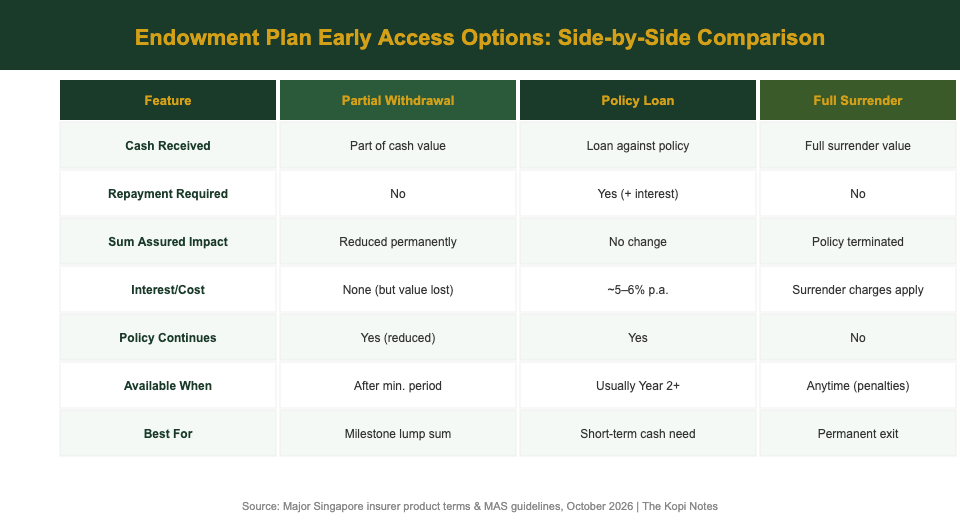
Source: Major Singapore insurer product terms & MAS guidelines, October 2026 | The Kopi Notes. Illustrative — verify with your specific policy terms.
- Choose partial withdrawal if you need a lump sum for a milestone expense and are comfortable with a permanently reduced sum assured.
- Choose a policy loan if your cash need is temporary and you can repay within 1–2 years. You preserve your sum assured in full.
- Choose full surrender only if the endowment plan no longer serves your financial goals. Surrendering early (before Year 7–8 on a 10-year plan) typically means receiving less than total premiums paid.
For liquidity without touching your endowment plan at all, Singapore T-Bills 2026 offer short-term yields and full capital return at maturity — a useful comparison benchmark for the opportunity cost of keeping money locked in an endowment.
Which Endowment Plans in Singapore Allow Partial Withdrawal?
Most Singapore insurers will process a partial surrender request once the policy has sufficient cash value. Here is a summary for major insurers:
| Insurer / Plan | Partial Withdrawal | Key Condition |
|---|---|---|
| NTUC Income Gro Saver Flex Pro | Yes — explicitly allowed | Minimum cash value must remain after withdrawal |
| Great Eastern GREAT Wealth Multiplier | Yes — flexible at any time | Subject to minimum balance requirements |
| Prudential PRUWealth / PRUWealth II | Yes — milestone withdrawals | Designed for life milestone events |
| AIA Smart Flexi Rewards II | Yes — cash-out facility | Minimum cash value retention applies |
| Manulife (Various Plans) | Yes via partial surrender form | Sum assured reduced; form required |
| Singlife (Various Plans) | Yes via request form | Minimum withdrawal and remaining value apply |
Source: Insurer product brochures and review resources, October 2026. Verify current terms directly with your insurer.
Short-term fixed endowments (2–3 year plans from DBS, OCBC, or banks) generally do not permit partial withdrawal — they are designed to run to maturity.
Understanding Your Cash Value Timeline
Knowing when meaningful cash value exists is critical before requesting a partial withdrawal. For a typical 10-year par endowment plan with S$20,000 annual premiums:
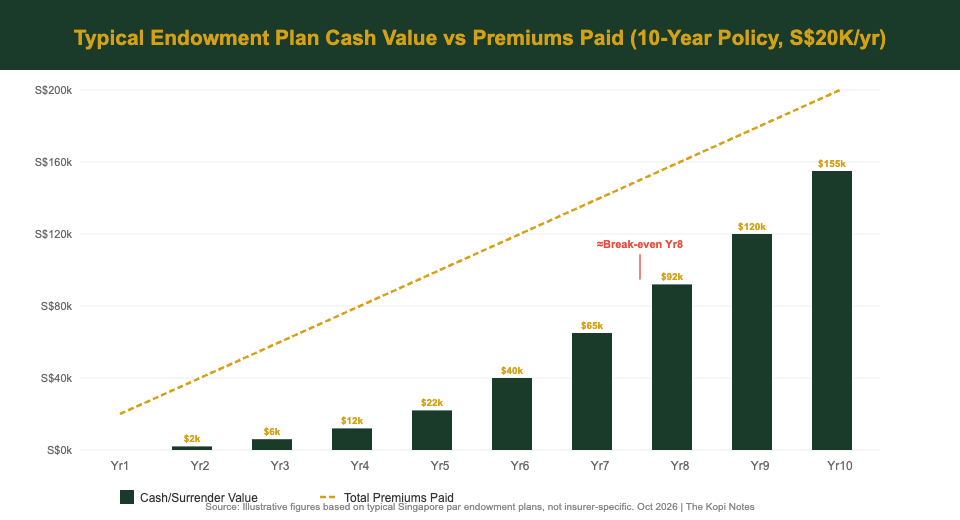
Source: Illustrative figures based on typical Singapore participating endowment plan projections. Actual values depend on insurer, plan, and bonus declarations. Oct 2026 | The Kopi Notes
- Year 1: Surrender value typically near zero. First-year agent commissions and underwriting costs are deducted from premiums.
- Years 2–4: Cash value begins building but remains significantly below total premiums paid. Partial withdrawal crystallises a loss.
- Years 5–7: Cash value grows meaningfully. Partial withdrawal becomes more viable but you are still drawing down capital below break-even.
- Year 7–8 (Break-even): Surrender value roughly equals total premiums paid. Earliest point where partial withdrawal doesn’t mean a capital loss on the withdrawn portion.
- Years 9–10 (Maturity): Full maturity payout — guaranteed plus non-guaranteed bonuses — maximises total return.
Withdrawing in Years 1–5 permanently locks in a capital loss on the withdrawn portion. Use our retirement planning calculator to model the long-term impact of early endowment withdrawal on your retirement income projections.
For context on how endowment plan returns compare to other passive income instruments, see our passive income Singapore 2026 guide.
Pros and Cons of Endowment Plan Partial Withdrawal
| Pros | Cons |
|---|---|
| Access cash without closing the policy | Permanently reduces sum assured and death benefit |
| No repayment obligation (unlike policy loan) | Reduces future maturity payout |
| Policy continues earning bonuses on reduced base | Reversionary bonuses lose compounding benefit if encashed |
| Flexible — available for milestone cash needs | Not available for short-term fixed endowments |
| No interest cost (vs policy loan ~5–6% p.a.) | Early-year cash value may be well below premiums paid |
Source: The Kopi Notes analysis based on Singapore insurer product terms, October 2026.
How to Apply for Partial Withdrawal in Singapore
- Check your policy document: Locate the “Partial Surrender” clause. Note minimum withdrawal and minimum remaining balance requirements.
- Log into your insurer’s portal: NTUC Income, AIA, Prudential, and Great Eastern offer online withdrawal requests. Authenticate via Singpass or customer credentials.
- Complete the withdrawal form: If online is unavailable, download from the insurer’s website. Manulife and Singlife both offer downloadable forms.
- Submit supporting documents: Typically: NRIC copy, original policy document, and bank account details for crediting.
- Await processing: Standard 5–10 business days. Insurer will send revised policy schedule confirming the new (reduced) sum assured.
- Receive funds: Credited to your bank account via FAST or GIRO.
If you are deploying the withdrawn capital into investment portfolios, Endowus (referral code: 2V343) and Syfe (referral code: SRPRFFFCD) are regulated platforms offering managed funds for Singapore investors.
Alternatives to Consider Before Partial Withdrawal
- Policy loan: If the cash need is temporary, a policy loan at ~5–6% p.a. preserves your sum assured in full. Suitable for bridging finance where you can repay within 1–2 years.
- Premium holiday: Some plans allow temporarily stopping premium payments, using accumulated cash value to cover them. Preserves the policy without a cash-out.
- Personal loan or credit line: If the plan is still in early years (Year 1–5), surrender value may be low — a personal loan may be more cost-effective than crystallising a capital loss.
- CPF OA or SRS funds: For retirement-related expenses, check if CPF investment strategy alternatives or SRS withdrawals are available at lower cost.
- Singapore Savings Bonds: Singapore Savings Bonds offer flexible monthly redemption with no penalty — useful as a liquidity reserve alongside your endowment plan.
Frequently Asked Questions
Can I partially withdraw from my endowment plan at any time?
How much can I withdraw from my endowment plan?
Will my death benefit decrease after a partial withdrawal?
What is the difference between partial withdrawal and a policy loan?
Is a partial withdrawal from an endowment plan taxable in Singapore?
How long does it take to process a partial withdrawal?
Should I partially withdraw from my endowment plan to invest in REITs or ETFs?
Get Free Insurance Advice
Speak with a licensed insurance advisor. No obligation, no cost.
By submitting this form, you agree to our Privacy Policy.
This article was researched with the help of AI. While we strive to keep all information accurate and up to date, there may be errors. If you notice any discrepancies, please contact us.