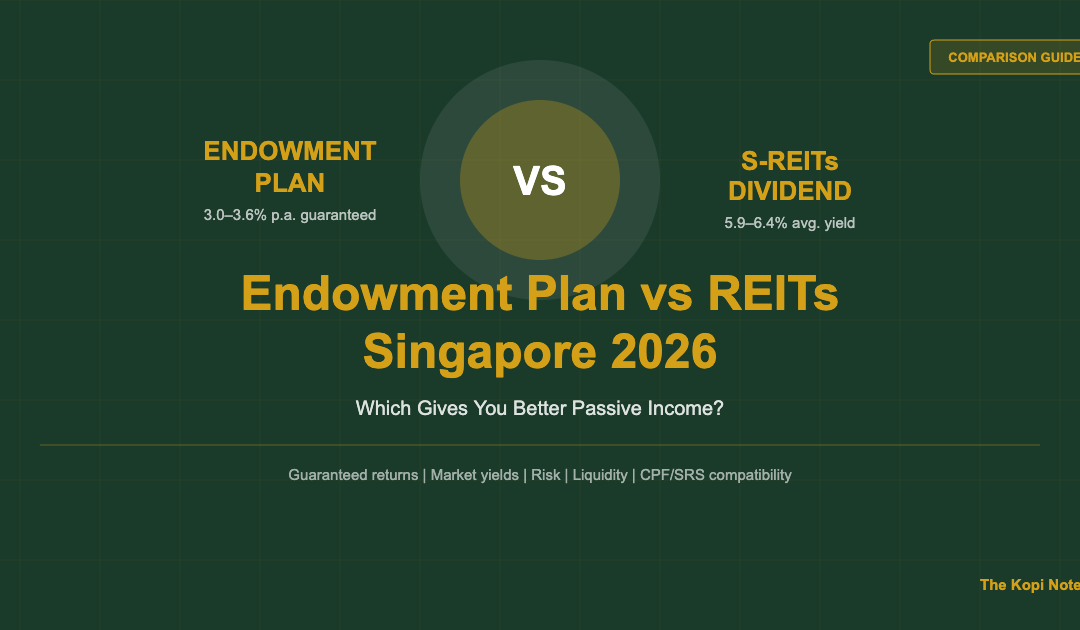
Endowment Plan vs REITs Singapore 2026: Which Gives You Better Passive Income?
A data-driven comparison of guaranteed returns vs dividend yields — for Singapore investors seeking passive income without the guesswork.
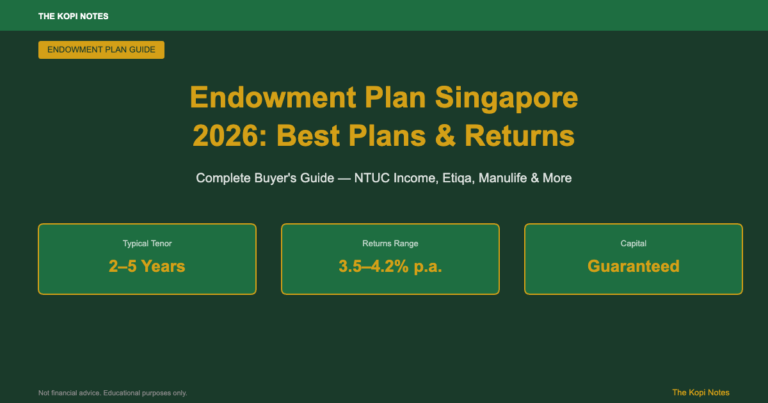
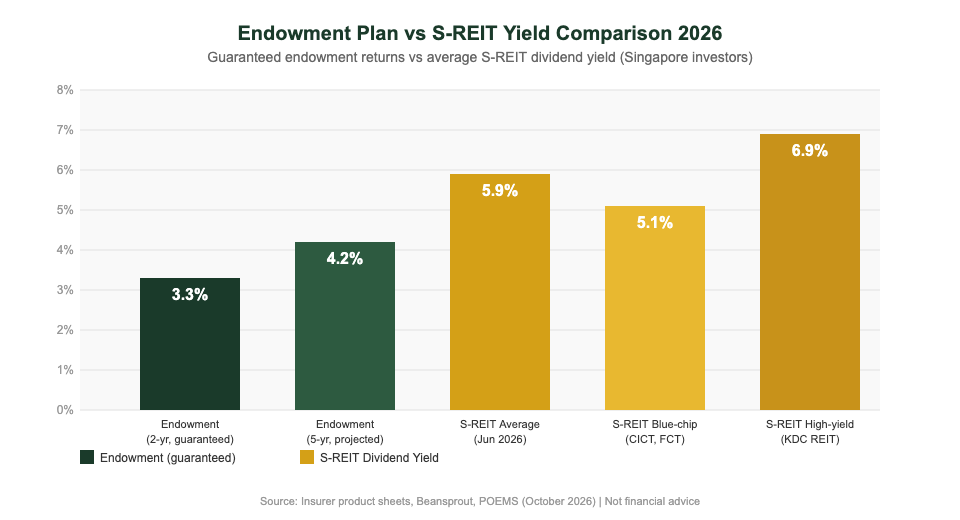
For Singapore investors in 2026, the endowment plan vs REITs debate comes down to certainty versus yield. Endowment plans offer guaranteed returns of 3.0–3.6% p.a. on short-term policies, backed by the Policy Owners’ Protection Scheme, with zero market risk. S-REITs deliver higher average dividend yields of 5.9–6.4% p.a., but prices fluctuate with interest rates and property fundamentals. Your choice depends on your investment horizon, risk tolerance, and income needs.
Not financial advice. All figures are for educational reference only. Data verified as at 11 October 2026 unless otherwise stated.
Table of Contents
Contents — Click to expand
Quick Answer: Which Wins in 2026?
Neither product is universally “better” — they solve different problems. In 2026’s rate environment, where the U.S. Federal Reserve has already begun cutting rates and bond yields are easing, S-REITs have bounced back from multi-year lows while still offering yields well above those of traditional savings products.
If you need capital certainty and guaranteed income — say, for a financial goal in 2–5 years — a short-term endowment plan at 3.0–3.6% p.a. guaranteed is hard to beat without taking on market risk. If you are investing for the long term and can stomach short-term price swings, S-REITs at average yields of 5.9–6.4% p.a. (as at mid-2026) offer significantly more income per dollar invested.
The comparison also depends on your tax position, CPF/SRS eligibility, and whether you have an existing emergency fund — all of which we break down below.
Key Differences at a Glance
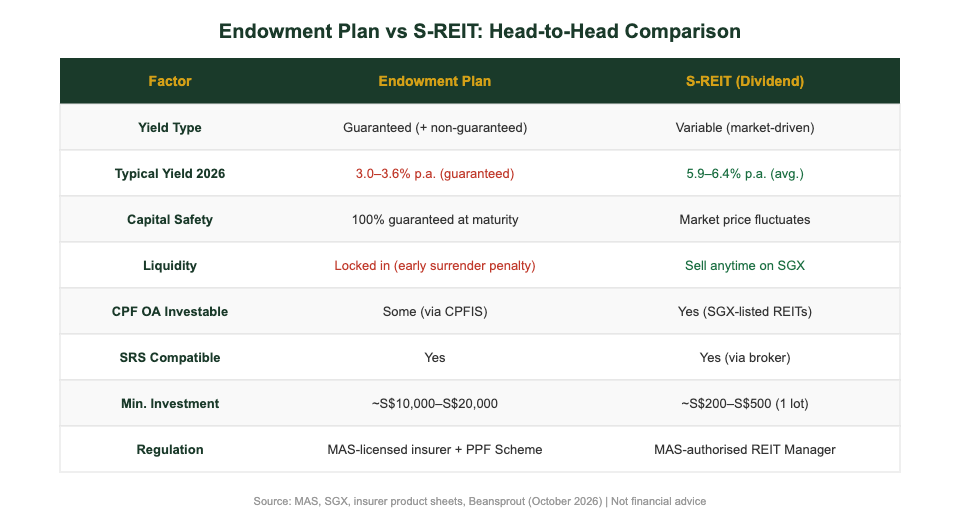
| Factor | Endowment Plan | S-REIT (Dividend) |
|---|---|---|
| Yield Type | Partly guaranteed, partly projected | Variable (distributed quarterly/semi-annually) |
| Typical Yield 2026 | 3.0–3.6% p.a. (guaranteed, short-term) | 5.9–6.4% p.a. (sector average) |
| Capital Safety | Guaranteed at maturity (PPF Scheme up to S$100k) | Market price fluctuates; no capital guarantee |
| Liquidity | Locked in — early surrender incurs penalty | Tradeable on SGX during market hours |
| CPF-Investable | Some plans (via CPFIS-OA, subject to limits) | SGX-listed REITs eligible via CPFIS-OA |
| SRS Compatible | Yes (via SRS-approved insurers) | Yes (purchase via broker using SRS funds) |
| Min. Investment | S$5,000–S$20,000 (varies by plan) | ~S$200–S$600 per lot on SGX |
| Best For | Capital preservation + fixed-term goals | Long-term passive income + portfolio growth |
Source: MAS, SGX, insurer product sheets, Beansprout, POEMS (October 2026)
What Is an Endowment Plan? (Returns & Mechanics)
An endowment plan is a life insurance product that combines a savings element with insurance coverage. You pay premiums for a fixed policy term — typically 2, 3, 5, 10, or 20 years — and receive a maturity payout at the end that includes your guaranteed sum assured plus any non-guaranteed bonuses.
How returns work in 2026: Insurers in Singapore must, by MAS regulations, illustrate projected returns at both 3.25% and 4.75% p.a. par fund investment return scenarios. However, the guaranteed portion is the more reliable figure. In 2026’s post-rate-cut environment, short-term plans (2–3 years) typically offer guaranteed effective yields of 3.0–3.6% p.a. For example:
- Etiqa short-term tranche (2–3 year): Guaranteed yield ~3.0–3.6% p.a. — sold in tranches, often sells out quickly
- NTUC Income Gro Capital Ease (2-year): Guaranteed return ~3.3% p.a. effective yield
- DBS Manulife Goal (2-year): Up to 1.60% p.a. total return (including non-guaranteed maturity bonus of 0.16% p.a.) — significantly lower
Longer-tenor plans (5–20 years) tend to show higher projected non-guaranteed returns in the 4–5% p.a. range under MAS’s 4.75% par fund scenario, but the guaranteed floor is lower. The PPF Scheme (MAS Policy Owners’ Protection Scheme) protects guaranteed benefits up to S$100,000 per person per insurer.
Compared to alternatives in 2026: Singapore T-bills cut off at around 1.92% p.a. (Q4 2026), Singapore Savings Bonds yield ~2.4% p.a., and CPF OA earns 2.5% p.a. On a pure guaranteed return basis, short-term endowment plans are competitive — but they lock up your capital.
What Are S-REITs? (Yields & How They Work)
Singapore Real Estate Investment Trusts (S-REITs) are listed investment vehicles that own income-generating real estate — shopping malls, offices, data centres, hospitals, logistics warehouses, and industrial properties. By law, S-REITs must distribute at least 90% of their taxable income to unitholders, making them popular vehicles for passive income in Singapore.
S-REIT yields in 2026: The sector average dividend yield climbed to approximately 5.9–6.4% p.a. as at mid-to-late 2026, driven by share price corrections even as distribution per unit (DPU) held relatively steady for blue-chip names. Key examples:
| S-REIT | Sector | Approx. Yield (2026) | Gearing |
|---|---|---|---|
| CapitaLand Integrated CT (CICT) | Retail/Office | ~4.2% | 38.5% |
| Frasers Centrepoint Trust (FCT) | Suburban Retail | ~5.5% | ~40% |
| Mapletree Industrial Trust (MIT) | Industrial/Data Centres | ~5.8% | ~37% |
| Keppel DC REIT (KDC) | Data Centres | ~6.9% | ~45.5% |
Source: POEMS, Beansprout, individual REIT announcements (as at Q3 2026). Past distribution is not a guarantee of future DPU.
A key difference from endowment plans: S-REIT distributions are not guaranteed. During COVID-19, several S-REITs cut DPU significantly. In 2022–2023, rising interest rates compressed valuations and increased financing costs. However, well-managed, low-gearing REITs with diversified tenant bases have delivered consistent DPU growth over 5–10 year periods. For a deeper dive, see our guide to the best S-REITs in Singapore 2026.
Yield Comparison: A SGD 50,000 Worked Example
Let us compare what a Singapore investor with SGD 50,000 to deploy would actually receive from each option over 2 years, assuming they invest the full amount:
| Scenario | Annual Income | 2-Year Total | Capital at End |
|---|---|---|---|
| Endowment Plan (3.3% p.a. guaranteed) | S$1,650 | ~S$3,369 (compounded) | S$53,369 (guaranteed) |
| S-REIT Basket (5.9% avg. yield) | S$2,950 | ~S$6,081 (reinvested) | S$56,081 if price unchanged |
| S-REIT Basket (5.9% yield, -10% price) | S$2,950 | S$6,081 income | ~S$51,081 (after capital loss) |
| S-REIT Basket (5.9% yield, +10% price) | S$2,950 | S$6,081 income | ~S$61,081 (income + gain) |
Illustration only. REIT price movement is hypothetical. Endowment maturity value is guaranteed only for the guaranteed sum; non-guaranteed bonuses are additional. Source: Author’s calculations (October 2026).
The key insight: a short-term endowment plan gives you certainty but caps your upside. S-REITs in a rising market can deliver substantially higher total returns, but in a falling market, dividend income may not fully offset capital losses within a short 2-year window. The FTSE ST REIT Index fell approximately 6.7% year-to-date as of June 2026, illustrating that price risk is real even in a dividend-rich sector. You can use our Singapore retirement calculator to model long-term scenarios with different return assumptions.
Risk, Liquidity & Capital Safety
Endowment plan risks: The primary risk is liquidity risk — if you need to exit early, surrender values are typically less than total premiums paid in the first few years. This means endowment plans should never substitute your emergency fund. There is also insurer credit risk, though the PPF Scheme mitigates this for guaranteed benefits up to S$100,000 per person per insurer. Non-guaranteed bonuses (from par fund performance) can also be lower than projected if investment conditions deteriorate.
S-REIT risks: S-REITs carry market price risk (valuations move with interest rates, investor sentiment, and property fundamentals), DPU risk (distributions can be cut if occupancy or rental income falls), and refinancing risk (REITs use debt; higher rates increase finance costs). Gearing ratios above 45% are a warning sign under MAS’s leverage limit of 50%. REITs with overseas assets also face currency risk. That said, Singapore blue-chip REITs with government-linked sponsors (CapitaLand, Mapletree, Keppel) have stronger institutional backing and balance sheets.
Liquidity comparison: S-REITs win here decisively. You can sell a REIT position on SGX during any market session — within 3 business days (T+2 settlement) you have your cash. Endowment plans, once committed, cannot be easily unwound without penalty. For investors who value flexibility, this is a significant factor. Platforms like Syfe referral code offer simple access to REIT portfolios without needing to manage individual stock picks.
Who Should Pick Which?
An endowment plan makes more sense if:
- You have a specific financial goal in 2–5 years (e.g. wedding, home renovation, child’s school fees) and cannot afford capital fluctuation
- You want guaranteed income above CPF OA (2.5%) and T-bills (~1.92%) without taking on equity risk
- You are close to retirement and prioritise capital preservation over maximising yield
- You want insurance coverage bundled into a savings product
- You have already funded your emergency fund, CPF SA, and other liquid investments
See also our comparison of an endowment plan vs SRS account for a different angle on the same capital allocation decision.
S-REITs make more sense if:
- You are investing for 5–10 years or longer and can ride out short-term price volatility
- You want higher income (5.9–6.4% average yield) and are comfortable with variability
- You already have an emergency fund and stable income — REIT dividends supplement rather than replace certainty
- You want liquidity — the ability to sell and access cash within days
- You are building a diversified passive income portfolio and want exposure to real estate without direct property ownership
For investors who want the best of both worlds — guaranteed returns on a core allocation plus REIT dividends on a growth sleeve — a split strategy works well. Allocate 40–60% to short-term endowment plans (rolling 2-year tranches) and 40–60% to a diversified S-REIT basket. This approach smooths income variability while capturing REIT upside. You can use the Endowus referral code to access a diversified REIT fund through CPF or cash with lower platform fees. For building a REIT portfolio from scratch, our guide to passive income in Singapore covers individual stock selection and fund options.
Important: Both products should be purchased after reviewing the official Product Highlights Sheet and consulting a MAS-licensed financial adviser. Always verify current rates directly with the insurer or REIT manager before investing.
Frequently Asked Questions
Is an endowment plan better than investing in REITs for passive income?
It depends on your goals and risk tolerance. Endowment plans offer guaranteed returns of 3.0–3.6% p.a. (short-term, 2026) with zero capital risk, making them suitable for specific savings goals within 2–5 years. S-REITs offer higher average yields of 5.9–6.4% p.a. but with market price risk and no capital guarantee. For long-term passive income investors with a 5–10 year horizon, S-REITs typically deliver better total returns. For capital preservation within a fixed timeframe, endowment plans are more appropriate.
What is the typical guaranteed return on an endowment plan in Singapore in 2026?
Short-term endowment plans (2–3 year tenor) in Singapore are offering guaranteed effective yields of approximately 3.0–3.6% p.a. as at October 2026, which is above Singapore T-bills (Q4 2026 cut-off ~1.92%) and Singapore Savings Bonds (~2.4% p.a.). Longer-tenor plans (5–20 years) may project higher total returns under the MAS 4.75% par fund scenario, but the guaranteed portion is typically lower. Always check the Product Summary for the exact guaranteed maturity value.
Can I use my CPF or SRS funds to invest in both endowment plans and S-REITs?
Yes, both are eligible for CPF and SRS investments, but with conditions. For CPF OA (via CPFIS), you can invest in selected endowment plans and SGX-listed REITs, but the CPF Investment Scheme requires that your OA balance exceeds S$20,000 before you can invest. SRS funds can be used to purchase endowment plans from SRS-approved insurers, and to buy SGX-listed REITs through a broker. In both cases, check with your broker or insurer for the latest approved list, as it changes periodically.
Are S-REIT dividends guaranteed in Singapore?
No. S-REIT distributions (DPU) are not guaranteed and can be cut if occupancy rates fall, rental income declines, or financing costs rise. S-REITs must distribute at least 90% of taxable income to qualify for tax transparency, but the actual DPU level varies with the REIT’s financial performance. During COVID-19 (2020–2021), several S-REITs cut distributions significantly. Blue-chip S-REITs with government-linked sponsors and stable tenant bases tend to have more consistent DPU histories, but past performance does not guarantee future distributions.
What happens if I need to exit an endowment plan early?
Early surrender of an endowment plan typically results in a surrender value that is less than your total premiums paid, especially in the first few years of the policy. This means you could receive back less than you put in. The exact surrender schedule is in the Product Summary from your insurer. Most plans impose steep penalties in years 1–3. If you anticipate needing funds within 1–2 years, a more liquid product (S-REITs, T-bills, or Singapore Savings Bonds) is more appropriate than an endowment plan.
Which is safer — an endowment plan or S-REITs?
Endowment plans are generally safer in terms of capital certainty. The guaranteed maturity value is contractually set, and guaranteed benefits up to S$100,000 per person per insurer are covered by Singapore’s Policy Owners’ Protection (PPF) Scheme administered by SDIC. S-REITs do not have capital protection — share prices can fall significantly during market downturns. However, high-quality S-REITs are regulated by MAS and listed on SGX, providing transparency and liquidity that endowment plans do not offer. Safety depends on what you are measuring: capital certainty (endowment wins) vs regulatory oversight and liquidity (S-REITs score better).
Start Building Your Passive Income Portfolio
Whether you pick endowment plans, S-REITs, or a combination — use these resources to get started with the best rates and bonuses available in Singapore.
Get Free Insurance Advice
Speak with a licensed insurance advisor. No obligation, no cost.
By submitting this form, you agree to our Privacy Policy.
This article was researched with the help of AI. While we strive to keep all information accurate and up to date, there may be errors. If you notice any discrepancies, please contact us.