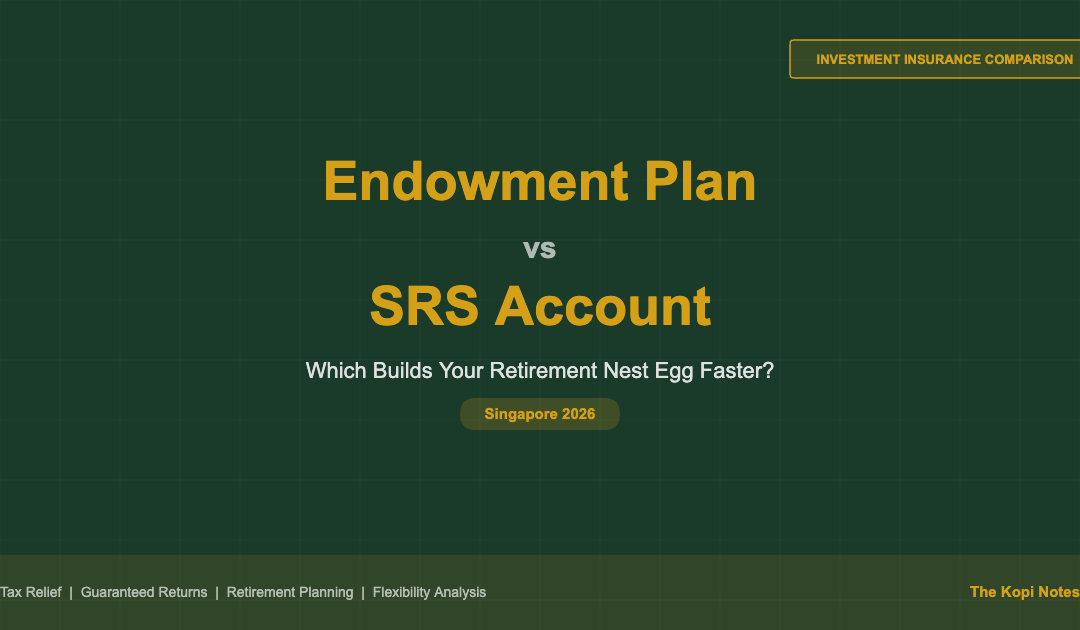
Endowment Plan vs SRS Account Singapore 2026: Which Builds Your Retirement Nest Egg Faster?
A data-driven comparison of two popular retirement savings tools — guaranteed returns, tax relief, flexibility, and the combination strategy that maximises both.
An endowment plan is a MAS-regulated insurance savings product that pays a guaranteed sum at maturity, plus non-guaranteed bonuses for participating (par) plans. An SRS (Supplementary Retirement Scheme) account is a government-backed tax deferral scheme at DBS, OCBC, or UOB where Singapore citizens and PRs can contribute up to S$15,300 per year for full tax relief. The critical difference: SRS is a container — you can fund an endowment plan using your SRS dollars, combining guaranteed returns with upfront tax savings in a single retirement strategy.
Not financial advice. All figures are for educational reference only. Data verified as at October 2026.
Table of Contents
What Is an SRS Account?
The Supplementary Retirement Scheme (SRS) is a voluntary government initiative by the Ministry of Finance (MOF), administered through three approved operators — DBS, OCBC, and UOB. It was designed to complement CPF savings, encouraging Singaporeans to save more for retirement through a tax incentive structure.
When you contribute to your SRS account, the full amount is deductible from your chargeable income for that Year of Assessment. For example, if you earn S$120,000 and contribute S$15,300 to SRS, you are taxed on only S$104,700 instead. At a marginal tax rate of 11.5%, that single contribution saves you approximately S$1,760 in taxes for the year — before factoring in the investment returns on the S$15,300 itself.
Crucially, SRS is not an investment product — it is a holding account. Funds left in SRS earn a nominal interest of just 0.05% per annum. To meaningfully grow your SRS balance, you need to invest it. Approved SRS investments include:
- SGX-listed stocks and REITs
- ETFs listed on SGX or approved international exchanges
- Singapore Savings Bonds (SSBs) and T-bills
- Unit trusts and endowment insurance plans
- Fixed deposits at SRS operator banks
Withdrawals from SRS are permitted from the statutory retirement age — currently 63 for those who opened their SRS accounts from 2022 onwards. Only 50% of the amount withdrawn is taxable in the year of withdrawal, making a phased withdrawal strategy from age 63 to 72 highly tax-efficient for most retirees. Early withdrawals before the statutory retirement age attract a 5% penalty and the full withdrawal amount (not just 50%) becomes taxable income.
If you want to compare SRS against CPF Top-Up contributions for tax relief, read our detailed breakdown: SRS vs CPF Top-Up Singapore 2026.
What Is an Endowment Plan?
An endowment plan is a life insurance savings product regulated by the Monetary Authority of Singapore (MAS). You pay premiums — either as a lump sum (single premium) or in regular instalments over the policy term — and receive a guaranteed maturity payout at the end of the term, along with a death benefit if you pass away during the policy period.
There are two main types of endowment plans available in Singapore:
- Participating (par) plans: Include both a guaranteed component and a non-guaranteed bonus declared annually from the insurer’s par fund. The guaranteed returns are typically lower (around 1.5–2.5% IRR), but non-guaranteed bonuses can bring the total projected yield to 4–5.5% over the long term, depending on the insurer’s investment performance.
- Non-participating (non-par) plans: Fixed, guaranteed returns with no non-guaranteed component. Short-term non-par plans (2–5 year) typically offer IRRs of 2.8–3.8%, making them highly predictable but with no upside potential.
Endowment plans are not eligible for the CPF Investment Scheme (CPFIS) — you cannot use CPF OA or SA funds to purchase them. However, you can use SRS funds to pay endowment plan premiums, which is a key strategy explored later in this article.
Key considerations for endowment plans include early surrender penalties: in the first few years of a long-term policy, surrendering early often returns less than total premiums paid. For short-term plans (2–5 years), early surrender clauses are less punishing but still reduce your effective yield. Always read the policy illustration and benefit illustration documents before committing. For more on planning your Singapore retirement income, use our free retirement calculator.
Key Differences at a Glance
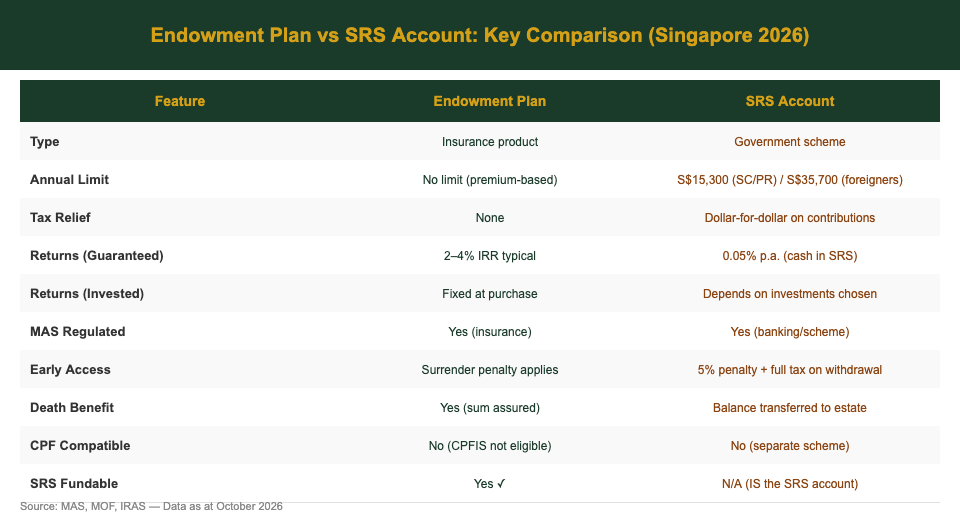
Before diving into tax and return calculations, here is a side-by-side overview of the fundamental structural differences between SRS accounts and endowment plans.
| Feature | Endowment Plan | SRS Account |
|---|---|---|
| Product type | MAS-licensed insurance product | Government retirement savings scheme |
| Annual contribution limit | No limit (premium-determined) | S$15,300 (SC/PR); S$35,700 (foreigners) |
| Upfront tax relief | None | Yes — dollar-for-dollar on contributions |
| Guaranteed returns | Yes (stated IRR at purchase) | 0.05% p.a. (cash only; invest for more) |
| Death benefit | Yes — sum assured + bonuses | No (balance transferred to estate) |
| Early access penalty | Surrender value may be less than premiums | 5% charge + full amount taxable |
| CPFIS eligible | No | No (separate scheme) |
| Can be funded by SRS? | Yes ✓ | N/A (this is the SRS account itself) |
Source: MAS, Ministry of Finance Singapore, IRAS — as at October 2026
Tax Benefits Compared
The tax treatment of each product is fundamentally different — and understanding this gap is the key to choosing (or combining) the two intelligently.
SRS tax relief on the way in: Every dollar contributed to SRS reduces your taxable income. A Singapore resident contributing the maximum S$15,300 in 2026 saves the following in income tax depending on their marginal rate:
| Annual Income | Marginal Rate | SRS at S$15,300 | Annual Tax Saved |
|---|---|---|---|
| Up to S$40,000 | 7% | S$15,300 | S$1,071 |
| S$40,001 – S$80,000 | 11.5% | S$15,300 | S$1,760 |
| S$80,001 – S$120,000 | 15% | S$15,300 | S$2,295 |
| S$120,001 – S$160,000 | 18% | S$15,300 | S$2,754 |
| S$160,001 – S$200,000 | 19% | S$15,300 | S$2,907 |
Source: IRAS Singapore income tax rates, Year of Assessment 2026
Endowment plans offer no upfront tax relief. Premiums are paid from after-tax income, and the maturity proceeds are also received tax-free (Singapore does not tax capital gains or insurance payouts). The advantage here is in the returns themselves, not the tax structure — a short-term endowment plan yielding 3.2% IRR compares favourably to a savings account or T-bill in the 2026 rate environment.
SRS tax treatment on withdrawal: When you withdraw from SRS at or after age 63, only 50% of the withdrawal amount is added to your taxable income for that year. If you withdraw in a year when your taxable income is low (e.g. in retirement), the effective tax rate on SRS withdrawals can approach zero. A retiree withdrawing S$40,000 per year from SRS only has S$20,000 as taxable income from SRS — well within the zero-tax threshold after personal reliefs.
For more on CPF and SRS investment strategy Singapore, see our comprehensive guide.
Returns: A Worked SGD Example
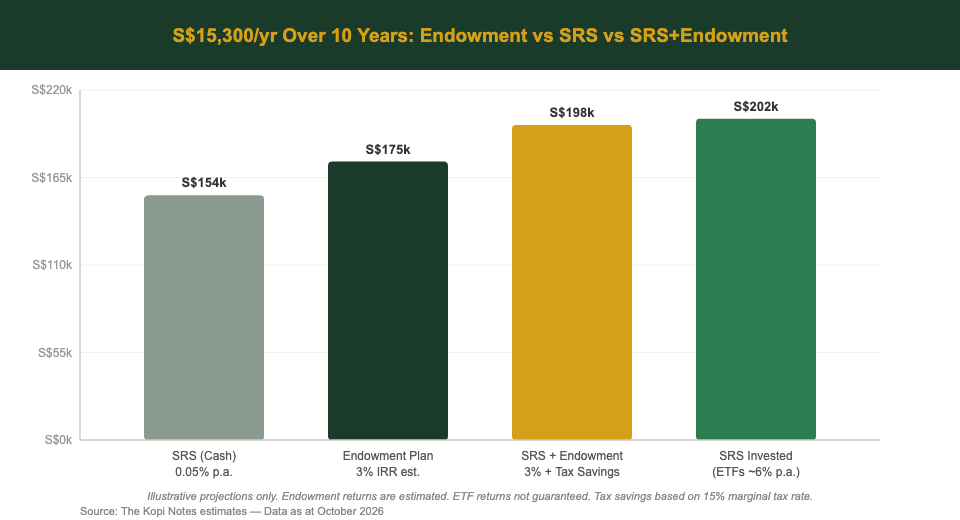
To illustrate the difference concretely, consider a Singapore resident aged 40 earning S$100,000 per year (marginal tax rate: 15%). They invest S$15,300 per year over 10 years — the maximum SRS contribution limit for 2026.
Scenario A — SRS (Cash, 0.05% p.a.):
- Total contributions: S$153,000
- 10-year interest (0.05%): ~S$765
- Upfront tax savings over 10 years: S$15,300 × 15% × 10 = S$22,950
- Total effective pot (contributions + tax savings + interest): ~S$176,715
- Withdrawal at 63: only 50% taxable; at low retirement income, tax on withdrawal ≈ near zero
Scenario B — Endowment Plan (3% IRR, no SRS):
- Total contributions: S$153,000
- Estimated maturity value at 10 years (3% p.a.): ~S$175,000
- Upfront tax savings: S$0
- Death benefit: included (sum assured)
- Gain: S$22,000 — received tax-free at maturity
Scenario C — SRS-Funded Endowment Plan (best of both):
- Contribute S$15,300/yr to SRS → claim tax relief (saves S$2,295/yr)
- Use SRS funds to pay endowment plan premiums inside the SRS wrapper
- Endowment plan grows at 3% IRR: maturity value ~S$175,000
- Total tax savings over 10 years: ~S$22,950
- Combined benefit (maturity + tax savings): ~S$197,950 effective
- Only 50% of SRS withdrawal is taxable at retirement — further tax efficiency
Scenario C demonstrates why the SRS + endowment combination is powerful for Singapore residents in the 15%+ marginal tax bracket: the guaranteed endowment return is essentially augmented by 15–22% upfront tax savings that compound over time. To model your own projections, try the Singapore retirement planning calculator.
Flexibility and Withdrawal Rules
This is where SRS has a clear structural advantage — and endowment plans have a structural disadvantage.
SRS flexibility: While early withdrawal is penalised (5% fee + full tax), you retain full control over how you invest the SRS balance. You can switch between unit trusts, ETFs, bonds, fixed deposits, or endowment plans at any time without triggering the early-withdrawal penalty. This flexibility makes SRS useful as a long-term retirement accumulation vehicle where your investment strategy can evolve over decades.
Endowment plan constraints: Once you sign an endowment policy, you are committed to the premium schedule. Missing premiums on a regular-premium policy can cause the policy to lapse, forfeiting your benefits. Early surrender, especially within the first 3–5 years of a long-term (15–25 year) par plan, typically returns a surrender value significantly below your total premiums paid — sometimes 60–80 cents on the dollar in the early years.
For short-term endowment plans (2–5 years), this risk is lower. If you access a Singapore Savings Bonds alternative instead, you get full capital preservation with no penalty for early redemption — though SSBs offer lower returns than endowment plans at the current interest rate environment.
The verdict on flexibility: SRS wins decisively. Endowment plans offer certainty of returns but sacrifice liquidity. SRS can hold endowment plans, capturing the returns benefit while maintaining the optionality of the SRS wrapper for future switching.
The SRS + Endowment Combination Strategy
Singapore’s smartest retirement savers are not choosing between SRS and endowment plans — they are using SRS to fund endowment plan premiums, capturing both the tax deduction and the guaranteed insurance returns in a single strategy.
Here is how the combination works in practice:
- Open an SRS account with DBS, OCBC, or UOB (no fee, takes 15 minutes)
- Contribute up to S$15,300 before 31 December to maximise that year’s tax relief
- Purchase a short-term or long-term endowment plan from a licensed insurer, paying premiums directly from your SRS account (the insurer or financial adviser arranges this)
- At maturity, the payout flows back into your SRS account — held as cash or reinvested until retirement age
- From age 63, withdraw from SRS strategically — only 50% of each withdrawal is taxable, so phasing S$30,000–S$40,000/year over 10 years minimises your tax bill
Not all endowment plans accept SRS funding. Check with your financial adviser or the insurer directly — major insurers including Prudential, AIA, Great Eastern, NTUC Income, Manulife, and Singlife offer SRS-compatible endowment plans. SRS-compatible plans are clearly labelled in product illustrations.
To invest SRS into unit trusts or ETFs instead of endowment plans, platforms like Endowus and Syfe both support SRS investing with access to diversified fund portfolios — giving you market-rate returns within the tax-advantaged SRS wrapper.
Who Should Choose What?
Choose an endowment plan (without SRS) if:
- You want guaranteed, predictable returns without investment risk and are in a low marginal tax bracket (below 7%) where SRS tax savings are minimal
- You have a specific savings goal — a child’s education fund, a property down payment, or a retirement lump sum — with a fixed timeframe
- You want a death benefit included in your savings product
- You have already maxed out your SRS contribution for the year and want additional guaranteed savings
Choose SRS (invested in ETFs or unit trusts) if:
- You are in the 11.5% or higher marginal tax bracket and want maximum upfront tax relief
- You prefer market-linked returns and accept short-term volatility for long-term growth (15+ year horizon)
- You want full flexibility to switch investments within the SRS wrapper as your strategy evolves
- You are comfortable with investment risk and do not need a guaranteed payout amount
Choose SRS + Endowment (combination) if:
- You are in the 11.5% or higher marginal tax bracket and want both tax savings AND guaranteed returns
- You value capital protection alongside the insurance buffer (death benefit)
- You have 10+ years to retirement and want a structured, no-worry savings approach
- You are risk-averse and are not comfortable with equity market volatility, but still want to make SRS contributions productive
Frequently Asked Questions
Can I use my SRS funds to pay for an endowment plan?
Yes. Singapore’s SRS scheme allows you to invest in MAS-licensed endowment plans by paying premiums directly from your SRS account. Not all endowment plans accept SRS payments, so confirm with your insurer before purchasing. Major insurers — including Prudential, AIA, Great Eastern, NTUC Income, and Singlife — offer SRS-compatible endowment products. Using SRS to fund an endowment plan lets you claim income tax relief on contributions while still earning the plan’s guaranteed return.
Which is better for retirement — SRS or endowment plan?
It depends on your marginal tax rate and risk appetite. If you are in the 11.5% or higher income tax bracket, SRS offers meaningful upfront tax savings that endowment plans cannot match on their own. SRS also provides flexibility to invest in equities or ETFs for potentially higher long-term returns. Endowment plans offer guaranteed returns and a death benefit but no tax relief. For most working Singaporeans in the 11.5–22% tax bracket, combining both — using SRS contributions to fund an endowment plan — delivers the strongest retirement outcome.
What is the SRS contribution limit for 2026 in Singapore?
The SRS contribution cap for 2026 is S$15,300 per year for Singapore Citizens and Permanent Residents, and S$35,700 per year for foreigners. Contributions must be made by 31 December to count for that year’s tax relief claim. The annual cap has remained unchanged since 2016, though MOF periodically reviews it. You can contribute any amount up to the cap — partial contributions are allowed and still attract tax relief proportionate to the amount contributed.
What happens to my SRS account if I withdraw before retirement age?
If you withdraw from SRS before the statutory retirement age (currently 63), a 5% penalty charge is levied on the full withdrawal amount. Additionally, 100% of the withdrawn amount — not the usual 50% — is added to your taxable income for that year. This can result in a significantly higher tax bill, especially if you are still employed. Early withdrawal essentially negates most of the SRS tax benefit. The 5% penalty is waived only in specific circumstances such as death, bankruptcy, or permanent disability.
Are endowment plan payouts taxable in Singapore?
No. In Singapore, maturity proceeds from endowment plans — including both the guaranteed sum and any non-guaranteed bonuses — are received tax-free. Singapore does not impose capital gains tax or tax on insurance policy payouts. This applies to both regular premium and single premium endowment plans. If the endowment plan is funded via SRS, the payout re-enters your SRS account and the tax treatment reverts to standard SRS withdrawal rules: 50% of any SRS withdrawal at or after age 63 is taxable income.
How does a participating endowment plan differ from a fixed endowment plan?
A participating (par) endowment plan invests your premiums in the insurer’s par fund — a mixed portfolio of bonds and equities. You receive a guaranteed sum at maturity plus non-guaranteed annual bonuses that depend on the par fund’s performance. The upside potential is higher but so is the uncertainty. A non-participating (non-par) endowment plan offers a fixed, guaranteed return from day one — what you see in the policy illustration is exactly what you receive, with no variation. Non-par plans suit investors who prioritise certainty; par plans suit those comfortable with a participation upside.
Ready to Maximise Your Retirement Savings?
Open an SRS account and start investing for retirement today. Use our referral links for exclusive sign-up bonuses.
Get Free Insurance Advice
Speak with a licensed insurance advisor. No obligation, no cost.
By submitting this form, you agree to our Privacy Policy.
This article was researched with the help of AI. While we strive to keep all information accurate and up to date, there may be errors. If you notice any discrepancies, please contact us.