Endowment Plan vs Corporate Bonds Singapore 2026: Which Pays Better Fixed Income?
A side-by-side look at endowment plans and Singapore’s retail corporate bonds — real coupon rates, a worked S$20,000 projection, and who each one actually suits.
An endowment plan Singapore illustrates returns of 3.00%-4.25% p.a. (non-guaranteed, capped by the Life Insurance Association) plus a small guaranteed component and bundled life cover. Singapore’s retail corporate bonds, like Astrea 9’s 3.40% p.a. SGD coupon, pay a fixed rate you know upfront — but carry issuer credit risk and zero deposit-style protection. Here’s how the numbers and the risks actually compare.
Not financial advice. All figures are for educational reference only. Data verified as at 22 August 2026 unless otherwise noted.
- Endowment plans illustrate 3.00%-4.25% p.a. — a projection capped by LIA rules, not a promise. Corporate bonds like Astrea 9 pay a fixed 3.40% p.a. (SGD tranche) coupon you know before you buy.
- Corporate bonds carry real issuer credit risk and are NOT covered by SDIC. Endowment plans have their guaranteed portion protected by the Policy Owners’ Protection (PPF) Scheme, up to S$500,000 sum assured / S$100,000 surrender value per insurer.
- On S$20,000 over 10 years, a mid-range retail corporate bond (~4.50% p.a.) can out-earn an endowment’s lower illustration by over S$4,000 — but you’re trading a guarantee and insurance cover for yield and credit exposure.
Table of Contents
Contents — Click to expand
- Quick Answer: Endowment Plan or Corporate Bonds?
- What Is a Corporate Bond? How Is It Different From an Endowment Plan?
- Key Differences at a Glance
- Returns Compared: LIA Illustration Rates vs Real Bond Coupons
- S$20,000 Over 10 Years: What You’d Actually Walk Away With
- Credit Risk, SDIC Protection & What Happens If the Issuer Defaults
- How to Buy Corporate Bonds vs Endowment Plans in Singapore
- Who Should Pick Which?
- Frequently Asked Questions
Quick Answer: Endowment Plan or Corporate Bonds?
If you want a fixed coupon you can calculate before you commit a single dollar, corporate bonds win on paper. Astrea 9’s SGD tranche pays 3.40% p.a., set the day you buy — not a range that depends on how well an insurer’s fund performs years down the road.
If you want forced savings discipline, a bundled death benefit, and some capital protection on the guaranteed slice, an endowment plan still has a role. Just anchor your expectations near the 3.00% lower illustration, not the eye-catching 4.25% headline.
Many Singapore investors treat corporate bonds as a small “satellite” allocation for extra yield, while keeping endowment plans (or safer instruments) as the core. The two aren’t really substitutes — one is an insurance product with a savings feature, the other is pure credit risk for a fixed return.
What Is a Corporate Bond? How Is It Different From an Endowment Plan?
A corporate bond is a loan you make to a company (or, in Singapore’s retail market, often a special-purpose vehicle backed by a portfolio of assets). In exchange, the issuer pays you a fixed coupon — usually twice a year — and returns your principal at maturity. If the issuer runs into trouble, you could lose part or all of your money, because you’re an unsecured creditor, not a government-backed depositor.
An endowment plan is a life insurance policy with a savings component. You pay premiums for a set term. At maturity you get your premiums back plus bonuses: a small guaranteed slice, and a larger non-guaranteed slice tied to how the insurer’s participating (par) fund performs. Die during the policy term, and your beneficiaries receive a death benefit too.
Singapore’s retail bond market is smaller than you might expect, but it is genuinely accessible. Bonds like the Astrea 9 PE Bonds (cited with a source link further below) — issued by Azalea Asset Management and backed by cash flows from a diversified portfolio of private equity fund interests, not a single company’s earnings — let retail investors buy in from S$2,000. More than a dozen other retail bonds trade on SGX with minimums as low as S$1,000, covering everything from bank capital instruments to statutory board bonds.
| Feature | Endowment Plan | Corporate/Retail Bond |
|---|---|---|
| Issuer | Life insurer (e.g. Great Eastern, NTUC Income, Manulife) | Private company or SPV (e.g. Azalea/Astrea, banks, statutory boards) |
| Return Type | Small guaranteed + non-guaranteed bonus (illustrated 3.00%-4.25% p.a.) | Fixed coupon set at issuance, typically 3%-6% p.a. across issues |
| Insurance Component | Yes — death benefit included | None |
| Minimum Investment | Varies by insurer, typically S$100-S$500/month | S$1,000-S$2,000, in fixed multiples |
| Downside Protection | PPF Scheme covers guaranteed sum assured (up to S$500k) if insurer fails | None — not SDIC-covered, you bear full issuer credit risk |
| Early Exit | Surrender — often below what you paid in, especially in early years | Sell on SGX secondary market — price moves with rates and credit sentiment |
| CPF/SRS Compatible | Some plans, insurer-dependent | Some issues via SRS or broker CPFIS accounts; varies by bond |
Key Differences at a Glance
The clearest comparison uses real numbers currently quoted, not brochure marketing. Here’s what a Singapore investor could actually get, as at August 2026.
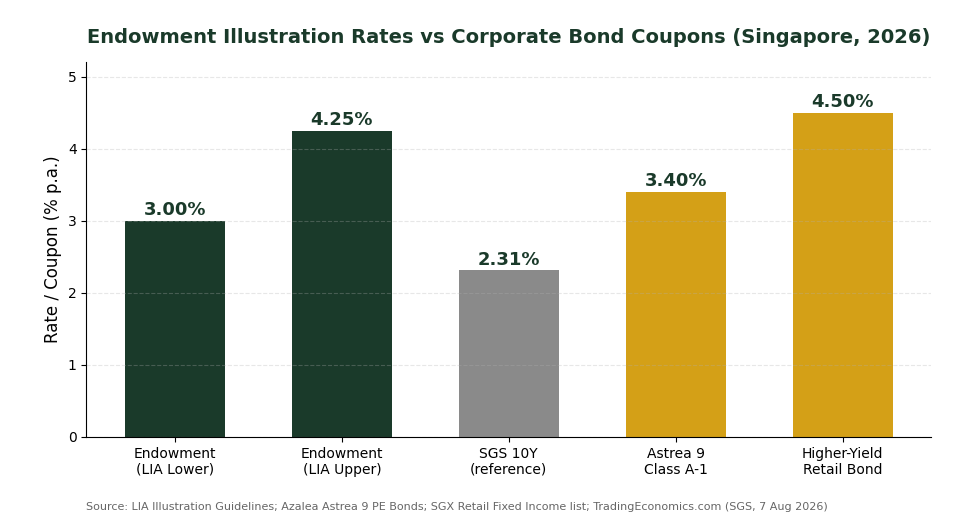
| Instrument | Rate/Coupon | Basis | Guaranteed? |
|---|---|---|---|
| Endowment (LIA Lower Illustration) | 3.00% p.a. | Industry-wide illustration cap, eff. 1 Jul 2021 | No |
| Endowment (LIA Upper Illustration) | 4.25% p.a. | Industry-wide illustration cap, eff. 1 Jul 2021 | No |
| SGS 10-Year Bond (for reference) | 2.31% | Secondary market yield, 7 Aug 2026 | Yes, sovereign |
| Astrea 9 Class A-1 PE Bond (SGD) | 3.40% | Fixed coupon, listed on SGX since 11 Aug 2025 | No — issuer credit risk |
| Higher-yield retail/corporate bonds | ~3%-6% (typical range) | Varies by issuer credit quality and tenor | No — issuer credit risk |
Source: LIA Illustration Rate Guidelines; Azalea Astrea 9 PE Bonds product page; SGX Retail Fixed Income Securities list; SGS yield via TradingEconomics.com, 7 Aug 2026.
Returns Compared: LIA Illustration Rates vs Real Bond Coupons
Here’s the part that trips people up. The 4.25% figure in endowment brochures is a maximum illustration cap set by the Life Insurance Association (LIA), not a promised return. Insurers may only illustrate a scenario between 3.00% and 4.25% — what you actually get depends on how the insurer’s par fund performs over your entire policy term.
A corporate bond works differently. When Astrea 9’s SGD tranche priced at 3.40% p.a. in August 2025, that number was locked in for bondholders who held from issuance — not a projection that moves with fund performance. However, that certainty comes with a catch: unlike an endowment plan or an SGS bond, a corporate bond’s promise is only as good as the issuer’s ability to pay. There’s no government or insurer standing behind it.
Retail corporate bonds as a category span a wider range than Astrea 9 alone. Depending on the issuer’s credit quality, coupon type, and tenor, retail and corporate bonds on SGX have historically priced anywhere from roughly 3% to 6% p.a. — generally higher than SGS bonds, and often overlapping with or exceeding an endowment’s upper illustration, precisely because you’re being paid for taking on credit risk the government and (to a lesser extent) a regulated insurer don’t carry.
S$20,000 Over 10 Years: What You’d Actually Walk Away With
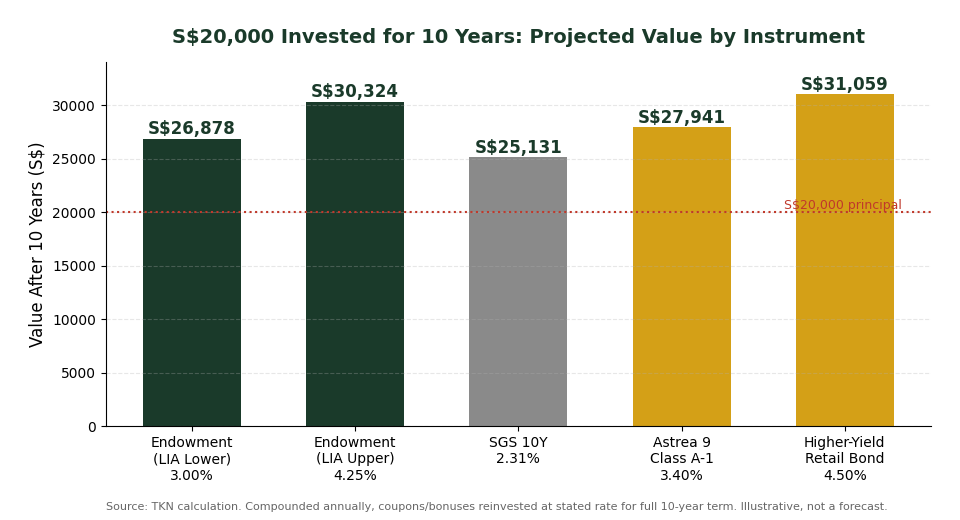
Let’s put a real lump sum on this. Say you have S$20,000 to park for 10 years — roughly the tenor of Astrea 9’s expected call date and a common endowment policy term.
| Scenario | Rate | Value After 10 Years | Total Growth |
|---|---|---|---|
| Endowment, LIA lower illustration | 3.00% | S$26,878 | S$6,878 |
| Endowment, LIA upper illustration | 4.25% | S$30,324 | S$10,324 |
| SGS 10-year bond (reference) | 2.31% | S$25,131 | S$5,131 |
| Astrea 9 Class A-1 PE Bond | 3.40% | S$27,941 | S$7,941 |
| Higher-yield retail corporate bond | 4.50% | S$31,059 | S$11,059 |
Source: TKN calculation, S$20,000 lump sum compounded annually over 10 years, coupons/bonuses assumed reinvested at the stated rate for the full term. Endowment scenarios illustrative per LIA caps; bond figures assume the stated fixed coupon holds for the full 10-year period and coupons are reinvested at the same rate — actual reinvestment rates will differ, so treat this as “what if today’s rate held,” not a forecast.
On paper, the higher-yield corporate bond scenario and the endowment’s upper illustration land close together — S$31,059 versus S$30,324. But only one of those numbers is a projection with a probability attached. The endowment’s 4.25% depends on the insurer’s par fund outperforming — worth remembering that LIA has cut its illustration caps once already, from 4.75%/3.25% down to 4.25%/3.00% in 2021 (see our endowment vs SGS bonds comparison further below for that full history). A fixed-coupon bond like Astrea 9, by contrast, pays exactly what was promised at issuance — as long as the issuer (or, for Astrea, the underlying private equity portfolio) can meet its obligations.
Notice, too, that Astrea 9’s 3.40% coupon actually lands below the endowment’s upper illustration and only modestly above its lower one. The “higher-yield” corporate bond row is doing the heavy lifting in that top-line comparison — and higher yield on a corporate bond almost always signals higher credit risk, not a free lunch.
Credit Risk, SDIC Protection & What Happens If the Issuer Defaults
This is the section most comparison articles skip, and it matters more than the yield gap.
Corporate bonds carry issuer credit risk. When you buy a bond, you’re an unsecured (or sometimes subordinated) creditor of the issuer. If the issuer defaults, you could lose part or all of your principal, and recovery isn’t guaranteed even after liquidation proceedings. Structures like Astrea 9 try to manage this by backing bonds with cash flows from a diversified pool of private equity fund interests rather than a single company — but “diversified” doesn’t mean “risk-free.” The Singapore Deposit Insurance Corporation (SDIC) explicitly does not cover bonds, shares, unit trusts, or other investment products. Only bank deposits up to S$100,000 per bank get that protection.
Endowment plans have a different backstop. Life insurers in Singapore are regulated by MAS and must hold minimum capital against their policy obligations. On top of that, the Policy Owners’ Protection (PPF) Scheme — administered by SDIC, but a separate scheme from bank deposit insurance — protects the guaranteed portion of your policy if a member insurer fails: up to S$500,000 of guaranteed sum assured and S$100,000 of guaranteed surrender value, per life assured, per insurer. That protection applies to the guaranteed slice only — the non-guaranteed bonus portion isn’t covered by the same hard caps.
There’s also a practical liquidity difference. Endowment plans can only be exited by surrendering, which usually returns less than you paid in during the early years. Retail corporate bonds like Astrea 9 trade on the SGX secondary market, so you can sell before maturity — but the price you get moves with prevailing interest rates and market sentiment on the issuer’s creditworthiness, not just the passage of time.
How to Buy Corporate Bonds vs Endowment Plans in Singapore
Retail corporate bonds are more accessible than most people assume. Public offers like Astrea 9 are typically applied for via ATM, internet banking, or mobile banking of DBS (including POSB), OCBC, or UOB during the offer window, with minimums as low as S$1,000-S$2,000 depending on the issue. Once listed, you can also buy on the SGX secondary market through any brokerage account — but you’ll pay whatever the current market price is, which may be above or below the original issue price. You’ll generally need a CDP Securities Account to hold retail bonds bought this way.
Endowment plans are bought directly from an insurer or through a financial adviser or bank distributor. There’s no public offer window — you agree to a fixed premium and policy term upfront, and the insurer runs a Financial Needs Analysis (FNA) before you can proceed. If your plans change, exiting early means surrendering, which in the first several years often returns less than what you’ve paid in, since upfront distribution costs are deducted early in the policy’s life.
Who Should Pick Which?
Corporate bonds fit you if: you understand and are comfortable pricing in issuer credit risk; you want a known, fixed coupon rather than a range of possible outcomes; you’re diversifying a fixed-income sleeve that already has safer government-backed instruments as its core; or you have S$1,000-S$2,000 of spare capital you’re comfortable locking up (or trading, with some price risk) for several years.
Endowment plans fit you if: you specifically want the forced-savings discipline of a monthly premium you can’t easily touch; you want a death benefit bundled with your savings; or you’re using it as part of a broader insurance planning conversation with an adviser rather than treating it as a standalone yield play. Anchor your planning near the 3.00% lower illustration, not the 4.25% headline number.
Most Singapore households treat corporate bonds as a satellite allocation, not a core holding — a smaller slice sitting alongside safer instruments like T-bills or Singapore Savings Bonds. If you’re weighing an endowment plan against a broader set of fixed-income options, our endowment vs SGS bonds comparison covers the government-backed side of that trade-off in more depth, and our endowment plans Singapore guide is the place to start if you’re new to how these policies work.
Before committing either way, run your numbers through our retirement planning calculator to see how each option fits your overall timeline — and if you’re building out a broader investing platform for bond funds or diversified portfolios, our Endowus referral code and FSMOne referral code pages have the latest sign-up offers.
Frequently Asked Questions
Is an endowment plan better than corporate bonds in Singapore?
It depends on what you value more. Corporate bonds like Astrea 9 pay a fixed, known coupon (3.40% p.a. for its SGD tranche) but carry issuer credit risk and no SDIC protection. Endowment plans illustrate 3.00%-4.25% p.a., which is a projection, not a guarantee, but bundle in life insurance and PPF Scheme protection on the guaranteed portion. Neither is universally “better” — it comes down to your appetite for credit risk versus your need for insurance cover.
What is the current yield on Singapore retail corporate bonds?
Retail and corporate bonds listed on SGX have historically priced across a wide range, roughly 3% to 6% p.a., depending on the issuer’s credit quality and tenor. As a concrete example, Astrea 9’s SGD Class A-1 bonds priced at a fixed 3.40% p.a. when they were publicly offered in August 2025 and began trading on SGX on 11 August 2025. Always check the specific issue’s prospectus or SGX listing for the latest terms before investing.
Are corporate bonds covered by SDIC in Singapore?
No. The Singapore Deposit Insurance Corporation (SDIC) explicitly excludes bonds, shares, unit trusts, and other investment products from its Deposit Insurance Scheme, which only covers bank deposits up to S$100,000 per bank. If a bond issuer defaults, there’s no deposit-style safety net — you’re relying entirely on the issuer’s ability to repay and any recovery through liquidation proceedings.
Is the 4.25% endowment illustration rate guaranteed?
No. The 3.00%-4.25% range is a Life Insurance Association (LIA) illustration cap that insurers are permitted to project, effective since 1 July 2021. It’s designed to stop insurers from overpromising — it isn’t a guaranteed return. Your actual payout depends on how the insurer’s participating fund performs over your policy term.
What happens to my endowment plan if my insurer fails?
The Policy Owners’ Protection (PPF) Scheme, administered by SDIC, protects the guaranteed portion of your policy if a member insurer fails — up to S$500,000 of guaranteed sum assured and S$100,000 of guaranteed surrender value, per life assured, per insurer. This cap applies to the guaranteed benefits; the non-guaranteed bonus portion isn’t covered by the same structure.
What's the minimum amount to invest in Singapore retail corporate bonds?
It varies by issue, but many retail bonds on SGX have minimums as low as S$1,000, in fixed multiples. Astrea 9’s Class A-1 (SGD) bonds required a minimum subscription of S$2,000 at their August 2025 public offer, while the Class A-2 (USD) tranche required US$2,000.
Do corporate bonds or endowment plans include life insurance?
Endowment plans do — they’re structured as life insurance policies with a savings component, so your nominated beneficiaries receive a death benefit if you pass away during the policy term. Corporate bonds are pure fixed-income instruments with no insurance component; if you die holding one, it simply forms part of your estate.
Ready to Build Out Your Fixed-Income Allocation?
Run the numbers on your own timeline, then decide where corporate bonds, endowment plans, or both fit into your plan.
Get Free Insurance Advice
Speak with a licensed insurance advisor. No obligation, no cost.
By submitting this form, you agree to our Privacy Policy.
This article was researched with the help of AI. While we strive to keep all information accurate and up to date, there may be errors. If you notice any discrepancies, please contact us.