MediSave Limit 2026: Outpatient Pre-Surgery Tests — What’s Covered and What Isn’t
A plain-English breakdown of what your MediSave can cover before you even check in — and exactly when your Integrated Shield Plan picks up the rest.
Yes — MediSave can pay for pre-surgery outpatient tests in 2026, but only if those tests are directly linked to your upcoming hospitalisation. Common examples include pre-operative blood panels, ECGs, chest X-rays, and urine tests ordered by your surgeon before admission. Under Singapore’s MediShield Life rules, these costs are bundled into your inpatient claim and drawn from your MediSave account when the hospital submits the bill. If you have an Integrated Shield Plan (ISP), your insurer may extend pre-hospitalisation coverage to 100–180 days before surgery — giving you far greater flexibility than the basic scheme.
Not financial or medical advice. All figures are for educational reference only. Verify current limits at cpf.gov.sg or moh.gov.sg before making claims. Data as at October 2026 unless noted.
Table of Contents
Contents — Click to expand
- What Counts as Pre-Hospitalisation Outpatient Treatment?
- How MediSave Covers Pre-Surgery Tests
- Tests That Are Covered (With Examples)
- Tests That Are NOT Covered
- How Integrated Shield Plans Extend Pre-Hospitalisation Coverage
- ISP Pre-Hospitalisation Windows: Plan Comparison 2026
- How to Claim Pre-Surgery Test Costs via MediSave
- Tips for Singapore Patients
- Frequently Asked Questions
What Counts as Pre-Hospitalisation Outpatient Treatment?
When your surgeon schedules you for an operation, they typically need to assess your fitness first. You might be sent for blood tests to check your clotting factors, an electrocardiogram (ECG) to evaluate your heart rhythm, a chest X-ray to screen for lung issues, or a series of urine tests. These happen in an outpatient clinic or polyclinic before you are formally admitted to the hospital ward.
Under Singapore’s healthcare framework, the Ministry of Health (MOH) classifies these as pre-hospitalisation outpatient expenses — costs that arise outside the hospital stay but are clinically necessary for the planned surgical episode. The key test MOH applies is straightforward: were the tests directly linked to the surgery? If yes, they qualify for MediSave. If they are routine health screenings unrelated to your specific operation, they do not qualify.
This distinction matters because MediSave is normally restricted to inpatient and approved outpatient conditions. Pre-surgery tests sit in a special category — they are outpatient visits, but they are treated as part of your inpatient episode for claim purposes. The hospital bundles these costs into your final bill and submits them to CPF Board as part of the same MediSave deduction.
For Singapore residents managing healthcare costs, understanding this rule is critical. Many patients assume the pre-surgery clinic visit will be a full out-of-pocket expense and are surprised to learn that MediSave — and potentially their Integrated Shield Plan — can cover a significant portion of it.
How MediSave Covers Pre-Surgery Tests
MediSave does not have a separate standalone limit for pre-hospitalisation outpatient tests. Instead, the costs are bundled into your inpatient MediSave claim when you are admitted. Here is how it works in practice:
Your surgeon orders the pre-op tests. You attend the outpatient clinic and pay at the counter (or charge to your insurance). When you later check into the hospital for surgery, the hospital submits a combined claim that includes both the inpatient charges and the linked pre-admission test costs. MediSave is then deducted from your CPF MediSave account to cover eligible amounts up to the applicable daily withdrawal limits.
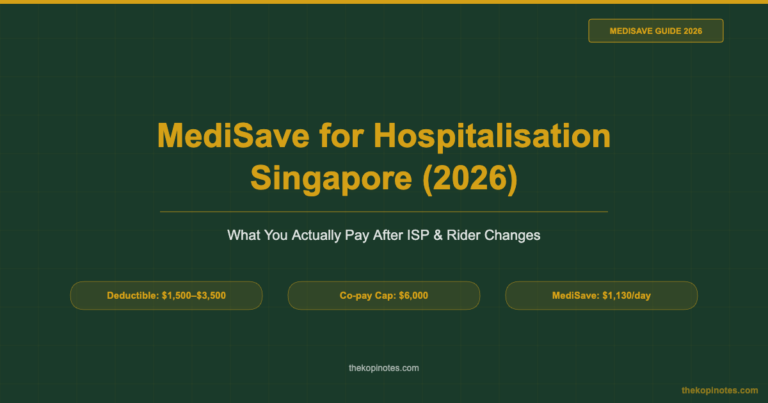
The 2026 MediSave withdrawal limits for inpatient stays at restructured acute hospitals are:
| Inpatient Day | MediSave Daily Limit (Acute Hospital) | Community Hospital |
|---|---|---|
| Day 1 and Day 2 | $1,130/day | $250/day |
| Day 3 onwards | $400/day | $250/day |
| Day surgery (same-day) | $830 (flat) | N/A |
| Surgical fees (TOSP) | $240–$5,290 depending on complexity | N/A |
Source: Ministry of Health Singapore, inpatient care MediSave limits, August 2026. Full TOSP schedule available at moh.gov.sg.
Pre-hospitalisation test costs are absorbed within these daily limits. The hospital’s billing department is responsible for categorising and submitting the claim correctly — as a patient, you do not need to file separately for the pre-op tests. If your total bill exceeds MediSave limits, the remainder must be paid out-of-pocket or through your Integrated Shield Plan.
Tests That Are Covered (With Examples)
The governing principle is direct clinical linkage to the surgery. If your orthopaedic surgeon needs a full blood count before a knee replacement to assess anaesthesia risk, that blood test qualifies. If you happen to ask for a Vitamin D check at the same visit, it does not — because it is not clinically required for the procedure.
Common pre-surgery tests that typically qualify under Singapore’s MediSave pre-hospitalisation rules:
| Test / Procedure | Why It Usually Qualifies | Why It May Not |
|---|---|---|
| Full Blood Count (FBC) | Anaesthesia assessment; checks clotting | If ordered months before with no clear link |
| Electrocardiogram (ECG) | Cardiac clearance for surgery | Routine health screening not linked to surgery |
| Chest X-ray | Pre-anaesthetic lung assessment | If ordered for a separate unrelated condition |
| Urine Test (Urinalysis) | Kidney function screen for certain surgeries | General wellness check |
| Liver / Renal Function Tests | Anaesthesia metabolism assessment | If ordered purely for annual review |
| CT Scan / MRI (pre-op staging) | Required to plan surgery (e.g. cancer staging) | If ordered for a different specialist or condition |
| Blood Group & Cross-Match | Required for procedures with transfusion risk | Routine blood typing not linked to a procedure |
Source: MOH Singapore guidance on pre-hospitalisation MediSave coverage; The Kopi Notes editorial, October 2026.
The simplest guide: if the test appears on your surgeon’s pre-admission checklist, it almost certainly qualifies. If it does not appear there, it may still qualify, but you would need the hospital to confirm that it will be included in the inpatient claim before you pay for it.
Tests That Are NOT Covered
Despite the flexibility above, several categories of outpatient tests do not qualify for MediSave even if done around the time of a surgery:
- Routine annual health screenings — MediSave has a separate outpatient screening framework (e.g., CHAS for subsidised screenings) that is distinct from the inpatient pre-hospitalisation channel.
- Elective health panels not linked to the surgery — If you request a fertility test or hormone panel during the same clinic visit, these are not linked to your orthopaedic surgery and will not be bundled.
- Dental pre-assessments — MediSave cannot be used for most dental procedures except dental surgery (e.g., surgical extractions under GA).
- Tests ordered by a different specialist for a different condition — If your cardiologist orders tests that happen to coincide with your upcoming abdominal surgery, the cardiology visit is a separate episode.
- Cosmetic procedure pre-assessments — MediSave does not cover cosmetic surgery, so the associated pre-op tests also do not qualify.
When in doubt, ask your hospital’s billing department before the test is done — not after. Once a test is classified and billed as a standalone outpatient visit, it may be difficult to reclassify it as part of the inpatient claim.
How Integrated Shield Plans Extend Pre-Hospitalisation Coverage
The most significant gap in Singapore’s basic MediShield Life coverage is the pre-hospitalisation window. Under MediShield Life, the pre-hospitalisation outpatient tests are claimable only when they are directly bundled into the inpatient admission — effectively covering tests done very close to the admission date.
Integrated Shield Plans offered by private insurers change this picture dramatically. For a Singapore resident who has an ISP, the pre-hospitalisation benefit typically covers medical expenses incurred from 100 to 180 days before admission, depending on the plan tier. This means if your surgeon requests an MRI three months before your planned operation, that cost may be covered by your ISP — even though it would not be covered under MediShield Life alone.
The post-hospitalisation window is equally important. ISPs typically extend coverage to 90–365 days after discharge for follow-up outpatient treatments related to the hospitalisation episode. For those managing the MediSave limit 2026 alongside real medical costs, an ISP is one of the most efficient ways to close the coverage gap without large out-of-pocket outlays.
It is important to note that ISP benefits are paid by the insurer — not deducted from MediSave. The MediSave withdrawal (via MediShield Life) and the ISP claim are submitted as separate components of the same bill. The hospital handles this split automatically for patients treated at panel hospitals.
ISP Pre-Hospitalisation Windows: Plan Comparison 2026
Not all ISPs offer the same pre-hospitalisation window. For Singapore residents who anticipate needing elective surgery — joint replacement, cancer surgery, hernia repair — the pre-hospitalisation window can determine whether several thousand dollars of diagnostic costs are covered or must be paid out of pocket. Here is a comparison of the major ISP providers in 2026:
| ISP Provider | Plan Name | Pre-Hosp Window | Post-Hosp Window | Ward Level |
|---|---|---|---|---|
| Great Eastern | SupremeHealth P Plus | 120 days | 365 days | Private |
| Raffles Health Insurance | Raffles Shield Premier | 180 days | 365 days | Private |
| Prudential | PRUShield Premier | 180 days | 365 days | Private |
| AIA | HealthShield Gold Max A | 100 days | 100 days | Private |
| NTUC Income | IncomeShield Preferred | 100 days | 100 days | Private |
| Singlife with Aviva | Shield Plan 1 | 100 days | 100 days | Private |
Source: ISP insurer benefit schedules, 2026. Limits shown are for the top-tier private hospital plans. B1/A-ward plan windows may differ. Verify with your insurer before making claims.
If you are in the market for an ISP and anticipate surgery, the 180-day pre-hospitalisation window offered by Raffles Shield Premier and PRUShield Premier is meaningfully better than the 100-day windows offered by other providers. However, premiums for the top-tier plans are significantly higher and must be partially paid in cash (MediSave can only cover the MediShield Life component plus the Additional Withdrawal Limit for the IP component — S$300/year for ages 1–40, S$600 for ages 41–70, S$900 for age 71+).
For those without an ISP who rely purely on MediShield Life, the practical window for pre-hospitalisation tests is much narrower — the tests generally need to be part of the same admission episode to be bundled into the MediSave claim. If you have significant elective surgery on the horizon and are weighing healthcare costs, this is a good time to review whether your savings plan is optimised. A Singapore retirement and savings calculator can help you estimate how much you should be setting aside for long-term healthcare costs alongside your CPF contributions.
How to Claim Pre-Surgery Test Costs via MediSave
The process is largely handled by your hospital, but understanding the steps helps you avoid billing errors:
Step 1: Get your pre-op test orders in writing. Ask your surgeon for a written referral or documented pre-admission order listing all required tests. This is the paper trail the hospital billing department uses to justify the pre-hospitalisation claim.
Step 2: Attend the tests at the correct facility. If your surgeon is based at a private hospital, doing the pre-op tests at the same hospital (or its affiliated clinics) simplifies billing. Cross-institution billing can complicate the claim — the tests may need to be re-submitted manually. Doing your tests at a polyclinic for cost savings is possible, but confirm with the hospital that the polyclinic invoice can be included in the eventual inpatient claim.
Step 3: Keep all receipts and invoices. Even though the hospital handles claim submission, retain your copies. In the event of a billing dispute — or if your ISP requires supporting documents — you want the original itemised receipts showing each test was ordered by your surgeon pre-operatively.
Step 4: At discharge, review the hospital bill carefully. Ask the hospital’s billing desk to confirm that your pre-hospitalisation outpatient tests have been included in the MediSave claim. The bill summary should show a “pre-hospitalisation charges” line item. If it is missing, raise it before settling the bill.
Step 5: If you have an ISP, submit the insurer’s claim form. ISPs typically require you to submit a claim form with attached invoices, lab reports, and the surgeon’s referral letter within 90–180 days of discharge. Keep a copy of everything you send.
For those looking to optimise their overall CPF investment strategy, keeping MediSave well-funded is a key part of the equation — especially for those in their 40s and 50s who are statistically more likely to need elective surgery in the coming decade.
Tips for Singapore Patients
A few practical tips that frequently trip up patients navigating MediSave pre-hospitalisation coverage:
Ask about the “pre-admission protocol” before you book your surgery date. Many private hospitals have a dedicated pre-admission nursing team that walks you through required tests and confirms which ones will be included in the inpatient claim. This is standard practice at SGH, NUH, NUH, Gleneagles, Mount Elizabeth, and Parkway hospitals.
Do not pay for tests as “standalone outpatient visits” if you can avoid it. Some clinics will bill a pre-op test as a regular outpatient consultation (charged to MediSave under the outpatient withdrawal limit). This uses up a different MediSave bucket. If the test is truly pre-operative, ask for it to be held and billed as part of your inpatient admission instead.
MediSave does not cover ISP rider premiums. The additional coverage rider your insurer sells — the part that removes co-insurance and deductibles — cannot be paid from MediSave. You pay rider premiums entirely in cash. This catches many policyholders off guard who assume their ISP is fully MediSave-funded.
The 2026 MediSave Basic Healthcare Sum (BHS) is S$79,000 for members aged 65 and below. Amounts above this are transferred to your Ordinary Account or Special Account (depending on your age). The BHS does not cap your withdrawals — it is a savings ceiling, not a withdrawal ceiling.
If your surgery is cancelled, the pre-hospitalisation tests may not be claimable. Since the tests are approved as part of the inpatient episode, if the hospitalisation does not proceed, MediSave cannot be used for those outpatient costs. Check with your ISP whether pre-hospitalisation coverage applies even if the surgery is ultimately not performed.
Frequently Asked Questions
Can I use MediSave for blood tests before surgery in Singapore?
Yes. Pre-operative blood tests ordered by your surgeon as part of your pre-admission workup are claimable via MediSave. They are bundled into your inpatient hospital claim when you are admitted for the surgery. The key condition is that the tests must be directly linked to the planned surgical episode — not ordered for a separate health condition or as a general wellness screen.
What is the MediSave limit 2026 for pre-hospitalisation outpatient treatment?
There is no separate, standalone MediSave limit specifically for pre-hospitalisation outpatient tests. These costs are absorbed within the overall inpatient daily withdrawal limits — $1,130/day for the first two days and $400/day from day 3 onwards for acute hospitals. The hospital bundles pre-op test costs into the inpatient claim and deducts from MediSave as part of the same submission. If you have an Integrated Shield Plan, your insurer covers eligible pre-hospitalisation expenses incurred 100–180 days before admission, depending on your plan tier.
Does MediSave cover ECG before surgery?
Yes, an ECG ordered as part of pre-operative cardiac clearance qualifies for MediSave coverage. It falls under pre-hospitalisation outpatient treatment directly linked to your surgery. The ECG must be ordered by your surgeon (or an anaesthetist assessing your fitness for surgery) and must appear in the pre-admission documentation that the hospital submits with the inpatient claim.
How far in advance do pre-surgery tests need to be done to qualify for MediSave?
Under MediShield Life (the basic scheme), pre-hospitalisation tests need to be directly linked to the upcoming hospitalisation and are typically bundled in when the hospital submits the inpatient claim. There is no fixed time window published by CPF Board for how far in advance these tests can occur, but practically speaking, they are usually done within a few weeks of the planned admission date. Under Integrated Shield Plans, however, the pre-hospitalisation benefit window is explicitly stated — ranging from 100 days to 180 days before admission, depending on the plan. Tests done within this window are eligible for ISP reimbursement.
If my surgery is cancelled, can I still claim MediSave for the pre-op tests?
Generally no. Since pre-hospitalisation outpatient tests are approved as part of the inpatient episode, if the hospitalisation does not go ahead, MediSave cannot be used for those outpatient costs — they lose their inpatient claim classification. For ISP holders, it depends on your specific policy wording. Some ISPs cover pre-hospitalisation investigations even if the surgery is ultimately not performed; others require the hospitalisation to have taken place. Review your policy terms or contact your insurer directly to confirm.
What happens if my pre-op tests are done at a different clinic from the hospital?
It is still possible to include tests done at external clinics (e.g. a polyclinic or GP clinic) in the inpatient MediSave claim, but it requires more paperwork. The hospital will need the original itemised invoices from the external provider and a written referral from your surgeon confirming the tests were ordered for the pre-operative workup. It is generally simpler to have all pre-op tests done at the hospital or its affiliated clinics, where the billing is integrated. If you choose an external provider for cost reasons, confirm with the hospital in advance that the invoice can be submitted as part of your inpatient claim.
Do I need an Integrated Shield Plan if MediSave already covers pre-surgery tests?
MediSave’s coverage of pre-surgery tests is real but limited. It covers tests bundled into your inpatient claim and draws from the daily inpatient MediSave limits — which have a cap. For more extensive diagnostic workups, specialist consultations, imaging, and tests done weeks or months before admission, MediSave alone may not be sufficient. An Integrated Shield Plan extends the pre-hospitalisation window to 100–180 days and covers costs beyond MediSave limits up to the plan’s as-charged or sub-limit amounts. For anyone planning major elective surgery — or who wants financial certainty for unplanned surgeries — an ISP provides a meaningful safety net that MediSave alone cannot replicate.
Disclaimer: This article is for informational purposes only and does not constitute financial, medical, or insurance advice. MediSave limits and ISP benefit terms change over time — always verify current figures at cpf.gov.sg and moh.gov.sg, and consult your insurer or a licensed financial adviser before making coverage decisions. The Kopi Notes may earn referral compensation from some links on this page.
Get Free Insurance Advice
Speak with a licensed insurance advisor. No obligation, no cost.
By submitting this form, you agree to our Privacy Policy.
This article was researched with the help of AI. While we strive to keep all information accurate and up to date, there may be errors. If you notice any discrepancies, please contact us.