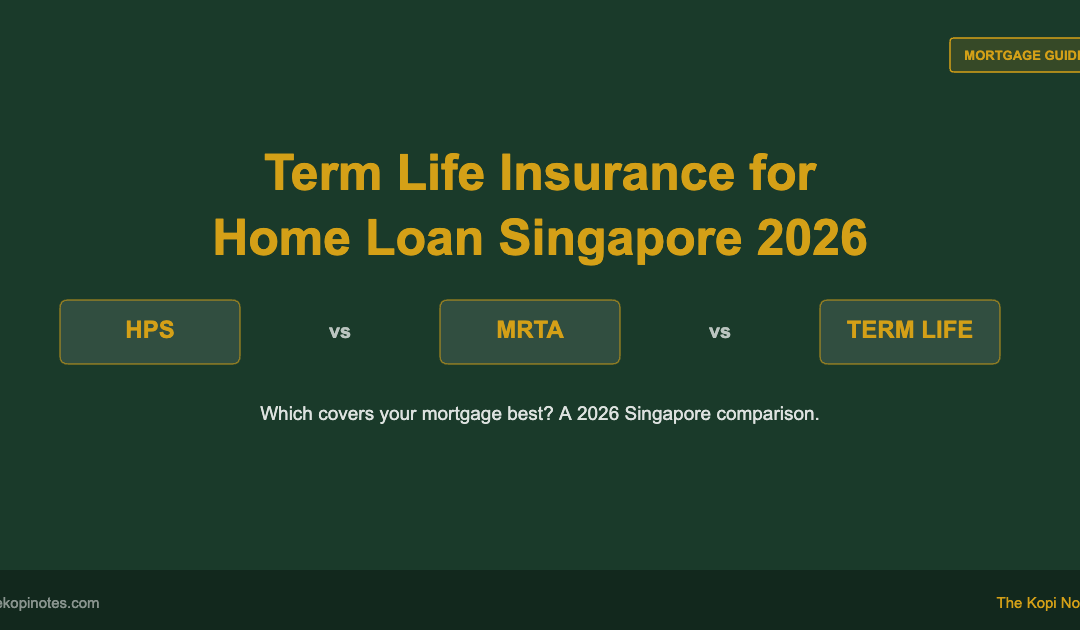
Term Life Insurance for Home Loan Singapore 2026: HPS vs MRTA vs Term Life Explained
Which policy covers your mortgage best? A plain-English comparison for Singapore homeowners.
📋 Table of Contents
- What Is Mortgage Life Insurance in Singapore?
- HPS: Home Protection Scheme
- MRTA: Mortgage Reducing Term Assurance
- Level Term Life Insurance
- HPS vs MRTA vs Term Life: Side-by-Side Table
- Cost Comparison: What Do You Actually Pay?
- Coverage Comparison: Who Gets Paid Out?
- Which One Should You Choose?
- Frequently Asked Questions
What Is Mortgage Life Insurance in Singapore?
When you take out a home loan in Singapore, most lenders — and CPF Board for HDB flats — require you to have some form of mortgage protection. The three main options are: the mandatory Home Protection Scheme (HPS) for CPF-financed HDB loans, Mortgage Reducing Term Assurance (MRTA) purchased from a bank or insurer, and a standalone level term life insurance policy that you buy separately. Each covers your outstanding home loan if you die or are permanently disabled — but they differ significantly in cost, flexibility, and coverage structure.
Not financial advice. All figures are educational reference only. Data as at October 2026 unless noted.
Owning a home is typically the largest financial commitment a Singapore family will make. A 25-year mortgage on an HDB flat worth S$500,000 means two decades of monthly repayments — and if the breadwinner passes away or suffers total permanent disability (TPD), those repayments don’t stop. Mortgage protection insurance fills that gap, ensuring your family keeps the home.
But the type of protection you choose matters enormously. Many Singaporeans default to whatever the bank bundles with their home loan, without realising they may be paying more than necessary — or getting less coverage than they need. This guide breaks down all three options so you can make an informed choice.
HPS: Home Protection Scheme
The Home Protection Scheme (HPS) is a mandatory mortgage insurance scheme administered by CPF Board. If you’re using CPF Ordinary Account (OA) savings to service your HDB home loan, you must be covered under HPS (unless you have an equivalent private insurance policy).
Key features of HPS
- Who qualifies: Singapore Citizens and Permanent Residents aged 21–65 who use CPF OA for HDB loan repayments
- What it covers: Your outstanding HDB home loan balance in the event of death, terminal illness, or total permanent disability
- Coverage structure: Decreasing — mirrors the outstanding loan balance, so as you pay down your mortgage, the cover reduces in tandem
- Premiums: Deducted from your CPF OA — no cash outlay required. Annual premiums range from roughly S$20–S$150/year depending on age and loan amount, making it one of the most affordable options available
- Pre-existing conditions: HPS expanded its coverage significantly in May 2025, now covering a broader range of pre-existing conditions that were previously excluded
- Joint applicants: Both borrowers must be individually covered under HPS if both are on the loan
The beauty of HPS is its simplicity and low cost — premiums are pulled from CPF OA automatically, so there’s no monthly cash payment. However, because it only covers HDB loans paid with CPF, private property owners and those using bank loans are excluded.
You can check your HPS coverage and premiums at any time through CPF Board’s official HPS portal.
MRTA: Mortgage Reducing Term Assurance
Mortgage Reducing Term Assurance (MRTA) is a private insurance policy — typically offered by banks or insurers — that covers your home loan. Unlike HPS, MRTA is available for both HDB and private property, and for bank loans or HDB loans.
Key features of MRTA
- Coverage structure: Decreasing — the sum assured declines over time to track your diminishing loan balance
- Premium structure: Usually paid as a single lump sum at the start of the policy (which may be bundled into your loan, adding to your interest cost)
- Portability: Portable across properties — useful if you refinance or sell and buy another property
- Medisave use: You can use Medisave savings (up to S$600/year under CPF LIFE rules) to pay for certain MRTA premiums — confirm with your insurer
- Flexibility: You can choose coverage duration shorter than the loan tenure (e.g. cover the first 15 years of a 25-year loan when most of the interest is front-loaded)
- Riders: Some MRTA plans include critical illness (CI) riders for additional premiums
MRTA is popular for private property buyers who need flexibility and portability. The single-premium structure means you pay upfront and don’t worry about monthly premiums lapsing — but if you sell the property or refinance, you may not recover the full premium.
Level Term Life Insurance
Level term life insurance (or standalone term life) is a separate life insurance policy that pays a fixed lump sum if you die or suffer TPD during the policy term. Unlike HPS or MRTA, the payout is not tied to your loan balance — your family receives the full sum assured regardless of how much remains on the mortgage.
Key features of Level Term Life
- Coverage structure: Level — the sum assured stays constant throughout the policy term (e.g. S$500,000 for 25 years)
- Flexibility: The payout can be used for any purpose — not just mortgage repayment. Your family could pay off the loan, cover living expenses, or invest the remainder for passive income in Singapore
- Portability: Fully portable — not tied to any specific property or lender
- Medical underwriting: Requires a full health declaration; pre-existing conditions may lead to exclusions or higher premiums
- Annual premiums: Paid monthly or annually for the full policy term — easy to budget but requires cash outlay
- Riders: Can add CI coverage, hospitalisation riders, and other benefits that MRTA typically doesn’t offer
For many Singapore homeowners, a level term life policy offers the most flexible mortgage protection — because the payout isn’t restricted to settling the loan. This is especially valuable if you have other financial obligations (children’s education, parents’ expenses) alongside the mortgage.
Platforms like Endowus (referral code: 2V343) and Syfe (code: SRPRFFFCD) can help your family invest the payout proceeds if they choose not to use the entire lump sum for mortgage repayment.
HPS vs MRTA vs Level Term Life: Side-by-Side Comparison
Here’s a direct comparison across the key parameters that matter to Singapore homeowners:
| Feature | HPS | MRTA | Level Term Life |
|---|---|---|---|
| Coverage type | Decreasing | Decreasing | Level (fixed) |
| Eligible properties | HDB only (CPF-financed) | HDB + Private | Any |
| Payout restriction | Loan only | Loan only | No restriction |
| Premium payment | CPF OA (annual) | Lump sum (cash) | Annual/monthly (cash) |
| Mandatory? | Yes (HDB/CPF) | No | No |
| Portable? | No (HDB specific) | Yes | Yes |
| Includes CI? | No | With rider (extra) | With rider (extra) |
| Cost estimate (S$500k/25yr) | ~S$21k total | ~S$16k lump sum | ~S$18k total |
Source: CPF Board, MAS guidelines, insurer illustrations. Estimates for 35-year-old male, S$500k loan, 25-year tenure. Data as at October 2026.
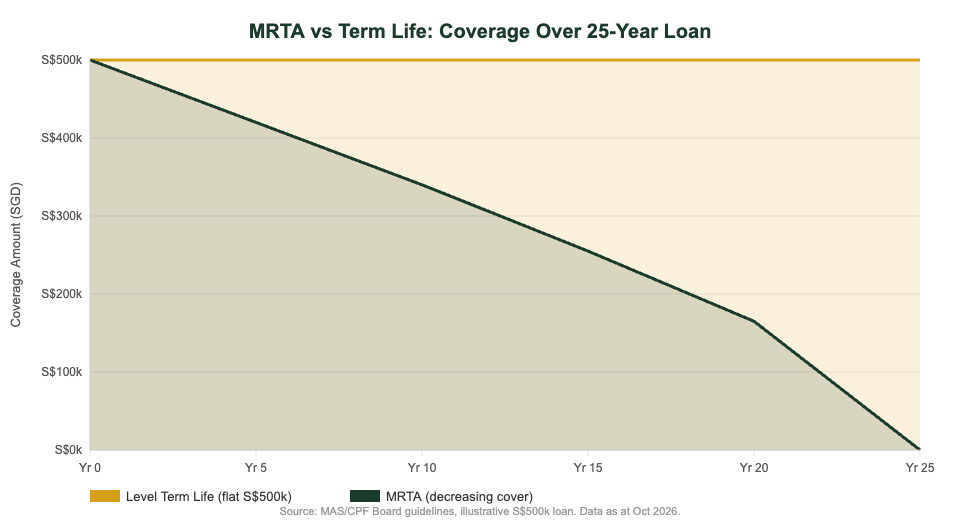
Coverage Comparison: Who Gets Paid Out — and How Much?
The chart above illustrates why the “coverage type” matters as much as the price. Both HPS and MRTA provide decreasing coverage — the payout amount falls each year to match your reducing loan balance. By year 25, your outstanding balance (and hence the payout) approaches zero.
A level term life policy, on the other hand, pays the full S$500,000 regardless of when the claim is made — whether in year 1 or year 24. That excess above the outstanding loan gives your family a financial cushion beyond just settling the mortgage.
Worked example: S$500,000 HDB loan, 35-year-old policyholder
| Scenario | Year of Claim | Outstanding Loan | HPS/MRTA Payout | Level Term Payout |
|---|---|---|---|---|
| Early death | Year 5 | ~S$420k | ~S$420k | S$500k |
| Mid-loan death | Year 15 | ~S$260k | ~S$260k | S$500k |
| Late-stage death | Year 22 | ~S$80k | ~S$80k | S$500k |
Illustrative only. Actual loan balance depends on interest rate and repayment history. Data as at October 2026.
The S$240k difference in year 15 is not trivial — it could fully fund a child’s university education overseas, or provide years of living expenses while a surviving spouse restructures finances. This is why financial advisers often recommend holding a standalone term life policy in addition to HPS (not instead of it) if you can afford both.
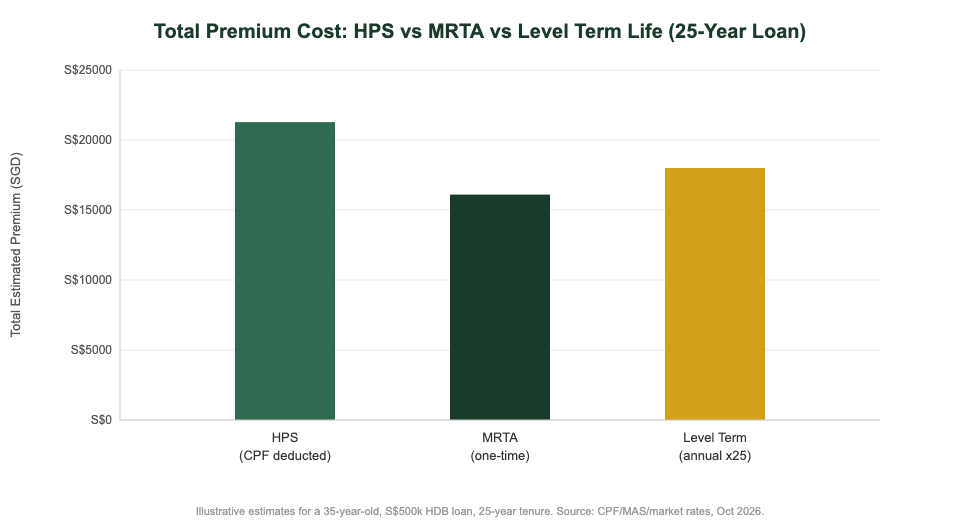
Cost Comparison: What Do You Actually Pay?
Cost is often the deciding factor — and the chart above shows total estimated premium outlay across the three options for a 35-year-old male on a S$500,000 HDB loan over 25 years (illustrative figures from CPF Board, MAS, and insurer data as at October 2026):
- HPS: ~S$21,275 total — paid from CPF OA over 25 years. Highest nominal total, but zero cash outlay. CPF OA otherwise earns 2.5% p.a., so opportunity cost is real but modest.
- MRTA: ~S$16,100 lump sum — lowest headline cost, but paid upfront in cash (or bundled into loan and subject to interest). A S$16k lump sum at year 0 is more expensive in present-value terms than it looks.
- Level Term Life: ~S$18,000 total — paid over 25 years at roughly S$60/month. Provides greater coverage than MRTA but at comparable or lower cost, especially for non-smokers in good health.
Note: Premium costs vary significantly by age, health, gender, loan amount, and insurer. Always get quotes from multiple providers. The figures above are illustrative for comparison purposes only.
You can use our Singapore retirement planning calculator to model how your insurance premiums fit into your overall financial plan — especially as you approach CPF withdrawal age and retirement.
For those using CPF for mortgage payments, it’s also worth reviewing your CPF investment strategy to ensure your OA savings are working hard between mortgage payments.
Which One Should You Choose?
There’s no single right answer — it depends on your property type, loan structure, health, and financial goals. Here’s a practical framework:
Choose HPS if:
- You have an HDB flat financed with CPF — it’s mandatory (unless you opt out with a qualifying policy)
- You want the lowest-effort, lowest-cash-outlay option
- You’re on a tight monthly budget and prefer CPF deductions over cash premiums
Choose MRTA if:
- You have a private property or bank loan (not CPF-financed)
- You prefer a lump-sum premium and want no ongoing premium obligation
- You plan to sell or upgrade within 10–15 years and want portability
- Cost minimisation is the priority and you have limited need for life insurance beyond the loan
Choose Level Term Life if:
- You have dependants who need financial support beyond just the mortgage
- You want flexibility — your family can use the payout however they choose
- You’re young and healthy and can lock in low premiums for 25–30 years
- You’re a private property owner who wants maximum flexibility
The optimal strategy for most Singaporean HDB owners:
Keep HPS + add a standalone term life policy on top. HPS handles the mandatory HDB mortgage protection cheaply from your CPF OA. A separate term life policy (sum assured equal to 5–10x your annual income) gives your family far broader financial protection. The two are complementary, not mutually exclusive.
You can compare term life policy quotes directly through MAS-licensed Syfe (code SRPRFFFCD for bonus credits) or robo-advisers that also offer insurance referrals. For a comprehensive wealth management approach that integrates insurance, CPF, and investments, Endowus (code 2V343) is worth exploring.
Frequently Asked Questions
Is HPS mandatory for all HDB flat buyers?
Can I use MediSave to pay for MRTA premiums?
What happens to my HPS if I sell my HDB flat?
Is term life insurance cheaper than MRTA for mortgage protection?
Can I have both HPS and a separate term life policy?
What if I have a private property — do I need MRTA?
Related Guides
• CPF investment strategy for Singapore residents
• Singapore retirement planning calculator
• Building passive income in Singapore 2026
Disclosure: Some links on this page may be referral links. The Kopi Notes may earn a referral fee at no extra cost to you. We only recommend products and services we believe are genuinely useful. This article is for educational purposes only and does not constitute financial advice. Please consult a licensed financial adviser before making insurance decisions.
Get Free Insurance Advice
Speak with a licensed insurance advisor. No obligation, no cost.
By submitting this form, you agree to our Privacy Policy.
This article was researched with the help of AI. While we strive to keep all information accurate and up to date, there may be errors. If you notice any discrepancies, please contact us.