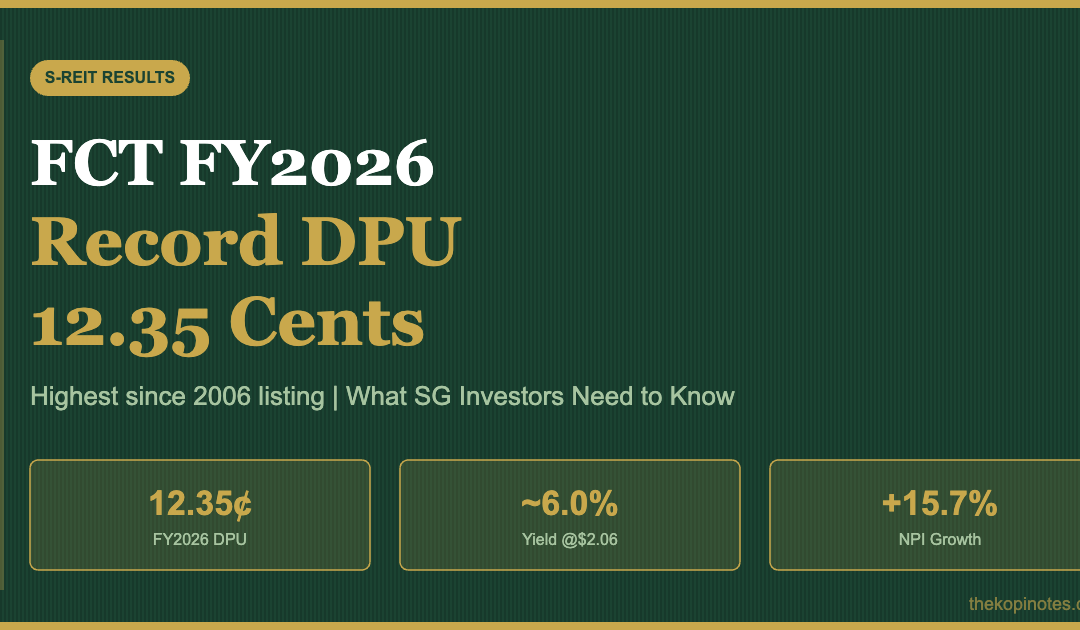
Frasers Centrepoint Trust (SGX: J69U) just posted its highest Distribution Per Unit since its 2006 listing — a full-year FY2026 DPU of 12.35 Singapore cents, up 2.0% year-on-year. With suburban malls hitting 99.7% occupancy, falling borrowing costs, and a S$467 million divestment strengthening the balance sheet, here’s everything Singapore retail investors need to know right now.
This is an editorial analysis. Not financial advice. Data verified as at 25 October 2026.
What Just Happened: FCT Breaks Its Own DPU Record
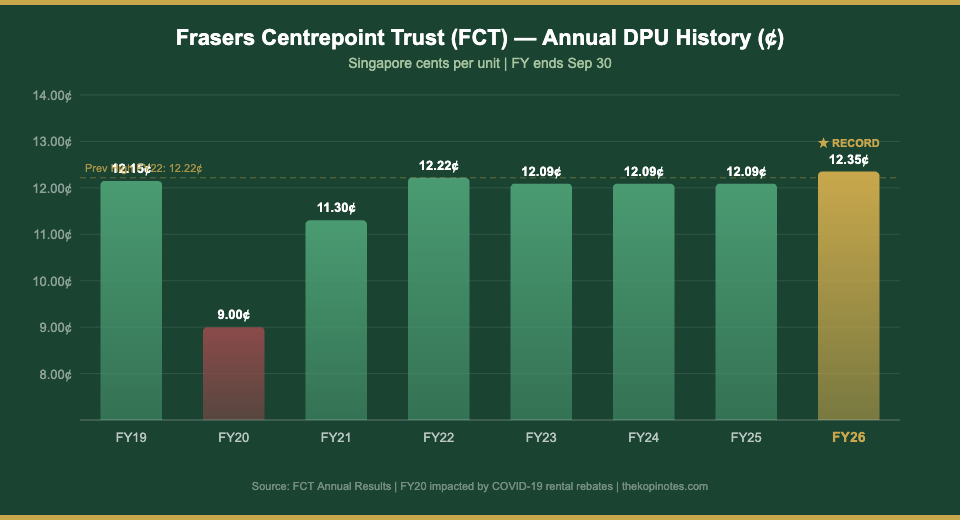
On 22 October 2026, Frasers Centrepoint Trust announced its full-year results for the fiscal year ended 30 September 2026. The headline number: a DPU of 12.35 cents per unit — surpassing the previous all-time high of 12.22 cents set in FY2022.
For context, FCT is Singapore’s largest suburban-focused retail REIT, with a portfolio anchored by malls like Causeway Point, Northpoint City, NEX, Waterway Point, Hougang Mall, and White Sands (since divested). Unlike Orchard Road-focused REITs, FCT’s suburban malls serve everyday consumer spending — a resilient segment that has continued to outperform.
The record DPU reflects three converging tailwinds: strong retail operations, a completed major acquisition (Northpoint City South Wing, acquired May 2025), and lower financing costs as Singapore interest rates eased through 2026.
Breaking Down the FY2026 Numbers
Here’s a full breakdown of FCT’s FY2026 financial performance, verified against the official SGX announcement:
| Metric | FY2026 | FY2025 | Change |
|---|---|---|---|
| Gross Revenue | S$444.9 million | S$389.6 million | +14.2% |
| Net Property Income (NPI) | S$321.7 million | S$277.9 million | +15.7% |
| Distributable Income | S$252.2 million | S$233.1 million | +8.2% |
| Full-Year DPU | 12.35 cents | 12.09 cents | +2.0% |
| H2 2026 DPU | 6.214 cents | 6.059 cents | +2.6% |
| Retail Occupancy | 99.7% | 99.5% | +0.2 ppt |
| Rental Reversion | +6.6% | +5.8% | Improved |
| Aggregate Leverage | 36.8%* | 40.4% | ▼ Improved |
| Avg. Cost of Debt | 3.2% | 3.8% | ▼ -60 bps |
| NAV Per Unit | S$2.32 | S$2.21 | +5.0% |
*Post White Sands divestment debt repayment. As at 30 September 2026: 38.7%. Source: FCT FY2026 Annual Results, SGX Announcement, October 2026.
Portfolio Strength: Why Suburban Malls Are Winning
FCT’s malls don’t sell luxury goods — they sell groceries, haircuts, childcare, and daily essentials. That’s precisely why they’ve been so resilient. When office workers eat out less, when tourism slumps, suburban malls barely flinch because their tenants serve residents, not tourists.
The FY2026 results reinforce this thesis:
- Committed occupancy: 99.7% — effectively full. This has been above 99% for four consecutive years, showing how entrenched FCT’s tenant mix has become.
- Rental reversion: +6.6% — this means that when a lease expires and is renewed, tenants are paying 6.6% more rent than before. At mid-single-digit inflation, this is real organic income growth.
- Shopper footfall: +1.8% and tenant sales: +1.3% — modest but consistent. FCT’s malls are not growing explosively, but they are growing steadily.
- Occupancy cost ratio: 16.3% — this measures rent as a percentage of tenant sales. A healthy ratio below 20% means tenants can afford their rent, making renewals more likely.
The first full year of Northpoint City South Wing’s contribution (acquired May 2025) boosted revenue significantly, adding S$55.3 million in gross revenue versus the prior year when the asset was only partially owned.
Separately, FCT divested White Sands — a mature, lower-yield suburban mall — for S$467 million, representing an 8.4% premium to its last independent valuation. The timing was savvy: it crystallised value at a premium while freeing up gearing headroom for future growth. If you want to understand how FCT compares to other high-yield Singapore REITs, the divestment-adjusted balance sheet makes FCT look increasingly compelling.
Capital Management: Lower Gearing, Falling Debt Costs
This is where the FY2026 story becomes particularly interesting for income investors. FCT has quietly engineered a significant improvement in its financial position:
Gearing fell sharply. Before the White Sands divestment proceeds were applied, gearing was 38.7% at 30 September 2026. After applying the S$467 million in divestment proceeds to debt repayment, gearing drops to 36.8% — well within MAS’s 50% regulatory limit and comfortably in the mid-30s range preferred by conservative REIT managers.
Cost of debt dropped 60 basis points. FCT’s average borrowing cost fell from 3.8% in FY2025 to 3.2% in FY2026, with Q4 2026 cost falling to just 3.1%. This matters enormously: for a REIT with S$1.5+ billion in debt, a 60-basis-point reduction in financing costs translates directly to millions more in distributable income per year.
No refinancing walls in FY2027. FCT does not face any major debt maturing in FY2027, removing a key risk that plagues some other S-REITs. This gives FCT’s management flexibility to focus on AEI execution rather than scrambling for refinancing.
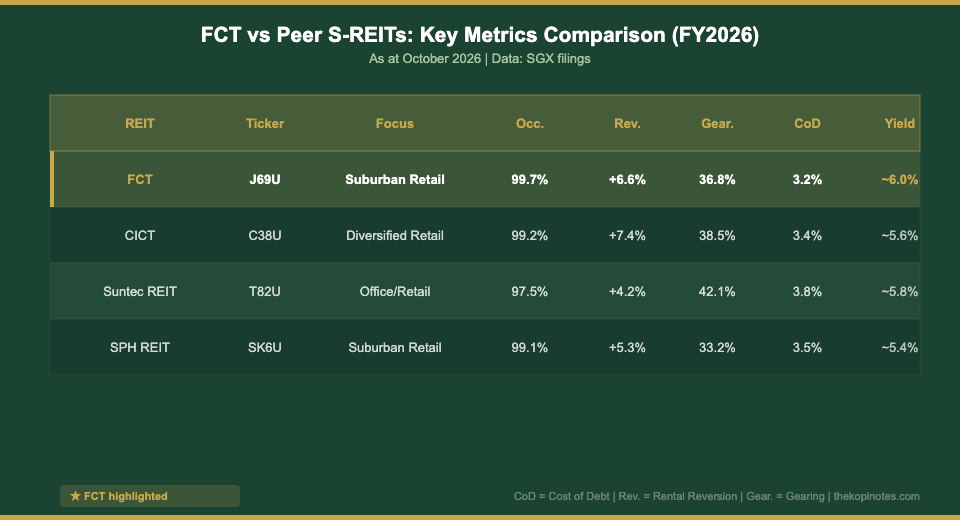
At the current unit price of S$2.06 to S$2.11, FCT trades at a significant discount to its NAV of S$2.32 — a P/NAV of approximately 0.89x. For context, see our overview of the 2026 S-REIT DPU recovery landscape and how gearing levels compare across the sector.
The AEI Pipeline: Where Future Growth Comes From
Asset Enhancement Initiatives (AEIs) are FCT’s primary organic growth lever. Unlike acquisitions — which require capital raising and create DPU dilution risk — AEIs improve existing assets with targeted spend, typically at higher returns on investment.
Here’s the current AEI pipeline:
- NEX (Serangoon Central) — Phase 1 complete, Phase 2 ongoing: Phase 1 refreshed anchor tenant mix and repositioned the food & beverage offering. Phase 2 is expected to complete by end-2026, adding fresh retail concepts. NEX is one of the highest-traffic malls in the Northeast of Singapore.
- Hougang Mall AEI — Completed September 2026: Delivered approximately 8% ROI against a 7% target. Management calls this a proof-of-concept for the AEI playbook — invest, refresh, revert at higher rents.
- Causeway Point AEI — Q2 2027 onwards: The centrepiece of FCT’s next growth phase. Causeway Point is FCT’s largest and most established asset, anchoring the Woodlands new town. The AEI coincides with the opening of the Johor Bahru–Singapore Rapid Transit System (RTS) Link, which is expected to drive significant cross-border traffic to the Woodlands area. The National Library Board’s *The HomePage @ Causeway Point* will be part of this revamp, adding a public-sector anchor tenant.
- Bayshore Drive development: FCT has a joint development opportunity at Bayshore Drive, funded in part by the White Sands divestment. This is a long-term growth option, with the development expected to complete around 2030.
The timing of the Causeway Point AEI means FY2027 will see some temporary void space from works, which management has flagged will weigh slightly on near-term DPU. A S$7.6 million retained distribution buffer has been set aside specifically to cushion this.
What the Record DPU Means for FCT Investors
If you already hold FCT units, the record DPU of 12.35 cents is a validation of the long-term income thesis. At a cost price of S$2.06 (as at 22 October 2026), the trailing yield is approximately 6.0% — one of the more attractive yields among blue-chip Singapore retail REITs.
The upcoming ex-distribution date of 30 October 2026 (books close) and distribution payment on 27 November 2026 are immediately relevant. Investors who wish to receive the H2 DPU of 6.214 cents must hold units before books close on 30 October 2026.
For prospective investors, the P/NAV discount of 0.89x suggests the market has already priced in some of the FY2027 AEI disruption risk. Management has guided for muted growth in FY2027, followed by more substantial increases in FY2028 as the Causeway Point AEI completes and new RTS-driven footfall materialises.
FCT’s long-term track record — a DPU CAGR of approximately 4% over 15 years, including the COVID-19 disruption year — speaks to the resilience of suburban retail as an asset class. For Singapore income investors building a dividend portfolio, FCT’s suburban mall moat is hard to replicate.
That said, investors should weigh:
- FY2027 near-term DPU headwinds from AEI void space
- Potential for gearing to tick up if FCT makes new acquisitions
- Competition from online retail, though FCT’s necessity-driven tenants are largely insulated
- The unit price, which at S$2.06 is near the bottom of its 52-week range of S$2.03–S$2.47
See our complete FCT 2027 investment guide for a full buy/hold/sell analysis.
Bottom Line for SG Investors
FCT’s FY2026 record DPU of 12.35 cents is a landmark result that validates the suburban retail S-REIT model. The combination of near-full occupancy, 6.6% rental reversions, falling debt costs, and a freshened AEI pipeline gives long-term income investors a lot to like.
The near-term FY2027 outlook is intentionally muted — management has been transparent about the temporary drag from AEI works. But the Causeway Point AEI, set against the backdrop of the RTS Link opening, positions FCT for a meaningful DPU uplift from FY2028 onwards.
At S$2.06, with a ~6.0% trailing yield and a P/NAV discount of 0.89x, FCT offers a combination of income and value that stands out in the current S-REIT landscape. The October 30 ex-dividend date creates immediate urgency for income-focused investors.
For Singapore retail investors who want steady, suburban-backed dividend income, FCT remains one of the most compelling names on SGX. As always, ensure it fits within a diversified S-REIT portfolio and aligns with your risk tolerance and income goals.
Frequently Asked Questions: FCT FY2026 DPU
Q1: What is FCT’s FY2026 DPU and why is it a record?
Frasers Centrepoint Trust (SGX: J69U) announced a full-year FY2026 DPU of 12.35 Singapore cents per unit — the highest distribution since its listing in 2006. It surpassed the previous record of 12.22 cents set in FY2022. The increase reflects higher NPI from a full year of Northpoint City South Wing, lower borrowing costs, and strong suburban retail performance.
Q2: When is the FCT H2 2026 ex-dividend date and payment date?
The books close date (ex-distribution date) for FCT’s H2 FY2026 DPU of 6.214 cents is 30 October 2026. Unitholders on record as of that date will receive the distribution, which will be paid on 27 November 2026.
Q3: What is FCT’s current yield at S$2.06?
At a unit price of S$2.06, FCT’s trailing yield based on the FY2026 DPU of 12.35 cents is approximately 6.0%. This is near the upper end of FCT’s historical yield range and reflects the unit price trading close to its 52-week low of S$2.03.
Q4: What is FCT’s gearing after the White Sands divestment?
FCT’s aggregate leverage was 38.7% as at 30 September 2026. After using the S$467 million White Sands divestment proceeds (received at an 8.4% premium to valuation) to repay debt, the pro-forma gearing drops to 36.8% — a comfortable level that gives FCT headroom for future acquisitions.
Q5: What is FCT’s AEI pipeline and when will it impact DPU?
FCT’s key AEI projects are: (1) NEX Phase 2, completing end-2026; (2) Causeway Point AEI, starting Q2 2027 (linked to the RTS Link opening); and (3) Bayshore Drive joint development, completing ~2030. FY2027 DPU may be slightly muted due to AEI void space, but management expects a more material uplift from FY2028 onwards.
Q6: How does FCT compare to other Singapore suburban retail REITs?
FCT leads peers on key metrics: 99.7% occupancy (vs sector average ~98%), 6.6% rental reversion (above peer average ~5%), and a 36.8% post-divestment gearing (among the lowest in the sector). Its 6.0% yield at current price also compares favourably to other high-yield S-REITs.
This article was researched with the help of AI. While we strive to keep all information accurate and up to date, there may be errors. If you notice any discrepancies, please contact us.