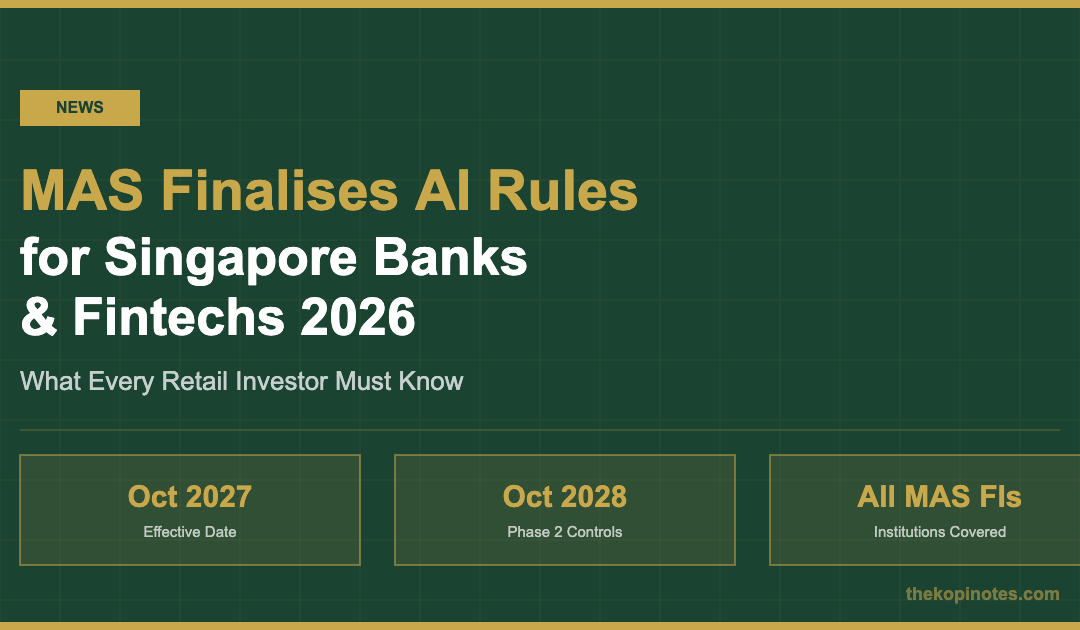
The Monetary Authority of Singapore (MAS) published binding AI governance guidelines on 7 October 2026, making Singapore one of the first financial regulators in Asia to impose structured AI accountability requirements across banks, insurers, and fintech platforms. For retail investors in Singapore, this means the digital tools managing your money — from robo-advisors to insurance chatbots — will face mandatory oversight rules starting from 2027.
This is an editorial analysis. Not financial advice. Data verified as at 11 October 2026.
What Are the MAS AI Risk Management Guidelines?
After a two-month public consultation that ran from November 2025 to January 2026, MAS finalised its Guidelines on Artificial Intelligence Risk Management (AIRG) on 7 October 2026. These are the first binding supervisory expectations for how financial institutions (FIs) must govern, monitor, and manage AI systems across their operations.
The guidelines cover all forms of AI — from simple rule-based systems to complex generative AI and autonomous agents — and apply to every entity regulated by MAS. This includes commercial banks like DBS, OCBC, and UOB; digital banks like Trust Bank, GXS, and MariBank; robo-advisors like Endowus, Syfe, and StashAway; and insurance companies running AI underwriting or chatbot tools.
The AIRG is principles-based and risk-proportionate, meaning smaller fintech firms running low-risk AI applications face lighter requirements than large banks deploying high-impact AI systems. However, the accountability framework is universal — every regulated entity must comply.
Key Requirements: What Banks and Fintechs Must Now Do
The guidelines impose requirements across five core areas that every Singapore retail investor should understand:
1. Board and Senior Management Accountability
Every regulated institution must designate a senior manager responsible for AI oversight. Boards must define risk appetite for AI — including quantitative measures such as the maximum number of material AI use cases dependent on a single third-party vendor. No dedicated AI committee is required, but the accountability must sit at the most senior level.
2. AI Inventory and Materiality Assessment
Institutions must maintain a comprehensive inventory of all AI systems — including AI embedded inside vendor products and unsanctioned “shadow AI” that employees may be using without formal approval. Each use case is assessed on three dimensions: Impact, Complexity, and Reliance. Only AI where residual risk falls within the institution’s risk appetite may be deployed with customers.
3. AI Lifecycle Controls
Controls must apply across the full AI lifecycle: data governance, model selection, testing, cybersecurity safeguards, human oversight mechanisms, and change management. Institutions must also build internal capability and capacity to manage AI responsibly, which has headcount and skills implications.
4. Third-Party AI Accountability
This is the most significant change from the consultation draft. Even when a financial institution uses AI built and run by an external vendor, the FI remains primarily accountable for all outcomes. Institutions must obtain independent assessments of vendor AI (not just vendor self-attestations) and must maintain the ability to limit, suspend, or replace a vendor whose residual risk exceeds their risk appetite.
5. Agentic AI Safeguards
Autonomous AI agents — systems that can take sequences of actions without continuous human approval — must have their tool access, guardrails, and kill switches documented and tested (including red teaming before deployment). High-materiality agentic AI systems must have verified, regularly tested kill switches. MAS has also signalled a separate 2027 consultation specifically on agentic AI governance.
MAS AI Guidelines: Implementation Timeline
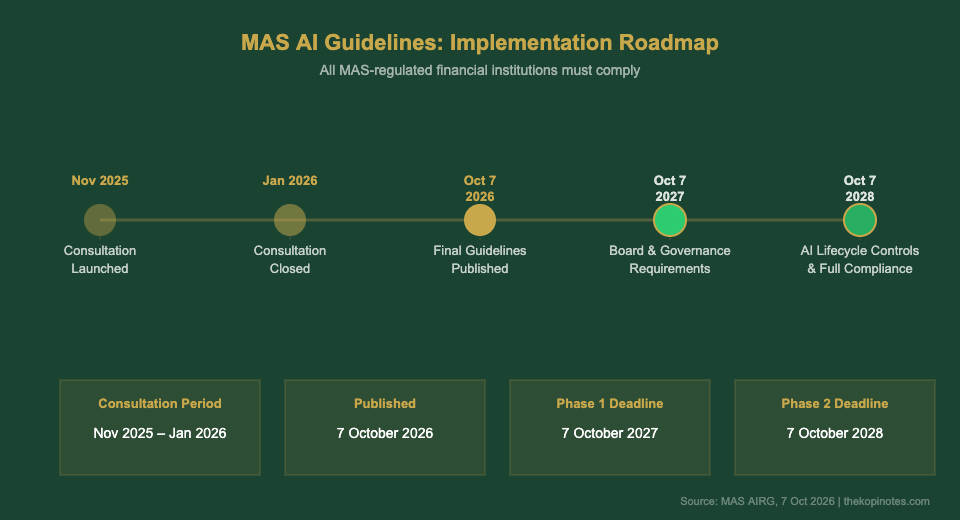
| Milestone | Date | What It Means |
|---|---|---|
| Consultation Paper (P017-2025) Launched | November 2025 | MAS invited public feedback on proposed AI governance rules |
| Consultation Closed | January 2026 | Industry and public responses submitted to MAS |
| Final AIRG Guidelines Published | 7 October 2026 | Binding supervisory expectations now in force |
| Phase 1: Board & Governance Requirements | 7 October 2027 | FIs must have named AI governance, board oversight, and AI inventories in place |
| Phase 2: AI Lifecycle Controls & Full Compliance | 7 October 2028 | Full lifecycle controls, third-party oversight, and organisational capabilities required |
Who Is Affected? The Financial Services You Use Every Day
If you are a Singapore retail investor, here are the specific AI applications now subject to mandatory MAS oversight — and why they matter to you:
Digital Banks (Trust Bank, GXS, MariBank)
These banks use AI for credit decisioning, fraud detection, transaction monitoring, and customer service chatbots. Under the new guidelines, their AI must be inventoried and risk-assessed. If a digital bank relies on a third-party AI provider for any customer-facing service, the bank — not the vendor — is responsible for outcomes. For more on Singapore’s digital banking landscape, see our guide to digital bank accounts and zero-fee cash buffers.
Robo-Advisors (Endowus, Syfe, StashAway, FSMOne)
Robo-advisory platforms use AI to construct, rebalance, and optimise investment portfolios — including those holding your CPF and SRS money. Under AIRG, these platforms must inventory and risk-assess their AI models and have a designated senior manager accountable for all AI decisions. For a detailed comparison of Singapore’s top robo-advisors, see our Best Robo Advisor Singapore 2026 guide.
Singapore Banks’ Investment Tools (DBS digiPortfolio, OCBC RoboInvest)
DBS, OCBC, and UOB all offer AI-powered portfolio and wealth management tools. These are now subject to board-level accountability, AI inventory requirements, and lifecycle controls. Given the recent bank stock volatility, understanding how AI governance affects these platforms is increasingly relevant — see our analysis of the October 2026 Singapore bank selloff.
Insurance Companies (Great Eastern, Prudential, AIA, Income)
Insurers use AI for underwriting decisions, claims processing, and premium pricing — including for integrated shield plans and life insurance policies. The AIRG requires insurers to document AI use in these customer-facing processes. For context on rising ISP costs, see our ISP base premium increases 2026 analysis.
Singapore Financial AI Under New Oversight — By Risk Level
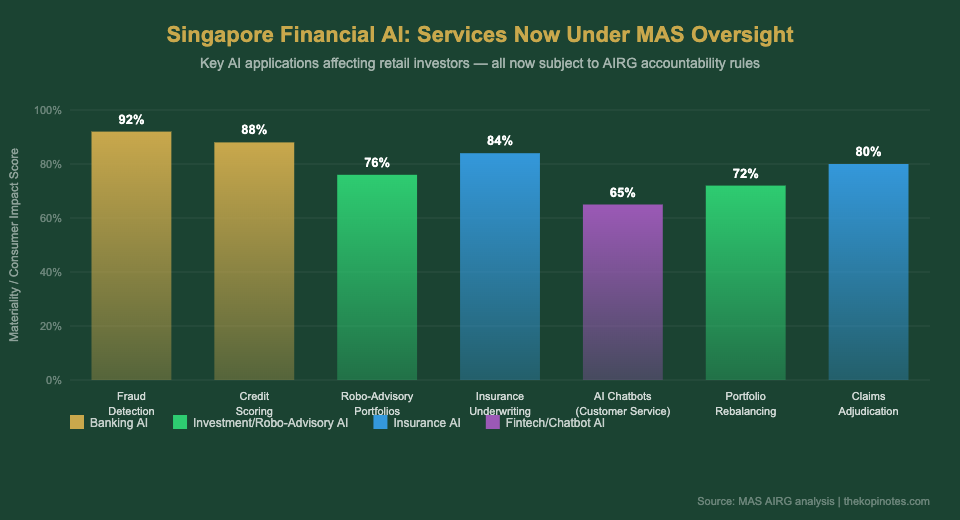
Third-Party AI: Why This Changes Everything for Fintech Users
Before the AIRG, a common industry practice was for financial firms to manage third-party AI risk through vendor self-attestations — essentially taking the vendor’s word for it that their AI was safe and fair. MAS has explicitly closed this loophole. The key changes:
- FIs must obtain independent assessments of third-party AI — not just vendor self-declarations
- Where vendor disclosure is limited, FIs must run compensatory testing on their own customer data
- FIs must maintain the ability to limit, suspend, or replace any AI vendor whose risk profile exceeds their risk appetite before deployment
- Even AI embedded inside material providers’ platforms — such as AI features inside core banking systems or payment infrastructure — must be identified, inventoried, and governed
- Shadow AI — AI tools employees use without formal company approval — must also be identified
The practical implication for Singapore retail investors: if your robo-advisor, digital bank, or insurer is running third-party AI models that make decisions about your money, the FI now has explicit legal accountability for those decisions under MAS supervision. The “the vendor did it” defence is no longer available.
What This Means for Your Shield Plan and Life Insurance AI
Singapore’s integrated shield plan (ISP) market and life insurance sector have rapidly expanded their use of AI in recent years — for AI-driven premium calculations, automated claims adjudication, and AI chatbots handling policy servicing. With ISP base premiums rising across all plans in 2026, the governance of AI pricing models is more material than ever.
Under the new guidelines, insurers must:
- Document every AI use case that affects premium pricing, claims, or underwriting
- Ensure AI outcomes align with the FEAT principles (Fairness, Ethics, Accountability, Transparency) established by MAS in 2018
- Disclose when customer service is handled by AI (under the IMDA Transparency Guidelines for Generative AI Chatbots)
- Have board-level sign-off on the acceptable risk appetite for AI-driven underwriting decisions
For retail investors and policyholders, this means AI-powered premium decisions and claims outcomes must now be traceable through a documented, board-approved governance framework. If you ever need to escalate a claim or dispute a premium increase, there will be an AI audit trail your insurer must be able to produce.
Consumer Protections Under the New Framework
While the AIRG is addressed to financial institutions rather than directly creating new consumer rights, the practical impact for retail customers is material:
Accountability trails: Every AI decision affecting a customer — a loan rejection, an investment recommendation, a claims decision — must now be traceable through a documented governance process. This means greater auditability for any decision you want to challenge.
No more “vendor did it” defence: If your digital bank’s AI makes a decision you believe is wrong, the bank cannot deflect responsibility to its technology vendor. They own the outcome under MAS supervision.
Kill switch protections: For high-materiality AI systems (those influencing large numbers of customers’ financial outcomes), FIs must maintain tested kill switches — meaning an AI causing widespread harm can be shut down immediately without waiting for a vendor response.
FEAT principles remain the ethical baseline: The underlying ethical framework (Fairness, Ethics, Accountability, Transparency) established by MAS in 2018 continues to underpin all AI governance requirements. AI systems must not produce unfair customer outcomes, and there must be transparency about when AI is making decisions that affect you.
Bottom Line for SG Investors
The MAS AI Risk Management Guidelines represent a watershed moment for Singapore’s financial sector — and for every retail investor who relies on digital financial tools to manage their savings, investments, and insurance.
What this means right now (2026): Nothing changes immediately for consumers. Banks and fintechs have until October 2027 to have governance frameworks in place, and until October 2028 for full lifecycle controls. But the accountability regime starts now — MAS will begin supervisory assessments against these expectations from the publication date.
What to watch for in 2027: MAS has signalled a separate consultation on agentic AI governance — rules specific to fully autonomous AI systems that can take financial actions on your behalf. If you use any AI-powered portfolio management or automated investing tools, this will be the next major regulatory development to watch.
Your action steps as a Singapore retail investor:
- Check whether your robo-advisor, digital bank, or insurer has published an AI governance framework or transparency disclosures
- For any claim rejection, loan decline, or premium increase you suspect involved AI, ask your FI whether AI was used and request disclosure of the decision process
- When comparing investment platforms and digital banks, AI accountability will increasingly be a differentiating factor — see our StashAway 2026 review and T-Bill and fixed income guide for platforms doing this well
- Follow MAS’s 2027 agentic AI consultation — this will determine the rules for AI that can autonomously buy, sell, and manage your investments
Frequently Asked Questions
What is the MAS AIRG and why does it matter?
The MAS Guidelines on Artificial Intelligence Risk Management (AIRG) are supervisory expectations published on 7 October 2026 requiring all MAS-regulated financial institutions to govern, inventory, and control every AI system they use — including third-party vendor AI. They are binding supervisory expectations (not legislation), but non-compliance can trigger MAS supervisory action including formal investigations and public reprimands.
When do the MAS AI guidelines take effect?
In two stages: board and governance requirements (Sections 3 and 4 of the AIRG) take effect on 7 October 2027, while AI lifecycle controls and organisational capability requirements (Sections 5 and 6) must be met by 7 October 2028. However, MAS has begun supervisory engagement with the industry from the publication date of 7 October 2026.
Does this affect my DBS, OCBC, or UOB savings account and banking?
Yes, indirectly. All three banks use AI extensively for fraud detection, credit scoring, customer service chatbots, and wealth management tools like DBS digiPortfolio and OCBC RoboInvest. Under the new guidelines, these banks must have board-level accountability for all AI systems affecting customers — including third-party AI embedded in their platforms. This does not change your day-to-day banking experience, but it means stronger governance behind the decisions that affect your accounts.
Will my robo-advisor have to change how it manages my portfolio?
Robo-advisors like Endowus, Syfe, and StashAway must now inventory and risk-assess their AI models, maintain lifecycle controls on how those models evolve, and have a designated senior manager responsible for AI governance. The practical investment strategy may not change immediately, but the governance and documentation requirements will be significant — and MAS will hold them accountable for outcomes even when AI is provided by a third-party model provider.
What about AI-powered insurance chatbots and underwriting decisions?
Under the guidelines, insurers must document all AI used in underwriting, claims adjudication, and premium pricing. They must ensure outcomes align with FEAT principles (Fairness, Ethics, Accountability, Transparency), and under IMDA Transparency Guidelines, AI chatbots must disclose that they are AI — not human agents — when interacting with customers.
Can I complain to MAS if an AI made a wrong financial decision about me?
The AIRG does not create a new direct consumer redress mechanism. If you believe an AI decision caused you financial harm, the standard process is to first raise a formal complaint with your financial institution, then escalate to the Financial Industry Disputes Resolution Centre (FIDReC) if unresolved. However, the AIRG strengthens FIs’ obligation to have documented and justifiable AI governance processes — giving you a stronger basis for escalating disputes involving AI decisions.
What is “agentic AI” and why should Singapore investors care?
Agentic AI refers to autonomous AI systems that can take sequences of actions without requiring human approval at each step — such as an AI that autonomously rebalances your investment portfolio, submits insurance claims, or makes real-time trading decisions. The AIRG requires FIs to document, test (including red teaming), and maintain kill switches for high-materiality agentic AI. MAS has also signalled a separate 2027 consultation on agentic AI governance — watch this space if you use any automated investing or AI-driven financial planning tools.
This article was researched with the help of AI. While we strive to keep all information accurate and up to date, there may be errors. If you notice any discrepancies, please contact us.