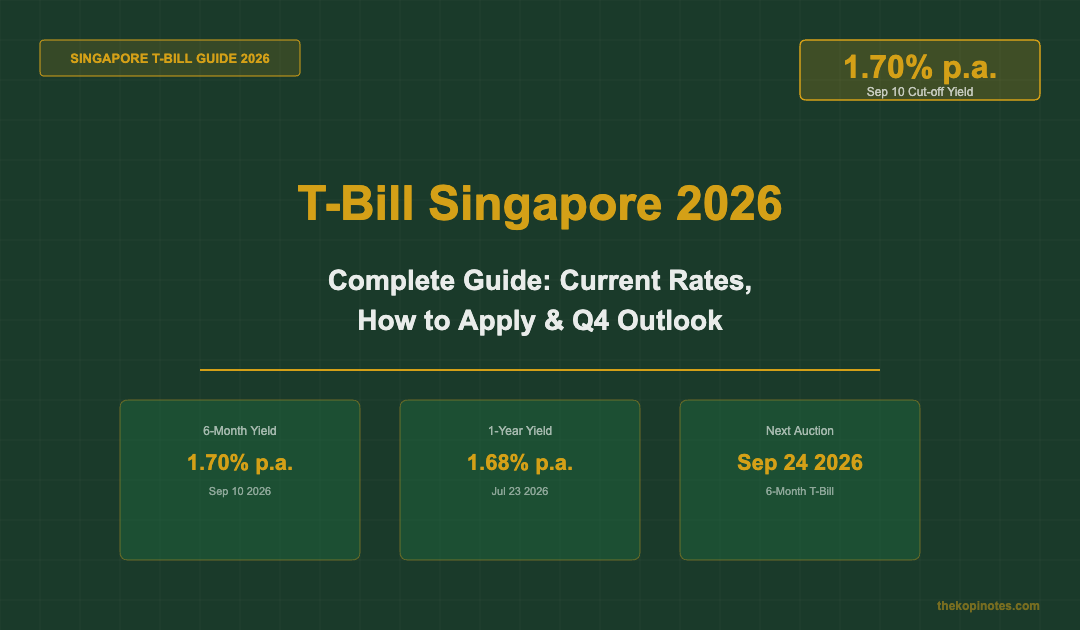
T-Bill Singapore 2026: Complete Guide
Current Rates, How to Apply, and Q4 2026 Outlook
Singapore T-bills (Treasury Bills) are short-term government securities issued by the Monetary Authority of Singapore (MAS). The latest 6-month T-bill (BS26118E) cut off at 1.70% per annum at the September 10, 2026 auction — the highest yield of 2026 so far. Yields have recovered from a 2026 low of 1.46% in early July. This guide covers everything you need: current rates, how to apply via cash, CPF or SRS, and what to expect in Q4 2026.
Not financial advice. All figures are for educational reference only. Data as at September 2026 unless noted.
- Latest 6-month T-bill cut-off yield: 1.70% p.a. (Sep 10, 2026 auction — highest of 2026)
- Apply via DBS/POSB/OCBC/UOB ATM or internet banking; also via CPF-OA or SRS account
- Next auction: September 24, 2026 — apply by September 23 if using a bank account
What Is a T-Bill in Singapore?
A Treasury Bill (T-bill) is a short-term debt instrument issued by the Singapore Government. When you buy one, you are essentially lending money to the government. In return, the government pays you back the full face value at maturity — plus the yield earned.
Singapore T-bills are available in two tenors:
| Feature | 6-Month T-Bill | 1-Year T-Bill |
|---|---|---|
| Tenor | 6 months | 1 year |
| Auction frequency | Every 2 weeks | Monthly |
| Minimum investment | S$1,000 | S$1,000 |
| Funded by | Cash, CPF-OA, SRS | Cash, CPF-OA, SRS |
| Tax on returns | Exempt (Singapore residents) | Exempt (Singapore residents) |
Source: MAS Singapore Government Securities | Data as at September 2026
T-bills are issued at a discount to face value. If the cut-off yield is 1.70% and you invest S$10,000 in a 6-month T-bill, you receive approximately S$10,085 at maturity (S$85 in interest). The returns are fully exempt from income tax for Singapore residents.
T-bills are considered one of the safest investments available in Singapore. They are backed by the full faith of the Singapore Government and carry essentially zero credit risk. You can check out our Singapore T-bills 2026 guide for a deeper look at the mechanics.
Singapore T-Bill Rates 2026: The Full Year Story
This year has been a dramatic one for T-bill yields. Singapore T-bills started 2026 above 3%, riding the high interest rate environment that persisted from 2024 and 2025. But as the US Federal Reserve cut rates through H1 2026, MAS monetary policy eased alongside it — and T-bill yields fell sharply.
The low point came at the July 10, 2026 auction, where the 6-month cut-off yield hit just 1.46%. Since then, yields have been recovering. The September 10 auction printed 1.70% — the highest of 2026 — as inflation ticked up slightly and bond markets repriced rate cut expectations for Q4.
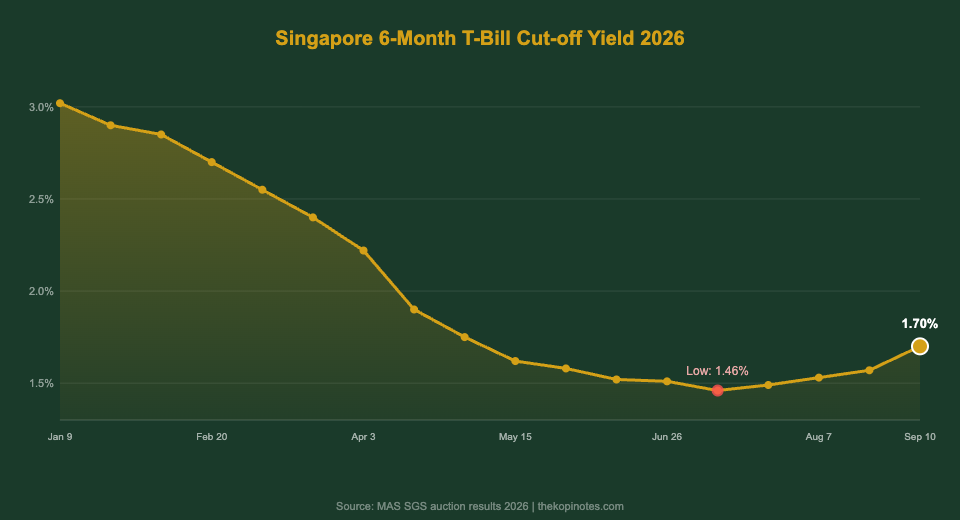
Source: MAS Singapore Government Securities auction results 2026
Here is a summary of recent 6-month T-bill auction results:
| Auction Date | T-Bill Code | Cut-off Yield | Maturity Date |
|---|---|---|---|
| Sep 10, 2026 | BS26118E | 1.70% p.a. | Mar 12, 2027 |
| Aug 27, 2026 | BS26113E | 1.60% p.a. | Feb 27, 2027 |
| Aug 7, 2026 | BS26108E | 1.53% p.a. | Feb 9, 2027 |
| Jul 24, 2026 | BS26104E | 1.49% p.a. | Jan 26, 2027 |
| Jul 10, 2026 | BS26099E | 1.46% p.a. (2026 low) | Jan 12, 2027 |
Source: MAS Singapore Government Securities | Data as at September 2026
How to Apply for a Singapore T-Bill in 2026
There are three ways to apply for a T-bill in Singapore: via cash through your bank, via your CPF Ordinary Account (CPF-OA), or via your Supplementary Retirement Scheme (SRS) account. Here is how each works.
Option 1: Apply via Cash (ATM or Internet Banking)
This is the most straightforward method. You apply through your bank’s ATM or internet banking portal. The following banks support T-bill applications:
- DBS/POSB: ATM (select “More” → “Invest” → “SGS” → “T-Bills”) or digibank online
- OCBC: ATM or OCBC Online Banking → “Invest” → “SGS Bonds & T-Bills”
- UOB: UOB Personal Internet Banking → “Wealth” → “Unit Trusts & Bonds” → “SGS”
Funds are deducted from your linked bank account at the time of auction and returned to your account if your bid is not successful (or partially filled).
Option 2: Apply via CPF Ordinary Account (CPF-OA)
You can use your CPF Ordinary Account funds to buy T-bills. The current CPF-OA interest rate is 2.50% per annum. At a T-bill yield of 1.70%, the T-bill actually earns less than the guaranteed CPF-OA rate right now.
This means using CPF-OA for T-bills in September 2026 is not recommended. You would be giving up 2.50% CPF-OA returns for 1.70% T-bill returns. The math only works in your favour if T-bill yields rise above 2.50%.
If you are still interested, apply through your DBS/POSB ATM (select “CPF Investments”) or OCBC. Your CPF Board account must be linked to a bank account.
Option 3: Apply via SRS Account
Your Supplementary Retirement Scheme (SRS) account can also be used to invest in T-bills. SRS contributions earn just 0.05% in cash by default, so even the current 1.70% T-bill yield is a significant improvement.
SRS T-bill applications are made through your SRS operator bank: DBS, OCBC, or UOB. This is one of the most tax-efficient uses of SRS funds if you prefer capital preservation over growth. For growth-focused SRS investing, you might consider platforms like Endowus (referral code: 2V343), which offers diversified portfolios for SRS money.
Competitive vs Non-Competitive Bids
When applying, you choose between two bid types:
| Bid Type | How It Works | Best For |
|---|---|---|
| Non-competitive | You accept whatever cut-off yield MAS sets. Guaranteed allotment (up to S$1 million per auction). | Most retail investors — simple and reliable |
| Competitive | You name your minimum yield. If cut-off is below your bid, you get nothing. If above, you get the cut-off yield. | Sophisticated investors who monitor the market closely |
Source: MAS Singapore Government Securities guidelines
Recommendation: Use a non-competitive bid if you just want to earn whatever the market rate is. The risk of getting a zero allotment on a competitive bid is not worth it for most investors.
T-Bill vs SSB vs Fixed Deposit 2026: Which Pays More?
With T-bill yields well below their 2024-2025 highs, it is worth comparing your options. Here is how the main risk-free alternatives stack up in September 2026:
| Product | Current Rate | Tenor | Liquidity | Best For |
|---|---|---|---|---|
| 6-Month T-Bill | 1.70% p.a. | 6 months | Locked until maturity | Short fixed horizon |
| 1-Year T-Bill | 1.68% p.a. | 1 year | Locked until maturity | 1-year fixed horizon |
| Singapore Savings Bond (SSB) | Year 1: ~1.65% / 10-yr avg: 2.32% | Up to 10 years | Redeem any month | Flexible 2–10 year saving |
| Fixed Deposit (best rate) | ~1.50–1.80% p.a. | 3–12 months | Locked until maturity | Simplicity, no auction needed |
| CPF Ordinary Account | 2.50% p.a. | Rolling | CPF-restricted | Keep in CPF-OA (beats T-bill) |
| Trust Bank / MariBank Savings | Up to 2.0–2.5% (conditions apply) | Daily liquidity | Withdraw anytime | Liquidity + competitive rate |
Source: MAS, bank product pages | Data as at September 2026. Bank rates subject to conditions. Compare before applying.
Key finding: The 6-month T-bill at 1.70% is competitive with 6-month fixed deposits. However, CPF-OA at 2.50% and some bank savings accounts with bonus rates can outperform T-bills without the auction complexity. The SSB wins for anyone with a 3–10 year horizon, offering 2.32% average over 10 years with full flexibility to redeem.
For passive income ideas beyond T-bills, explore our guide to passive income in Singapore — including S-REITs and dividend stocks that can yield 5–7% annually.
If you want to compare Singapore Savings Bonds in more detail, our 2026 SSB guide covers the current tranche, how to apply, and when SSB beats T-bills.
Should You Apply for a T-Bill in Q4 2026?
Whether to buy a T-bill depends entirely on what you are trying to achieve. Here is a quick decision guide for Q4 2026:
| Your Situation | Recommendation |
|---|---|
| You need the money in exactly 6 months | T-bill is ideal — guaranteed return, exact maturity date |
| You might need the money before 6 months | Use a savings account (Trust Bank, MariBank) for flexibility |
| You want to earn more than 1.70% | Consider SSB (2.32% 10-yr avg) or best S-REITs (5–7% yield) |
| You have idle CPF-OA money | Leave it in CPF-OA at 2.50% — do NOT use for T-bills at 1.70% |
| You have idle SRS money | T-bill at 1.70% beats SRS default 0.05% — a clear upgrade |
| You are risk-averse, nearing retirement | T-bill + SSB ladder is a safe, low-volatility approach. Use our retirement calculator to plan your portfolio. |
Rate outlook: T-bill yields have been rising since the July 2026 low. If the Fed keeps rates steady (or cuts more slowly than expected), Singapore T-bill yields could continue moving upward into Q4. The September 24, 2026 auction — just one day away — will be a key signal to watch.
For long-term wealth building beyond T-bills, our guide to the best S-REITs in Singapore 2026 covers income-generating REITs with yields well above what T-bills currently offer.
Upcoming T-Bill Auction Dates — Q4 2026
Singapore 6-month T-bill auctions take place roughly every two weeks. Here are the confirmed and estimated auction dates for the rest of 2026:
| Auction Date | Application Closes | Issue Date | Maturity Date |
|---|---|---|---|
| Sep 24, 2026 | Sep 23, 2026 (9pm) | Sep 26, 2026 | Mar 26, 2027 |
| Oct 8, 2026 (est.) | Oct 7, 2026 | Oct 10, 2026 | Apr 9, 2027 |
| Oct 22, 2026 (est.) | Oct 21, 2026 | Oct 24, 2026 | Apr 23, 2027 |
| Nov 5, 2026 (est.) | Nov 4, 2026 | Nov 7, 2026 | May 7, 2027 |
| Nov 19, 2026 (est.) | Nov 18, 2026 | Nov 21, 2026 | May 21, 2027 |
| Dec 3, 2026 (est.) | Dec 2, 2026 | Dec 5, 2026 | Jun 5, 2027 |
Source: MAS Singapore Government Securities calendar. Estimated dates based on bi-weekly schedule. Confirm dates at MAS.gov.sg before applying.
You can set up a standing instruction with DBS/POSB to auto-apply for each T-bill auction using your savings account. This is known as T-bill laddering — a strategy where you invest in each auction automatically, so that a portion of your portfolio matures every 6 months.
Frequently Asked Questions
What is the current T-bill interest rate in Singapore 2026?
Is T-bill interest rate better than CPF in 2026?
How do I apply for a T-bill in Singapore?
What is a non-competitive bid for a T-bill?
Is T-bill better than Singapore Savings Bond (SSB)?
Can foreigners buy Singapore T-bills?
What happens if I do not get a full allotment in a T-bill auction?
Explore More Ways to Grow Your Money in Singapore
T-bills are just one piece of the puzzle. Here are more options to consider:
This article was researched with the help of AI. While we strive to keep all information accurate and up to date, there may be errors. If you notice any discrepancies, please contact us.