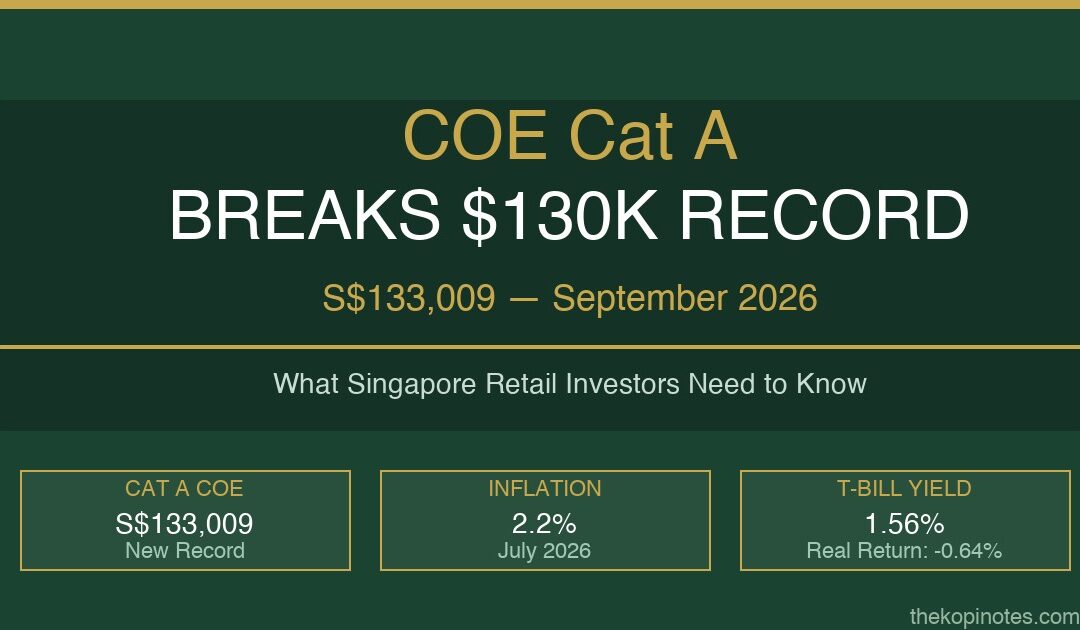
Certificate of Entitlement (COE) Category A premiums closed at a record S$133,009 on 9 September 2026 — crossing the $130,000 barrier for the first time in Singapore’s history. Every category rose in the first bidding exercise of the month. With inflation already running at 2.2% and T-bill yields at just 1.56%, the message is clear: the cost of living in Singapore is squeezing investors on multiple fronts.
This is an editorial analysis. Not financial advice. Data verified as at 10 September 2026.
The COE Results: A Historic Bidding Exercise
The first COE bidding exercise of September 2026 ended on Wednesday 9 September, and the results were nothing short of historic. Category A — covering cars with engines up to 1,600cc or 97kW — rose 3.51% to S$133,009, smashing through the $130,000 ceiling for the first time ever. It was also the second time Category A set a record in 2026 alone.
Every single category rose. Here’s the full breakdown from the LTA’s open bidding results:
| COE Category | Coverage | September 2026 (1st Exercise) | Change |
|---|---|---|---|
| Category A | Cars ≤1,600cc or ≤97kW | S$133,009 | +3.51% 🔺 New Record |
| Category B | Cars >1,600cc or >97kW | S$135,001 | +3.05% 🔺 |
| Category C | Goods vehicles & buses | S$93,101 | 🔺 |
| Category D | Motorcycles | S$12,556 | 🔺 (double-digit %) |
| Category E | Open (any vehicle) | S$137,890 | 🔺 |
Source: LTA COE Open Bidding Results, 9 September 2026. OneMotoring LTA.
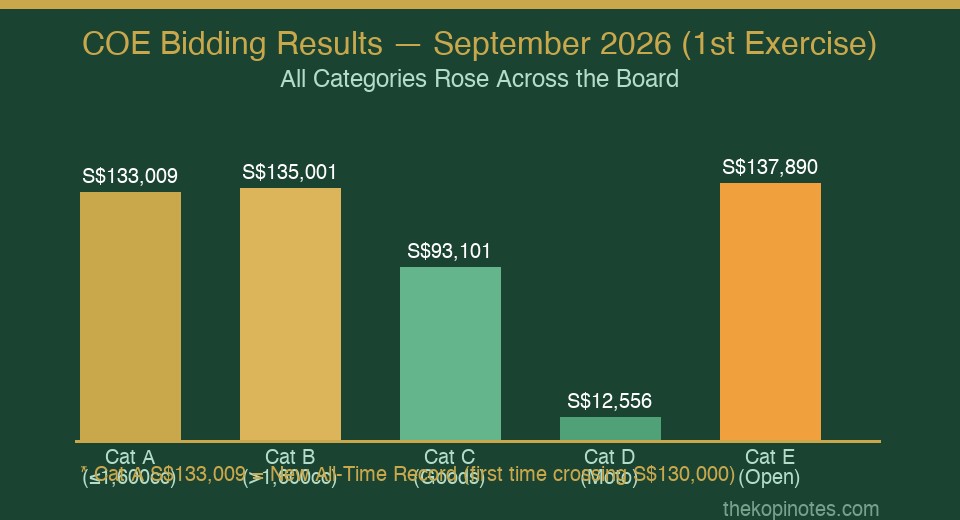
To put Cat A’s $133,009 in perspective: this COE alone — before buying the car itself — costs more than many Singaporeans’ annual household income. The total on-the-road price of a typical 1.6-litre family car now routinely exceeds S$200,000.
What’s Pushing COE Premiums Higher?
Several structural and cyclical factors are converging to drive COE prices to record levels:
Tight COE quota. The Land Transport Authority (LTA) controls how many new vehicles can be registered each year through the Vehicle Growth Rate policy. With the quota remaining constrained, strong demand chases limited supply — classic conditions for price surges.
Pent-up demand + strong economic growth. Singapore’s GDP is forecast to hit 5% in 2026 per the latest MAS Survey of Professional Forecasters. A booming economy means more households can afford and want to buy cars, even at record prices.
EV transition driving up Category A demand. Electric vehicles under 97kW fall under Category A, creating additional competition from EV buyers who previously wouldn’t have bid in this bracket. This structural shift is permanently expanding the Cat A demand pool.
Category B spillover. As Category B premiums rose above $130,000 in 2025, some buyers downgraded to Category A vehicles — pushing up competition and prices in the smaller car segment.
The Broader Inflation Picture for Singapore Investors
COE isn’t an isolated number. It sits within a broader inflation story that every Singapore investor needs to understand right now.
Singapore’s headline CPI (All-Items) inflation jumped to 2.2% year-on-year in July 2026 — the highest reading in nearly two years — driven by three converging shocks:
- Electricity & Gas: +17% — SP Group raised household electricity tariffs by 17% for Q3 2026, adding roughly S$17/month to the average four-room HDB bill before GST.
- Accommodation inflation — rising with private rental recovery and the record HDB resale market (a Pinnacle @ Duxton five-room flat just sold for S$1.701 million).
- Transport inflation — COE premiums are the primary driver of Singapore’s transport cost index, which registered 38.8% year-on-year as of recent data.
Meanwhile, MAS Core Inflation — which strips out accommodation and private transport costs — rose to 2.0% in July. This matters because core inflation reflects the underlying price pressures that affect everyday spending: food, services, and non-transport goods.
| Inflation Metric | July 2026 (YoY) | June 2026 | 2026 Full-Year Forecast |
|---|---|---|---|
| CPI All-Items (Headline) | 2.2% | ~1.8% | 1.5–2.5% |
| MAS Core Inflation | 2.0% | 1.6% | 1.5–2.5% |
| 6-Month T-bill Yield | 1.56% | — | — |
| Real T-bill Return | –0.64% | — | — |
Sources: MTI Consumer Price Developments July 2026; LTA; MAS. Real T-bill return = T-bill yield minus headline inflation.
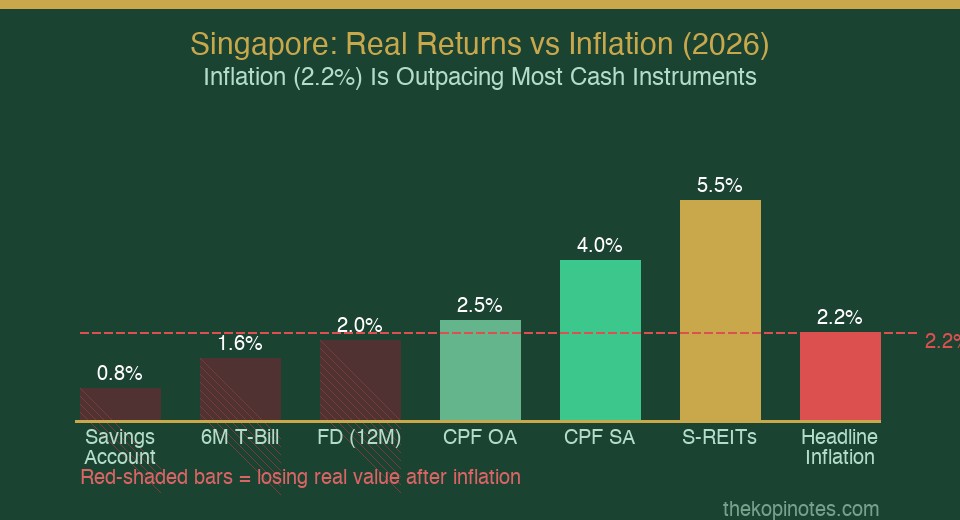
The uncomfortable reality: if you’re parking cash in T-bills at 1.56%, inflation at 2.2% means you’re losing real purchasing power at a rate of –0.64% per year. The “safe” option is quietly eroding your wealth.
What COE Records Mean for Singapore Retail Investors
You might wonder: I’m not buying a car, so why does COE matter to me as an investor?
There are three direct investor implications:
1. The opportunity cost argument just got much stronger. A Singapore investor who went car-free in 2022 and redirected S$2,500/month in car-related expenses into a global ETF like IWDA has accumulated a significant portfolio by now. Our TribeCar Singapore Review breaks down the exact numbers for going car-free in 2026.
2. Inflation above 2% demands growth assets. With headline inflation at 2.2% and core at 2.0%, cash instruments paying sub-2% are delivering negative real returns. Investors who relied solely on savings accounts, T-bills, and fixed deposits are now behind inflation. Allocation to growth assets — Singapore dividend stocks, S-REITs, global ETFs — is no longer optional for wealth preservation.
3. CPF as an inflation hedge. CPF OA pays 2.5% p.a. and SA pays 4% p.a. Both beat headline inflation. Maximising CPF contributions in 2026 — especially voluntary top-ups to SA/RA for tax relief — is one of the most effective inflation-fighting moves. Use our CPF Top-Up vs Investing Calculator to model your scenario.
The Car-Free Investor: Quantifying the COE Arbitrage
At $133,009 for Category A COE alone, the all-in monthly car cost exceeds S$3,000–$3,500/month. Investing S$3,000/month at 7% annualised returns over 10 years compounds to approximately S$497,000.
Car-sharing platforms like TribeCar (with redirect to Syfe + IBKR) offer one way to go car-light while redirecting freed-up capital into long-term wealth building.
How to Protect Your Portfolio From This Inflation Environment
Step 1: Audit your real returns. T-bills at 1.56% means –0.64%/year real return. CPF OA at 2.5% is barely ahead.
Step 2: Ensure allocation to growth assets. The best passive income strategies for Singapore in 2026 combine S-REITs (5–7% yields), global ETFs, and CPF.
Step 3: Maximise CPF. Voluntary SA top-ups yield dollar-for-dollar income tax relief up to S$8,000/year.
Step 4: Model the car ownership opportunity cost before committing to a purchase at current COE levels.
Bottom Line for SG Investors
COE Category A crossing $133,009 is more than a car market story — it’s a symptom of Singapore’s hot economy. GDP at 5%, inflation at 2.2%, HDB and COE at records. For retail investors: cash in T-bills is losing real value at –0.64%/year. Growth assets, CPF optimisation, and rethinking the car ownership equation are the priorities for 2026.
Frequently Asked Questions
Why did COE Category A hit a record in September 2026?
COE Cat A hit S$133,009 in the first bidding exercise of September 2026 due to tight LTA quota, strong economic growth (GDP forecast at 5%), pent-up demand, and EVs under 97kW competing in the Cat A bracket. First time Category A crossed S$130,000.
What is the current COE price for Category A in Singapore 2026?
As of the September 9, 2026 bidding exercise: Category A S$133,009 (new record), Category B S$135,001, Category E S$137,890. Highest-ever levels for Category A.
Is Singapore’s inflation a problem for investors in 2026?
Yes. Headline inflation rose to 2.2% in July 2026, driven by a 17% electricity tariff hike, rising accommodation costs, and COE-driven transport inflation. With T-bill yields at 1.56%, cash investors are earning a real return of –0.64%.
Should I buy a car in Singapore now given the $133K COE?
The all-in monthly cost exceeds S$3,000/month. That same capital invested over 10 years at 7% annualised returns compounds to ~S$497,000. The opportunity cost at today’s COE levels is enormous.
How does CPF help investors beat inflation in Singapore?
CPF OA earns 2.5% and SA earns 4% — both beat 2.2% headline inflation. Voluntary SA top-ups also provide dollar-for-dollar income tax relief up to S$8,000/year.
What investments beat inflation in Singapore in 2026?
CPF SA (4%), S-REITs (5–7% yield), Singapore dividend stocks (2.5–5%), and long-term global ETFs (CSPX, IWDA, VWRA). T-bills (1.56%) and most savings accounts (1–2%) are currently losing real value after inflation.
What are all the COE results for September 2026?
First bidding exercise ending 9 September 2026: Cat A S$133,009 (record), Cat B S$135,001, Cat C S$93,101, Cat D S$12,556, Cat E S$137,890. All categories rose.
This article was researched with the help of AI. While we strive to keep all information accurate and up to date, there may be errors. If you notice any discrepancies, please contact us.