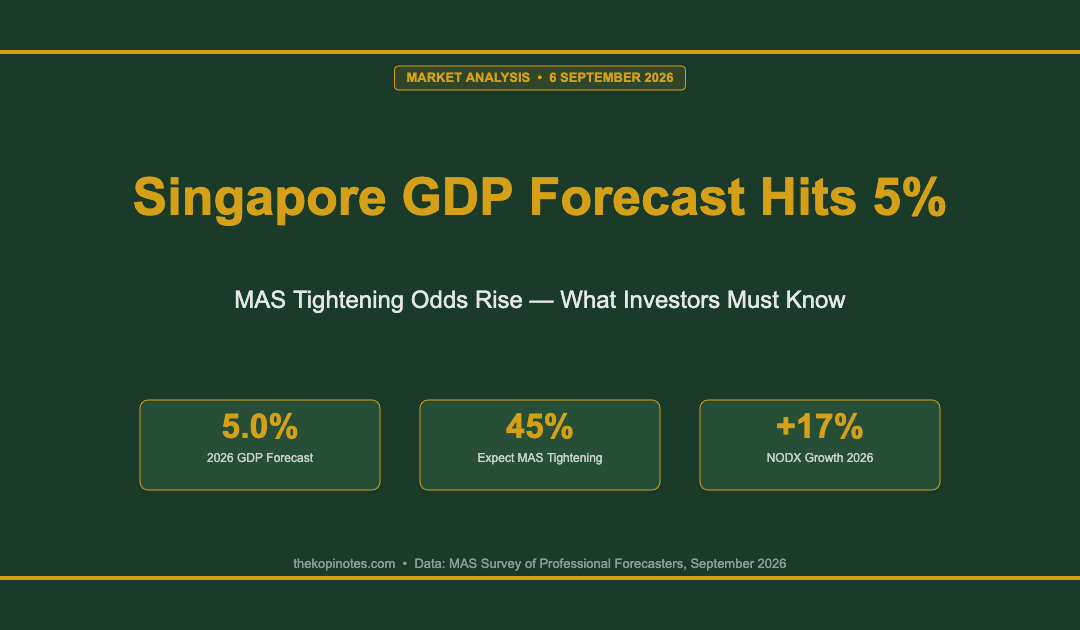
Singapore’s professional forecasters have raised the 2026 GDP growth forecast to 5% — up sharply from 3.5% just three months ago — driven by a powerful AI-fuelled surge in electronics and semiconductor demand. With 45% of respondents now expecting the Monetary Authority of Singapore to tighten monetary policy, the interest rate picture for Singapore retail investors is more uncertain than at any point this year. Here is what the data says and what you should do about it.
This is an editorial analysis. Not financial advice. Data verified as at 6 September 2026.
What the MAS September 2026 Survey Actually Says
The MAS Survey of Professional Forecasters is published quarterly and aggregates the views of 21 economists and analysts covering Singapore’s economy. The September 2026 edition, released on 2 September, contained one of the most significant upgrades in the survey’s recent history.
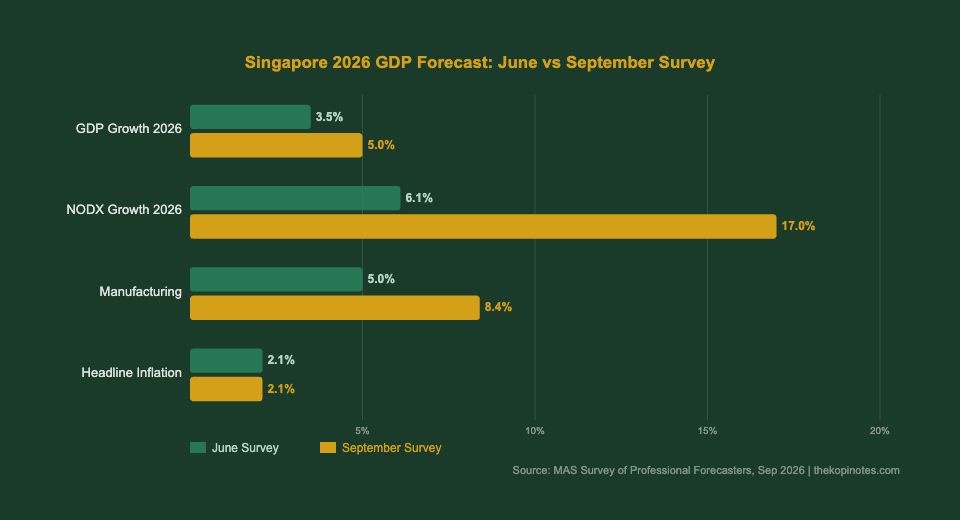
The median 2026 GDP growth forecast jumped to 5.0% from 3.5% in the June survey — a 1.5 percentage point revision upward. The most probable growth range shifted from 3.0–3.4% to 5.0–5.4%, with respondents assigning a 37% probability to that range. Non-oil domestic exports (NODX) are now expected to surge 17% year-on-year, up dramatically from 6.1% in the June survey. Manufacturing growth was revised up to 8.4% from 5.0%.
Inflation, however, was actually trimmed slightly. Headline inflation is forecast at 2.1% (down from 2.3%) and core inflation at 1.9% (down from 2.0%). This combination — strong growth, contained inflation — is the ideal macro backdrop for an economy, but it also gives MAS room to act if it chooses.
The most market-moving finding: 45% of survey respondents now expect MAS to tighten its monetary policy stance going forward. This is a notable shift from the broadly neutral posture that has characterised the past several quarters.
Why AI Is Driving Singapore’s GDP Surge
All 21 respondents cited a sustained AI-driven upturn in the technology cycle as the primary support for Singapore’s upgraded outlook. This is not a vague narrative — it translates directly into hard numbers that Singapore’s export-oriented economy can measure and feel.
AI infrastructure buildout globally requires enormous quantities of semiconductors, advanced packaging, and data centre equipment. Singapore sits at the centre of this supply chain. Companies like TSMC, Micron, GlobalFoundries, and numerous supporting industries run significant Singapore operations. When AI capex globally surges, Singapore’s manufacturing and NODX numbers surge with it.
The 17% NODX growth projection for 2026 is particularly striking when set against the context of global trade uncertainty earlier this year. It suggests that Singapore’s electronics and chemical exports are firing on all cylinders in a way that is comfortably offsetting any broader trade headwinds.
For the 2027 outlook, respondents expect Singapore’s GDP to moderate to 3.1%, implying a natural normalisation after this year’s exceptional AI-driven spike.
What MAS Tightening Would Mean — and Why It Matters
MAS does not control interest rates directly the way the US Federal Reserve does. Instead, it manages the Singapore Dollar Nominal Effective Exchange Rate (S$NEER) — allowing the SGD to appreciate or depreciate within a managed band. When MAS “tightens”, it typically steepens the appreciation slope of the S$NEER band, making the SGD stronger.
A stronger SGD has several downstream effects. It makes Singapore exports relatively more expensive in foreign currency terms. However, given current strong demand for AI-related semiconductors, buyers are unlikely to push back significantly on a modestly stronger SGD. It also reduces imported inflation — good news for consumers and for keeping headline inflation anchored near 2%. And critically for investors, a tightening MAS stance keeps SORA (Singapore Overnight Rate Average) elevated, which sustains higher yields on savings accounts, T-bills, and fixed deposits.
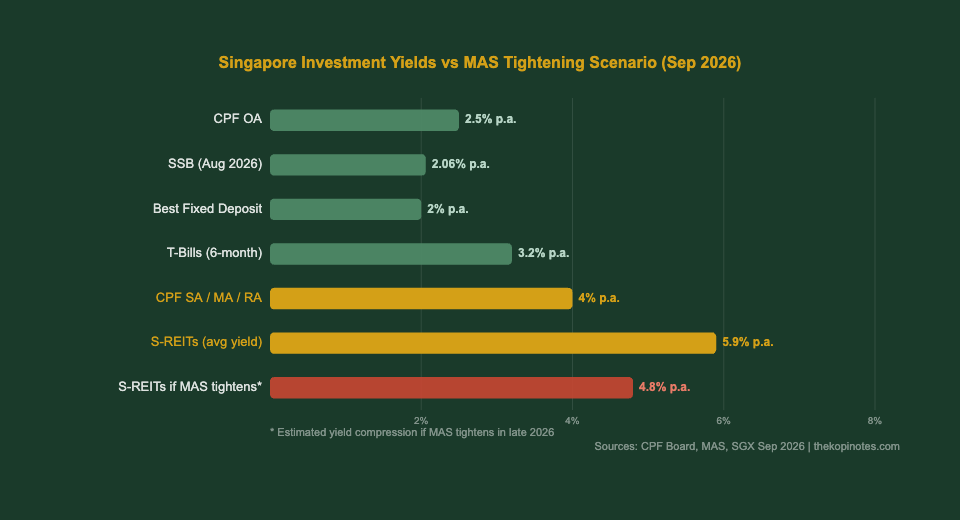
SORA is currently hovering around 2.80–3.10%. If MAS tightens further, SORA could firm toward 3.2–3.5%, giving a modest lift to cash-equivalent instruments. This is relevant context for Singapore T-bill yields, which already offer around 3.2% p.a. on the 6-month tenor.
On the other hand, if MAS decides to hold steady — the other 55% of survey respondents expect this — the current rate environment continues broadly unchanged, and the calculus for investors stays similar to today.
Impact on S-REITs: The Double-Edged Sword
Singapore real estate investment trusts are the investment vehicle most sensitive to interest rate expectations. S-REIT average dividend yields are currently around 5.9% — an attractive spread over risk-free rates. But that spread is what keeps REIT unit prices supported.
If MAS tightens and SORA drifts higher, two things happen simultaneously. First, REITs’ borrowing costs rise, as many S-REIT loans are SORA-pegged. Higher interest costs eat into distributable income, potentially compressing distributions per unit (DPU). Second, the spread between REIT yields and risk-free rates narrows, making REITs relatively less attractive versus cash instruments, which often leads to unit price softness.
Historically, when Singapore rates rise by 50–100 basis points, S-REIT prices tend to experience temporary compression of 5–12%, before fundamentals reassert themselves. The flip side: if MAS holds, and the strong economic growth drives higher rental income and positive rental reversions, S-REITs could see DPU growth that more than offsets any yield spread compression.
The sector is not monolithic. Industrial and data centre REITs, benefiting directly from AI infrastructure demand, are best positioned to grow DPUs in this environment. Office and retail REITs are more cyclical but are currently showing positive rental reversions too — Suntec REIT posted a 24.8% DPU jump in 1H2026, and CICT has commenced a S$160 million AEI at Plaza Singapura.
Fixed Deposits and T-Bills: Rates Could Stabilise or Nudge Higher
For the large segment of Singapore retail investors who rely on cash-equivalent instruments — fixed deposits, T-bills, and the Singapore Savings Bond — the MAS tightening signal is mildly positive.
Currently, the best fixed deposit rate in Singapore sits at 2.00% p.a. for a 6-month tenure (Citibank). This is well below the peaks of 3.5%+ seen in 2023–2024, when global rates spiked. The SSB August 2026 issue offers a 2.06% 10-year average return, while 6-month T-bills yield approximately 3.2% p.a.
If MAS does tighten, T-bill yields could edge toward 3.3–3.5% while fixed deposit rates from competitive banks might nudge back above 2.00–2.25%. This would be a tailwind for conservative savers who missed the 2023 rate peak window.
However, the magnitude should not be overstated. MAS tightening via S$NEER appreciation is a gentler instrument than, say, a Federal Reserve rate hike. The direct impact on SORA is indirect and lagged. The Fed’s hawkish hold in July 2026 remains the dominant factor anchoring global short-term rates, and Singapore rates track global conditions closely.
CPF SA Floor Rate: The September Decision That Hasn’t Arrived Yet
There is one crucial CPF-related development that intersects directly with today’s MAS macro picture. The government’s 4% interest rate floor on CPF Special, MediSave, and Retirement Account (SMRA) balances has been extended annually since 2013. It expires on 31 December 2026 — and as of today, no extension announcement has been made for 2027.
The September window is historically when the government signals its intention for the following year. If the 4% floor is not extended, the CPF SA rate would revert to a market-linked formula based on 10-year Singapore Government Securities (10Y SGS) plus 1%. Given that 10Y SGS currently yields approximately 2.8–3.0%, the underlying formula rate would fall to around 3.8–4.0% — close to the floor but not guaranteed.
Here is where the MAS tightening narrative becomes relevant to CPF holders: if MAS tightens and yields across the curve rise slightly, the market-linked CPF SA rate might actually stay above 4% even without a floor. This could give the government political cover to allow the floor to expire naturally — letting the market rate do the work.
That said, given the track record of extensions, most analysts expect the floor to be renewed for 2027. An announcement before end-October is widely anticipated.
Key Forecasts: June vs September 2026 MAS Survey
| Metric | June 2026 Survey | September 2026 Survey | Change |
|---|---|---|---|
| GDP Growth 2026 | 3.5% | 5.0% | +1.5 pp |
| Most Likely Range | 3.0–3.4% | 5.0–5.4% | ▲ Upgraded |
| NODX Growth 2026 | 6.1% | 17.0% | +10.9 pp |
| Manufacturing Growth | 5.0% | 8.4% | +3.4 pp |
| Headline Inflation | 2.3% | 2.1% | −0.2 pp |
| Core Inflation | 2.0% | 1.9% | −0.1 pp |
| Expect MAS Tightening | N/A | 45% | New data |
| 2027 GDP Forecast | N/A | 3.1% | New data |
Source: MAS Survey of Professional Forecasters, September 2026. Published 2 September 2026.
What Singapore Retail Investors Should Do Now
The 5% GDP upgrade is unambiguously good news for Singapore assets broadly. A growing economy lifts occupancy rates, rental income, corporate earnings, and consumer spending — all of which feed positively into the investment landscape. The question is how to position against the secondary risk of MAS tightening.
For investors with S-REIT exposure, the key is to review portfolio quality and duration sensitivity. Industrial and data-centre REITs have shorter weighted average lease expiry (WALE) structures that allow them to reset rents to market faster — a positive in a growing economy. Office and retail REITs with long leases and fixed escalators offer predictability but less upside in an accelerating environment.
For cash-heavy investors sitting in fixed deposits yielding 2.0%, there is a case for moving some allocation into T-bills, which currently offer 3.2% p.a. — a full 120 basis points more for essentially equivalent credit risk. You can check the latest T-bill auction results and application guide to get started.
For CPF members, the practical action is to monitor for the 4% SMRA floor announcement. If the floor is extended — as is widely expected — nothing changes and your SA, MA, and RA balances continue earning 4% through 2027. If unexpectedly it is not extended, the market rate is likely to be close to 4% anyway in a firmer rate environment, so the impact would be minimal. Either way, consider whether deploying OA savings into eligible CPFIS instruments makes sense if your CPF OA balance comfortably exceeds the $20,000 threshold.
Broadly, the MAS survey should reinforce conviction in Singapore’s fundamentals — but not complacency. With 45% of professional forecasters expecting a tightening, markets may front-run MAS action through currency and bond market moves before any formal announcement.
Bottom Line for SG Investors
Singapore’s economy is having an exceptional 2026, driven by the global AI infrastructure cycle landing squarely in Singapore’s manufacturing and export sweet spot. The 5% GDP forecast and 17% NODX growth are real and data-backed. For retail investors, this is broadly positive — a strong economy supports higher rents, better DPUs, and a healthy equities market.
The MAS tightening risk is real but not alarming. At 45%, the survey is telling you a significant minority of experts see it coming — not a consensus. And even if MAS does tighten, it is likely to be a measured, incremental move, not an aggressive rate hike cycle. The outcome for most Singapore investors is: stay invested in quality assets, ensure your cash holdings are earning competitive yields (T-bills over FDs currently), watch the CPF SMRA floor announcement in October, and don’t let short-term rate noise distract you from a fundamentally strong macro backdrop.
Frequently Asked Questions
What is the MAS Survey of Professional Forecasters?
It is a quarterly survey published by the Monetary Authority of Singapore that collects GDP, inflation, and economic outlook projections from 21 professional economists and analysts covering Singapore. It is one of the key documents the market uses to gauge Singapore’s economic trajectory and expectations for MAS monetary policy.
What does the 5% GDP forecast mean for S-REITs?
A stronger GDP typically supports higher occupancy rates and rental growth across commercial, industrial, and retail property — which are the underlying assets of S-REITs. In the near term, growth upgrades are positive for REIT fundamentals. The risk factor is that strong growth increases the probability of MAS tightening, which could marginally compress REIT valuations. The net effect depends on whether DPU growth (from better fundamentals) outpaces any yield spread re-pricing.
Should I buy S-REITs now given the 5% GDP upgrade?
This is not financial advice. That said, the macro backdrop is broadly supportive of Singapore property assets. The key variables to monitor are: (1) whether MAS tightens at its October review, (2) individual REIT debt structures and refinancing timelines, and (3) sector-specific demand drivers. Industrial and data-centre REITs are most directly benefiting from AI infrastructure demand. Always assess your own risk tolerance and investment horizon.
What happens to fixed deposit rates if MAS tightens?
MAS tightening (via S$NEER appreciation) has an indirect effect on domestic interest rates through SORA. If SORA firms upward, banks may selectively raise fixed deposit rates to attract deposits. The effect is likely modest — perhaps 10–25 basis points on competitive promotional FD rates. T-bill yields would respond more directly and quickly to any rate environment shift.
Will the CPF SA 4% floor be extended to 2027?
No announcement has been made as of 6 September 2026. The government has extended the floor every year since 2013, and most analysts expect a renewal. The October 2026 MAS policy review window is a likely catalyst for an announcement. If the floor expires without renewal, the market-linked rate (based on 10Y SGS + 1%) would apply — and in the current rate environment, that rate is close to 4% regardless. See our detailed CPF SA floor analysis for more context.
What does the MAS tightening mean for Singapore savings accounts?
Most high-yield savings accounts in Singapore (offering up to 5.85% p.a. with salary crediting and card spend conditions) are tied to bank-set promotional rates, not directly to SORA. However, digital banks and fixed deposit promotional rates do track the broader interest rate environment. If MAS tightens and SORA firms, there is a case for a modest improvement in base savings rates over the next 1–2 quarters. In the meantime, locking in a 6-month T-bill at approximately 3.2% p.a. remains one of the most competitive risk-free options for cash savers.
This article was researched with the help of AI. While we strive to keep all information accurate and up to date, there may be errors. If you notice any discrepancies, please contact us.