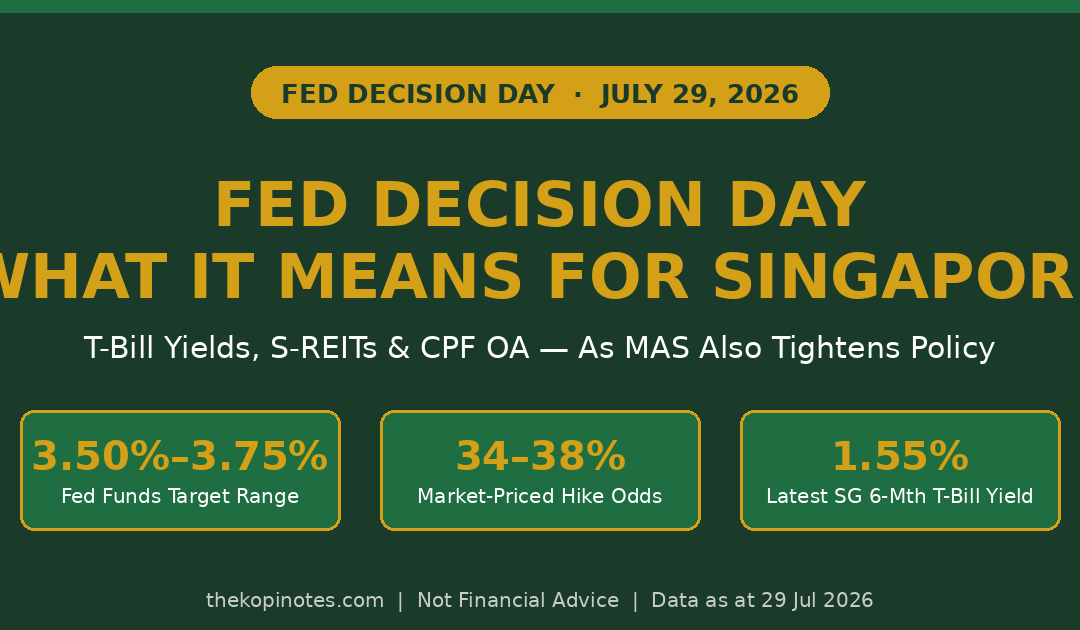
Fed Decision Day: What a Hawkish Hold Means for Singapore Investors
MAS just tightened SGD policy for the second time this year. Now the US Federal Reserve delivers its own rate decision on 29 July 2026 — here’s what’s actually at stake for your T-bills, S-REITs, and CPF OA.
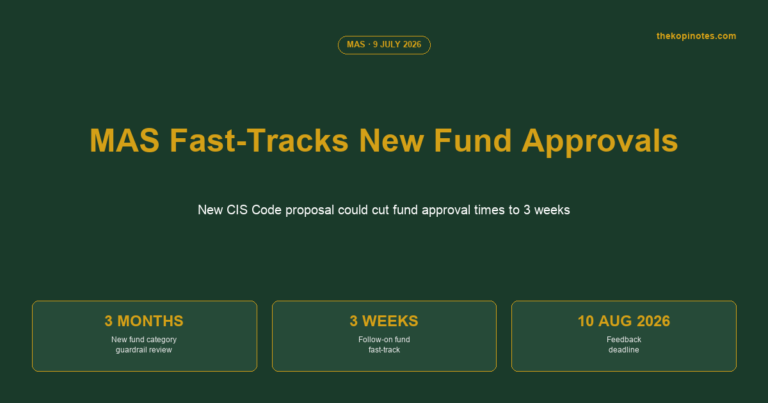
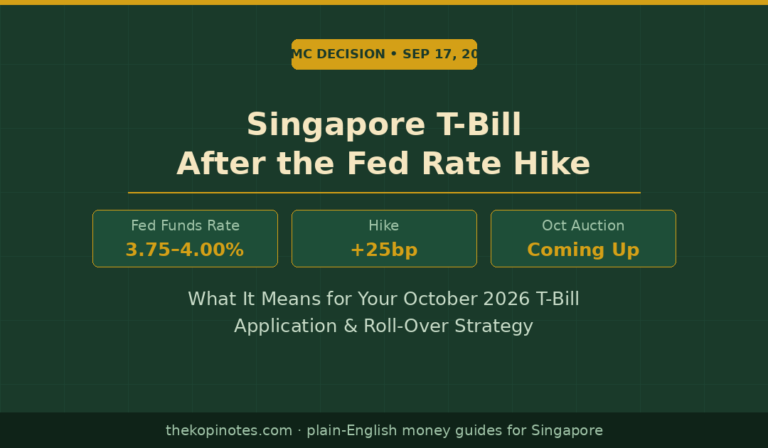
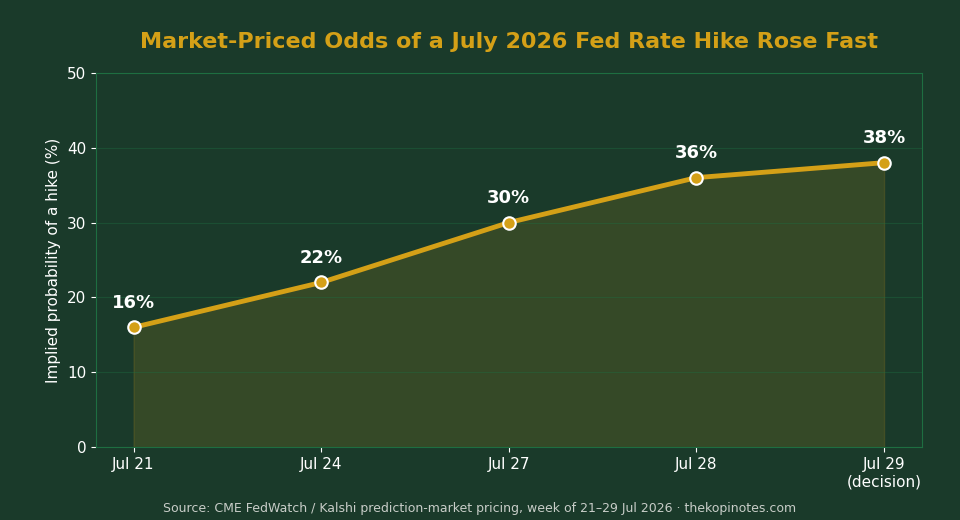
Two central banks, one week. On 27 July, the Monetary Authority of Singapore (MAS) made a surprise second tightening of its S$NEER policy band in 2026. Now, the US Federal Reserve wraps up its own two-day meeting with a rate decision due 2pm ET on Wednesday, 29 July — 2am Singapore time on Thursday, 30 July. Markets are leaning toward a fifth straight hold at 3.50%–3.75%, but hike odds have nearly doubled in the space of a week, from around 16% to as high as 38%, as oil-driven inflation concerns build.
Why should a Singapore investor holding CPF, T-bills, and S-REITs care about a US rate call when MAS runs its own SGD-based policy? Because the two are more connected than they look — and this week, both are tightening at the same time. Here’s what’s actually happening, what it means for SG T-bill yields ahead of Thursday’s auction, and what it means for REIT investors caught between rising rates and record retail inflows.
Not financial advice — this article is for general information only and reflects data available as at 29 July 2026.
Table of Contents
Contents — Click to expand
What the Fed Is Expected to Decide Today
The Federal Open Market Committee (FOMC) met on 28–29 July 2026, with the rate decision announced at 2pm ET on Wednesday (2am Singapore time, Thursday 30 July), followed by Fed Chair Kevin Warsh’s press conference at 2:30pm ET.
Going into the decision, market pricing put the odds of a fifth consecutive hold at 3.50%–3.75% at roughly 62–64%. But that confidence has been eroding fast: hike odds climbed from around 16% a week earlier to as high as 38% in the final stretch, as rising oil prices fed through into fresh inflation concerns.
Warsh, who took the helm as Fed Chair earlier in 2026, has been notably more sparing with forward guidance than his predecessor — prediction markets have assigned high odds that words like “oil” and “shock” would feature heavily in his press conference, a signal that energy-driven inflation is the dominant theme this cycle.
The bottom line: a hold was still the more likely outcome heading into the decision, but the market was far less confident than it had been even a week earlier — and that uncertainty alone has been enough to move Treasury yields, the SGD, and REIT prices before a single word was spoken.
MAS Already Tightened — Now Singapore Faces Pressure From Two Directions
Two days before the Fed even met, MAS tightened its own policy for the second time in 2026, re-slope/re-centring the S$NEER band against analyst expectations — 12 of 16 economists surveyed had actually expected no change. It was the first time MAS moved twice within a single year since the current policy regime was cemented.
MAS doesn’t set an interest-rate target the way the Fed does. Instead, it manages the Singapore dollar against an undisclosed basket of currencies (the S$NEER) within a policy band, adjusting the band’s slope, width, or centre to fight imported inflation. Tightening means allowing the SGD to appreciate faster within that band — which dampens imported inflation but also, all else equal, squeezes exporters and rate-sensitive sectors.
For a Singapore investor, the two moves compound each other in an unusual way this week. MAS tightening supports SGD strength, while a hawkish (or outright hiking) Fed keeps USD funding costs elevated. For REITs and dividend stocks that are priced off both SGD risk-free rates and US Treasury yields, that’s tightening pressure arriving from two directions in the same seven-day window. SRS and CPFIS investors holding US-listed or USD-denominated income assets should also note that a stronger SGD from MAS’s move means smaller SGD-converted returns from USD dividends — on top of whatever the Fed itself does to underlying yields.
Want your cash ready to move before Thursday’s T-bill auction? Trust Bank offers a competitive daily-interest savings account with no minimum balance.
T-Bill Yields Are Already Climbing — What to Expect at Thursday’s Auction
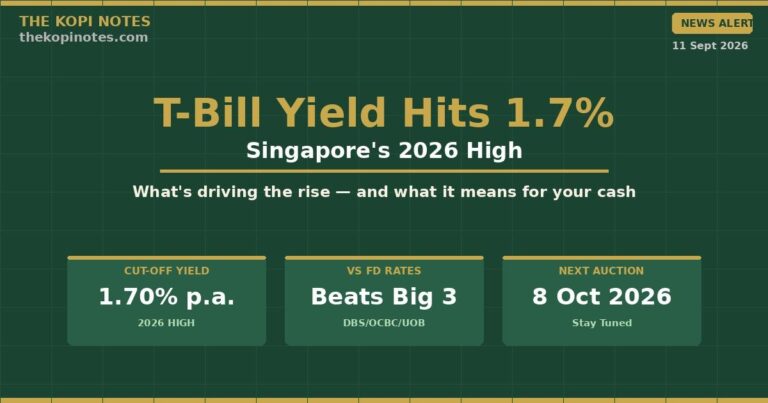
Singapore’s 6-month T-bill cut-off yield has risen for two straight auctions: from 1.50% on 2 July (BS26113X) to 1.55% on 16 July (BS26114W) — the highest level since the start of 2026. Total applications actually eased slightly, from S$17.4 billion to S$16.0 billion, with a bid-to-cover ratio of 1.82 and S$8.8 billion issued — still comfortably oversubscribed, but a little less crowded than earlier in the year when yields were lower.
The next 6-month T-bill auction lands this Thursday, 30 July 2026 — just hours after the Fed’s decision and press conference. If the Fed leans hawkish or surprises with a hike, expect the cut-off yield to push higher again; a more dovish-sounding hold could see it plateau or ease slightly instead. See our full T-bill auction results and yield tracker for the latest cut-off figures as they’re released.
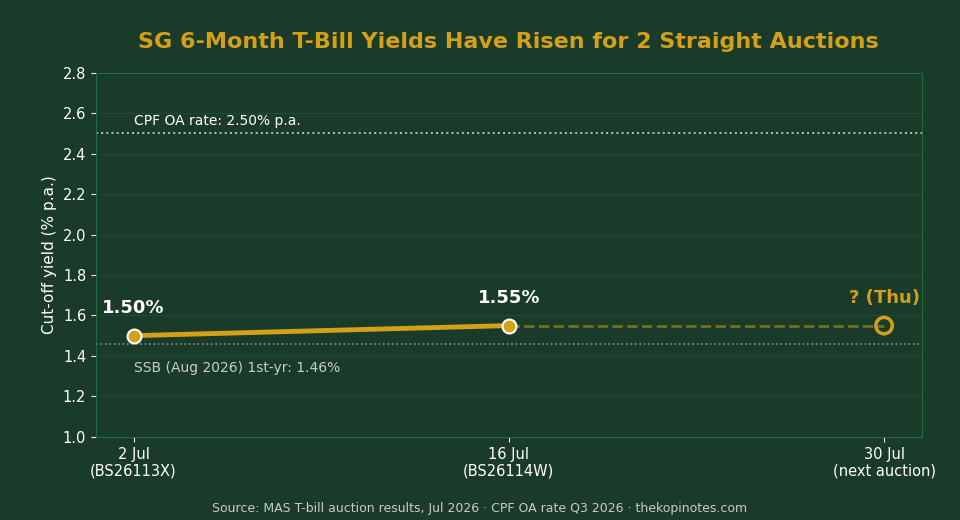
Here’s the nuance that matters most for CPF planning right now: at 1.55%, the latest T-bill yield still sits below the CPF Ordinary Account’s fixed 2.50% p.a. floor. That means the popular “T-bill vs CPF OA” trade — withdrawing OA funds to chase a higher T-bill yield — doesn’t currently make mathematical sense on yield alone. It would only start to make sense again if T-bill yields climb back above 2.5%, which a genuinely hawkish Fed outcome this week could help nudge along.
| Instrument | Latest Yield | Type |
|---|---|---|
| SG 6-Month T-Bill (16 Jul auction) | 1.55% p.a. | Market-set, re-auctioned every 2 weeks |
| CPF Ordinary Account (OA) | 2.50% p.a. | Fixed, gazetted quarterly |
| CPF Special / MediSave / Retirement Account | 4.00% p.a. (floor extended to Dec 2026) | Fixed, gazetted quarterly |
| Singapore Savings Bond (Aug 2026 tranche) | 1.46% (1st-year step) | Step-up, 10-year average typically higher |
Rates as at 29 July 2026. Always check the latest CPF Board and MAS figures before making a decision. Use our T-Bill, SSB & Fixed Deposit Comparison Calculator to model your own numbers.
S-REITs: Squeezed by Rates, Propped Up by Retail Demand
The Fed’s “higher for longer” stance — or the risk of an outright hike — keeps pressure on income assets like REITs, since elevated benchmark yields make distribution yields relatively less attractive and can raise refinancing costs on USD-denominated debt.
Yet retail investors haven’t been scared off. An estimated S$925 million flowed into S-REITs by the end of May 2026 alone, as low-risk cash alternatives — T-bills, SSBs, fixed deposits — lost their yield edge relative to REIT distributions. Structural bright spots have persisted even amid the rate noise: Keppel DC REIT’s 1H2026 DPU rose 11.3% year-on-year to 5.714 cents on AI and data-centre demand, and NTT DC REIT’s mid-July debut was the largest S-REIT listing on SGX in a decade — both signs that data-centre and logistics REITs are still attracting capital regardless of the macro headline noise.
Pure S-REIT ETFs continue yielding well above the broader market — the CSOP iEdge S-REIT Leaders Index ETF near 5.90% and the Lion-Phillip S-REIT ETF near 5.42% — a spread wide enough to keep attracting income-focused capital even as the “higher for longer” narrative dominates headlines. For a deeper look at the sector’s broader trajectory, see our S-REIT Recovery 2026 breakdown and our Best S-REITs Singapore 2026 guide.
What Singapore Investors Should Do Right Now
- Don’t over-index CPF OA into T-bills purely for yield. At 1.55%, the 6-month T-bill sits below CPF OA’s 2.50% floor — the trade only becomes attractive again if T-bill yields climb back above 2.5%.
- If bidding at Thursday’s auction, place your bid ahead of the cut-off. A hawkish Fed statement on Wednesday night could nudge the cleared yield higher before applications close.
- For REIT exposure, focus on fundamentals over Fed-timing. Occupancy, DPU growth, and gearing versus MAS’s 50% leverage cap have proven more durable signals than any single rate decision this year.
- Diversify cash and near-cash holdings across SSBs, T-bills, and fixed deposits rather than concentrating in one instrument — relative yields have been shifting week to week through 2026.
- Consider a diversified income platform if you’d rather not actively trade around every FOMC and MAS meeting — see our CPF investment strategy guide for how to structure OA/SA allocations alongside instruments like these.
Building a diversified income portfolio around this week’s rate moves?
Frequently Asked Questions
When exactly is the Fed's July 2026 rate decision?
Did the Fed hike rates in July 2026?
Does the Fed's decision actually affect Singapore's interest rates?
What did MAS just do with its own policy?
What's the outlook for the 30 July T-bill auction?
Is it better to put CPF OA money into T-bills right now?
Are S-REITs still worth buying with rates staying elevated?
How does CPF OA/SA compare with SSBs and T-bills today?
This article was researched with the help of AI. While we strive to keep all information accurate and up to date, there may be errors. If you notice any discrepancies, please contact us.