Best Short-Term Investments in Singapore 2026: T-Bills, SSB, FDs & Cash Funds Compared
Find the highest-yielding safe option for your 1–3 year timeline
The best short-term investments in Singapore in 2026 are T-Bills (6-month yield: ~1.60%), Singapore Savings Bonds (SSB Oct 2026 10-year average: 2.32%), and cash management accounts (SGD yields up to ~2.15%). If you have a 1–3 year timeline and want capital safety plus a real yield above your savings account, these are the options to compare. Each has different minimum amounts, lock-up periods, and access rules — and this guide breaks them all down so you can pick the right one.
Not financial advice. All figures are for educational reference only. Data verified as at September 2026 unless noted.
- T-Bills are the safest 6-month option at ~1.60% p.a. — fully backed by MAS, no price risk
- SSB gives you government-backed flexibility: redeem any month, earn 1.65%–2.32% depending on how long you hold
- Cash management accounts (Endowus, Syfe, StashAway) beat savings accounts and require zero lock-up
- Fixed deposits are predictable but lock your money and rarely beat SSB or T-bills right now
What Counts as a Short-Term Investment?
In Singapore’s context, “short-term” typically means a holding period of 1 month to 3 years. You might have this money earmarked for a home purchase, an emergency buffer, a renovation, or just a rainy-day fund that’s working harder than a savings account.
Short-term investing has one overriding priority: you need the money back intact. That rules out stocks, ETFs, and REITs — not because they’re bad, but because their prices can swing 20–40% in a year. You can’t afford to need your flat downpayment in 18 months and find your portfolio down 30%.
So the universe narrows to products where capital is protected or near-protected: government securities, bank deposits, and money market funds. The question is which of these pays you the most for your timeline and liquidity needs.
At a Glance: Best Short-Term Investments in Singapore 2026
Here’s a quick comparison of your main options as at September 2026:
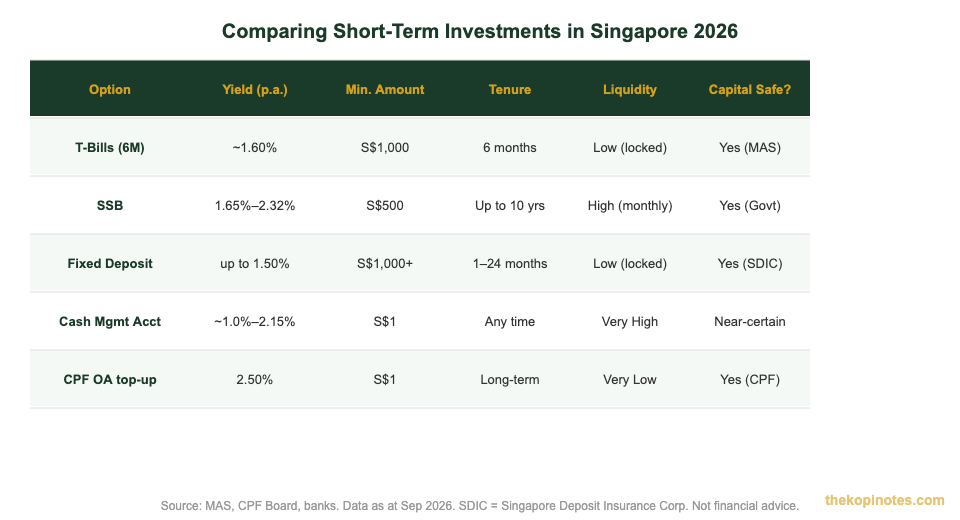
Source: MAS, CPF Board, SDIC, bank websites. Data as at September 2026. Not financial advice.
| Option | Yield (p.a.) | Min. Amount | Lock-up | Backed By |
|---|---|---|---|---|
| T-Bills (6M) | ~1.60% | S$1,000 | 6 months | MAS |
| SSB (Oct 2026) | 1.65%–2.32% | S$500 | None (monthly) | Singapore Govt |
| Fixed Deposit (12M) | up to 1.50% | S$1,000+ | 1–24 months | SDIC (up to $100k) |
| Cash Mgmt (SGD) | ~1.0%–2.15% | S$1 | None (daily) | Fund assets |
| CPF OA | 2.50% | Any amount | Long-term | CPF Board |
Source: MAS auctions, CPF Board, bank promotions, Endowus. September 2026. All yields indicative.
Singapore T-Bills — The Safe 6-Month Pick
Singapore Treasury Bills (T-bills) are short-term government securities issued by the Monetary Authority of Singapore (MAS). The 6-month T-bill is the most popular among retail investors.
The latest confirmed cut-off yield was 1.60% p.a. from the August 27, 2026 auction — the highest 6-month yield in 2026. A new auction runs on September 10, 2026.
How it works: You buy T-bills at a discount to face value. If you invest S$10,000 in a 6-month T-bill at 1.60%, you receive approximately S$10,080 at maturity (before fees). The yield is locked in at the cut-off rate — you get exactly what you bid for, as long as you use a non-competitive bid via your bank or CPF.
How to buy: Apply via DBS/POSB, OCBC, or UOB internet banking, or through CPF-IS (if using CPF OA funds). Applications close at 9pm the day before the auction. Minimum is S$1,000, in S$1,000 increments.
The catch: T-bills lock your money for 6 months. There’s a secondary market, but selling early is illiquid and you may not get full value. Don’t put money here that you might need before maturity.
For a full guide, see TKN’s Singapore T-bills 2026 guide.
Singapore Savings Bonds (SSB) — Government-Backed with Full Flexibility
The SSB is arguably the best short-term instrument in Singapore for most people. Here’s why: it’s government-backed (same credit as T-bills), earns a competitive step-up rate, and you can redeem any month without penalty.
The October 2026 SSB offers:
- Year 1: 1.65% p.a.
- 10-year average: 2.32% p.a.
- Maximum allotment: S$200,000 per person lifetime
- Minimum: S$500
The October 2026 SSB is hitting a 14-month high for 10-year rates. If you hold for just 1 year, you earn 1.65% — already beating most 12-month fixed deposits. Hold for 3 years and your average yield steps up further.
How to apply: Via DBS/POSB, OCBC, or UOB internet banking, or the MAS website. Applications open the 1st of each month and close around the 25th-26th. Bonds are allotted on the last business day of the month.
Why SSB often beats T-bills for short-term savers: With T-bills, you’re locked in for 6 months. With SSB, you can redeem monthly. If you need the money in month 4, you get back your principal plus interest accrued to that point. That flexibility is worth something — especially if your timeline is uncertain.
For more, see TKN’s Singapore Savings Bonds guide.
Fixed Deposits — Predictable but Not Always Competitive
Fixed deposits (FDs) are the classic “park and forget” option. You lock money with a bank for a fixed period — 3, 6, 12, or 24 months — and earn a guaranteed rate.
As of September 2026, the best 12-month fixed deposit rates in Singapore are around 1.45%–1.50% p.a. These come from HSBC, Maybank, and a handful of digital banks. Most major local banks (DBS, OCBC, UOB) are offering less — often 0.8%–1.20% without promo conditions.
| Bank / Provider | Tenure | Rate (p.a.) | Min. Deposit |
|---|---|---|---|
| HSBC | 12 months | ~1.50% | S$1,000 |
| Maybank | 12 months | ~1.45% | S$1,000 |
| DBS/OCBC/UOB | 12 months | 0.80%–1.20% | S$10,000+ |
Source: Bank websites, Moneysmart, Syfe Magazine. September 2026. Rates subject to change.
The problem with FDs right now: The October 2026 SSB Year-1 rate (1.65%) already beats the best 12-month FD (1.50%) — and SSB lets you redeem early without penalty. The only reason to choose an FD over SSB today is if you want a specific short tenure (like 3 months) or your SSB allocation is already at the S$200,000 cap.
FD interest is protected by SDIC up to S$100,000 per depositor per bank — the same as your savings account. So it’s safe, just not always the best-yielding option.
Cash Management Accounts — Daily Liquidity, Better Than a Savings Account
Cash management accounts (CMAs) from platforms like Endowus Cash Smart, Syfe Cash+, and StashAway Simple invest your cash in money market funds and ultra-short-duration bond funds. You get liquidity — often withdrawable within 1–2 business days — with yields that beat most bank savings accounts.
As of July–August 2026, SGD-denominated cash management funds are yielding approximately:
- Conservative/money market options: ~0.84%–1.20% p.a.
- Enhanced/mixed short-bond options: ~1.50%–2.15% p.a.
Key advantages of CMAs:
- No lock-up period — withdraw any time
- No minimum investment (Syfe Cash+ starts at S$1)
- Diversified across multiple money market funds — lower counterparty risk than a single FD
- Yields adjust with market rates automatically
Key risks: CMAs are not capital-guaranteed. The funds they invest in are near-zero-risk (money market funds), but they are not insured like a bank deposit. In practice, losses are extremely rare for Singapore-focused money market funds, but you should know the difference.
CMAs shine for your emergency fund or near-term savings where you need daily access. T-bills and SSBs offer higher guaranteed yields, but CMAs win on pure flexibility.
Use Endowus referral code 2V343 or Syfe referral code SRPRFFFCD for new account bonuses.
CPF Ordinary Account — The 2.5% Guaranteed Rate You Already Have
Your CPF OA earns a guaranteed 2.50% p.a. — higher than T-bills and SSB Year-1 rates. The CPF Board has confirmed this floor rate is extended to 31 December 2026.
The catch: CPF OA isn’t “investable” in the traditional sense. You can’t top it up freely with cash and then withdraw it as passive income. But if you’re deciding whether to use CPF OA to buy T-bills or invest in equities, the 2.5% base might not be worth leaving behind.
However, if you’re a self-employed person or have extra cash, you can make voluntary CPF MediSave top-ups (which reduce taxable income) or SRS contributions (up to S$15,300 p.a. for citizens and PRs) which then invest in a 2.5%-equivalent safe environment with tax benefits. This is a more advanced strategy — see TKN’s CPF investment strategy guide for details.
Which Short-Term Investment Should You Choose?
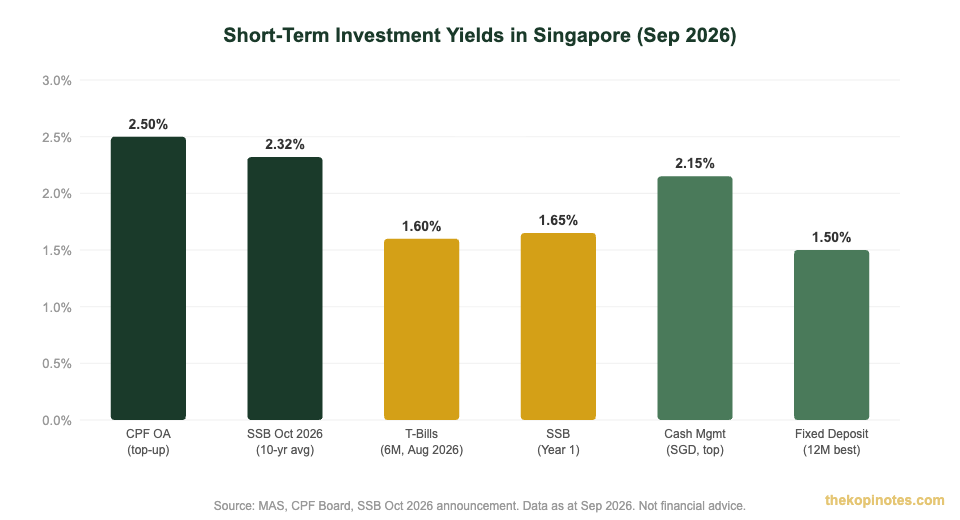
Source: MAS, CPF Board, bank data. September 2026. For illustration only.
Here’s a simple decision framework based on your situation:
If you need the money in <6 months: Use a cash management account. T-bills and SSBs don’t suit very short windows. A CMA gives you daily liquidity and a yield well above your savings account.
If your timeline is 6–12 months and it’s fixed: T-bills are your best friend. The 6-month yield is locked in at auction, capital is MAS-guaranteed, and you know exactly what you’ll receive.
If your timeline is 1–3 years but uncertain: SSB is likely your best option. The October 2026 SSB earns 1.65% in Year 1, stepping up over time. Redeem early any month without penalty. No T-bill rollover hassle.
If you have more than S$200,000 to park: You’ll hit the SSB lifetime cap. Split between SSB (up to your cap), T-bills, and fixed deposits. Diversifying across issuers and instruments reduces any single point of failure.
If you want passive income (monthly or quarterly cash): None of the above pay monthly — T-bills and SSBs pay at maturity or semi-annually. For genuine monthly passive income, see TKN’s guide to passive income investments in Singapore, which covers REITs and dividend stocks for longer-term income.
Also check out the Singapore retirement planning calculator to see how short-term savings fit into your bigger financial picture.
Summary: Best Short-Term Investments in Singapore 2026
Here’s the bottom line for September 2026:
- Best for flexibility: SSB (Oct 2026) — 1.65% Y1, redeem any month, no penalty
- Best for locked-in short yield: T-bills — 1.60% for exactly 6 months
- Best for daily access: Cash management account — 1.0–2.15% SGD, withdraw anytime
- Best guaranteed rate you already have: CPF OA — 2.50% p.a.
- Fixed deposits: Viable but usually outpaced by SSB right now
The key insight for 2026: with T-bill and SSB yields near 2026 highs, this is actually a reasonable time to lock in short-term rates — especially versus the near-zero environment of 2020–2021. Don’t leave your emergency fund or short-term savings in a regular savings account earning 0.05%.
Frequently Asked Questions
What is the best short-term investment in Singapore right now?
How do I buy Singapore T-bills?
Is SSB better than a fixed deposit in Singapore?
Are Singapore T-bills safe?
What is the SSB October 2026 interest rate?
How do cash management accounts compare to T-bills and SSBs?
This article was researched with the help of AI. While we strive to keep all information accurate and up to date, there may be errors. If you notice any discrepancies, please contact us.