Data verified as at 25 August 2026. Term life insurance is the most cost-effective way to protect your family’s financial future in Singapore — but many buyers get the sum assured wrong. Too little and your family struggles; too much and you are paying premiums that could be invested instead.
This guide walks you through the two most reliable methods to calculate the right amount of coverage: the LIA-recommended 9x income rule and the more precise DIME method. It also includes verified 2026 premium benchmarks from the top Singapore insurers.
What Is Term Life Insurance?
Term life insurance pays a lump sum — the sum assured — to your beneficiaries if you pass away or are diagnosed with a terminal illness during the policy period. Unlike whole life insurance, there is no cash value or investment component: you are paying purely for protection, which is why premiums are far lower per dollar of coverage.
In Singapore, all life insurance products are regulated by the Monetary Authority of Singapore (MAS). Term life plans must follow Life Insurance Association Singapore (LIA) guidelines on product design, policy terms, and claims. Most standard plans cover death and terminal illness, with optional riders for Total and Permanent Disability (TPD) and Critical Illness (CI).
Singapore’s Protection Gap Problem
LIA Singapore’s Protection Gap Study 2022 — the most recent comprehensive industry study — found that economically active Singaporeans carry a S$373 billion mortality protection gap, representing a 21% shortfall from what families would need to maintain their standard of living. The Critical Illness protection gap is even larger at S$579 billion (74% gap).
These gaps exist because many Singaporeans either skip personal coverage in favour of employer group insurance, or choose sum assured amounts based on what they can afford rather than what they actually need. The two methods below help you calculate the right number first.
Method 1: The LIA 9x Annual Income Rule
The LIA Singapore Basic Financial Planning Guide recommends a minimum of 9 times your annual income for combined Death and Total and Permanent Disability protection. This is the simplest and most widely used benchmark in Singapore.
Multiply your gross annual income by 9. Most financial planners suggest rounding up to 10x to build in a buffer for inflation and changing circumstances.
| Annual Income | LIA 9x (Minimum) | Rounded 10x (Suggested) |
|---|---|---|
| S$48,000 (S$4,000/mo) | S$432,000 | S$480,000 |
| S$60,000 (S$5,000/mo) | S$540,000 | S$600,000 |
| S$72,000 (S$6,000/mo) | S$648,000 | S$720,000 |
| S$96,000 (S$8,000/mo) | S$864,000 | S$960,000 |
| S$120,000 (S$10,000/mo) | S$1,080,000 | S$1,200,000 |
The 9x rule is a quick starting point, not a precise figure. It does not account for outstanding debts, your mortgage balance, the number of dependants, or education costs. The DIME method below provides a more complete picture.
Method 2: The DIME Method (More Precise)
The DIME method adds up four specific financial obligations: Debt, Income replacement, Mortgage, and Education. It is more detailed and typically produces a higher figure than the 9x rule — which is appropriate, since most families have obligations beyond simple income replacement.
| Component | What to Include | Example |
|---|---|---|
| D — Debt | Car loans, personal loans, credit card balances (not mortgage) | S$40,000 |
| I — Income | Annual income × years until youngest child is financially independent | S$60,000 × 20 = S$1,200,000 |
| M — Mortgage | Outstanding HDB or private property loan balance | S$350,000 |
| E — Education | Estimated university/polytechnic costs per child | 2 children × S$60,000 = S$120,000 |
| Total DIME | Gross coverage target | S$1,710,000 |
From the DIME total, subtract existing coverage (employer group insurance, current personal policies) and immediately accessible liquid assets (savings, non-CPF investments). This is your net coverage gap.
Example: S$1,710,000 − S$200,000 (group cover) − S$100,000 (savings) = S$1,410,000 net gap. This is how much additional term life you need.
Use TKN’s Insurance Gap Calculator to model different scenarios for your situation.
How to Choose Your Policy Term
The policy term should match the period during which your dependants are financially reliant on your income. Once your mortgage is repaid, your children are working, and your retirement income (CPF LIFE, savings) is sufficient, the need for life insurance diminishes sharply.
| Your Situation | Recommended Term | Reasoning |
|---|---|---|
| Young single, no dependants | 10–15 years | Early career protection; lock in low premiums now |
| Married couple, no children | 20–25 years | Covers family formation and early mortgage period |
| Parent with young children | 25–30 years (or to age 65) | Covers until children finish university and mortgage is repaid |
| Sole breadwinner | To age 65 or 70 | Protects family until CPF LIFE payouts and savings take over |
| Mortgage protection only | Match loan tenure | Decreasing term is typically cheaper for this specific purpose |
A common approach for Singaporeans: buy coverage to age 65. If you are 30, that is a 35-year term — long enough to cover most financial obligations, and premiums are still competitive at that age.
2026 Premium Benchmarks
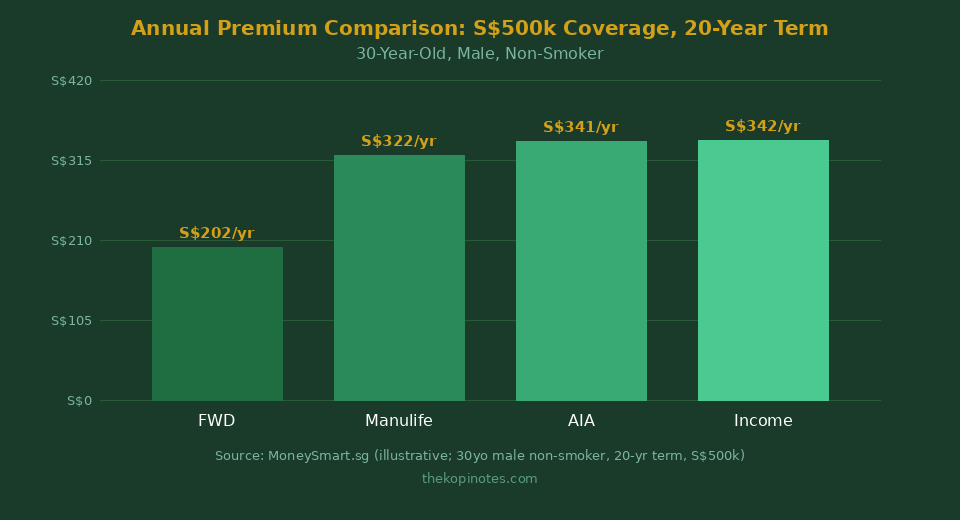
The table below shows indicative annual premiums for a 30-year-old male non-smoker purchasing S$500,000 of coverage on a 20-year level term. Data is sourced from MoneySmart.sg and insurer websites as of August 2026.
| Insurer | Plan | Monthly | Annual | Key Feature |
|---|---|---|---|---|
| FWD | Term Life Plus | S$16.84 | ~S$202 | No medical check up to S$1.5M (age ≤50) |
| Manulife | ManuProtect Term II | S$26.81 | ~S$322 | Conversion privilege; quit-smoking premium reset |
| AIA | Secure Flexi Term | S$28.47 | ~S$341 | Guaranteed renewal to age 101; terminal cancer benefit |
| Income | Term Life Solitaire | S$28.50 | ~S$342 | Guaranteed renewal to age 100; terms to age 100 |
Source: MoneySmart.sg (illustration purpose only; 30yo male non-smoker, 20-year term, S$500k sum assured). Actual premiums vary by health status, age, riders, and insurer underwriting at time of application.
For a personalised estimate, use TKN’s Term Life Insurance Premium Calculator — it models premiums across different ages, coverage amounts, and policy terms.
Key Riders to Consider
| Rider | Covers | Verdict |
|---|---|---|
| TPD Rider | Pays out if you become totally and permanently disabled | Essential for working adults with dependants |
| Critical Illness Rider | Lump sum on diagnosis of 37 LIA-defined conditions (cancer, heart attack, stroke, etc.) | Compare against standalone CI — standalone often broader |
| Early CI Rider | Covers early and intermediate-stage conditions beyond severe CI | Good for comprehensive coverage; check LIA CI Framework 2024 definitions |
| Waiver of Premium | Waives future premiums if you are disabled or critically ill | Reasonably priced; keeps coverage active when most needed |
For CI coverage, TKN recommends comparing a standalone CI policy versus adding a CI rider to your term plan. Standalone policies generally offer broader definitions, multi-pay options, and more flexibility. See our Best Critical Illness Insurance Singapore 2026 guide for a full comparison.
5 Common Mistakes When Buying Term Life Insurance
1. Choosing sum assured based on affordability, not need. Work out your coverage need first using the 9x rule or DIME method, then find a competitively priced plan that meets it — not the other way around.
2. Choosing too short a policy term. A 20-year term sounds long, but if you buy at 35 with a newborn and a 30-year HDB loan, the policy expires at 55 with your mortgage still running and your child only 20. Match the term to your actual obligations.
3. Over-relying on employer group insurance. Group policies typically cover 2–3x salary — well below the LIA 9x guideline — and they lapse when you change jobs. Do not treat group cover as your primary protection.
4. Failing to disclose pre-existing conditions. Singapore life insurance operates on the principle of utmost good faith. Non-disclosure — even for conditions you consider minor — can void your policy at claim time. Always disclose fully.
5. Not reviewing coverage after major life events. Marriage, children, a new mortgage, and significant salary changes all affect your coverage needs. Review your sum assured at every major milestone and adjust accordingly.
Invest the Premium Savings
Choosing affordable term over whole life can free up hundreds of dollars per year. Put the difference to work through a diversified, low-cost investment platform:
Frequently Asked Questions
How much term life insurance do I need in Singapore?
LIA Singapore recommends a minimum of 9 times your annual income for Death and Total and Permanent Disability coverage. The DIME method — adding Debts, Income replacement (annual income × years to financial independence), Mortgage balance, and Education costs, then subtracting existing coverage and accessible savings — gives a more precise figure. Most working Singaporeans with dependants and a mortgage need S$500,000 to S$1.5 million in coverage.
What is the cheapest term life insurance in Singapore 2026?
For a 30-year-old male non-smoker purchasing S$500,000 of coverage on a 20-year term, FWD Term Life Plus is among the most competitively priced at approximately S$16.84 per month (about S$202 per year) based on MoneySmart.sg data. Use TKN’s Term Life Insurance Premium Calculator to estimate premiums for your specific profile.
Should I buy term or whole life insurance?
Term life is generally the better choice for most Singaporeans who need pure protection. It costs significantly less per dollar of coverage, allowing you to buy the right sum assured and invest the premium savings. Whole life includes a cash-value component but typically costs five to ten times more for equivalent coverage. Most Singapore financial planners recommend the “buy term, invest the rest” approach for the majority of working adults.
Can I use CPF to pay for term life insurance?
Yes. Under the CPF Investment Scheme (CPFIS), you can use CPF Ordinary Account (OA) funds to pay premiums for CPFIS-approved term life policies. Not all term life plans qualify — confirm CPFIS eligibility with your insurer before applying. Typically only the basic plan premium (not riders) can be paid with CPF OA funds.
What happens to my term life policy if I lose my job?
Your term life policy remains active as long as you continue paying premiums, regardless of your employment status. This is a key advantage over employer group insurance, which lapses when you leave the company. If paying becomes difficult, a Waiver of Premium rider can suspend your premium obligations if you become totally and permanently disabled or are diagnosed with a critical illness.
Is the Dependants' Protection Scheme (DPS) sufficient?
No. The DPS provides a maximum of S$70,000 in coverage and is a basic safety net, not a comprehensive plan. For most Singaporean families — especially those with a mortgage, children, or a sole breadwinner — S$70,000 covers only a fraction of actual financial needs. DPS should be seen as a supplement to, not a replacement for, personal term life insurance.
How do I buy term life insurance without a medical check-up?
Several Singapore insurers offer coverage up to S$1 million to S$1.5 million without a medical examination for healthy applicants aged 50 and below. You typically complete a health declaration form instead. FWD and Singlife both offer this option. Buyers requiring higher sums assured, or with pre-existing conditions, will undergo full medical underwriting.
What is the difference between level term and decreasing term insurance?
Level term insurance pays the same sum assured whether you die in year one or year twenty-five. Decreasing term insurance reduces the payout over time, mirroring a declining mortgage balance. Decreasing term is cheaper and works well purely for mortgage protection. For general income replacement and family protection, level term is the more appropriate choice.
Should I get Critical Illness as a rider or a separate policy?
Both options work, but standalone CI policies typically offer broader coverage — more conditions, multi-pay features, early-stage definitions, and independent claim settlement. CI riders are simpler and more cost-effective if you only need basic coverage. Always compare both options at the same sum assured before deciding. See TKN’s Best Critical Illness Insurance Singapore 2026 for a detailed breakdown.
Get Free Insurance Advice
Speak with a licensed insurance advisor. No obligation, no cost.
By submitting this form, you agree to our Privacy Policy.
This article was researched with the help of AI. While we strive to keep all information accurate and up to date, there may be errors. If you notice any discrepancies, please contact us.