Traded Endowment Policies Singapore 2026: How They Work, Key Risks & Whether It’s Worth Buying
CONTENTS
Table of Contents
Traded endowment policies (TEPs) are existing endowment insurance plans that original policyholders sell before maturity. Instead of surrendering the policy to the insurer, the seller passes it to a buyer — who then continues paying premiums and receives the full maturity payout. In Singapore, this secondary market exists but is largely unregulated by MAS, which makes it a very different risk profile from buying a new endowment plan.
Not financial advice. All information is for educational reference only. Data verified as at 22 September 2026 unless noted. The Kopi Notes is not a licensed financial adviser.
- A TEP lets you buy a “second-hand” endowment plan closer to its maturity date, potentially shortening your wait for returns.
- TEP intermediaries are NOT regulated by MAS — you have limited recourse if things go wrong.
- In a post-rate-hike environment (Sep 2026), new fixed-income alternatives like T-bills and new endowment plans often offer comparable or better risk-adjusted returns with full regulatory protection.
What Are Traded Endowment Policies (TEPs)?
A traded endowment policy (TEP) is an endowment insurance plan that has been sold by the original policyholder to a third-party investor. The original insurer — think AIA, Prudential, Great Eastern — is not involved in the sale itself. You are buying rights to the policy from the previous owner, not from the insurance company.
This is sometimes called a “second-hand policy” or a “resale endowment.” The concept originated in the UK, where the traded endowment market grew large in the 1980s and 1990s. Singapore’s market is much smaller but active.
Here’s the core idea: the original policyholder wants to exit the plan early. Surrendering to the insurer gives them only the surrender value, which is typically lower than the policy’s true market worth. An intermediary — a company that buys and resells these policies — offers more than the surrender value to acquire the policy. The intermediary then sells it to an investor like you.
As the new policy owner, you take over the obligation to pay any remaining premiums. At maturity, the insurer pays the full maturity sum and any bonuses to you as the new policyholder of record.
Unlike buying a new endowment plan, with a TEP the underlying policy has already been running for some years. That means the remaining term to maturity may be shorter — an attractive feature if you want a quicker payoff. However, as you will see below, this benefit comes with significant caveats.
How a TEP Transaction Works in Singapore
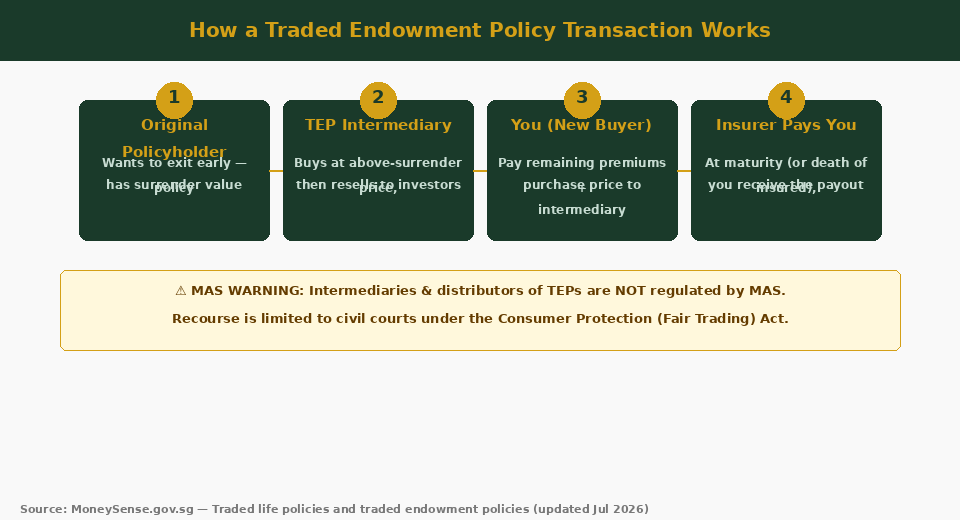
There are three parties in a typical TEP transaction: the original policyholder, the intermediary (or “TEP company”), and you as the buyer. Here is how the process flows:
- Original policyholder decides to exit. They approach a TEP company — examples in Singapore include TES Invest, Conservation Capital, REPs Holdings, and Vita Markets.
- The TEP company buys the policy. They offer a price above the insurer’s surrender value. The policy is transferred via an absolute assignment — a legal mechanism that permanently transfers all rights from the original owner to the new owner.
- The TEP company lists the policy for resale. You see it advertised with details like remaining term, outstanding premiums, and projected maturity value.
- You buy the policy. You pay the TEP company (which includes their margin). The insurer is notified of the change of ownership and acknowledges you as the new policyholder.
- You pay remaining premiums (if any) until the policy matures.
- At maturity, the insurer pays you directly. You receive the sum assured plus any bonuses, just as if you had been the original policyholder.
Transfer typically takes two to four weeks after all documents are submitted and the insurer acknowledges the assignment. MoneySense confirms that the original life insured on the policy remains unchanged — this matters for whole-life policies sold as TLPs (traded life policies), where the payout only comes when that person passes away.
Are TEPs Regulated by MAS? (This Is the Most Important Section)
This is the part that most TEP promoters in Singapore gloss over. According to MoneySense (updated 2 July 2026):
“MAS does not regulate the sale, purchase, or distribution of TLPs and TEPs. This means that any individual or company involved in buying or distributing these policies is not regulated or licensed by MAS.”
This is a significant red flag for everyday Singapore investors. When you buy a new endowment plan from a licensed insurer or financial adviser, MAS oversees the entire process — from what the adviser can recommend, to how the product must be disclosed, to what recourse you have if something goes wrong. With a TEP, none of that applies to the intermediary you’re dealing with.
The insurer who originally wrote the policy is still a licensed entity. And the underlying policy contract remains valid. So when the insurer pays out at maturity, that payment is protected by normal insurance law. The problem is everything that happens in between — the TEP company that sold you the policy, the paperwork, the pricing, and the transfer process — is not supervised by MAS.
MoneySense also notes that TEP products distributed in Singapore could originate from overseas insurers, adding another layer of legal and jurisdictional complexity.
Key Risks You Must Know Before Buying a TEP
MoneySense identifies six major risk categories for TEP buyers. Here they are with a Singapore context added:
| Risk Type | What It Means for You | Severity |
|---|---|---|
| Life extension (TLPs) | For life policies, if the insured lives longer than expected, you pay premiums for longer. Returns fall. | High (TLPs) |
| Legal risk | Overseas-originated policies may involve foreign legal systems. Disputes are your problem to resolve. | High |
| Liquidity risk | TEPs are very illiquid. You cannot easily re-sell. You may be locked in for 10+ years. | High |
| Credit risk | If the original insurer fails, your policy could be worthless. Singapore insurers are stable, but overseas ones less so. | Medium |
| FX risk | If the policy pays out in GBP or USD, exchange rate moves affect your SGD return. | Medium |
| Fraud risk | MoneySense notes fraud has been detected in some countries where TEPs are sold. | High |
Source: MoneySense.gov.sg, updated July 2026
In the current rate environment, with the Fed having hiked to 3.75–4% in September 2026, there are now more low-risk alternatives that offer comparable returns with full MAS protection. T-bills, Singapore Savings Bonds, and new short-term endowment plans from licensed insurers all provide regulatory recourse that TEPs simply cannot match.
TEPs vs New Endowment Plans: Side-by-Side Comparison
If you are weighing a TEP against buying a new endowment plan from a Singapore insurer, here is what the two options look like side-by-side. This is particularly relevant in 2026, where new endowment plan rates have risen in response to the higher rate environment.
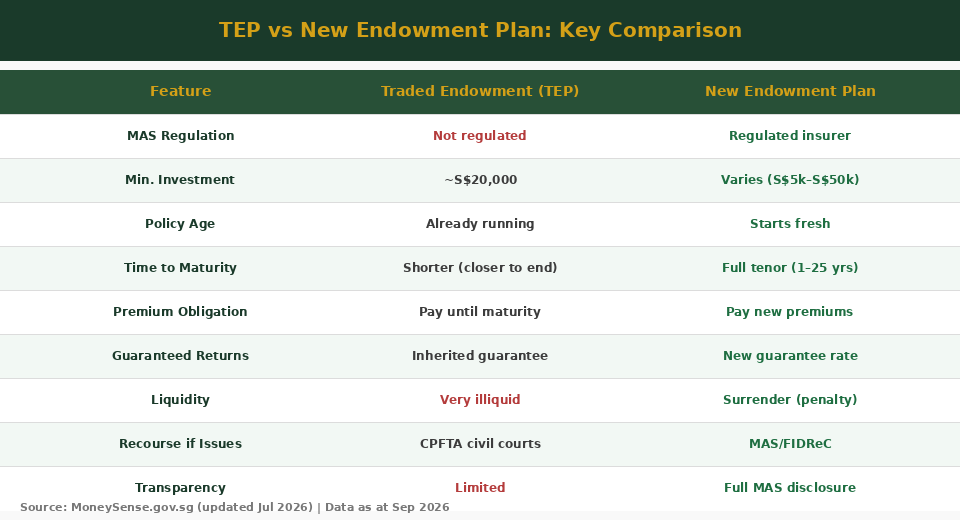
A few points from this comparison stand out. First, new endowment plans from MAS-licensed insurers give you full regulatory recourse through both MAS and FIDReC. You also benefit from the insurer’s licensed financial adviser network and mandatory disclosure requirements. Second, the “shorter time to maturity” benefit of TEPs is real — but only if the pricing is fair. TEP intermediaries build in a margin that may erode the yield advantage.
Third, and critically: new Singapore savings plans after the Sep 2026 rate hike are offering higher guaranteed rates than they did one to two years ago. The gap between TEPs and new plans has narrowed.
If you are specifically looking at endowment plans vs ETF investing, note that both TEPs and new endowment plans come in well below long-run global equity returns — but with much lower volatility and capital risk.
Who Should (and Shouldn’t) Consider TEPs
TEPs are not for everyone. Here is a frank assessment based on the regulatory landscape and the current investing environment in Singapore.
You might consider a TEP if:
- You have significant investable assets (the effective minimum is ~S$20,000 per policy)
- You are comfortable with an unregulated intermediary and have done thorough due diligence on the company’s track record
- You want a specific policy from a reputable Singapore insurer that happens to be available at a price you can verify independently
- You have a legal adviser or financial planner who can review the assignment contract
- The remaining term matches your liquidity needs and you have no need to access funds early
You should probably avoid TEPs if:
- You need any regulatory protection or guaranteed recourse beyond civil courts
- You are investing your emergency fund or funds you may need within 5 years
- You cannot independently verify the policy’s terms directly with the original insurer
- The intermediary cannot provide complete documentation of the policy’s history and bonuses
- You are attracted primarily by promised returns without understanding the liquidity lock-up
For most retail investors in Singapore, there are better-regulated alternatives. Use the Singapore retirement calculator to model what your capital needs to earn to reach your goals — then compare that against the returns on MAS-licensed products first.
If you want capital growth with liquidity, platforms like Endowus (referral code 2V343) or Syfe (code SRPRFFFCD) give you access to diversified portfolios with daily liquidity and MAS oversight — a very different risk profile from a TEP.
Where Are TEPs Sold in Singapore?
Several companies operate in Singapore’s TEP market. None are MAS-regulated for TEP distribution. Do your own due diligence before engaging any of them.
| Company | Website | Note |
|---|---|---|
| TES Invest | tesinvest.com.sg | Focuses on SG local policies |
| Conservation Capital | conservationcapital.com.sg | Published MAS legal status FAQ |
| REPs Holdings | repsholdings.com.sg | Claims “SG No. 1 since 2010” |
| Vita Markets | vitamarkets.com.sg | Also handles policy surrender |
| Endowment Exchange | endowmentexchange.com | Online marketplace format |
This is not an endorsement of any of these companies. The Kopi Notes has not independently verified their operations or track records. None are MAS-regulated for TEP distribution. Data as at Sep 2026.
Before engaging any TEP company, verify their business registration with ACRA, ask for references, and request to see the original policy documents before paying anything. The Singapore endowment plan landscape has many MAS-licensed alternatives worth comparing first.
Frequently Asked Questions
Are traded endowment policies legal in Singapore?
What is the minimum investment for a TEP in Singapore?
Can I claim from MAS or FIDReC if a TEP company cheats me?
What happens if the insurer of my TEP goes bankrupt?
Is buying a TEP better than surrendering my own policy early?
How do traded endowment policies compare to Singapore T-bills in 2026?
The Bottom Line on Traded Endowment Policies
Traded endowment policies occupy a niche but genuine corner of Singapore’s investment landscape. The concept is sound — buying a second-hand policy closer to maturity to reduce the waiting period for returns. But the execution risk is significant.
The unregulated nature of TEP intermediaries is the central issue. In 2026, with MAS-regulated alternatives offering solid yields — from T-bills to new endowment plans from licensed insurers — most Singapore retail investors will find better risk-adjusted value staying within the regulated ecosystem.
If you do decide to explore TEPs, treat it as you would any unregulated investment: do exhaustive due diligence, involve a lawyer for the assignment contract, and never invest money you cannot afford to lock up for the full remaining term.
Get Free Insurance Advice
Speak with a licensed insurance advisor. No obligation, no cost.
By submitting this form, you agree to our Privacy Policy.
This article was researched with the help of AI. While we strive to keep all information accurate and up to date, there may be errors. If you notice any discrepancies, please contact us.