Singapore Savings Plans After the Fed Rate Hike: What 3.75–4% Means for Your Returns 2026
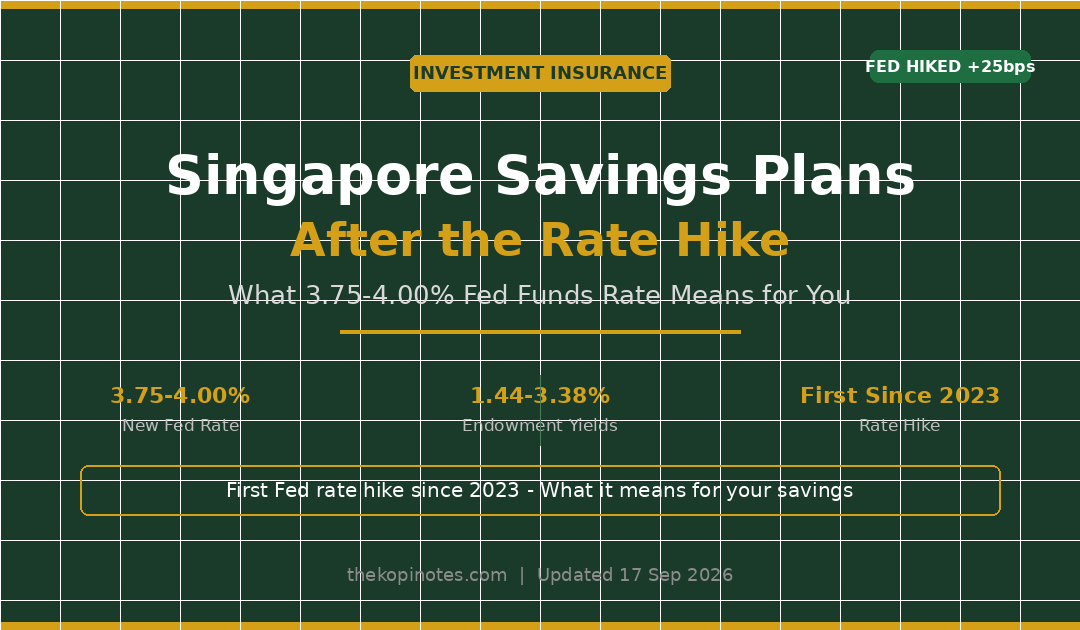
The US Federal Reserve raised its benchmark rate by 25 basis points to 3.75–4.00% on 17 September 2026 — the first rate hike since 2023. For Singapore savers holding endowment plans, T-bills, and fixed deposits, this changes the calculus. This guide explains what actually happens to each savings product when US rates go up.
Table of Contents
The Fed Rate Hike: What Happened and Why
The Federal Open Market Committee (FOMC) voted on 17 September 2026 to raise the federal funds rate by 25 basis points, bringing it to a target range of 3.75–4.00%. This is the first rate hike since 2023, when the Fed had spent most of the prior two years cutting rates to stimulate the economy.
The reversal surprised markets. Coming into September, futures had been pricing a rate cut. The Fed’s decision to hike instead reflects two things: a re-acceleration of US inflation to approximately 3.4–3.7% driven largely by higher oil prices following geopolitical disruptions in the Middle East, and Fed Chair Kevin Warsh’s stated preference for re-anchoring inflation expectations before easing monetary conditions further.
Why does the FOMC matter to Singapore savers? Singapore does not directly follow Fed rate decisions — the Monetary Authority of Singapore (MAS) manages monetary policy through the Singapore dollar nominal effective exchange rate (SGD NEER) band, not through interest rates. However, because Singapore’s financial system is deeply integrated with global dollar markets, a higher Fed funds rate tends to push up Singapore interbank borrowing rates (SORA), which in turn feeds through to what savers earn on T-bills, fixed deposits, and insurance savings products.
How US Rate Hikes Affect Singapore Savings Rates
The transmission from Fed rate hike to Singapore savings rates is not instant, but the direction is typically clear. Here is the general sequence:
1. SORA rises. The Singapore Overnight Rate Average (SORA) is influenced by global dollar funding conditions. When the Fed raises rates, international investors adjust their dollar positions, which pushes up SORA within days to weeks.
2. T-bill cut-off rates rise. Singapore Treasury bills are auctioned bi-weekly. The cut-off yield at each auction reflects current market demand and the prevailing interest rate environment. When SORA rises after a Fed hike, T-bill yields at subsequent auctions typically rise as well — though the magnitude and timing depends on how much of the hike was already priced in.
3. Banks raise fixed deposit rates. Singapore banks compete for retail deposits. When market rates rise, banks typically adjust their fixed deposit rates upward over the following weeks, though they are slower to move up than to pass through rate cuts.
4. Endowment plan yields on new tranches increase. Non-participating (non-par) endowment plans are backed primarily by Singapore Government Securities and corporate bonds. When yields on these instruments rise, insurers can offer higher guaranteed returns on new tranches. Plans currently open may not change, but new tranches launched after the rate hike are likely to offer higher guaranteed yields.
The key caveat throughout: this is the general pattern, not a guarantee. MAS’s SGD NEER management means Singapore rates can partly diverge from US moves, especially if the MAS is tightening or easing its own currency settings at the same time.
Endowment Plans After the Rate Hike
Endowment plans — also known as savings insurance plans or insurance savings plans — are the primary fixed-income savings product sold by Singapore life insurers. They come in two main types:
- Non-participating (non-par) single-premium plans: Fully guaranteed return, typically 1.44–3.38% p.a. for tenors of 1–5 years. These are the most comparable to fixed deposits.
- Participating (par) whole-life or endowment plans: A guaranteed portion plus a non-guaranteed bonus that depends on the insurer’s par fund performance. Longer tenor, often 10–25 years.
For existing policyholders, nothing changes. If you already hold a non-par endowment plan, your guaranteed yield is locked in for the policy term regardless of what happens to the Fed funds rate. A policyholder who locked in a 3.38% p.a. guaranteed yield in August 2026 continues to earn exactly that rate.
For new savers, the outlook improves. Because insurers’ investment income rises when interest rates go up, they have room to offer higher guaranteed yields on new tranches. Historically, a 25bps Fed hike translates to a 15–30bps improvement in new endowment plan yields over the following 1–3 months, as existing tranches close and new ones are priced at higher rates.
Current verified guaranteed yields on open plans (as at September 2026) include:
| Plan | Insurer | Guaranteed Yield | Tenor | Notes |
|---|---|---|---|---|
| AIA Wealth Savvy (no longer available — was offered on a tranche basis) | AIA | 3.00% p.a. | 3 years | Single premium, non-par |
| Singlife Max Saver II | Singlife | 2.00% p.a. | 2 years | SRS eligible |
| NTUC Income Gro Capital Ease | Income | 1.44% p.a. | 3 years | Par plan, guaranteed portion only |
| Etiqa EasySave | Etiqa | ~2.70% p.a.* | 2 years | *Verify availability with insurer |
Rates and plan availability change frequently. Always verify directly with the insurer before applying. SDIC protection applies up to S$100,000 per policy owner per insurer for eligible benefits.
With a higher-rate environment taking hold, it is reasonable to expect insurers to launch new tranches with yields closer to — or slightly above — the current market leaders over the next one to two months. If you are not in a hurry, watching for new tranche announcements over October–November 2026 may offer better entry yields than locking in today.
For a full guide to how these plans work and how to compare them, see our Singapore Endowment Plan Guide 2026.
T-Bills and Singapore Savings Bonds: What Happens Next
Singapore 6-month and 1-year T-bills are among the most popular short-term fixed-income instruments for retail investors. They are auctioned on a bi-weekly schedule, and the cut-off yield at each auction reflects prevailing market conditions.
6-month T-bill: Before the September 2026 rate hike, 6-month T-bill cut-off yields were running at approximately 3.05–3.15% p.a. With the Fed now at 3.75–4.00%, subsequent auctions over the next one to two months are likely to reflect a higher yield — possibly in the 3.20–3.40% range, though this depends on how much of the hike was already priced in by the market.
1-year T-bill: Tends to track 6-month yields closely, with a slight premium for the additional duration. Expect similar upward pressure.
Singapore Savings Bonds (SSB): SSBs are fixed-rate instruments where the interest rate for each monthly issuance is set at the time of announcement. The average 10-year yield on recent SSBs has been in the 2.60–2.80% range. Rate hikes typically push SSB rates higher over the following one to two months as underlying SGS yields adjust.
One key difference between T-bills/SSBs and endowment plans is flexibility. T-bills and SSBs can be sold on the secondary market or redeemed early without penalty (SSBs allow full redemption at any interest payment date). This makes them a more liquid option for savers who want to ride rising rates without being locked in.
For more detail on T-bill mechanics and how to apply, see our Singapore T-Bill Interest Rate Guide.
Fixed Deposits: Waiting for Banks to Move
Singapore banks — DBS, OCBC, UOB, CIMB, and others — adjust their fixed deposit (FD) rates based on their own cost-of-funds calculations, competitive pressures, and market conditions. They are typically slower to raise deposit rates than they are to pass through rate cuts.
Before the September rate hike, competitive 12-month FD rates in Singapore were in the range of approximately 2.50–3.00% p.a. for amounts above S$10,000. Following a 25bps hike, banks are unlikely to immediately revise their board rates — but competitive pressure from T-bills and endowment plans may push them to adjust within 4–8 weeks.
What to watch: CIMB, Standard Chartered, and digital banks (GXS, MariBank) tend to be more aggressive in adjusting deposit rates to attract deposits. It is worth checking these banks’ promotions before committing to a new FD at your primary bank’s current rate.
MariBank: MariBank offers a savings account with competitive rates. For new users, the referral code 2DCT80WQ may apply to welcome promotions. Always verify the current rate at maribank.com/savings before depositing.
Side-by-Side Comparison: Singapore Savings Products in a Higher-Rate Environment
The chart below summarises how each major savings product is positioned after the September 2026 rate hike. All indicative rates assume modest upward adjustment of 15–25bps from pre-hike levels over the next 4–8 weeks.
* All post-hike rate estimates are indicative only and depend on how quickly Singapore interbank rates and individual institutions adjust. Verify current rates before making any decision. This is not financial advice.
What Should Singapore Savers Consider Now?
The rate hike does not create an obvious single right answer — it depends on your goals, timeline, and risk tolerance. Here are some frameworks savers are considering:
Framework 1: Ride rising rates with shorter tenors. If you believe rates will continue rising or stay high for a while, locking in a 3-year endowment plan today may mean missing higher yields available 2–3 months from now. Shorter-tenor instruments like 6-month T-bills let you roll over at potentially higher rates and maintain flexibility.
Framework 2: Lock in certainty if you have a specific goal. If you need a guaranteed sum in exactly 3 years (e.g. for a house downpayment), a non-par endowment plan at 3.00% p.a. guaranteed may be better than rolling 6-month T-bills, because you eliminate reinvestment risk. The current AIA Wealth Savvy (no longer available — was offered on a tranche basis) rate may look attractive even in a rising-rate environment if certainty is your priority.
Framework 3: Use a cash management account for flexibility. Products like Endowus Cash+, Syfe Cash+, and money market funds offer liquid access to higher yields without locking in. As market rates rise, these floating-rate products typically adjust upward within weeks. For a free-to-try experience, Endowus referral code 2V343 gives new users bonus credits, and Syfe referral code SRPRFFFCD offers a similar welcome benefit.
Framework 4: Diversify across tenors. Splitting your savings across a 6-month T-bill, a 1-year SSB, and a 2-year endowment plan gives you exposure to different maturities. As each matures, you redeploy at the rate available at that time — a strategy sometimes called a “savings ladder.”
None of these approaches is objectively superior — the right fit depends on your individual cash flow needs, tax situation (especially if you have SRS funds), and view on where rates go from here. For SRS-specific guidance, our SRS Account Singapore Guide covers SRS-eligible savings products in detail.
If you are looking for help structuring a savings portfolio, Endowus and Syfe both offer commission-free advisory services for cash and SRS portfolios. Use referral code 2V343 at Endowus or SRPRFFFCD at Syfe to access their platforms.
Frequently Asked Questions
”Did
”Does
”What
”Are
”Should
”What
”Is
Explore Singapore Savings Products
Maximise your savings in a higher-rate environment with the right platform and products.
- Endowus referral code 2V343 — fee rebates on Cash+ and CPF/SRS investing
- Syfe referral code SRPRFFFCD — fee waiver for new users on Cash+ and portfolios
- MariBank referral code 2DCT80WQ — welcome bonus for new MariBank savings account
- Singapore Endowment Plan Guide 2026 — full comparison of open plans
- Retirement Planning Calculator — see how higher savings rates affect your retirement projections
This article is for informational purposes only and does not constitute financial advice. All savings product rates and availability change frequently — verify with the provider before making any decision. The Kopi Notes may receive referral compensation for some links above.
Get Free Insurance Advice
Speak with a licensed insurance advisor. No obligation, no cost.
By submitting this form, you agree to our Privacy Policy.
This article was researched with the help of AI. While we strive to keep all information accurate and up to date, there may be errors. If you notice any discrepancies, please contact us.