CPF Calculator 2026: Contribution Rates, OA/SA/MA Allocation & Take-Home Pay
📋 Table of Contents
- What Is the CPF Calculator?
- 2026 CPF Contribution Rates by Age Group
- CPF OA, SA & MediSave Allocation Rates
- How to Calculate Your CPF Contributions
- 2026 Ordinary Wage Ceiling & Additional Wage Ceiling
- Take-Home Pay Examples (Worked Calculations)
- CPF Calculator for Age 55 and Above
- Making the Most of Your CPF
- FAQs About CPF Calculator 2026
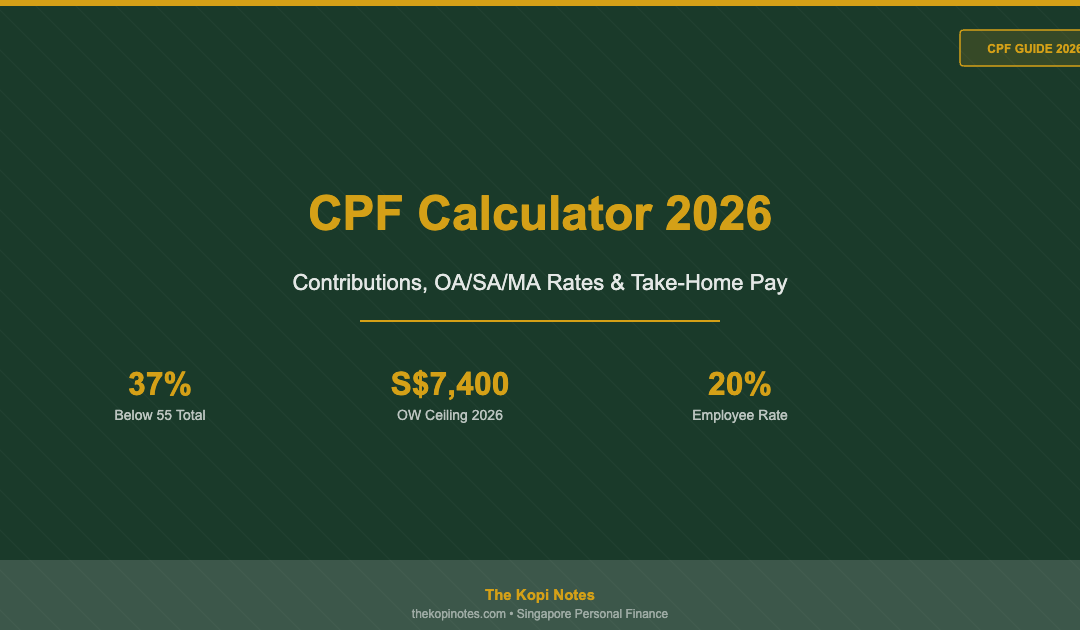
A CPF calculator for 2026 helps Singapore workers compute their exact monthly CPF contributions based on the updated Ordinary Wage (OW) ceiling of S$7,400, age-tiered contribution rates (20% employee + 17% employer for workers below 55), and the OA/SA/MediSave allocation ratios. Total CPF contributions can range from 12.5% to 37% of wages depending on your age — this guide walks you through the exact formula, every rate change for 2026, and worked S$-figure examples.
Not financial advice. All CPF figures are sourced from CPF Board and are for educational reference only. Data as at November 2026 unless noted.
What Is the CPF Calculator?
A CPF calculator is a tool that computes how much you and your employer contribute to your Central Provident Fund (CPF) each month, and how those contributions are split across your three CPF accounts: the Ordinary Account (OA), Special Account (SA), and MediSave Account (MA).
The CPF Board provides an official online CPF calculator at cpf.gov.sg, but many Singaporeans prefer using independent calculators — like the CPF Net Salary & Deduction Calculator on The Kopi Notes — that offer clearer breakdowns and can model take-home pay alongside CPF contributions.
For 2026, three key inputs determine your CPF contribution amount:
- Your monthly ordinary wages — capped at S$7,400 for CPF purposes (the 2026 Ordinary Wage Ceiling)
- Your age bracket — contribution rates step down at ages 55, 60, 65, and 70
- Your employment status — employee and employer rates differ; self-employed persons (SEPs) contribute only to MediSave
Understanding your CPF calculation matters for cash flow planning, knowing when you can tap your OA for housing, and mapping out your retirement balance trajectory. For long-term projections, pair this guide with TKN’s Singapore retirement calculator.
2026 CPF Contribution Rates by Age Group
CPF contribution rates in Singapore are age-banded — the younger you are, the higher the combined employee + employer contribution. This design front-loads savings into CPF during peak earning years when you need them least, then reduces the burden as workers approach retirement age.
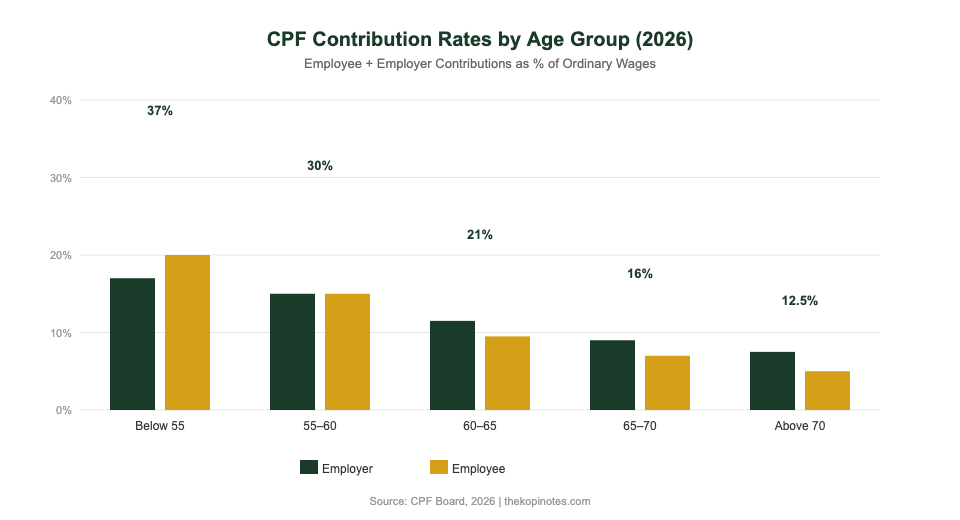
Source: CPF Board, 2026 Contribution Rate Table
2026 CPF Contribution Rates Table (Employees & Employers)
| Age (Last Birthday) | Employee (%) | Employer (%) | Total (%) |
|---|---|---|---|
| Below 55 | 20% | 17% | 37% |
| 55–60 | 15% | 15% | 30% |
| 60–65 | 9.5% | 11.5% | 21% |
| 65–70 | 7% | 9% | 16% |
| Above 70 | 5% | 7.5% | 12.5% |
Source: CPF Board, 2026. Rates apply to Singaporeans and Singapore Permanent Residents (SPRs from their 3rd year onwards).
Key change in 2026: The Ordinary Wage Ceiling has been raised to S$7,400 per month (from S$6,800 in 2024), meaning workers earning above S$7,400/month now have more wages subject to CPF contributions. This benefits higher-income earners by channelling more into retirement savings — but also slightly reduces take-home pay for those who cross the threshold.
CPF OA, SA & MediSave Allocation Rates (2026)
Your total CPF contribution is not deposited into a single account — it is split across up to three accounts according to CPF Board’s allocation ratios. Understanding these splits is essential for housing planning (OA), retirement savings (SA/RA), and medical coverage (MediSave).
Important 2025–2026 change: Following the CPF LIFE transition, contributions to the Special Account (SA) for members aged 55 and above effectively ceased from January 2025, as SA savings are transferred to the Retirement Account (RA) upon reaching 55. For workers below 55, the SA still receives contributions.
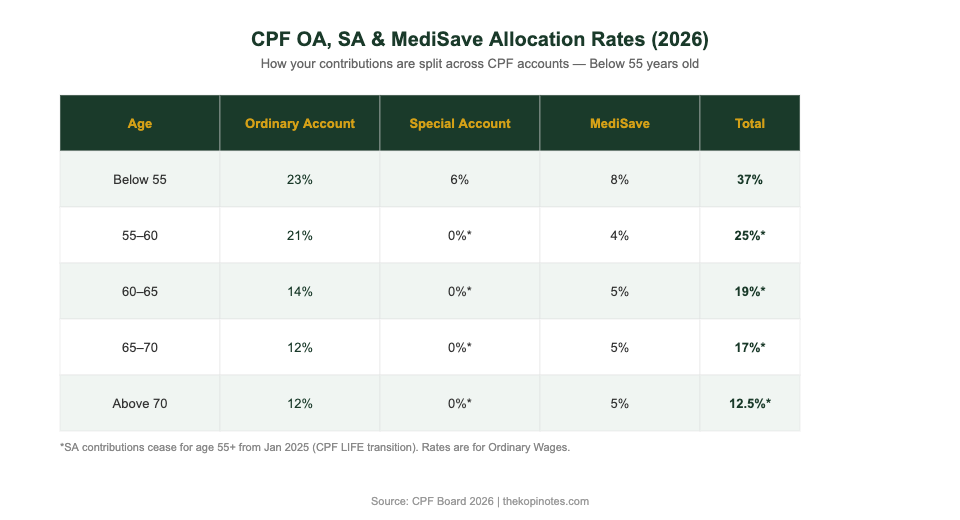
Source: CPF Board, 2026 Allocation Rate Table
CPF Allocation Rates: Below 55 (Most Common)
For the majority of Singapore workers — those below 55 — the total 37% contribution breaks down as:
| CPF Account | Allocation Rate | What It’s For | 2026 Interest Rate |
|---|---|---|---|
| Ordinary Account (OA) | 23 percentage points | Housing, education, investment | 2.5% p.a. |
| Special Account (SA) | 6 percentage points | Retirement savings (long-term) | 4.0% p.a. |
| MediSave (MA) | 8 percentage points | Medical expenses, insurance | 4.0% p.a. |
Note: The first S$60,000 in combined CPF balances earns an extra 1% interest. Members aged 55–65 earn an additional 1% on the first S$30,000. Source: CPF Board, 2026.
The SA earns 4.0% — significantly better than what most Singapore banks offer on savings accounts in 2026. This is a key reason why maximising CPF SA contributions (via voluntary top-ups) is a cornerstone of CPF investment strategy for many Singapore workers.
How to Calculate Your CPF Contributions (Step-by-Step)
Here is the exact calculation method for a Singapore employee below age 55 earning ordinary wages of S$5,500/month in 2026:
Step 1: Determine applicable wages
Ordinary wages of S$5,500 are below the S$7,400 OW ceiling, so the full S$5,500 is subject to CPF.
Step 2: Calculate employee contribution
S$5,500 × 20% = S$1,100 (deducted from your pay)
Step 3: Calculate employer contribution
S$5,500 × 17% = S$935 (paid by employer, on top of your salary)
Step 4: Total CPF inflow
S$1,100 + S$935 = S$2,035 per month into your CPF accounts
Step 5: Break down by account
- OA: S$2,035 × (23/37) ≈ S$1,265
- SA: S$2,035 × (6/37) ≈ S$330
- MediSave: S$2,035 × (8/37) ≈ S$440
Take-home pay = S$5,500 − S$1,100 (employee CPF) = S$4,400 net cash
Tip: Use TKN’s CPF Net Salary Calculator to model different salary levels, ages, and bonus months instantly — no manual calculation needed.
2026 Ordinary Wage Ceiling & Additional Wage Ceiling Explained
Two ceilings govern how much of your income is subject to CPF contributions:
Ordinary Wage (OW) Ceiling — S$7,400/month
The OW ceiling caps the monthly salary on which CPF is computed. If you earn S$9,000/month, only S$7,400 is subject to the full CPF rate. The ceiling has been rising progressively: S$6,000 (2023) → S$6,300 (2024) → S$6,800 (2025) → S$7,400 (2026 and beyond).
This ceiling increase is good news for retirement savings — more of higher earners’ wages are now channelled into OA/SA/MediSave — but results in a slight take-home pay reduction for those earning above S$6,800.
Additional Wage (AW) Ceiling — Annual Bonus CPF
For bonus payments (AWS, variable bonus, commissions), the AW ceiling is: S$102,000 − total ordinary wages already contributed in that calendar year.
Example: An employee earning S$7,400/month has ordinary wage contributions totalling S$7,400 × 12 = S$88,800. Their AW ceiling = S$102,000 − S$88,800 = S$13,200. CPF applies to only the first S$13,200 of any bonus received.
This mechanism means employees earning the maximum OW ceiling throughout the year effectively reduce CPF liability on large year-end bonuses above S$13,200.
For context on how to put your OA savings to work beyond housing, see our guide to passive income Singapore strategies — many Singapore investors deploy CPF OA savings into Singapore T-bills or REITs via the CPFIS scheme.
Take-Home Pay Examples: CPF Calculations for Common Salary Levels (2026)
Here is how CPF calculations work across four common salary levels for a Singapore employee below age 55:
| Monthly Salary (OW) | Employee CPF (20%) | Employer CPF (17%) | Total CPF | Take-Home Pay |
|---|---|---|---|---|
| S$3,000 | S$600 | S$510 | S$1,110 | S$2,400 |
| S$5,000 | S$1,000 | S$850 | S$1,850 | S$4,000 |
| S$7,400 (ceiling) | S$1,480 | S$1,258 | S$2,738 | S$5,920 |
| S$10,000 (above ceiling) | S$1,480* | S$1,258* | S$2,738* | S$8,520 |
*CPF on S$7,400 capped OW only. The remaining S$2,600 of the S$10,000 salary is not subject to CPF (OW ceiling applies). Take-home = Gross salary − Employee CPF contribution.
For a deeper look at how to grow your savings using Singapore government instruments, our Singapore T-bills 2026 guide explains how to channel OA funds into T-bills via CPFIS for potentially higher returns than the 2.5% OA rate.
CPF Calculator for Age 55 and Above — What Changes?
Reaching 55 is a milestone in Singapore’s CPF system. Several significant changes occur:
1. Contribution Rates Step Down
At 55, combined CPF contributions drop from 37% to 30% (employee 15% + employer 15%). This reduction was introduced to ease employment costs for older workers while keeping them competitive in the labour market. Rates continue stepping down every five years (see the table above).
2. Retirement Account (RA) Is Created
When you turn 55, CPF automatically creates a Retirement Account (RA) and transfers savings from your SA and OA (up to the Full Retirement Sum) into it. The RA earns 4.0% interest and is the foundation for your CPF LIFE monthly payouts from age 65.
For 2026, the Full Retirement Sum (FRS) is S$213,000. The Basic Retirement Sum (BRS) is S$106,500 and the Enhanced Retirement Sum (ERS) is S$319,500.
3. SA Top-Ups Cease (From Jan 2025)
Following the CPF LIFE changes effective January 2025, the SA for members aged 55+ has been wound down. Voluntary contributions and top-ups are redirected to the RA or MediSave instead. This affects the classic “SA shielding” strategy — confirm the current rules with CPF Board directly.
4. OA Withdrawals Become Available
At 55, you may withdraw up to S$5,000 from your OA and SA (above the BRS threshold). This is a popular “first withdrawal” for many Singaporeans to access funds for lump-sum expenses or to seed an investment portfolio in best S-REITs in Singapore 2026 or ETFs.
Making the Most of Your CPF in 2026
Once you understand your CPF calculation, the next question is: should you supplement or redirect CPF savings to grow wealth faster?
Option 1: CPF Voluntary Top-Ups
Topping up your SA (or RA if you’re 55+) under the Retirement Sum Topping-Up Scheme (RSTU) earns 4.0% — better than most fixed deposits and Singapore Savings Bonds in 2026. Cash top-ups also qualify for income tax relief of up to S$8,000/year for yourself and an additional S$8,000 for family members.
Option 2: CPF Investment Scheme (CPFIS)
OA savings above S$20,000 can be invested via CPFIS into unit trusts, Singapore Savings Bonds, T-bills, and selected stocks. However, since the OA already earns a guaranteed 2.5%, investments must comfortably beat this hurdle rate to justify the risk.
Platforms like Endowus (use referral code 2V343 for fee rebates) allow you to invest CPF OA and SA savings into low-cost global funds — a popular option for Singaporeans who want market returns within the CPF framework.
Option 3: Focus on Non-CPF Investments for Higher Growth
For many Singapore investors under 45, CPF is best left untouched (compounding at 4% SA rate) while discretionary income is invested via a brokerage in dividend stocks, S-REITs, or global ETFs. Run your numbers with our Singapore retirement calculator to find the right balance.
FAQs: CPF Calculator 2026
What is the CPF contribution rate for 2026 in Singapore?
For employees below 55, the CPF contribution rate is 20% (employee) + 17% (employer) = 37% total. Rates step down with age: 30% for 55–60, 21% for 60–65, 16% for 65–70, and 12.5% for above 70. The 2026 Ordinary Wage Ceiling is S$7,400/month, up from S$6,800 in 2024.
How do I calculate my take-home pay after CPF?
Your take-home pay = Gross ordinary wages − Employee CPF contribution. Example: S$5,000 salary − S$1,000 (20% employee CPF) = S$4,000 net cash. The employer’s 17% contribution (S$850) is paid separately on top of your salary — it doesn’t reduce your take-home pay.
What is the CPF OW ceiling for 2026?
The 2026 Ordinary Wage (OW) Ceiling is S$7,400 per month. Only wages up to this amount are subject to CPF contributions. For higher earners, wages above S$7,400/month are not subject to the standard CPF rate (though Additional Wage contributions still apply to bonus payments up to the annual ceiling of S$102,000).
How is CPF split between OA, SA, and MediSave?
For workers below 55 (total 37% rate): 23 percentage points go to the Ordinary Account (OA), 6 percentage points to the Special Account (SA), and 8 percentage points to MediSave. This means roughly 62% of your total CPF inflow goes to OA, 16% to SA, and 22% to MediSave. For workers 55+, allocation ratios shift and SA contributions effectively cease.
What happens to CPF contributions when I turn 55?
At 55, your CPF contribution rate drops to 30% (15% employee + 15% employer). A new Retirement Account (RA) is created using your SA and OA savings (up to the Full Retirement Sum of S$213,000 for 2026). You may also withdraw up to S$5,000 from your CPF if your balances exceed the Basic Retirement Sum. CPF LIFE payouts begin at age 65.
Can self-employed persons use the CPF calculator?
Self-employed persons (SEPs) in Singapore are not required to make CPF contributions to their OA or SA, but are required to contribute to MediSave based on their annual net trade income (NTI). SEP MediSave contributions range from S$78 (income S$6,000) to 8% of NTI (income above S$6,000), capped at the Basic Healthcare Sum (BHS) of S$75,500 for 2026. SEPs can make voluntary CPF top-ups to their SA for retirement and tax relief purposes.
Is CPF interest rate changing in 2026?
The CPF OA rate remains at 2.5% p.a. and the SA/MediSave rates remain at 4.0% p.a. for 2026. These rates have been maintained despite the global interest rate cycle, as CPF rates are set by the Singapore government and reviewed periodically. The extra 1% bonus interest on the first S$60,000 in combined balances (and additional 1% for ages 55–65 on the first S$30,000) also continues in 2026.
This article was researched with the help of AI. While we strive to keep all information accurate and up to date, there may be errors. If you notice any discrepancies, please contact us.