How to Invest in Singapore as a Freelancer or Self-Employed Person (2026)
MediSave rules, SRS tax relief, and a savings plan built for income that changes every month.
Table of Contents
Contents — Click to expand
- Why Self-Employed Investors Start From a Different Line
- MediSave Rules You Must Know (2026)
- Building an Emergency Fund on Irregular Income
- Using SRS to Replace the CPF Top-Ups You’re Missing
- Grab, Foodpanda, and Deliveroo Workers: What’s Different
- How to Actually Invest as a Freelancer
- DIY, Robo-Advisor, or SRS-Linked Fund?
- FAQ
If you’re self-employed in Singapore, no employer tops up your CPF Ordinary or Special Account. Only MediSave contributions are mandatory, and only once your net trade income (NTI) passes $6,000 a year. That gap is exactly why a deliberate savings and investing plan — built around SRS, ETFs, and a proper emergency fund — matters more for freelancers than for employees, not less.
Not financial advice. All figures are for educational reference only. Data verified as at 21 August 2026 against CPF Board and IRAS official sources unless otherwise noted.
- MediSave contributions are mandatory once your net trade income passes $6,000 a year — rates run from 4% to 10.5% depending on your age, capped at your Basic Healthcare Sum ($79,000 for 2026).
- You don’t get the 37% employer-plus-employee CPF top-up that a similarly-paid employee gets. SRS (capped at $15,300 a year for citizens and PRs) is the closest substitute, with full tax relief.
- Build a 6-month expense buffer before you invest anything else — irregular income means you can’t rely on monthly salary to smooth over a bad month.
Why Self-Employed Investors Start From a Different Line
When you’re an employee in Singapore, saving for retirement is partly automatic. Every month, 20% of your wage is deducted and your employer adds another 17% on top (for most workers below 55), and the combined 37% flows into your Ordinary, Special, and MediSave Accounts without you lifting a finger.
Freelancers, consultants, sole proprietors, and hawkers don’t get that employer half. As a self-employed person (SEP), you’re only required by law to contribute to one CPF account — MediSave — and only above a net trade income (NTI) threshold. There’s no mandatory Ordinary Account or Special Account contribution at all, which means the retirement and housing savings an employee builds passively simply don’t happen for you unless you top them up yourself.
This isn’t a reason to panic. It’s a reason to be deliberate. Once you understand exactly what’s mandatory, what’s optional, and what tools like SRS exist to close the gap, you can build a plan that’s arguably more flexible than a salaried employee’s — you decide how much goes where, instead of having it fixed by payroll rules.
This guide builds on our beginner investing guide for Singapore.
MediSave Rules Every Self-Employed Person Must Know (2026)
The moment your net trade income for the year exceeds $6,000, CPF Board requires you to contribute to MediSave. Your NTI is your gross trade income minus allowable business expenses, capital allowances, and trade losses, as assessed by IRAS when you file your income tax return — you don’t file a separate declaration with CPF Board.
Once IRAS finishes assessing your income, CPF Board sends you a Notice of CPF Contributions for Self-Employed Persons, and you have 30 days from that notice to pay. The rate you pay depends on both your age as at 1 January of the work year and your NTI band.
| Net Trade Income | Below 35 | 35 to <45 | 45 to <50 | 50 & above |
|---|---|---|---|---|
| $6,000 – $12,000 | 4.00% | 4.50% | 5.00% | 5.25% |
| $12,000 – $18,000 | Phased in between the lower and upper rate | |||
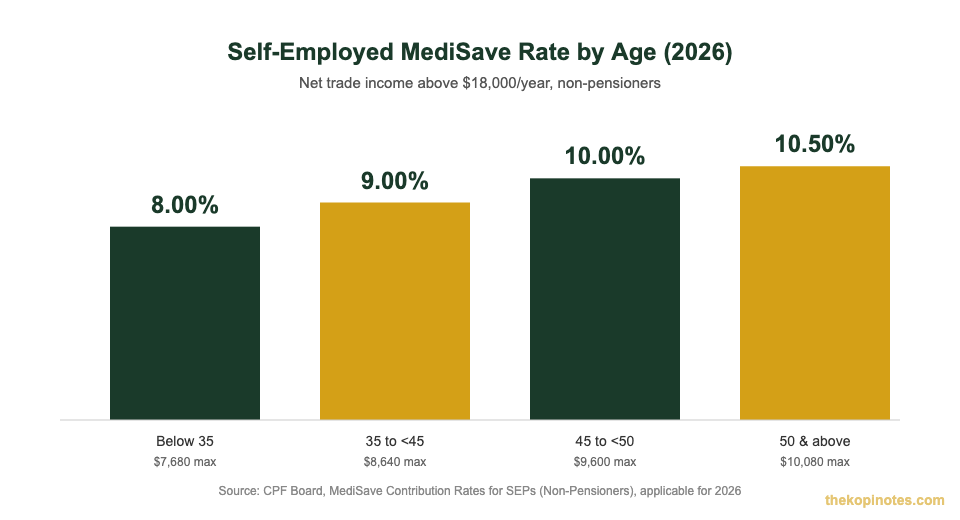
| Above $18,000 | 8.00% (max $7,680) | 9.00% (max $8,640) | 10.00% (max $9,600) | 10.50% (max $10,080) |
Source: CPF Board, MediSave Contribution Rates for SEPs (Non-Pensioners), applicable for 2026.
Your MediSave balance is capped at the Basic Healthcare Sum (BHS), which rose to $79,000 for 2026 (up from $75,500 in 2025) for members below 65. Once your MediSave Account hits that ceiling, any further mandatory contribution simply isn’t collected — though few freelancers hit this cap through mandatory contributions alone.
There’s an upside worth knowing: mandatory MediSave contributions get you full income tax relief, dollar for dollar. If you top up voluntarily beyond the mandatory amount, that relief is capped — check the IRAS CPF relief page for the current caps before topping up. If cash flow is tight, CPF Board also lets you use Contribute-As-You-Earn (CAYE) so contributions are deducted gradually as corporate clients pay your invoices, instead of one lump sum after your Notice of Assessment arrives.
Building an Emergency Fund on Irregular Income
Before you invest a single dollar, freelancers need a bigger buffer than employees do. An employee with a stable $5,000 monthly salary can reasonably hold 3 months of expenses in cash. A freelance photographer whose income swings between $2,000 and $9,000 a month needs more runway, because a slow quarter isn’t a hypothetical — it’s a near-certainty at some point in the year.
A practical rule: hold 6 months of your average monthly expenses (not income) in a savings account or T-bills before you invest anything beyond mandatory MediSave. If your income is especially lumpy — say, project-based consulting with long gaps between payouts — extend that to 9 months.
On top of the emergency fund, keep a separate “tax and MediSave” sinking fund. Because your income tax and MediSave bills arrive as lump sums months after you earned the money, it’s easy to spend it and then scramble when the Notice of Assessment lands. A simple habit: the moment a client pays you, move 20-25% of that invoice into a separate account earmarked for tax and MediSave, and don’t touch it until the bill comes.
Only once both buffers are funded should new income go toward investing. Our market-crash survival guide covers what to do if you’re forced to dip into investments during a lean month — but the better answer is to avoid needing to in the first place.
Using SRS to Replace the CPF Top-Ups You’re Missing
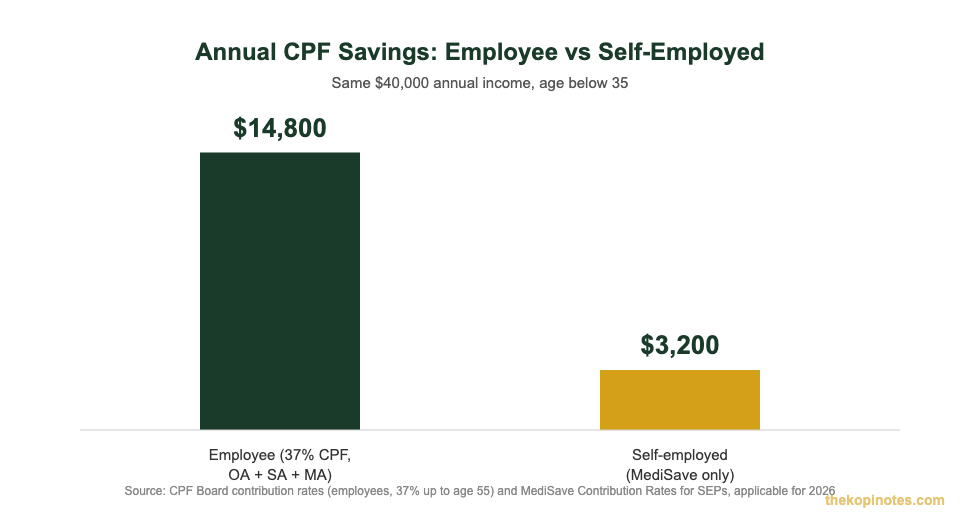
Here’s the calculation that makes the gap concrete. Take a 32-year-old freelance graphic designer and a 32-year-old employee, both earning $40,000 a year.
| Worker | Annual CPF-Type Savings | Where It Goes |
|---|---|---|
| Employee ($40,000 wage) | $14,800 (37% total) | Ordinary, Special & MediSave Accounts |
| Self-employed ($40,000 NTI) | $3,200 (8% NTI) | MediSave Account only |
Source: CPF Board contribution rate table (employees, 37% total up to age 55, Ordinary Wage ceiling $8,000/month for 2026) and MediSave Contribution Rates for SEPs, applicable for 2026. Illustrative calculation by The Kopi Notes.
That’s an $11,600-a-year gap in forced savings — money the employee never sees but which quietly compounds toward retirement and a home. As a freelancer, nobody puts that $11,600 away for you. The Supplementary Retirement Scheme (SRS) is the closest official tool to close it.
You can contribute up to $15,300 a year to SRS as a Singapore Citizen or PR ($35,700 for foreigners), and every dollar you put in reduces your taxable income by the same amount. Unlike CPF, SRS money can be invested in unit trusts, ETFs, robo-advisor portfolios, and single stocks through participating banks and brokers — it isn’t locked into government bonds earning a fixed rate.
The trade-off: SRS withdrawals before the statutory retirement age (currently 63 for those who began contributing from 2022) are taxed in full plus a 5% penalty, with limited exceptions. So treat SRS as genuinely locked-away retirement money, not a flexible investment account — it’s meant to substitute for the CPF Special Account you’re not building.
A workable split for many freelancers: contribute enough to MediSave to stay compliant (mandatory, non-negotiable), fund SRS up to a level you’re comfortable locking away for tax relief, and invest anything left over in a flexible brokerage or robo-advisor account you can access before age 63 if you need to. Endowus and Syfe both offer SRS-linked portfolios alongside cash accounts, which makes it easy to run both buckets from one platform.
Grab, Foodpanda, and Deliveroo Workers: What’s Different
If you drive for Grab, deliver for foodpanda or Deliveroo, or take on tasks through a similar app, you’re a “platform worker” under Singapore’s Platform Workers Act — a distinct category from the general self-employed. Since 2025, platform operators have been required to make CPF contributions on your behalf automatically, similar to how an employer does for a regular employee.
Platform workers born in or after 1995 are defaulted into this scheme; those born earlier can opt in voluntarily. Contribution rates are being phased up gradually from 2025 through to 2029, when they’re due to reach the same 20% (worker) and 17% (platform operator) split that regular employees and employers pay. Because the exact rate depends on your age band and whether you’ve opted in, use CPF Board’s platform worker CPF contribution calculator for your specific figure rather than relying on a single quoted percentage.
One practical consequence: if platform work is your only income, you no longer need to separately calculate and pay MediSave on those earnings — your platform operator’s contributions already cover it, and platform income is excluded from the net trade income used in the self-employed MediSave calculation from work year 2025 onwards. If you also freelance outside the platform (say, you drive for Grab part-time and do freelance design work on the side), the two income streams are treated separately: platform earnings go through the platform operator’s CPF contributions, and your other freelance NTI is still assessed under the standard self-employed MediSave rules above.
How to Actually Invest as a Freelancer (Step-by-Step)
Step 1: Get compliant first. Check your CPF self-employment dashboard (login with Singpass) to see whether you have any outstanding MediSave payable. Clearing this isn’t optional — it also affects licence renewals for certain trades, like taxi or private-hire driving.
Step 2: Size your buffers. Calculate 6-9 months of average expenses for your emergency fund, plus a running tax-and-MediSave sinking fund of roughly 20-25% of each invoice, before any new money goes to investing.
Step 3: Invest a percentage of income, not a fixed dollar amount. A $500-a-month Regular Savings Plan (RSP) works fine for a salaried employee with predictable pay. For a freelancer, it’s safer to commit a percentage — say, 10-15% of each payment received — so your investing pace naturally scales down in a lean month instead of forcing you to sell something or miss a payment.
Step 4: Keep the core simple. A globally diversified, low-cost ETF (such as a world equity index fund) or a robo-advisor portfolio matched to your risk tolerance covers most freelancers’ needs without requiring active stock-picking on top of running a business. Our DIY vs robo-advisor vs financial adviser guide walks through how to choose between them.
Step 5: Review quarterly, not monthly. Because your income is irregular, your investing pace will naturally be lumpy too. Check in every quarter to see whether you’re still on track for your MediSave, SRS, and buffer targets — obsessing over it monthly just adds stress without changing the underlying plan.
DIY, Robo-Advisor, or SRS-Linked Fund: Which Fits You?
All three can coexist in the same plan — the question is where your next dollar should go.
| Option | Best For | Access to Funds | Effort Required |
|---|---|---|---|
| DIY ETFs (cash account) | Lower fees, full control | Anytime | Higher — you rebalance yourself |
| Robo-advisor (cash account) | Hands-off investors, irregular top-ups | Anytime | Low — auto-rebalanced |
| SRS-linked portfolio | Tax relief + retirement-specific saving | Locked until age 63 (penalty before that) | Low — same platforms as above |
A reasonable default for most self-employed Singaporeans: keep your flexible emergency and near-term goals in a plain cash brokerage or robo account, and route your annual tax-relief-seeking savings into an SRS-linked version of the same portfolio. That way you’re not learning two different platforms — just splitting contributions between two account types with different liquidity rules.
Ready to Set Up Your Buckets?
Open an account and use these referral codes for sign-up perks on your first qualifying deposit.
Frequently Asked Questions
Do freelancers in Singapore have to contribute to CPF?
Only MediSave contributions are mandatory, and only once your net trade income for the year exceeds $6,000. There’s no requirement to contribute to your Ordinary or Special Account — those only grow through your own voluntary top-ups or SRS.
How much MediSave do self-employed persons need to pay in 2026?
Rates range from 4.00% to 5.25% of net trade income for NTI between $6,000 and $12,000, phasing up to 8.00%-10.50% for NTI above $18,000, depending on your age as at 1 January. The maximum annual contribution for NTI above $18,000 ranges from $7,680 (below 35) to $10,080 (50 and above).
What is the SRS contribution cap in Singapore for 2026?
$15,300 a year for Singapore Citizens and Permanent Residents, and $35,700 for foreigners. Contributions reduce your taxable income dollar for dollar, up to that cap, but withdrawals before the statutory retirement age are taxed in full plus a 5% penalty except in limited cases.
Do Grab or foodpanda drivers still need to pay MediSave themselves?
No, not on platform earnings. Since 2025, platform operators contribute CPF on your behalf automatically, and your net earnings from platform work are excluded from the net trade income used to calculate self-employed MediSave payable. If you also freelance outside the platform, that separate income still follows the standard self-employed MediSave rules.
How much should a freelancer keep in an emergency fund before investing?
A common rule is 6 months of average monthly expenses, extended to 9 months if your income is especially lumpy or project-based. This is larger than the 3-4 months often suggested for salaried employees, because freelance income doesn’t smooth itself out the way a fixed monthly paycheque does.
Can self-employed persons invest their MediSave savings?
No. MediSave funds are reserved for approved healthcare expenses, insurance premiums (like MediShield Life and CareShield Life), and specific medical needs — they can’t be invested in the way CPF Ordinary Account or SRS savings can under the CPF Investment Scheme or SRS-linked platforms.
Not financial advice. Data verified as at 21 August 2026 against CPF Board’s official MediSave Contribution Rates for SEPs (2026), CPF Board’s Basic Healthcare Sum announcement for 2026, IRAS’s SRS contribution guidance, and CPF Board’s platform worker CPF contribution pages. Figures may change — always check CPF Board and IRAS directly for your specific situation. The Kopi Notes may earn referral fees when you sign up using our codes.
This article was researched with the help of AI. While we strive to keep all information accurate and up to date, there may be errors. If you notice any discrepancies, please contact us.