SpaceX IPO Launch Day: $1.77 Trillion Debut — What Investors Need to Know (June 12, 2026)
The biggest IPO in history is happening today. Here’s what Singapore investors need to know before buying SPCX.
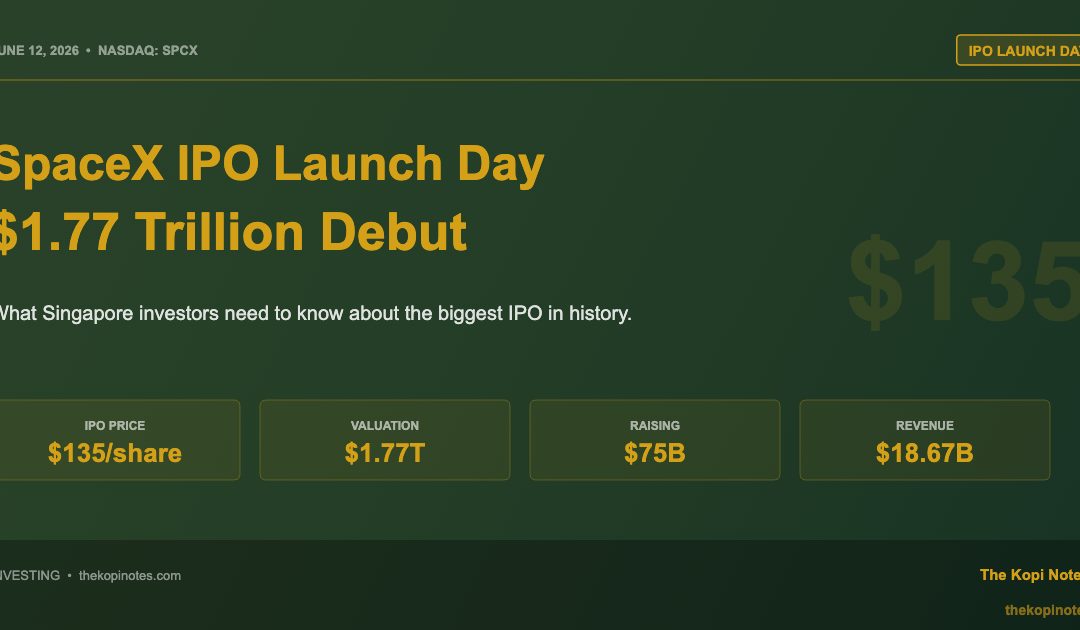
SpaceX launched 24 Starlink satellites into orbit yesterday. But the biggest SpaceX launch today isn’t a rocket — it’s the company’s stock market debut. On June 12, 2026, SpaceX begins trading on the Nasdaq under ticker SPCX at $135 per share, giving it a $1.77 trillion valuation. This is the largest IPO in history, raising $75 billion. Here’s everything Singapore investors need to know.
Not financial advice. All figures are for educational reference only. Data as at June 12, 2026 unless noted. SpaceX (SPCX) is a US-listed stock — currency, regulatory, and market risks apply.
- SpaceX IPO today (June 12) on Nasdaq at $135/share — ticker SPCX. Valuation: $1.77 trillion. Raising: $75 billion. Biggest IPO ever
- Revenue hit $18.67B in 2025 (Starlink drove $11.4B), but the company posted a $4.94B net loss thanks to massive AI and Starship spending
- Singapore investors can buy via IBKR, Saxo, Moomoo, or Tiger Brokers. But IPO-day volatility is real — waiting a few weeks may be the smarter play
Table of Contents
Contents — Click to expand
The Launch — What’s Happening Today
June 12, 2026. This morning, SpaceX — Elon Musk’s rocket and satellite company — begins trading on the Nasdaq stock exchange under the ticker symbol SPCX.
The IPO price is fixed at $135 per share. SpaceX is selling 555.6 million shares, which raises approximately $75 billion in fresh capital. That makes this the largest initial public offering in U.S. history — more than triple the size of Alibaba’s $25 billion IPO in 2014.
At a $1.77 trillion valuation, SpaceX would immediately become the seventh-largest company in the United States by market capitalisation. That puts it above Tesla (approximately $1.6 trillion as at June 2026) and just below Meta.
Here’s the timing twist that makes today poetic. Yesterday — June 11, 2026 — SpaceX launched a Falcon 9 rocket carrying 24 Starlink satellites into orbit from Vandenberg Space Force Base. It was the 34th mission for that particular booster (B1071). While you might have been looking for a rocket launch, the biggest SpaceX launch today is its stock market debut.
Nasdaq has also fast-tracked SpaceX for Nasdaq-100 index inclusion. Under a rule change from March 2026, mega-IPOs can join the Nasdaq-100 within 15 trading days. That means QQQ and other index fund holders could automatically own SpaceX by late June or early July. Analysts estimate index funds will need to purchase roughly $7 billion worth of SPCX around the inclusion date.
On the retail access front, SpaceX set aside about 30% of its public shares for everyday investors — far more than the typical 5–10%. In the US, platforms like Robinhood, SoFi, Fidelity, and E-Trade are offering direct IPO access. For Singapore investors, the path runs through international brokerages (more on that below).
S-1 Breakdown — The Numbers Behind the Hype
SpaceX filed its S-1 prospectus with the SEC in May 2026, giving the public its first real look at the company’s finances. Here’s what the numbers actually say.
Revenue grew 33% in 2025 to $18.67 billion. That’s impressive growth for a company already at scale. However, SpaceX also posted a net loss of $4.94 billion — a sharp reversal from its $791 million profit in 2024.
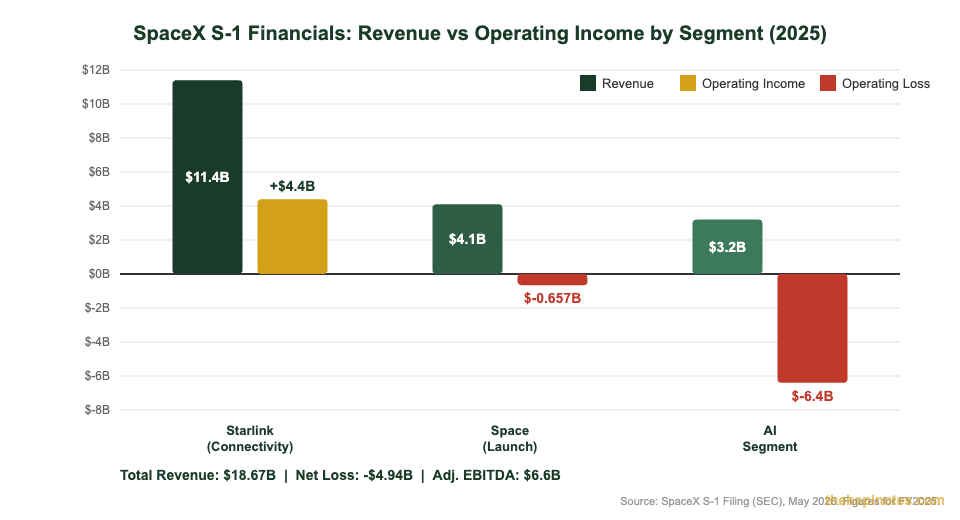
The gap between revenue growth and the net loss tells a story about where SpaceX is investing. The company operates three segments, and they look very different financially.
| Segment | Revenue (2025) | Operating Income/Loss | Key Driver |
|---|---|---|---|
| Starlink (Connectivity) | $11.4B | +$4.4B | 12M+ subscribers, 164 countries |
| Space (Launch) | $4.1B | -$657M | Falcon 9, Starship R&D costs |
| AI Segment | $3.2B | -$6.4B | Massive infrastructure capex |
| Total | $18.67B | Net loss: -$4.94B | Adj. EBITDA: $6.6B |
Source: SpaceX S-1 Filing (SEC), May 2026. Figures for fiscal year 2025.
The story here is clear. Starlink is the cash cow. It generated $11.4 billion in revenue and $4.4 billion in operating income. With over 12 million subscribers across 164 countries, Starlink has become a legitimate telecom business.
The Space (launch) segment — Falcon 9, Falcon Heavy, and Starship — brought in $4.1 billion but ran a $657 million operating loss. That’s largely because Starship development costs are enormous. However, Falcon 9 alone is almost certainly profitable.
The AI segment is where the bleeding happens. SpaceX generated $3.2 billion in AI revenue but recorded a staggering $6.4 billion operating loss. This is infrastructure buildout — data centres, GPU clusters, and satellite-based AI compute. It’s a bet on the future, not a current moneymaker.
Despite the GAAP net loss, SpaceX reported $6.6 billion in adjusted EBITDA. The gap is driven by stock-based compensation, depreciation on the Starlink satellite constellation, and AI infrastructure capital expenditure. Whether you focus on the GAAP loss or the EBITDA profit tells you which camp you’re in — bear or bull.
What Reddit Is Saying
If you want to know what real retail investors think — not what analysts are paid to say — Reddit’s r/investing community has been buzzing. A trending thread titled “SpaceX IPO is in 2 days. I read the entire S-1 so you don’t have to” broke down the filing and sparked thousands of comments debating whether the $1.77 trillion valuation is justified.
Here’s a summary of the bull and bear cases as the community sees them.
The Bull Case (Reddit version)
“Starlink alone justifies half the valuation.” Bulls point to Starlink’s $11.4 billion in revenue with $4.4 billion operating income. They argue this is a telecom monopoly in space — no real competitor exists at scale. The total addressable market (TAM) SpaceX identified in its S-1 is a jaw-dropping $28.5 trillion, described as “the largest actionable TAM in human history.”
Bulls also highlight the Falcon 9 reusability moat. Yesterday’s launch used a booster on its 34th flight. No competitor is even close to this level of rocket reuse. SpaceX dominates the global launch market, and Starship — if it works at scale — would widen the gap further.
The AI angle is another bull argument. SpaceX’s satellite network could become the backbone of edge computing and AI inference at global scale. Early revenue of $3.2 billion in a brand-new segment shows commercial traction.
The Bear Case (Reddit version)
“$1.77 trillion for a company that lost $5 billion?” Bears are sceptical. The net loss of $4.94 billion is hard to ignore. Some Reddit users compared it to the dot-com era: massive revenue growth masking unsustainable spending.
Key concerns from the community include the Musk concentration risk — Elon Musk is CEO of SpaceX, Tesla, xAI, and effectively runs the Department of Government Efficiency. If something happens to Musk, what happens to SpaceX? The S-1 itself flags this as a material risk.
Bears also question whether the AI segment is a distraction. Burning $6.4 billion on AI infrastructure while the core rocket business could be profitable on its own feels like empire-building to sceptics. And there’s the classic IPO concern: existing shareholders, including Musk, face a 366-day lockup. Once that expires, insider selling could pressure the stock.
The honest takeaway from the Reddit discourse: both sides make valid points. Starlink is a real business with real cash flow. But the valuation assumes everything goes right — and at $1.77 trillion, there’s very little margin for error.
Valuation Deep Dive — Is $1.77 Trillion Justified?
Let’s put the $1.77 trillion valuation in context. At the IPO price of $135, SpaceX would be valued at roughly 95 times its 2025 revenue. That’s stratospheric, even by tech standards.
Here’s how it compares to other mega-cap IPOs at their debut:
| Company | IPO Valuation | Revenue at IPO | P/S Ratio at IPO | Year |
|---|---|---|---|---|
| SpaceX (SPCX) | $1.77T | $18.67B | 95x | 2026 |
| Alibaba (BABA) | $231B | $12.3B | 19x | 2014 |
| Meta (Facebook) | $104B | $5.1B | 20x | 2012 |
| Uber (UBER) | $82B | $11.3B | 7x | 2019 |
| Snowflake (SNOW) | $33B | $0.6B | 55x | 2020 |
Source: Company filings, public records. Revenue figures represent trailing twelve months at time of IPO.
A 95x price-to-sales ratio is higher than any mega-cap IPO in history. For context, even Snowflake — one of the most aggressively valued software IPOs ever — debuted at 55x sales.
The bull argument is that SpaceX isn’t a normal company. It’s a vertically integrated aerospace, telecom, and AI infrastructure monopoly with no real competitor. If Starlink hits 50 million subscribers and Starship opens up new markets (space tourism, Mars cargo, point-to-point travel), the TAM justifies the premium.
The bear argument is simpler: the company is not profitable. A $4.94 billion net loss means you’re paying $1.77 trillion for a story, not earnings. If AI spending continues to burn cash and Starship development hits delays, the stock could face significant downward pressure once the lockup expires in June 2027.
How to Buy SpaceX Stock from Singapore
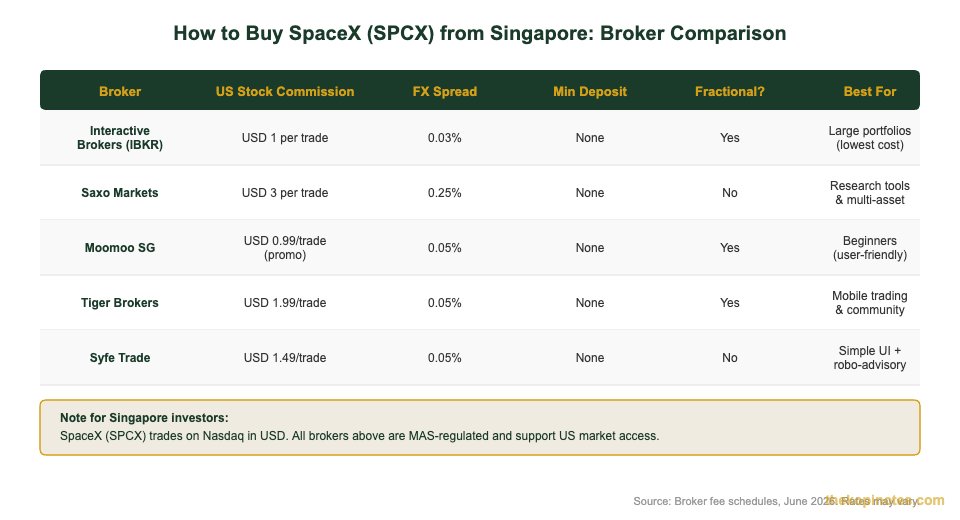
SpaceX (SPCX) trades on the Nasdaq in US dollars. Singapore investors can buy it through any brokerage that offers US market access. Here are the main options, ranked by cost-effectiveness for different portfolio sizes.
| Broker | Commission | FX Spread | Min Deposit | Fractional Shares | Best For |
|---|---|---|---|---|---|
| Interactive Brokers (IBKR) | USD 1/trade | 0.03% | None | Yes | Large portfolios — lowest overall cost |
| Saxo Markets | USD 3/trade | 0.25% | None | No | Research tools and multi-asset access |
| Moomoo Singapore | USD 0.99/trade (promo) | 0.05% | None | Yes | Beginners — user-friendly interface |
| Tiger Brokers | USD 1.99/trade | 0.05% | None | Yes | Mobile trading and community features |
| Syfe Trade | USD 1.49/trade | 0.05% | None | No | Simple UI + robo-advisory integration |
Source: Broker fee schedules, June 2026. Rates may vary — check each broker’s website for current pricing.
For most Singapore investors, IBKR remains the best option for US stocks. Its FX spread of 0.03% is unmatched, and USD 1 per trade keeps costs minimal. If you’re investing SGD 10,000 or more, the cost savings add up quickly over time. You can read our full moomoo Singapore review if you prefer a simpler platform.
For smaller portfolios or beginners, Syfe Trade offers a clean experience with low fees. It also integrates with Syfe’s robo-advisory portfolios if you want a more hands-off approach.
Steps to buy SPCX:
- Open a brokerage account with one of the brokers above (takes 1–3 business days)
- Fund your account in SGD — the broker will convert to USD
- Search for SPCX on Nasdaq
- Place a limit order (recommended) or market order
- Confirm the trade — you now own SpaceX stock
At $135 per share (approximately SGD 180 at current rates), one share of SpaceX is affordable for most investors. Brokers like IBKR and Moomoo also support fractional shares if you want to start smaller.
The SPAL & SNK Leveraged ETFs — Proceed With Extreme Caution
As if buying SpaceX stock wasn’t exciting enough, GraniteShares has launched two leveraged ETFs timed to the IPO:
- SPAL — GraniteShares 2x Long SpaceX Daily ETF (aims for 200% of SPCX’s daily return)
- SNK — GraniteShares 2x Short SpaceX Daily ETF (aims for -200% of SPCX’s daily return, i.e. profits when SPCX drops)
Both ETFs launched today (June 12, 2026) alongside the IPO itself.
These are not for beginners. Leveraged ETFs reset daily. That means they aim to deliver 2x or -2x the daily return of SPCX, not the cumulative return over weeks or months. Over time, a phenomenon called “volatility decay” erodes returns — even if the underlying stock ends up flat or slightly positive, a 2x leveraged ETF can lose money.
For example, if SPCX goes up 5% on Day 1 and down 5% on Day 2, the stock is roughly flat. But a 2x leveraged ETF would be down about 0.5% over those two days. The math gets worse the longer you hold.
If you’re a sophisticated trader who wants to take a directional bet on SpaceX’s first few trading days, these ETFs provide that exposure. But if you’re a long-term investor, just buy the stock itself. The cost of leverage compounding against you over months makes these unsuitable for buy-and-hold.
Risks Every Investor Should Know
SpaceX is a remarkable company. But remarkable companies can still be poor investments at the wrong price. Here are the key risks you should factor in.
1. No profitability (GAAP basis). SpaceX lost $4.94 billion in 2025. While the company is EBITDA-positive at $6.6 billion, GAAP losses matter. The AI segment alone burned $6.4 billion in operating losses. If AI spending doesn’t produce returns, the losses could widen.
2. Elon Musk dependency. The S-1 explicitly flags this as a risk factor. Musk is simultaneously CEO of SpaceX, CEO of Tesla, owner of X (formerly Twitter), chair of xAI, and head of the Department of Government Efficiency. Key person risk is arguably higher here than at any other trillion-dollar company. If Musk steps back — or is forced to — sentiment could shift dramatically.
3. Regulatory and political risk. SpaceX depends on government contracts (NASA, Department of Defense) and regulatory approvals (FAA launch licences, FCC spectrum rights for Starlink). Political dynamics can shift. Changes in administration, defence spending priorities, or spectrum allocation could impact the business.
4. Competition is coming. Amazon’s Project Kuiper is building a competing satellite constellation. Blue Origin is ramping up launch capabilities. China’s commercial space sector is growing quickly. Starlink’s current dominance isn’t guaranteed forever.
5. Lockup expiration (June 2027). Existing shareholders — including Musk — must hold their shares for 366 days after listing. When the lockup expires, insider selling could put significant downward pressure on the stock price. This is a well-documented pattern with IPOs.
6. Currency risk for Singapore investors. SPCX trades in USD. If the US dollar weakens against the Singapore dollar, your returns in SGD terms will be lower — even if the stock price rises. You can use our Singapore retirement calculator to model how currency fluctuations affect your long-term portfolio.
Should You Buy on Day 1?
Here’s the honest take: probably not.
IPO-day trading is notoriously volatile. The opening price could gap up 20–30% above the $135 IPO price as pent-up demand floods in. But it could also reverse sharply within hours or days as short-term traders take profits.
Historical data shows that many high-profile IPOs underperform in their first 3–6 months. Meta (Facebook) dropped 50% in its first four months of trading. Uber fell 30% in its first three months. Even the best companies can be poor short-term trades at IPO.
If you’re convinced SpaceX is a generational company — and there’s a legitimate case for that — consider these approaches:
- Wait 2–4 weeks. Let the initial volatility settle. The stock will still be there. Prices often dip after the first-week euphoria fades
- Dollar-cost average. Instead of putting your entire allocation in on Day 1, spread your purchases over 3–4 months. Buy SGD 1,000 worth each month rather than SGD 4,000 at once
- Set a limit price. If you must buy today, use a limit order — not a market order. Decide the maximum price you’re willing to pay and stick to it
- Size it appropriately. No single stock should be more than 5–10% of your portfolio, no matter how exciting. If you’re looking for diversified exposure, a broad-market ETF like CSPX or VWRA gives you exposure to thousands of companies instead of betting on one
The SpaceX IPO is a historic moment. But historic moments don’t always make for good entry points. Investing is a marathon, not a rocket launch.
Not financial advice. Always do your own research. Consider your personal risk tolerance, investment horizon, and portfolio diversification before making any investment decisions.
Frequently Asked Questions
What is the SpaceX IPO price and ticker symbol?
SpaceX is listing on the Nasdaq on June 12, 2026 under the ticker symbol SPCX at a fixed IPO price of $135 per share. This values the company at approximately $1.77 trillion, making it the largest IPO in US history. The company is raising $75 billion by selling 555.6 million shares.
Can Singapore investors buy SpaceX (SPCX) stock?
Yes. Singapore investors can buy SPCX through international brokerages that offer US market access. The main options are Interactive Brokers (IBKR), Saxo Markets, Moomoo Singapore, Tiger Brokers, and Syfe Trade. All are MAS-regulated. You’ll need to fund your account in SGD, which the broker converts to USD for the trade. At $135 per share (roughly SGD 180), one share is accessible for most retail investors.
Is SpaceX profitable?
SpaceX is not profitable on a GAAP basis. The company reported a net loss of $4.94 billion in 2025 on revenue of $18.67 billion. However, its adjusted EBITDA was positive at $6.6 billion, and the Starlink segment alone generated $4.4 billion in operating income. The losses come primarily from the AI segment ($6.4 billion operating loss) and Starship development costs.
What are the SPAL and SNK ETFs?
SPAL and SNK are leveraged ETFs launched by GraniteShares on June 12, 2026. SPAL is a 2x Long SpaceX Daily ETF — it aims to deliver 200% of SPCX’s daily return. SNK is a 2x Short (inverse) SpaceX Daily ETF — it aims to deliver -200% of SPCX’s daily return. Both reset daily and are designed for short-term trading, not long-term holding. Volatility decay means they can lose value even if SpaceX stock stays flat over time.
Will SpaceX join the Nasdaq-100 (QQQ)?
Very likely, and soon. Nasdaq changed its rules in March 2026 to allow fast-track inclusion for mega-IPOs. Under the new rules, SpaceX could be evaluated by trading day 7, announced by day 10, and added to the Nasdaq-100 by trading day 15 — potentially by late June or early July 2026. If included, index funds like QQQ would be required to purchase an estimated $7 billion of SPCX shares.
Should I buy SpaceX stock on IPO day?
IPO-day trading carries significant risks. Opening prices often gap up sharply above the IPO price, then reverse in subsequent days or weeks. Historical examples like Meta (-50% in 4 months) and Uber (-30% in 3 months) show that even great companies can be poor IPO-day buys. Consider waiting 2–4 weeks for volatility to settle, dollar-cost averaging over 3–4 months, or using limit orders instead of market orders. Never allocate more than 5–10% of your portfolio to any single stock.
What is the biggest risk of investing in SpaceX?
The biggest risks include the sky-high 95x price-to-sales valuation (higher than any mega-cap IPO in history), the $4.94 billion net loss, key person dependency on Elon Musk, and the lockup expiration in June 2027 when insiders can sell. For Singapore investors specifically, there’s also currency risk since SPCX trades in USD — a weakening US dollar would reduce your returns in SGD terms.
How does SpaceX compare to other space companies like Blue Origin?
SpaceX is far ahead of competitors in both revenue and launch capability. SpaceX generated $18.67 billion in revenue in 2025, while Blue Origin and other competitors are much smaller. SpaceX’s Falcon 9 has completed over 400 successful missions with routine booster reuse (up to 34 flights per booster). No competitor comes close to this operational track record. However, Amazon’s Project Kuiper is building a competing satellite internet constellation, which could challenge Starlink’s dominance in the long term.
Want to Start Investing in US Stocks?
Open a brokerage account and get access to Nasdaq-listed stocks like SPCX. Use our referral links for exclusive sign-up bonuses.
This article was researched with the help of AI. While we strive to keep all information accurate and up to date, there may be errors. If you notice any discrepancies, please contact us.