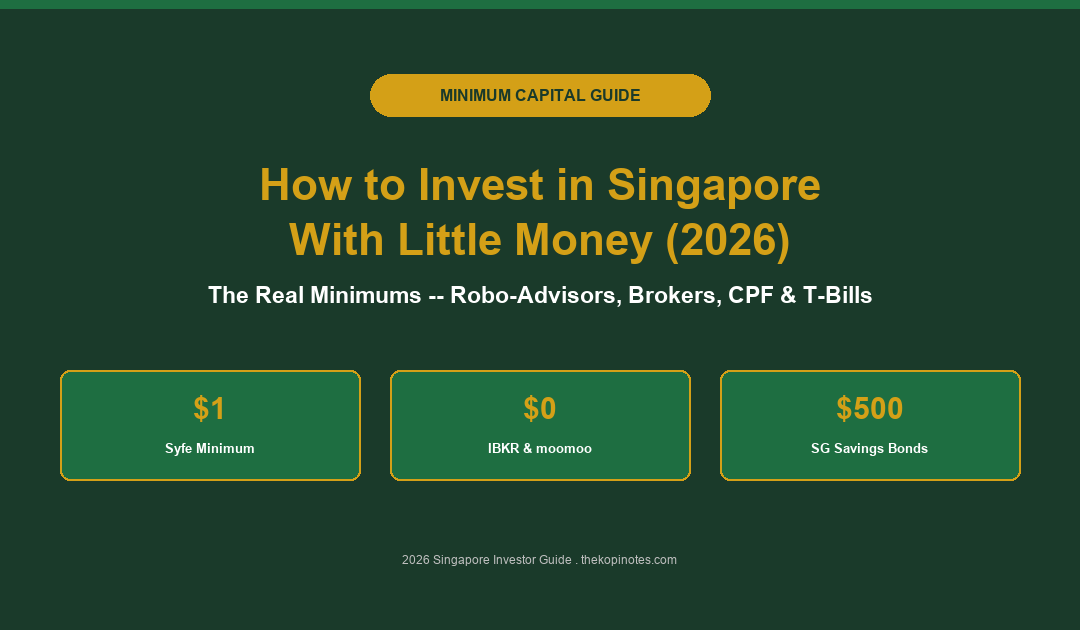
How to Invest in Singapore With Little Money: The Real Minimum Amounts (2026)
The actual dollar figures — from $1 robo-advisors to CPF’s $20,000 floor — so a small budget stops being the excuse.
Wondering how to invest in Singapore without a large lump sum? You don’t need thousands of dollars — robo-advisors like Syfe let you begin with just $1, and brokers such as Interactive Brokers and moomoo have no minimum deposit at all. The real minimum depends entirely on where you put your money, and CPF, Singapore Savings Bonds and T-bills each play by their own separate rules.
Not financial advice. All figures are for educational reference only. Data verified as at 24 July 2026 against official CPF Board, MAS, Syfe, Endowus, StashAway, Tiger Brokers, Interactive Brokers and moomoo sources unless otherwise stated.
- Robo-advisors like Syfe start from $1, and brokers like IBKR, moomoo and Tiger Brokers have no minimum deposit at all.
- CPF and government bonds play by different rules — CPFIS-OA needs $20,000 left in your Ordinary Account, and Singapore Savings Bonds need a $500 minimum.
- The amount matters far less than starting early: even $10 a month, invested consistently for 30 years, can grow to over $12,000.
The Real Minimum: You Can Start With $1
Most people delay investing because they think they need a large lump sum first. That isn’t true in Singapore. Syfe, one of the most popular robo-advisors here, lets you open an account and invest with as little as $1. Recurring monthly investments start from just $10.
StashAway goes further still. There’s no official minimum deposit for most portfolios, though the platform recommends at least $10 so your money can actually be used to buy securities efficiently.
This matters because the real cost of waiting isn’t a “bad entry point” — it’s lost time. A dollar invested at 25 compounds for far longer than a dollar invested at 35, no matter how small it is. If you want the fundamentals first, our guide to how to start investing in Singapore is a good place to begin.
What counts as “starting small” still depends heavily on where you put your money — a robo-advisor, a DIY broker, a government bond, and your own CPF savings all play by different rules. Here’s the full breakdown.
Minimum Amounts by Platform (2026)
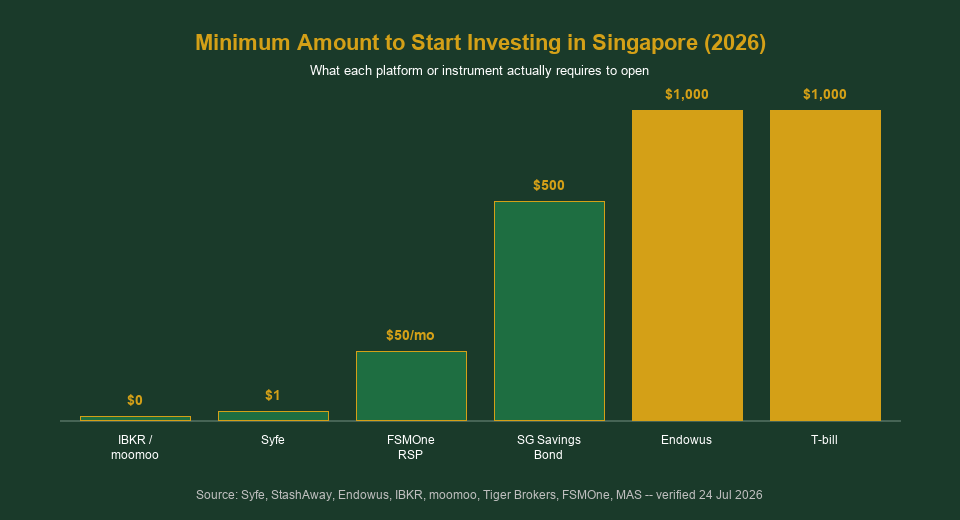
Here’s what each major platform actually requires before you can start investing in Singapore, based on their official pricing and account pages as at July 2026.
| Platform | Type | Minimum to Start | Notes |
|---|---|---|---|
| Syfe | Robo-advisor | $1 lump sum / $10 recurring | No minimum account balance |
| StashAway | Robo-advisor | $0 (recommended $10) | Income Portfolio needs $10,000 |
| Endowus | Robo-advisor (Cash/CPF/SRS) | $1,000 initial / $100 subsequent | Income Portfolios need $10,000 |
| Interactive Brokers | DIY broker | $0 | USD 100 required only for margin accounts |
| moomoo | DIY broker | $0 | Funding needed only to unlock sign-up promos |
| Tiger Brokers | DIY broker | $0 | $3,000 needed to unlock sign-up bonus |
| FSMOne | Fund platform (RSP) | $50/month | 0.08% buying fee per RSP transaction |
Source: Syfe, StashAway, Endowus, Interactive Brokers, moomoo, Tiger Brokers and FSMOne official pages, verified 24 July 2026.
If you’re starting with a small amount, a robo-advisor with a low or no minimum usually makes more sense than a DIY broker — you get instant diversification without needing enough capital to buy a full share of every stock you want. Sign up for Syfe and you can literally start with your next $1. Once your portfolio grows large enough that a flat percentage fee starts costing more than a flat commission, a DIY broker becomes the more cost-effective choice.
Minimum Amounts by Instrument: SSB, T-Bills, CPFIS
Platforms are only half the story. The instruments themselves — government bonds, T-bills, and your own CPF savings — have their own separate minimum rules, and these don’t work like a brokerage account minimum.
Singapore Savings Bonds (SSB) have a minimum investment of $500, and every top-up after that must be in multiples of $500, up to a $200,000 cap per investor, per MAS’s official SSB page.
Singapore T-bills need a bigger first step: a $1,000 minimum, also in multiples of $1,000. Unlike SSBs, T-bills are auctioned at a single point in time — you’re locking in a return based on that specific auction’s cut-off yield. Our complete T-bills guide breaks down how the auction process works.
CPF works differently again. There’s no “minimum to invest” in the traditional sense — instead, CPF sets a floor you must leave untouched. You can only invest your Ordinary Account (OA) savings under the CPF Investment Scheme (CPFIS-OA) after setting aside $20,000 in your OA. For your Special Account (SA), the set-aside floor is $40,000. CPF Board confirms both thresholds directly on its official investment scheme page.
| Instrument | Minimum | Increment | What It Really Means |
|---|---|---|---|
| Singapore Savings Bond | $500 | Multiples of $500 | True minimum to buy your first bond |
| T-bill | $1,000 | Multiples of $1,000 | True minimum per auction application |
| CPFIS-OA | — | — | Leave $20,000 in your OA before investing the rest |
| CPFIS-SA | — | — | Leave $40,000 in your SA before investing the rest |
Source: MAS Singapore Savings Bonds FAQ; MAS T-bills information for individuals; CPF Board CPFIS eligibility page — all verified 24 July 2026.
In practice, this means most people building up their first $20,000 in CPF shouldn’t touch CPFIS at all — that money is better left earning the CPF Ordinary Account’s guaranteed 2.5% interest rate. CPFIS only becomes relevant once your OA balance comfortably exceeds that floor.
Where Your First Dollar Goes Furthest
The “right” platform depends on how much you actually have to invest today, not how much you eventually want to have.
If you have under $100: A robo-advisor is your best option. Syfe and StashAway both accept small, irregular deposits and automatically diversify across dozens of underlying holdings — something you can’t do buying individual shares with $50.
If you have $500 to $1,000: You can now access Singapore Savings Bonds directly, or meet Endowus’s $1,000 initial minimum if you want one account across cash, CPF and SRS. Open an Endowus account and this is also comfortably enough to open a DIY broker account and buy a handful of shares or ETF units without fees eating too much of your capital.
If you have $1,000 to $5,000: T-bills become viable in $1,000 lots, and a DIY brokerage account starts to make more sense economically — fixed commissions matter less as a percentage of a larger trade.
If you have $20,000 or more sitting in your CPF Ordinary Account: You can start considering CPFIS-OA, though you should only do this if you’re confident of beating the OA’s risk-free 2.5% return net of fees over the long run.
What a Small Amount Actually Grows Into
It’s easy to dismiss $10 or $100 a month as too small to matter. The math says otherwise.
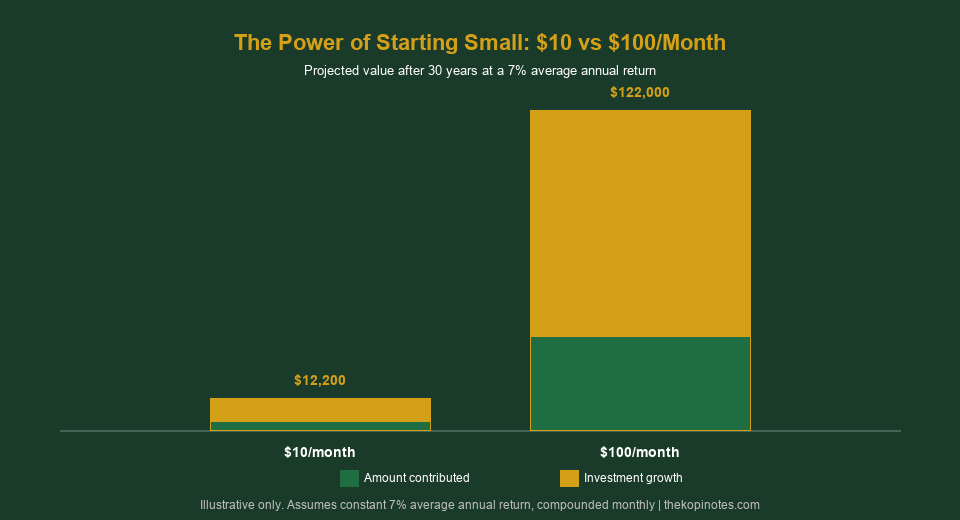
Assume you invest $100 a month from age 25, consistently, into a diversified portfolio earning an average 7% a year net of fees — a reasonable long-run assumption for a globally diversified equity portfolio, though not guaranteed. By age 55, 30 years later, that grows to approximately $122,000.
Now scale that down. $10 a month over the same 30 years, at the same 7% return, grows to roughly $12,200 — on just $3,600 you actually put in. The ending balance is exactly one-tenth of the $100-a-month scenario, because the math scales linearly. What doesn’t scale down is the habit you build by starting today instead of “when I have more.”
This is a simplified, illustrative calculation — it ignores platform fees, fund-level expense ratios, and the fact that real markets don’t return a smooth 7% every year. But the core lesson holds: the amount you start with matters far less than the number of years your money has to compound.
How Much You Actually Need, by Goal
“How much money do I need to start investing” is really two separate questions: how much do I need to open an account, and how much should I actually invest. The first answer, as this guide has shown, is often “almost nothing.” The second answer depends on your goals and where you are financially.
Before investing anything, build a small emergency fund — most financial planners suggest 3 to 6 months of essential expenses, parked somewhere liquid and low-risk like an SSB or T-bill ladder rather than a savings account earning close to nothing. Only invest money you’re confident you won’t need in the next 3 to 5 years.
Once that’s in place, the right ongoing amount is whatever you can commit to consistently — even if that’s $50 or $100 a month to start. It’s far better to invest a small, sustainable amount every month than to invest a large lump sum once and never contribute again. If you’re unsure of the right order to fund CPF, SRS and cash accounts as your income grows, our guide on the right order to invest across CPF, SRS and cash walks through the sequencing in more detail.
Two Mistakes People Make While “Saving Up” to Invest
Mistake 1: Waiting to hit a round number before starting. Many people set an arbitrary target — $5,000, $10,000 — before they’ll “seriously” start investing. As the compounding math above shows, every year you wait costs you disproportionately more than the last, because you lose a year of growth on top of a year of growth on top of a year of growth. Starting with $50 today usually beats waiting two years to start with $2,000.
Mistake 2: Draining your emergency fund to hit a platform’s minimum. Endowus’s $1,000 initial minimum or StashAway’s Income Portfolio $10,000 threshold can tempt people to over-commit before they have a cash buffer. If meeting a minimum means you’d have nothing left for a job loss or medical emergency, choose a platform with a lower minimum instead — Syfe’s $1 entry point exists for exactly this reason.
The goal isn’t to invest the maximum amount possible today. It’s to invest an amount you can sustain, consistently, for years. Use our retirement planning calculator to check whether your current monthly amount — however small it feels now — is actually on track for your goals.
Ready to Start With Whatever You Have?
Open an account and use these referral codes for sign-up perks on your first qualifying deposit.
Frequently Asked Questions
What is the minimum amount to start investing in Singapore?
It depends on the platform. Robo-advisors like Syfe let you start with just $1, and brokers like Interactive Brokers, moomoo and Tiger Brokers have no minimum deposit at all. Only a handful of platforms and instruments, like Endowus ($1,000) or Singapore Savings Bonds ($500), require a meaningful upfront amount.
Can I invest in Singapore with just $10 or $50 a month?
Yes. Syfe accepts recurring investments from $10 a month, and FSMOne’s Regular Savings Plan starts from $50 a month. Both let you dollar-cost average into a diversified portfolio without needing a large lump sum.
Do I need $20,000 to invest my CPF savings?
Not exactly — you need $20,000 remaining in your Ordinary Account before you can invest anything beyond that under CPFIS-OA. If your OA balance is below $20,000, all of it stays earning the CPF Board’s guaranteed 2.5% interest, and you can’t use CPFIS at all.
What's the minimum investment for Singapore Savings Bonds and T-bills?
Singapore Savings Bonds have a $500 minimum, in multiples of $500, up to a $200,000 cap per investor. Singapore T-bills need a larger $1,000 minimum, also in multiples of $1,000, applied for at a specific auction date.
Which platform has the lowest minimum investment in Singapore?
Interactive Brokers, moomoo and Tiger Brokers all technically have a $0 minimum deposit to open an account, though you’ll need enough to actually buy a share or ETF unit. Among robo-advisors, Syfe’s $1 minimum is the lowest in Singapore as at 2026.
Is it better to wait and save more before I start investing?
Usually not. Because of compounding, a small amount invested today has more time to grow than a larger amount invested later. Starting with $50 or $100 a month now, and increasing it as your income grows, generally beats waiting years to accumulate a larger lump sum.
Not financial advice. Figures verified as at 24 July 2026 against CPF Board, MAS, Syfe, Endowus, StashAway, Tiger Brokers, Interactive Brokers and moomoo official sources and are subject to change — always verify current rates before acting. The Kopi Notes may earn referral fees when you sign up using our codes.
This article was researched with the help of AI. While we strive to keep all information accurate and up to date, there may be errors. If you notice any discrepancies, please contact us.