How to Invest in Singapore With $100 to $1,000 a Month (2026 Guide)
Real platform minimums, real 10-30 year projections, and a step-by-step plan — no matter your budget.
You can start investing in Singapore with as little as $1 a month — robo-advisors like Syfe and StashAway have no minimum, and brokers like moomoo and Tiger Brokers charge no account fees. The real question isn’t how much you need to start, but how much you commit to each month. A steady $500 a month can grow to over $230,000 in 20 years at a 6% average annual return.
Not financial advice. All figures are for educational reference only. Data verified as at 14 July 2026 unless noted.
- Most robo-advisors (Syfe, StashAway) and brokers (moomoo, Tiger Brokers, IBKR) have no minimum investment — you can start with $1.
- $500 a month at a 6% average annual return grows to roughly $231,000 in 20 years and over $502,000 in 30 years.
- Time in the market beats the exact amount you start with — starting small today beats waiting to save up a “big enough” sum.
Table of Contents
You Don’t Need $10,000 to Start Investing in Singapore
Many Singaporeans delay investing because they think they need a large lump sum first. That’s not true anymore. Robo-advisors and brokers have removed minimums almost entirely over the past few years.
Syfe, StashAway and moomoo all let you start with $1 or less. Tiger Brokers and Interactive Brokers (IBKR) don’t enforce any minimum deposit either. The barrier to entry that existed a decade ago — when you needed thousands of dollars to open a unit trust or brokerage account — is largely gone.
Here’s why that matters. If you wait two years to “save up $10,000” before investing, you lose two years of compounding. However, if you start with $200 a month today, your money starts working immediately — even while you’re still building up your emergency fund.
It also doesn’t matter if you’re a fresh grad earning $3,500 a month or someone in your 40s catching up on retirement savings. The mechanics are the same: pick a platform, automate a fixed amount, and let compounding do the heavy lifting. This guide shows you exactly how, no matter your budget.
How $100, $500 or $1,000 a Month Actually Grows
Dollar-cost averaging (DCA) means investing a fixed amount on a regular schedule — usually monthly — regardless of whether markets are up or down. You buy more units when prices are low and fewer when prices are high, which smooths out your average cost over time.
The real driver of growth, though, is compounding. Each year, your returns generate their own returns. A small monthly amount invested consistently for 20 or 30 years can grow into a surprisingly large sum — mostly because of growth on growth, not just your own contributions.
Here’s a worked example. Suppose you invest $500 a month into a globally diversified portfolio — something like Syfe’s Core Equity100 or a Regular Savings Plan (RSP) into the VWRA ETF — and it earns a 6% average annual return. After 20 years, you’d have contributed $120,000 of your own money ($500 x 240 months). But your portfolio would be worth approximately $231,020. The extra $111,020 came from compounding alone.
The table below shows how $100, $500 and $1,000 a month grows over 10, 20 and 30 years, assuming the same 6% average annual return.
| Monthly Contribution | After 10 Years | After 20 Years | After 30 Years |
|---|---|---|---|
| $100/month | $16,388 | $46,204 | $100,452 |
| $500/month | $81,940 | $231,020 | $502,258 |
| $1,000/month | $163,879 | $462,041 | $1,004,515 |
Source: TKN calculation. Assumes 6% p.a. average annual return, monthly compounding, contributions at month-end. Illustrative only — not guaranteed.
Two things stand out. First, the jump from 20 to 30 years roughly doubles your final portfolio value at every contribution level — time compounds faster the longer you stay invested. Second, doubling your monthly contribution exactly doubles your final value, since the growth rate applies proportionally. That means there’s no “wrong” amount to start with, only a wrong time to start — which is now.
These figures are illustrative projections, not guarantees. Actual returns depend on the funds you choose, market conditions and fees. A 6% average annual return is a commonly used conservative assumption for a globally diversified equity portfolio, but real returns will vary year to year.
Best Platforms for Every Budget Level in Singapore
Not all platforms are built for the same budget. Some are designed for you to start with spare change; others expect a larger lump sum upfront. Here’s how the major platforms in Singapore compare as at July 2026.
| Platform | Type | Minimum Initial Investment | Notes |
|---|---|---|---|
| Syfe | Robo-advisor | No minimum — from $1 | USD portfolios recommend $10,000+ |
| StashAway | Robo-advisor | No minimum — $10 recommended | No minimum balance required |
| Endowus | Robo-advisor | $1,000 (Cash); $10,000 (Income Portfolios) | $100 minimum for top-ups |
| moomoo Singapore | Brokerage | No minimum deposit | $2,000 needed only for sign-up promos |
| Tiger Brokers | Brokerage | No minimum deposit | $3,000 needed only for sign-up promos |
| Interactive Brokers (IBKR) | Brokerage | No minimum deposit | Best for larger, cost-conscious portfolios |
Source: Syfe, StashAway, Endowus, moomoo, Tiger Brokers and IBKR help centres, as at July 2026.
Syfe’s referral code and sign-up bonus is worth checking if you’re leaning toward a robo-advisor — Syfe has no minimum investment and lets you start with as little as $1 in a diversified portfolio like Core Equity100 or the REIT+ income portfolio.
StashAway works similarly: no mandatory minimum, though the platform recommends at least $10 so your funds can be deployed efficiently. Both platforms let you set up recurring monthly transfers, so your investing becomes automatic and you’re not tempted to time the market.
The Endowus referral code is worth a look once you’ve built up some capital. Endowus works a little differently — its cash portfolios require a $1,000 initial investment (though only $100 for each top-up after that), and its Income Portfolios need $10,000 upfront because a smaller sum wouldn’t generate a meaningful monthly payout. Endowus makes more sense if you also want to invest your CPF or SRS savings alongside cash in one account.
If you’d rather pick your own ETFs or stocks, moomoo Singapore, Tiger Brokers and Interactive Brokers (IBKR) all have no minimum deposit to open an account. You can start a Regular Savings Plan (RSP) into a broad market ETF like VWRA or a Singapore-focused STI ETF with as little as $100 a month through moomoo or Tiger Brokers. IBKR tends to suit larger, less frequent lump-sum purchases, since its low per-trade fees reward bigger order sizes.
Using CPF and SRS to Invest When Cash Is Tight
If your take-home pay is fully stretched, you may still have CPF or SRS savings you can put to work. Under the CPF Investment Scheme (CPFIS), you can invest your Ordinary Account (OA) savings above the $20,000 safety buffer, or your Special Account (SA) savings above $40,000, subject to a 35% stock limit and a 10% gold limit on your investible savings, according to the CPF Board’s CPFIS eligibility rules (updated January 2026).
The Supplementary Retirement Scheme (SRS) is separate from CPF. Singapore Citizens and PRs can contribute up to $15,300 a year, while foreigners can contribute up to $35,700, according to IRAS. Every dollar you contribute also reduces your taxable income for that year, subject to the overall $80,000 personal tax relief cap. See our CPF investment strategy guide for a deeper walkthrough of CPFIS eligibility and product options.
Neither CPF nor SRS is a substitute for cash investing if you’re just starting out — but if you already meet the thresholds above, they’re a pool of capital you might be under-using.
$100 vs $500 vs $1,000 a Month: Which Should You Pick?
The “right” amount depends on your income stage, not a magic number. Here’s a simple way to think about it.
| Monthly Budget | Best Starting Point | Why |
|---|---|---|
| $100–$200/month | Syfe or StashAway robo-portfolio | No minimum, fully automated, diversified from day one |
| $300–$700/month | Robo-advisor or a broker RSP (moomoo/Tiger) into a global ETF like VWRA | Enough to diversify without fees eating into returns |
| $1,000+/month | Endowus (cash, CPF, SRS) or IBKR direct ETF purchases | Clears Endowus’s Income Portfolio minimum; IBKR’s low fees suit bigger orders |
If you’re a fresh graduate or early in your career, $100–$200 a month into a no-minimum robo-portfolio is a realistic starting point. The goal at this stage is building the habit, not maximising returns. As your income grows, you can increase your monthly contribution without switching platforms.
If you’re in your 30s with a stable income, $300–$700 a month lets you diversify across a broker RSP or a robo-advisor without fees eating too much into your returns. This is also a good point to start layering in CPF or SRS contributions alongside your cash investments.
If you can commit $1,000 or more a month, Endowus becomes cost-competitive because you clear its Income Portfolio minimum, and IBKR’s low per-trade fees start to matter more since you’re placing larger orders. At this level, it’s worth reading how to match your investments to your risk profile before committing a larger sum in one go.
The chart below shows how much of a difference the monthly amount makes after 20 years of consistent investing.
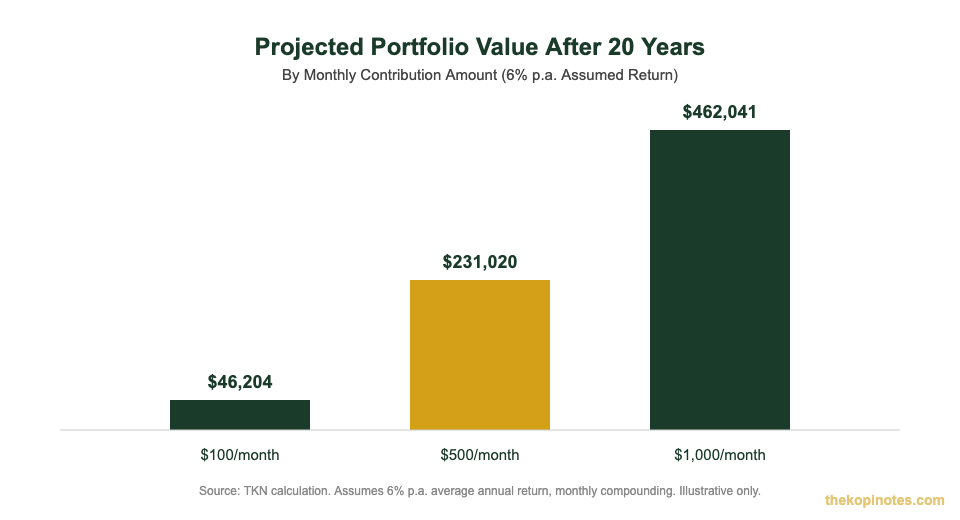
Notice that the gap between $100 and $1,000 a month isn’t small — it’s roughly tenfold, because the maths scales linearly with your contribution. However, this shouldn’t discourage you from starting with less. A smaller amount invested consistently for 20 years still comfortably beats a larger amount invested for only 5 or 10 years.
Your Step-by-Step Action Plan This Month
Here’s exactly what to do this week, regardless of your budget.
- Work out your real monthly amount. Look at your last 3 months of expenses. Whatever you have left after bills, food and an emergency fund contribution is your investable amount — even if it’s just $100.
- Open one account. Pick a robo-advisor (Syfe, StashAway) if you want a hands-off diversified portfolio, or a broker (moomoo, Tiger Brokers, IBKR) if you want to choose your own ETFs.
- Automate it. Set up a recurring monthly transfer or RSP order on the same day your salary is credited. This removes the temptation to skip a month or time the market.
- Pick one diversified fund or ETF to start. A globally diversified option like VWRA or a robo-advisor’s default equity portfolio is enough for most beginners — you don’t need five different funds on day one.
- Review once a year, not once a day. Checking your portfolio daily leads to emotional decisions. Set a calendar reminder to review your allocation annually instead.
- Increase your contribution as your income grows. Even a $50 increase each time you get a raise compounds meaningfully over 20-30 years. Use our retirement calculator to see how a higher monthly contribution changes your retirement outlook.
If you’re building your very first portfolio and want a more detailed walkthrough of fund selection and account setup, see our step-by-step portfolio-building guide.
The chart below shows why step 5 — staying invested — matters more than which exact amount you picked in step 1.
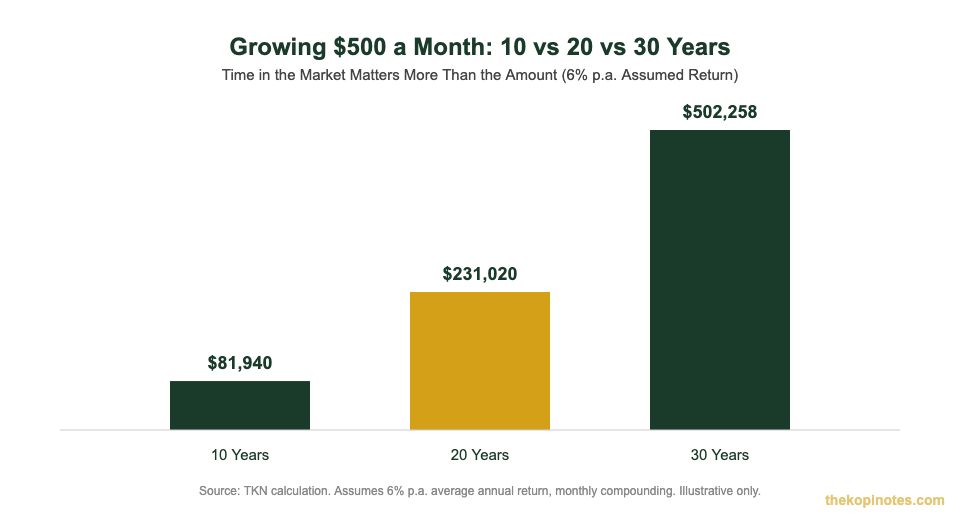
A $500 a month plan run for 30 years outgrows the same plan run for only 10 years by more than 6 times — not because the monthly amount changed, but because time did. That’s the single biggest lever you control.
Not financial advice. All projections are illustrative estimates based on a 6% average annual assumed return and are not guaranteed. Data verified as at 14 July 2026. Please do your own research or consult a licensed financial adviser before investing.
Common Mistakes That Slow Down Small-Budget Investors
Even with the right platform and a realistic monthly amount, a few habits quietly erode returns. Here’s what to watch for.
Chasing the “perfect” platform instead of starting. Comparing Syfe vs StashAway vs Endowus for weeks delays the one thing that actually matters — time in the market. Any of the platforms in the table above will do; pick one and start this month.
Stopping contributions when markets fall. A market dip is exactly when dollar-cost averaging works hardest for you, because your fixed monthly amount buys more units at a lower price. Pausing contributions during a downturn is one of the most common ways Singaporean investors accidentally lock in losses.
Ignoring fees on small balances. A 1% p.a. platform fee sounds small, but on a $5,000 portfolio it’s $50 a year — money that could have stayed invested. Compare the expense ratio and platform fee together, not just one or the other, before committing to a fund or robo-portfolio.
Over-diversifying too early. Splitting $200 a month across five different robo-portfolios and ETFs mostly adds complexity, not safety. A single globally diversified equity fund already spreads your risk across thousands of companies — that’s usually enough for your first few years.
Treating CPF/SRS and cash investing as separate goals. They’re not. Your CPF Investment Scheme eligibility, SRS contribution room and cash portfolio should all work toward the same retirement number, not be managed in isolation.
Frequently Asked Questions
Is $100 a month enough to start investing in Singapore?
Yes. Most robo-advisors like Syfe and StashAway have no minimum investment, so $100 a month is enough to open an account and start building a diversified portfolio. The amount matters less than starting consistently and increasing it as your income grows.
What is the best platform to start investing with a small budget in Singapore?
For a small monthly budget, Syfe and StashAway are typically the easiest starting points because neither enforces a minimum investment. Both let you automate monthly contributions into a diversified portfolio without needing to pick individual stocks or ETFs yourself.
Can I use CPF or SRS money to invest with a small monthly budget?
You can only invest CPF Ordinary Account savings above $20,000 or Special Account savings above $40,000 under CPFIS. SRS has no monthly minimum, but an annual contribution cap of $15,300 for citizens and PRs ($35,700 for foreigners). If you haven’t hit these CPF thresholds yet, focus on cash investing first.
How much can I realistically grow $500 a month over 20 years in Singapore?
Assuming a 6% average annual return, $500 a month grows to approximately $231,020 after 20 years, of which $120,000 is your own contribution and the rest is compound growth. This is an illustrative projection, not a guaranteed outcome.
Is dollar-cost averaging better than investing a lump sum?
Lump-sum investing statistically outperforms dollar-cost averaging slightly more often over long periods, because markets rise more often than they fall. However, DCA is more practical for most people because it matches how income actually arrives — as a monthly salary rather than a large sum sitting idle.
What happens if I miss a month of investing?
Nothing drastic. Missing one month won’t meaningfully change a 20-30 year outcome. What matters far more is resuming the habit quickly rather than letting one missed month turn into a year-long pause.
Ready to Start Investing This Month?
Open an account and automate your first contribution today — no matter your budget.
This article was researched with the help of AI. While we strive to keep all information accurate and up to date, there may be errors. If you notice any discrepancies, please contact us.