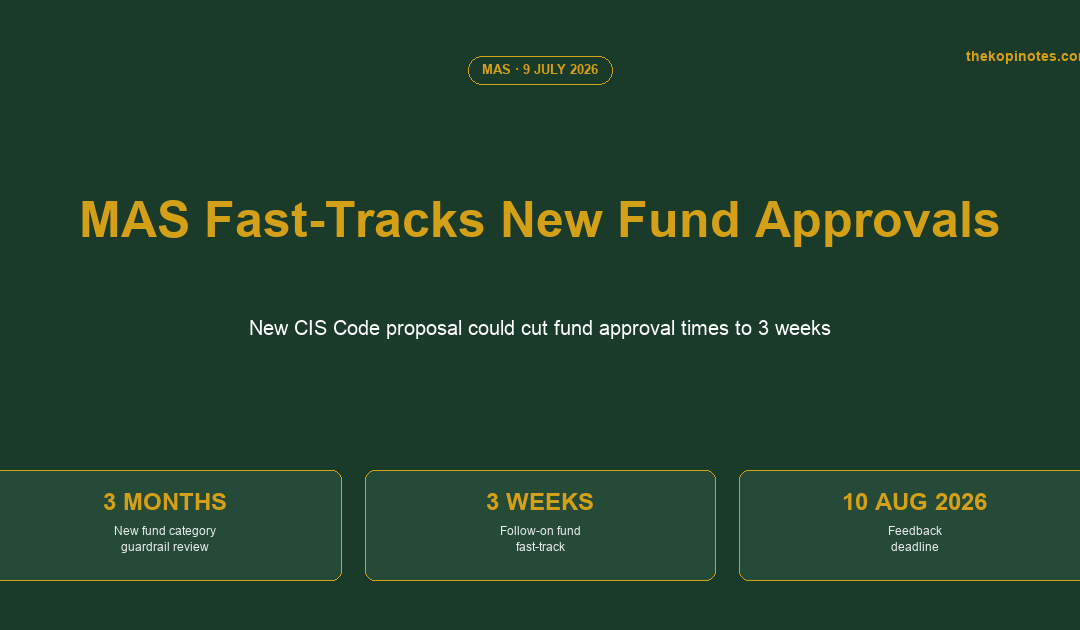
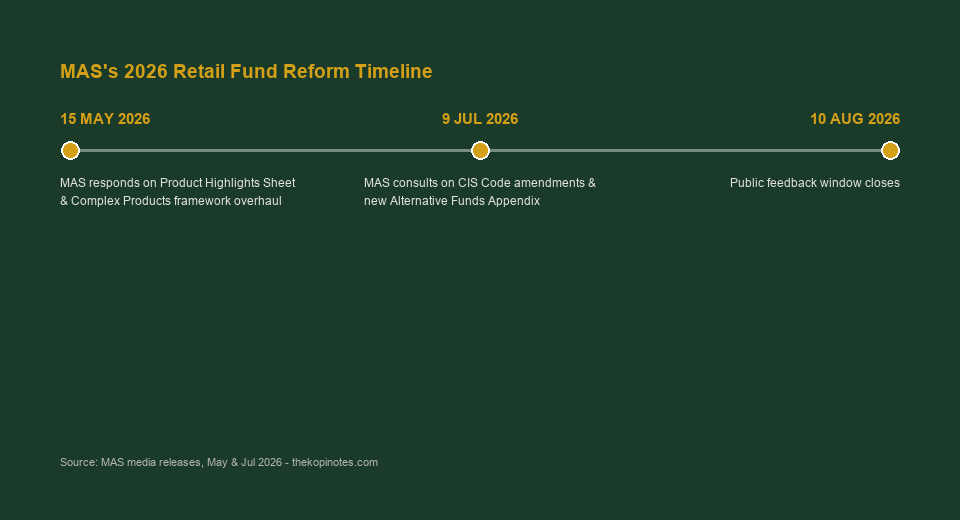
MAS published a consultation paper on 9 July 2026 proposing to fast-track approval of new retail fund types, with a new “Alternative Funds Appendix” and a target of authorising similar follow-on funds within three weeks. It’s an early-stage proposal, not a done deal — feedback closes 10 August 2026. Data verified as at 13 July 2026.
This is an editorial analysis. Not financial advice. All figures are for educational reference only.
What MAS Actually Proposed on 9 July 2026
The Monetary Authority of Singapore released a consultation paper proposing amendments to the Code on Collective Investment Schemes (CIS Code) — the rulebook that governs every retail unit trust and ETF authorised for sale in Singapore. The headline proposal is a new “Alternative Funds Appendix” that would sit alongside the existing CIS Code, giving fund managers a dedicated framework for products that don’t fit neatly into today’s investment guidelines.
MAS says the change is a response to “growing investor sophistication” and rising industry demand for fund structures that target newer investment themes and strategies. Crucially, MAS is not proposing to relax core protections: asset safeguarding, liquidity management, governance standards, and fair-dealing obligations for fund managers and distributors would all continue to apply. What changes is the speed and flexibility of getting new product types approved in the first place.
What this means for Singapore retail investors: nothing changes today. This is a consultation paper, not new law — MAS is inviting public and industry feedback until 10 August 2026 before deciding how to proceed.
Why “Three Weeks” Is the Number Everyone’s Talking About
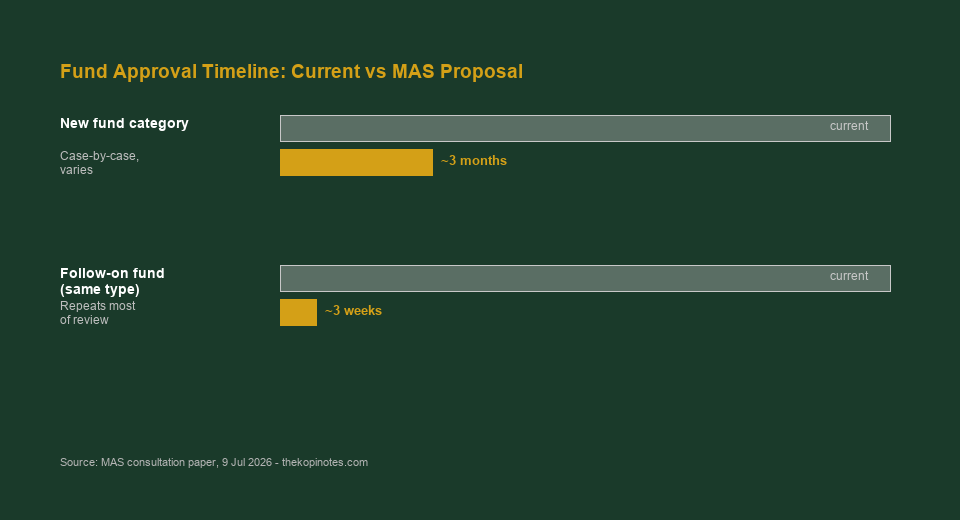
The detail generating the most industry chatter is MAS’s proposed approval timeline. For an entirely new category of fund, MAS expects to take about three months to work out the appropriate safeguards. But once those guardrails exist, a subsequent fund of the same type that meets the same requirements could reportedly be authorised in as little as three weeks — a significant compression versus how long novel product approvals can currently take.
| Stage | Under current process | Under MAS’s proposal |
|---|---|---|
| First-of-its-kind fund type | Case-by-case review; timelines vary | ~3 months to establish sector-specific guardrails |
| Follow-on fund of same type | Repeats much of the original review | ~3 weeks if it meets the established requirements |
| Core investor safeguards | Asset safeguarding, liquidity, governance, fair dealing | Unchanged — still mandatory |
What this means for Singapore retail investors: if this goes ahead broadly as proposed, it could mean more product choice arriving faster — new thematic funds, alternative strategies, or structures that current fund houses have wanted to launch but couldn’t easily fit under existing rules. Faster approval cycles also tend to increase competition among fund managers, which can pressure fees down over time — worth watching if you invest through platforms covered in our Endowus fees breakdown.
How This Builds on May 2026’s Complex Products Overhaul
This isn’t MAS’s first move this year to modernise the retail fund landscape. On 15 May 2026, MAS issued its response to an earlier consultation on Product Highlights Sheets (PHS) and the “complex products” framework. Under that reform, MAS will drop the mandatory financial advice requirement for complex products for most investors — except those who fail the Customer Knowledge Assessment or need extra safeguards — while requiring every complex product to carry a clear red-label alert. A six-month transition period applies from the effective date of the legislative changes.
Put the two reforms together and a pattern emerges: MAS is trying to widen the shelf of products retail investors can access directly, while shifting more of the “buyer beware” responsibility onto clearer, more prominent disclosure rather than blanket advice mandates.
What this means for Singapore retail investors: disclosure quality is about to matter more, not less. If you self-direct through CSPX, VWRA, or similar ETFs, or invest via CPFIS-approved unit trusts, get comfortable reading a Product Highlights Sheet properly — our Total Expense Ratio glossary entry explains one of the key figures buried in every PHS.
What Kinds of Funds Could This Actually Unlock
MAS hasn’t published a final list of what will sit under the new Alternative Funds Appendix — that detail is exactly what the consultation is meant to shape. But the direction of travel, alongside MAS’s broader 2025–2026 push to widen retail access to less-traditional strategies, points toward fund types built around alternative asset classes, more flexible mandates, or newer investment themes that don’t cleanly fit existing CIS Code categories today.
What this means for Singapore retail investors: don’t restructure a portfolio around a consultation paper. The prudent move is to keep building the core — broad-market ETFs like the ones in our CSPX ETF Singapore guide and VWRA ETF Singapore guide, or a diversified robo portfolio via our Endowus Singapore guide — and treat any new fund types that eventually launch as a satellite allocation to evaluate on their own merits, not a reason to chase novelty.
It’s also worth remembering that “faster to approve” is not the same as “better for you.” A streamlined pathway lowers the barrier for fund managers to bring niche or complex strategies to market — which is good for choice, but it also means more products will land on shelves carrying higher fees or less liquidity than a plain-vanilla index fund. The onus shifts further onto the Product Highlights Sheet and onto investors actually reading it, rather than relying on a lengthy pre-approval process to filter out weaker products.
The SGX Connection: A Bigger Push for a Livelier Products Market
MAS frames this proposal as part of a joint effort with the Singapore Exchange (SGX) to build “a more dynamic financial products ecosystem” in Singapore. That framing matters for context: this consultation didn’t appear in isolation. It follows a string of 2026 initiatives aimed at deepening Singapore’s capital markets, and fund innovation is one lever alongside listings reform and other SGX-side initiatives.
What this means for Singapore retail investors: if you invest CPF Ordinary Account or Special Account savings through CPFIS, it’s worth keeping an eye on whether any new fund categories eventually become CPFIS-approved. Our CPF Investment Scheme (CPFIS) glossary entry explains how instruments get approved for CPF money today, which is the same basic gatekeeping logic MAS is trying to speed up here for retail offers generally.
Bottom Line for SG Investors
Nothing in your portfolio needs to change because of this announcement. MAS has proposed — not finalised — a faster, more flexible pathway (a new Alternative Funds Appendix, a three-month guardrail-setting process, and a three-week fast lane for follow-on funds of the same type) for approving new categories of retail funds, while explicitly keeping core investor protections like asset safeguarding and liquidity rules intact. It builds directly on May 2026’s complex products and disclosure reforms, and its ultimate real-world effect — more choice, lower fees through competition, genuinely useful new strategies — depends entirely on what survives the consultation process, which runs until 10 August 2026. Worth watching, not worth acting on yet.
Frequently Asked Questions
Did MAS actually change any rules on 9 July 2026?
No. MAS published a consultation paper proposing changes to the CIS Code. Nothing takes legal effect until MAS reviews feedback (due by 10 August 2026) and finalises the amendments.
What is the CIS Code?
The Code on Collective Investment Schemes is MAS’s rulebook governing retail unit trusts and ETFs authorised for offer to the Singapore public.
What is the “Alternative Funds Appendix”?
A proposed new section of the CIS Code that would set out tailored requirements for fund types that don’t fit existing investment guidelines, distinguishing them from traditional retail funds.
Will new fund approvals really take just three weeks?
Only for follow-on funds of a type MAS has already assessed. MAS expects the initial assessment of a brand-new fund category to take about three months to establish the right safeguards.
Does this affect existing CPFIS-approved unit trusts or ETFs I already hold?
No. This proposal concerns the approval process for new fund types going forward; it doesn’t retroactively change funds already authorised and held by investors.
How does this relate to the May 2026 complex products changes?
Both are part of the same broader MAS push to modernise the retail fund and disclosure regime — May 2026 streamlined how complex products are labelled and sold, while this July proposal targets how new fund types get approved in the first place.
Should I wait for these new fund types before investing?
No specific new products exist yet — this is a rulemaking proposal. Most SG retail investors are better served sticking to a core of low-cost, broad-market ETFs or CPFIS-approved funds while this consultation plays out.
Where can I read the original MAS proposal?
MAS’s consultation paper and media release are available directly at mas.gov.sg.
Sources
MAS Proposes Regulatory Changes to Facilitate Faster Approvals of New Fund Types, Monetary Authority of Singapore, 9 July 2026. Singapore Looks to Open Door to More Retail Fund Products, Fintech News Singapore, 10 July 2026. MAS proposes rule changes to speed up approval of new fund types, TechNode Global, 9 July 2026. MAS Concludes Consultation on Enhancements to Product Highlights Sheets and Streamlined Framework for Complex Products, Monetary Authority of Singapore, 15 May 2026.
This article was researched with the help of AI. While we strive to keep all information accurate and up to date, there may be errors. If you notice any discrepancies, please contact us.