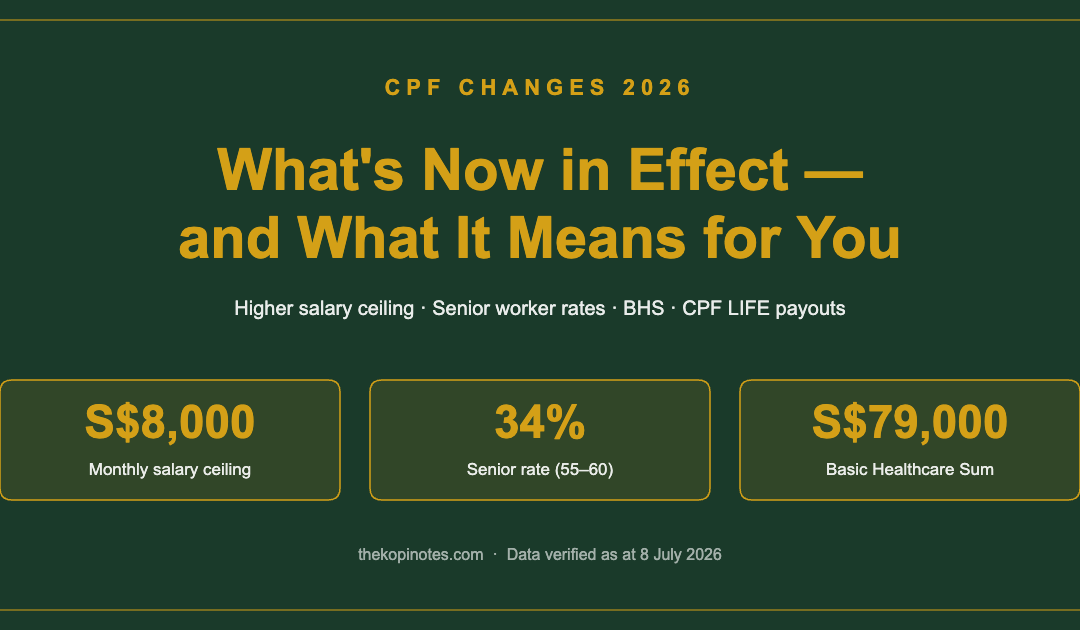
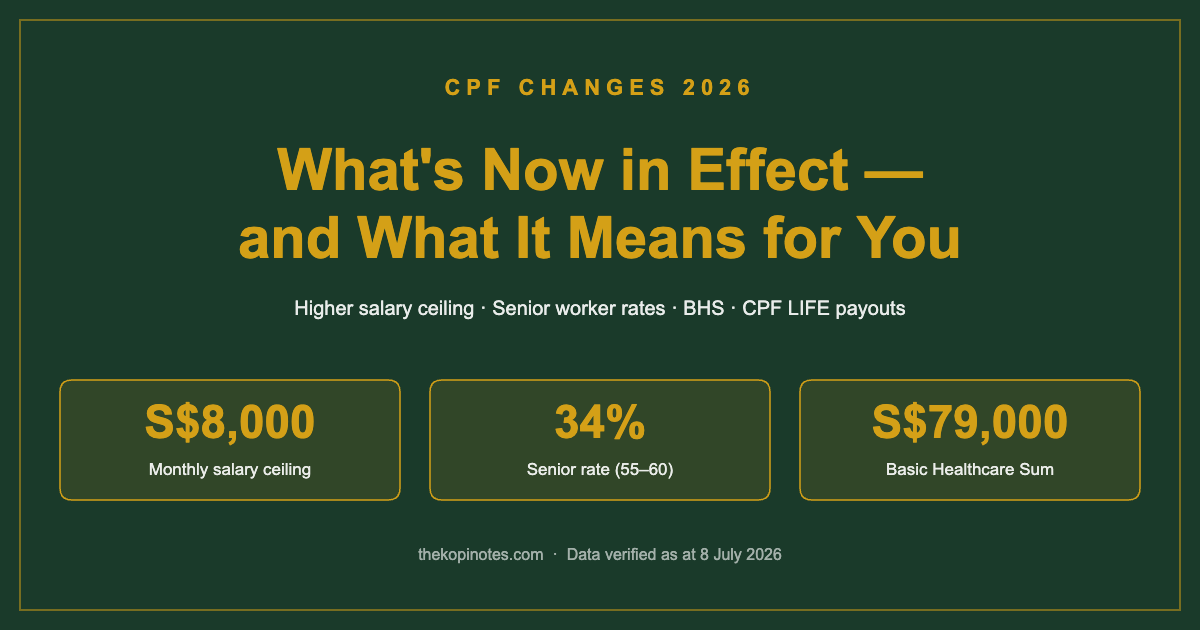
Singapore’s CPF changes for 2026 are now in full effect. Since 1 January, the CPF monthly salary ceiling has reached its final level of S$8,000, senior-worker contribution rates have risen again, and the Basic Healthcare Sum has climbed to S$79,000. The 2026 retirement sums are also set — with the Enhanced Retirement Sum now double the Full Retirement Sum at S$440,800. Here is what actually changed, and what it means for your money.
This is an editorial analysis. Not financial advice. Data verified as at 8 July 2026 against CPF Board, MOH and MOM sources.
- The CPF monthly salary ceiling hit its final S$8,000 level on 1 Jan 2026; the annual salary ceiling stays at S$102,000.
- Total contribution rates for workers aged above 55 to 65 rose by 1.5 percentage points — the above-55-to-60 band is now 34%.
- 2026 retirement sums: BRS S$110,200, FRS S$220,400, ERS S$440,800 (now double the FRS).
- Separately, the statutory retirement age rose to 64 and re-employment age to 69 from 1 July 2026.
What’s in this article
Jump to section
- 1. The S$8,000 salary ceiling
- 2. Higher senior-worker contribution rates
- 3. Retirement sums & bigger CPF LIFE payouts
- 4. Basic Healthcare Sum rises to S$79,000
- 5. New & expanded matching schemes
- What this means for retail investors
- What’s still coming in 2026 and 2027
- Bottom line for SG investors
- FAQ
1. The CPF Monthly Salary Ceiling Is Now S$8,000
The headline change most working Singaporeans feel in their payslip is the CPF monthly salary ceiling — the maximum monthly ordinary wage on which CPF contributions are calculated. Since 1 January 2026 it sits at its final level of S$8,000, up from S$7,400 in 2025, the last step of a phased increase from S$6,000 that began in 2023.
The CPF annual salary ceiling is unchanged at S$102,000, and the CPF annual contribution limit remains S$37,740. If you earn S$8,000 a month or more, a larger slice of your salary now flows into CPF each month. For an S$8,000 earner aged 55 and below, that is up to S$2,960 in combined monthly contributions (37% of S$8,000), versus S$2,738 when the ceiling was S$7,400.
What this means for you: higher earners see slightly lower cash take-home but more forced retirement and housing savings. If more of your pay is now locked into CPF, it is worth revisiting how you deploy the rest — our guide to where to park cash in H2 2026 covers the options as rates drift lower.
2. Senior-Worker Contribution Rates Rose Again
For older workers, 2026 brings another step up in CPF contribution rates. From 1 January 2026, total rates for employees aged above 55 to 65 increased by 1.5 percentage points — split as 0.5 points from the employer and 1.0 point from the employee. The increase is fully channelled to the Retirement Account, up to the Full Retirement Sum, to strengthen retirement adequacy.
| Employee age | Total 2025 | Total 2026 | Employer | Employee |
|---|---|---|---|---|
| 55 and below | 37% | 37% | 17% | 20% |
| Above 55 to 60 | 32.5% | 34% | 16% | 18% |
| Above 60 to 65 | 23.5% | 25% | 12.5% | 12.5% |
| Above 65 to 70 | 16.5% | 16.5% | 9% | 7.5% |
| Above 70 | 12.5% | 12.5% | 7.5% | 5% |
Source: CPF Board, rates from 1 Jan 2026 (monthly wages above S$750).
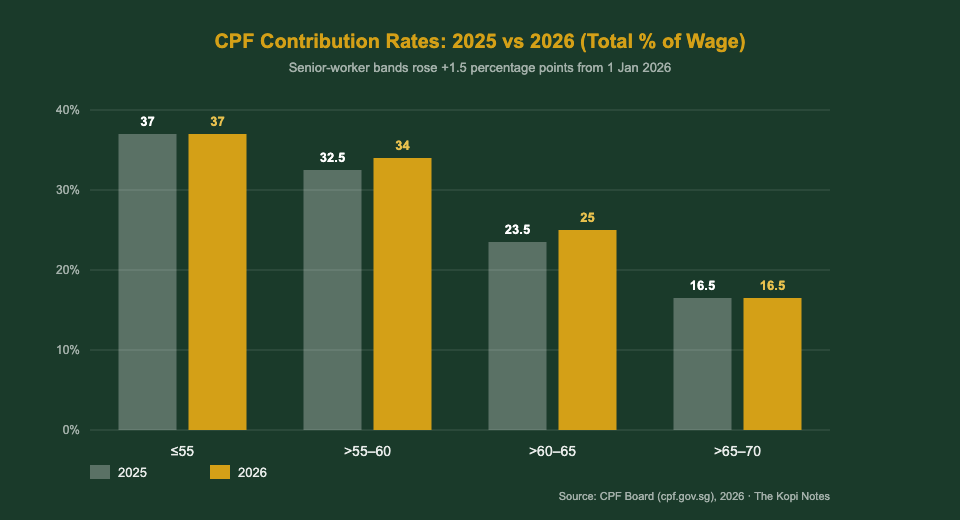
What this means for you: if you are in your late 50s or early 60s and still working, more of your income is being saved — and a bigger share now lands in your Retirement Account, directly boosting future CPF LIFE payouts. Employers face marginally higher wage costs, but the government’s Senior Employment Credit continues to offset part of this. For a full breakdown, see our CPF contribution 2026 guide.
3. The 2026 Retirement Sums — and Bigger CPF LIFE Payouts
CPF retirement sums rise by roughly 3.5% a year through to 2027 to keep pace with inflation and living standards. For members turning 55 in 2026, the three benchmark sums are the Basic Retirement Sum (BRS) of S$110,200, the Full Retirement Sum (FRS) of S$220,400, and the Enhanced Retirement Sum (ERS) of S$440,800. Since 2025 the ERS has been set at double the FRS, letting members top up more for higher lifelong payouts.
The table below shows estimated CPF LIFE Standard Plan payouts for a member turning 55 in 2026, based on the CPF payout estimator.
| Retirement sum (2026) | Set aside at 55 | Payout from 65 | Payout from 70 |
|---|---|---|---|
| Basic (BRS) | S$110,200 | S$890–930 | S$1,170–1,270 |
| Full (FRS) | S$220,400 | S$1,640–1,750 | S$2,190–2,370 |
| Enhanced (ERS) | S$440,800 | S$3,180–3,410 | S$4,200–4,550 |
Source: CPF monthly payout estimator, via DBS, Jan 2026. CPF LIFE Standard Plan; figures are estimates.
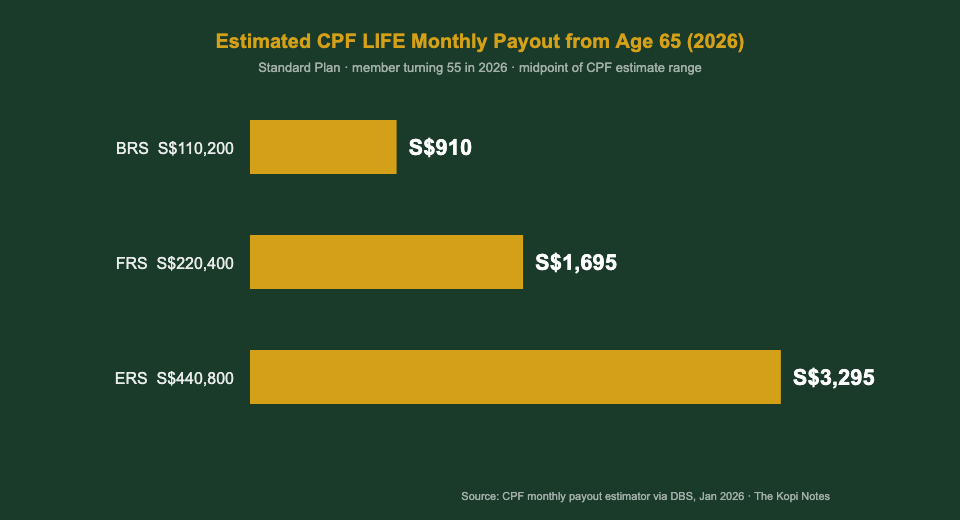
What this means for you: topping up to the ERS is one of the few ways to lock in a government-backed, inflation-adjusted income of over S$3,000 a month for life. But it also ties up a large sum you cannot easily access. Model it against your own targets with our Singapore retirement calculator before committing.
4. Basic Healthcare Sum Rises to S$79,000
The Basic Healthcare Sum (BHS) — the ceiling on your MediSave Account — rose to S$79,000 in 2026, up from S$75,500 in 2025. Members who turn 65 in 2026 have their BHS fixed at S$79,000 for life; those aged 66 and above keep their existing cohort BHS. Once your MediSave hits the BHS, further contributions overflow into your other CPF accounts.
If you plan to make a cash top-up to MediSave for tax relief, do it early in the year and before compulsory contributions fill the account. The combined annual tax relief cap for cash top-ups to MediSave and Special/Retirement accounts is S$8,000.
5. New and Expanded Matching Schemes
Two matching schemes stand out in 2026. The Matched Retirement Savings Scheme (MRSS) now includes eligible persons with disabilities below age 55, offering a dollar-for-dollar match of up to S$2,000 a year (lifetime cap S$20,000). And a new Matched MediSave Scheme (MMSS), running five years from 2026, matches voluntary MediSave top-ups for lower-income Singaporeans aged 55 to 70 by up to S$1,000 a year. Both are effectively free money for those who qualify — and no application is needed for MMSS.
What This Means for Singapore Retail Investors
CPF is the bedrock of most Singaporeans’ retirement plans, and 2026’s changes tilt the system further toward forced, guaranteed savings. Three practical takeaways:
- Your “safe” allocation just got bigger. With a higher salary ceiling and senior rates, more of your net worth compounds at CPF’s risk-free rates — up to 4% in the Special/Retirement Account and 2.5% in the Ordinary Account. That is a strong bond-like base that may free you to take measured risk elsewhere.
- Top-ups are a genuine yield. Voluntary top-ups earn up to 4% risk-free plus tax relief. For conservative savers that is hard to beat — the trade-off is liquidity, since the money is locked until 55 and beyond.
- CPF-OA can still be invested. If CPF’s base rates feel low, CPFIS-eligible funds and selected S-REITs remain an option. Platforms such as Endowus let you invest CPF-OA into low-cost funds. Pair that with a broader passive income strategy for the cash portion of your portfolio.
What’s Still Coming in 2026 and 2027
The 2026 story is not over. Separately from the contribution changes, the statutory retirement age rose to 64 and the re-employment age to 69 from 1 July 2026 — a change we covered in our report on Singapore’s new retirement age of 64. Note that the CPF payout eligibility age is unchanged at 65.
Looking ahead, another round of senior-worker CPF rate increases is legislated for 1 January 2027, which would lift the above-55-to-60 band from 34% toward 35.5%. The direction of travel is clear: by 2030, workers aged 55 to 60 are meant to contribute at the same rate as younger workers. If you are approaching that band, factor the rising contributions — and rising Retirement Account balances — into your cash-flow planning now.
Bottom Line for SG Investors
The 2026 CPF changes are incremental but meaningful: a higher salary ceiling, higher senior rates, a bigger Basic Healthcare Sum and larger potential CPF LIFE payouts all push more of your money into a guaranteed, inflation-aware system. For most retail investors the smart response is not to fight it but to build around it — treat CPF as your risk-free core, use top-ups and matching schemes where the returns and tax relief make sense, and take calculated risk with the cash you keep outside. Review your numbers once a year, ideally each January when the new figures take effect.
Frequently Asked Questions
What are the main CPF changes in 2026?
What is the CPF monthly salary ceiling in 2026?
What are the CPF contribution rates for senior workers in 2026?
What is the Full Retirement Sum in 2026?
What is the Basic Healthcare Sum for 2026?
Did the CPF retirement age change in 2026?
Will CPF contribution rates rise again after 2026?
Disclaimer
This article is editorial analysis for educational purposes only and is not financial advice. Figures are sourced from CPF Board, the Ministry of Health and the Ministry of Manpower and were verified as at 8 July 2026; they are subject to change. Please consult a licensed financial adviser before making CPF or investment decisions.
This article was researched with the help of AI. While we strive to keep all information accurate and up to date, there may be errors. If you notice any discrepancies, please contact us.