Singapore’s “risk-free” yields have quietly collapsed. The 6-month T-bill cut off at just 1.47% on 23 June 2026, the July Singapore Savings Bond offers a first-year rate of only 1.46%, and the best 12-month fixed deposit sits at 1.60%. For SG retail investors who parked cash for “safe” 3.7% returns two years ago, the income math has flipped — and CPF’s 2.5% floor now beats almost every cash instrument on the market.
This is an editorial analysis. Not financial advice. All figures are for educational reference only. Data as at 29 June 2026 unless noted.
What Happened to Singapore T-Bill and SSB Yields in 2026
If you have been rolling 6-month T-bills since the 2023 peak, the latest auctions have been a rude awakening. The 6-month T-bill (BS26112T) issued on 23 June 2026 cut off at 1.47% per annum, hovering near the same level as the 18 June auction. The 1-year T-bill last printed around 1.46%. Both are a world away from the 3.7%–4.2% cut-offs many Singaporeans enjoyed in late 2022 and 2023.
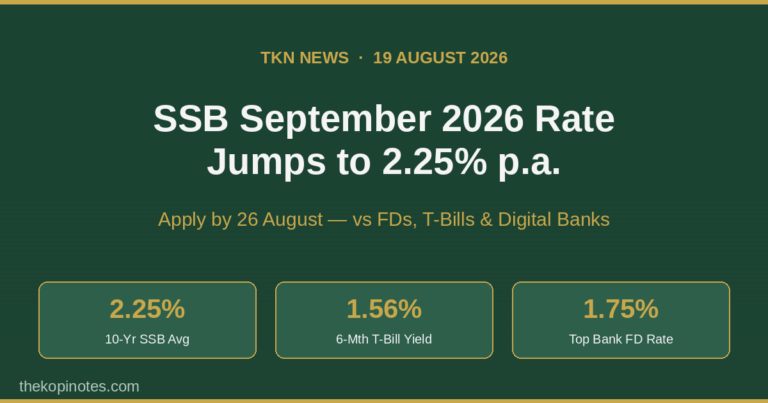
The picture is the same across the “safe yield” complex. The July 2026 Singapore Savings Bond (SBJUL26) offers a first-year rate of just 1.46% and a 10-year average return of 2.11% — flat against June and sitting near a multi-year low. Fixed deposits have held up marginally better, with the best 12-month rate at 1.60% p.a. (GXS) and the best 6-month rate at 1.50% (HL Bank, SBI), per Growbeansprout’s June 2026 tracker.
What this means for SG retail investors: the era of locking in 4% with zero risk is over for now. The driver is simple — Singapore’s short-term rates track US Treasury yields and SGD strength, and as global rate-cut expectations have fed through, SGS yields have drifted down through 2026. If your financial plan assumed cash would keep yielding 3%+, it now needs a rethink. The instruments that looked “boring but safe” are now boring and low-yielding.
The 2026 Yield Table: Where Your “Safe” Money Now Stands
Here is the uncomfortable comparison every Singaporean cash hoarder should look at. Note how the supposedly “low-risk” cash ladder now yields less than simply leaving money in your CPF Ordinary Account.
| Instrument | Latest Yield (Jun/Jul 2026) | Risk Profile | Liquidity |
|---|---|---|---|
| 6-month T-bill | 1.47% | Risk-free (SG govt) | Locked 6 months |
| SSB (year 1) | 1.46% | Risk-free (SG govt) | Redeem anytime |
| SSB (10-yr average) | 2.11% | Risk-free (SG govt) | Redeem anytime |
| Best 12-mth fixed deposit | 1.60% | SDIC-insured to $100k | Locked 12 months |
| CPF Ordinary Account | 2.50% | Govt-guaranteed | Restricted (housing/retirement) |
| CPF Special/Retirement Account | 4.00% | Govt-guaranteed | Restricted (retirement) |
| S-REIT sector (avg yield) | ~5.5%–5.9% | Market risk (price volatility) | Liquid (SGX-listed) |
What this means for SG retail investors: the gap between “risk-free” cash (1.46%) and CPF SA (4%) is now a full 2.5 percentage points. Even the CPF OA floor of 2.5% beats every T-bill, SSB and fixed deposit on the table. For the first time in this cycle, doing nothing with your CPF is a competitive yield strategy — and topping up voluntarily looks more attractive than chasing a 1.47% T-bill rollover.
Why CPF Is Suddenly the Best “Safe” Yield in Singapore
CPF interest rates are pegged to market benchmarks but protected by legislated floors. For the quarter from 1 July to 30 September 2026, CPF and HDB confirmed (in a joint statement on 26 May 2026) that the Ordinary Account stays at its 2.5% floor and the Special, MediSave and Retirement Accounts (SMRA) stay at the 4% floor. The HDB concessionary loan rate remains 2.6%.
The reason both rates are stuck at the floor is precisely because market yields have fallen. The OA rate is pegged to the higher of 2.5% or a bank-deposit formula; the SMRA rate is pegged to the 12-month average 10-year SGS yield plus 1%, floored at 4%. With 10-year SGS yields soft, both pegged rates sit below their floors — so members collect the floor, which is now far above what any T-bill pays.
What this means for SG retail investors: if you have idle cash and are over 55 or comfortable locking funds for retirement, a voluntary CPF top-up to the Special or Retirement Account effectively earns a government-guaranteed 4% — nearly triple the latest T-bill. You also get tax relief of up to $8,000 per year for self top-ups under the Retirement Sum Topping-Up scheme. For a full framework on deploying CPF beyond the floor, see our CPF investment strategy guide, and model the long-term impact with our retirement planning calculator.
Falling Rates Are Reviving S-REITs — The Income Trade-Off
The same falling-yield story that hurt cash savers is a tailwind for Singapore REITs. When government bond yields drop, the 5.5%–5.9% income from S-REITs looks comparatively more attractive, and lower borrowing costs lift distributable income. S-REITs have been actively refinancing debt at lower rates through 2026, which is expected to support distribution per unit (DPU). The June 2026 sector data shows the Lion-Phillip S-REIT ETF distributing around 5.42% — roughly 3.7x the latest T-bill yield.
But the comeback has been bumpy. As of early June 2026, the FTSE ST All-Share REIT Index was still down 6.7% year-to-date while the broader Straits Times Index rose 9.1%, weighed earlier in the year by higher bond yields and oil prices. The rebound since has tracked the decline in SGS yields — which cuts both ways: if rate-cut expectations reverse, REIT valuations can come under pressure again.
What this means for SG retail investors: S-REITs are not a substitute for a T-bill. You are swapping ~1.5% of guaranteed yield for ~5.5% of income that carries real price volatility. For income investors with a multi-year horizon, that trade can make sense — but it belongs in your growth/income bucket, not your emergency-fund bucket. If you want diversified exposure rather than single-name risk, an ETF wrapper spreads you across the sector; our Singapore REIT ETF guide and our list of the best S-REITs in Singapore 2026 break down the options. For the broader case on building cash flow, see our piece on passive income in Singapore.
A Practical 2026 Cash Strategy for SG Investors
Lower yields do not mean cash is useless — they mean you should be deliberate about which cash does what job. A simple tiered approach:
Tier 1 — Emergency fund (3–6 months expenses): Keep it liquid and accessible. With T-bills and FDs at 1.45%–1.60%, the yield difference is small, so prioritise flexibility — a high-yield savings account or SSB (redeemable monthly) is reasonable. Don’t lock emergency money into a 12-month FD just to chase 0.1%.
Tier 2 — Medium-term cash (1–3 years): This is where T-bills and FDs still earn their keep despite low rates, since capital is protected. But compare honestly against a CPF OA top-up if the funds are genuinely not needed before retirement. For a live comparison of T-bills against alternatives, see our Singapore T-bills 2026 guide.
Tier 3 — Long-term capital (5+ years): This is the bucket where the yield collapse matters most. Cash at 1.5% loses to inflation over a decade. CPF SA top-ups (4%), diversified equity ETFs, and S-REITs are the candidates here depending on your risk appetite. Robo-platforms make this easy to automate — readers using Endowus or Syfe can dollar-cost-average into diversified portfolios with referral bonuses.
What this means for SG retail investors: the single biggest mistake in a low-yield environment is leaving long-term money in short-term instruments “until rates recover.” Rates may not recover for years. Match each dollar to its time horizon, and let CPF do the heavy lifting on the guaranteed-return side.
Bottom Line for SG Investors
Singapore’s safe-yield landscape has inverted in 2026: the 6-month T-bill (1.47%), July SSB (1.46% year one) and best 12-month FD (1.60%) now all yield less than the CPF Ordinary Account’s 2.5% floor — and far less than the CPF SA/RA’s 4%. For idle long-term cash, a CPF top-up has quietly become one of the best risk-adjusted returns available to a Singaporean, with tax relief on top. For income seekers willing to accept price volatility, S-REITs yielding ~5.5% offer a compelling — but genuinely riskier — alternative as falling rates revive the sector.
The key discipline is matching money to time horizon: keep emergency cash liquid, let T-bills and FDs handle protected medium-term needs, and stop parking long-term capital at 1.5% out of habit. The “safe” choice that loses to inflation for a decade is not actually safe.
Frequently Asked Questions
Why have Singapore T-bill and SSB yields fallen so much in 2026?
Singapore’s short-term rates closely track US Treasury yields and SGD dynamics. As global rate-cut expectations have fed through and 10-year SGS yields have softened in 2026, the auction cut-offs on T-bills and the formula-linked SSB rates have drifted down to around 1.46%–1.47%, near multi-year lows. The CPF floors of 2.5% (OA) and 4% (SMRA) did not move, because they are legislated minimums that kick in precisely when market rates fall.
Is it better to put cash in CPF or a T-bill right now?
For funds you genuinely will not need before retirement, a CPF top-up is mathematically superior today: the OA floor (2.5%) and SA/RA floor (4%) both beat the latest T-bill (1.47%), and self top-ups to the SA/RA qualify for up to $8,000 in annual tax relief. The trade-off is liquidity — CPF money is locked for housing or retirement, whereas a T-bill returns your capital in six months. Emergency and near-term cash should stay liquid; only long-term idle cash belongs in CPF.
Are S-REITs a safe replacement for fixed deposits in 2026?
No. S-REITs yield far more (~5.5%) and are benefiting from falling rates and cheaper refinancing, but they carry market risk — the S-REIT index was still down 6.7% year-to-date in early June 2026 before its rebound. A fixed deposit returns your exact capital; a REIT can fall in price. Treat S-REITs as an income/growth allocation for a multi-year horizon, not as a swap for your emergency fund or short-term savings.
This article was researched with the help of AI. While we strive to keep all information accurate and up to date, there may be errors. If you notice any discrepancies, please contact us.