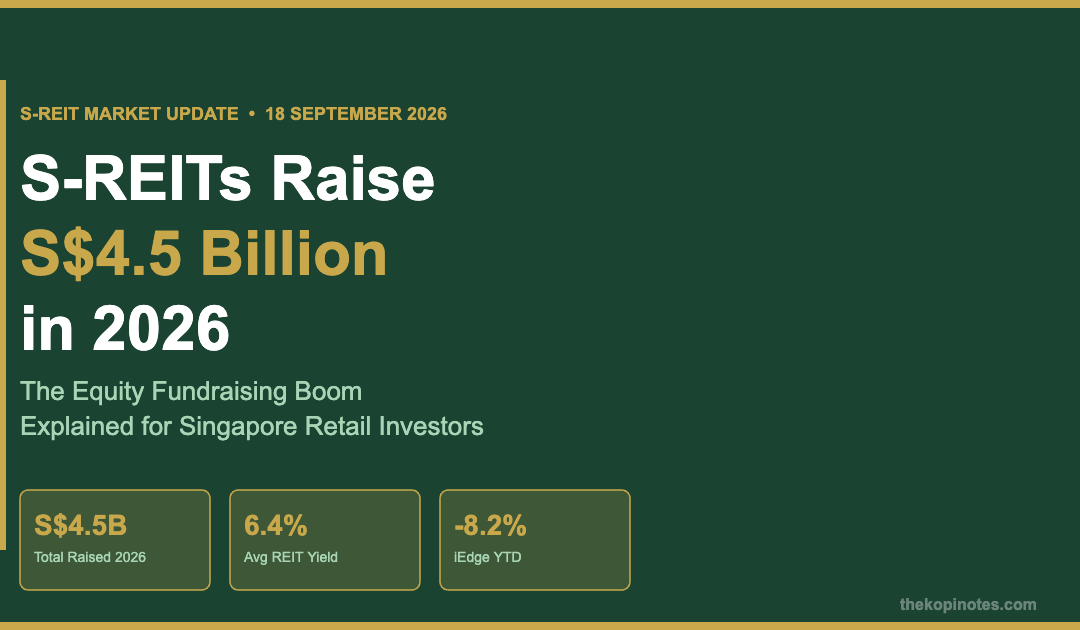
Singapore’s Real Estate Investment Trusts have raised S$4.5 billion through equity fundraising in 2026 — the highest tally since 2021 — even as the iEdge S-REIT Index slumps 8.2% year-to-date. With the US Federal Reserve hiking rates to 3.75%-4% on 17 September 2026, retail investors holding S-REITs face a critical question: does this fundraising surge signal confidence, or is it a warning sign of more dilution ahead?
This is an editorial analysis. Not financial advice. Data verified as at 18 September 2026.
Why S-REITs Are Raising Record Capital in 2026
Despite a challenging rate environment, Singapore’s REIT managers have been remarkably active in tapping the equity market this year. The Business Times reported on 14 September 2026 that S-REITs had raised at least S$4.5 billion through placements, rights issues, and IPOs in the year to 10 September — surpassing the fundraising haul over the same period in 2025, which was itself the strongest year since 2021.
The driving force is clear: acquisitions. Singapore’s largest REIT sponsors are using this window — even with borrowing costs elevated — to bulk up portfolios. Larger portfolios mean more diversified income streams, lower concentration risk, and potentially stronger unitholder distributions over time. For retail investors, understanding why REITs raise equity is just as important as understanding what they buy with the proceeds.
The Three Biggest Deals of 2026
Three deals have dominated the fundraising headline numbers:
1. UI Boustead REIT IPO (March 2026) — S$1 billion+
The year’s biggest debut, UI Boustead REIT listed on the SGX in March 2026 as a pure-play industrial REIT, raising over S$1 billion in its IPO. The offering was 3.3 times oversubscribed, reflecting strong institutional and retail demand for a new industrial income vehicle in Singapore. This IPO alone accounts for over 20% of the full-year equity fundraising total.
2. Keppel REIT Preferential Offering (January 2026) — S$886 million
Keppel REIT (SGX: K71U) kicked off the year with a major preferential offering, issuing 923.2 million new units at S$0.96 per unit — a ratio of 23 new units for every 100 existing units held. Proceeds were channelled into acquiring an additional one-third stake in Marina Bay Financial Centre Tower 3, growing Keppel REIT’s portfolio from S$9.8 billion to S$11.2 billion and increasing its Singapore exposure from 75.8% to 79%.
3. CapitaLand Ascendas REIT (March 2026) — S$903.5 million
CapitaLand Ascendas REIT (SGX: A17U) announced three acquisitions totalling around S$1.41 billion and simultaneously launched a private placement plus preferential offering to raise at least S$900 million. Eligible unitholders received 28 preferential offering units for every 1,000 existing units at S$2.35 per unit — a 6.5% discount. The combined exercise raised S$903.5 million and was oversubscribed.
The Dilution Question Every Retail Investor Must Ask
Every time a REIT issues new units, existing unitholders face dilution — their proportionate ownership shrinks unless they subscribe to their entitlement. This is where many retail investors get caught out. You receive a rights or preferential offering notice, and if you don’t act, your stake is automatically diluted.
The key test for any equity fund raising is whether the acquisition is accretive to DPU (Distribution Per Unit). A well-structured acquisition — like Keppel REIT’s Marina Bay Financial Centre deal or CLAR’s new industrial portfolio — should grow the income pie fast enough that each unitholder’s slice (the DPU) doesn’t shrink even after new units are issued. If the acquisition is DPU-accretive, taking up your entitlement is generally sensible. If it’s DPU-dilutive, question the deal’s rationale.
For a deep-dive on navigating a rights issue as a retail investor, see our Keppel DC REIT Rights Issue & Preferential Offering Guide.
S-REIT Performance Chart: Fundraising vs Index Returns
The chart below shows the contrast between strong fundraising activity and muted price returns:
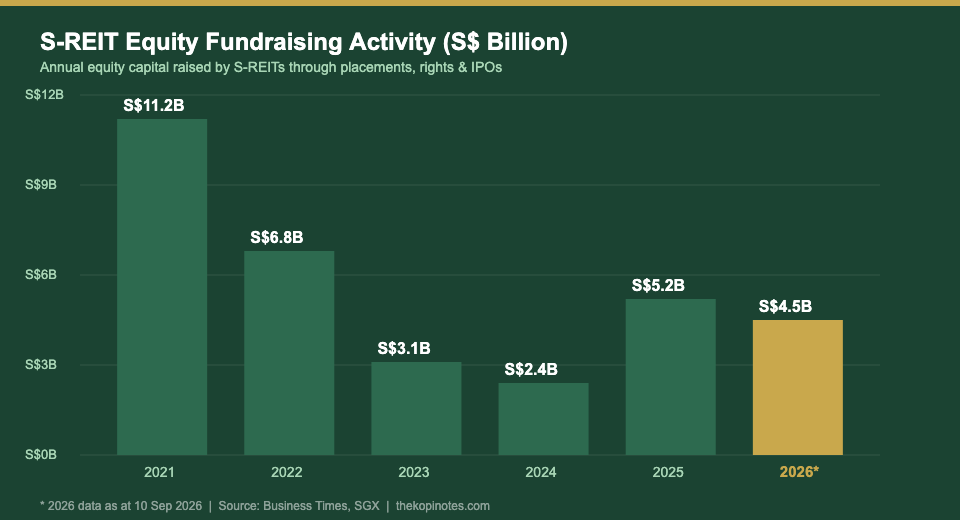
Note that 2021 was the peak fundraising year — S-REITs raised over S$11 billion, driven by post-pandemic portfolio opportunism and cheap debt. The slump in 2023-2024 coincided with rising interest rates that made debt-funded acquisitions less compelling. The recovery in 2025 and continued momentum in 2026 reflects a market that has repriced risk, with REIT managers taking advantage of a wider pool of institutional capital via Singapore’s S$6.5 billion Equity Market Development Programme (EQDP).
Yield Spread: Why 6.4% Still Looks Attractive (But Just Barely)
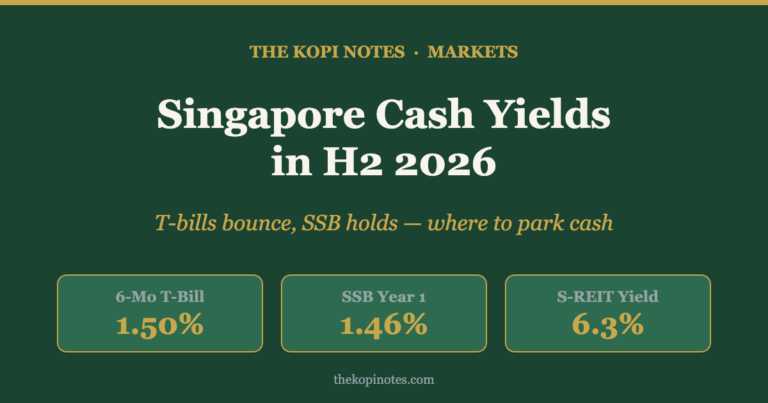
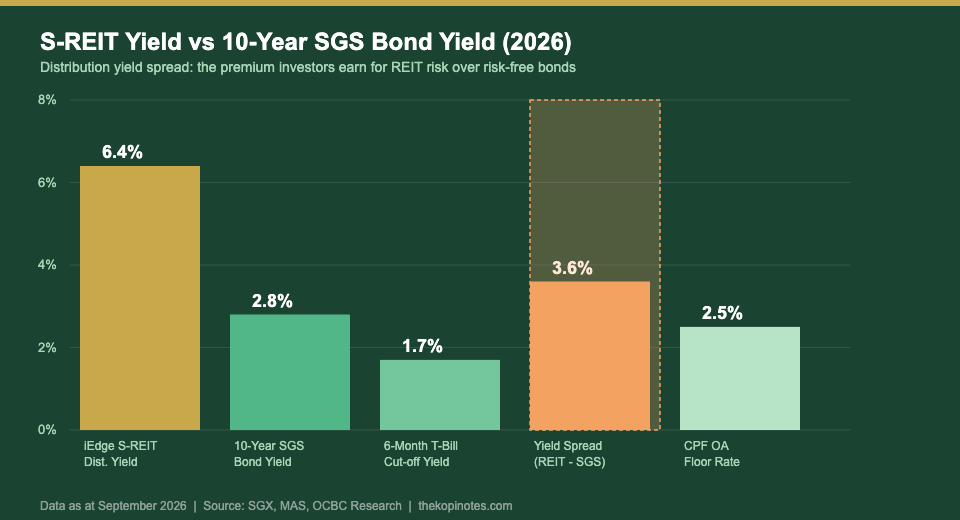
Despite the index declining 8.2% year-to-date, the silver lining for income investors is that distribution yields have risen — a lower unit price means a higher yield on the same DPU. The iEdge S-REIT Index now offers a market-cap weighted average distribution yield of 6.3%-6.4%, against a 10-year Singapore Government Security (SGS) yield of approximately 2.8%. That’s a yield spread of roughly 350 basis points — in line with the sector’s 10-year average.
However, the Federal Reserve’s rate hike on 17 September 2026 — to 3.75%-4.00% — introduces fresh upward pressure on Singapore interest rates and borrowing costs. With 16 of 18 FOMC officials pencilling in at least one more hike before year-end, REIT financing costs could tick higher in Q4 2026, potentially compressing DPUs. Read our full breakdown in S-REITs Down 8.2% in 2026: Buy the Dip?
Data Table: Key S-REIT Equity Raises in 2026
| REIT | Month | Type | Amount | Use of Proceeds |
|---|---|---|---|---|
| UI Boustead REIT | Mar 2026 | IPO | S$1.0B+ | Industrial portfolio acquisitions |
| CapitaLand Ascendas REIT | Mar 2026 | PP + PO | S$903.5M | 3 acquisitions worth S$1.41B |
| Keppel REIT | Jan 2026 | PO | S$886M | MBFC Tower 3 stake acquisition |
| Keppel DC REIT | Various | EFR | Undisclosed | Data centre acquisitions |
| Others | YTD | Various | ~S$710M | Portfolio acquisitions |
| TOTAL (YTD to Sep 10) | S$4.5B+ |
PP = Private Placement; PO = Preferential Offering; EFR = Equity Fund Raising. Source: Business Times, SGX announcements, September 2026.
What the Fed Rate Hike Means for Future S-REIT Fundraising
The Fed’s decision to hike rates on 17 September 2026 is a headwind — but not a deal-breaker — for S-REIT fundraising. Here’s why:
Higher borrowing costs → tighter acquisition economics. When debt costs rise, the yield-on-cost for any new acquisition shrinks. REIT managers will be more selective about what they buy and at what price. Expect fewer deals in Q4 2026 as the market digests the new rate regime.
But equity is still available. The SGX’s EQDP (expanded to S$6.5 billion in February 2026) continues to funnel institutional capital into Singapore equity markets, including REITs. This structural tailwind keeps a floor under equity appetite for high-quality S-REITs.
REITs at 0.86x P/NAV look cheap — but there’s a catch. When unit prices trade below net asset value, equity raises become more expensive (you’re issuing units at a discount to book value). This is why you’ll see more high-yield S-REITs opt for preferential offerings over private placements — preferential offerings let retail investors participate and avoid getting diluted out.
For the broader rate hike context and what to do with your Singapore savings and investments, read: Singapore T-Bill After the September 2026 FOMC Rate Hike and Fed Rate Hike: What It Means for Your VWRA, CSPX & STI ETFs.
The Retail Investor Checklist: 5 Things to Do When Your REIT Raises Equity
When a REIT you hold announces a fundraising exercise, work through this checklist before acting:
1. Is the acquisition DPU-accretive? Look at the manager’s pro forma DPU projections. If DPU rises post-acquisition, the deal is likely worth supporting.
2. What is the issue price discount? A discount of 5%-10% to the last traded price is standard. A deeper discount signals urgency or weak demand — a yellow flag.
3. What is the pro forma gearing after the deal? MAS caps REIT gearing at 50% of total assets. Check that the post-acquisition leverage stays comfortably below that ceiling, ideally under 42%.
4. Is the acquisition within the REIT’s core mandate? Industrial REITs buying data centres, or retail REITs buying logistics assets, are drift risk. Stick to REITs that stay in their lane.
5. Will you subscribe or sell the rights? If you can’t afford to subscribe (or don’t want to add), you may be able to sell renounceable rights on the market. Non-renounceable rights (like CLAR’s preferential offering) cannot be sold — it’s subscribe or dilute.
For a full breakdown of the S-REIT sector’s 2026 outlook, see our S-REIT Outlook 2026: Yield Comparison, Rate Cuts & Best Picks.
Bottom Line for SG Investors
S-REITs raising S$4.5 billion in 2026 is not a sign of desperation — it’s a sign of an asset class that is actively growing despite a hostile rate environment. The deals being done (MBFC Tower 3, CLAR’s industrial acquisitions, Boustead REIT’s IPO) are strategically sound and generally DPU-accretive.
For retail investors, the key is not to be passive recipients of dilution. Understand every equity fundraising your REITs announce, know your rights, and use the checklist above to make an informed decision. With the iEdge S-REIT Index at 0.86x P/NAV and a 6.4% yield spread sitting 350 basis points above the 10-year SGS, the income case for S-REITs remains intact — just don’t ignore the risks of rising rates and potential DPU compression in H2 2026.
Frequently Asked Questions
How much have S-REITs raised in equity fundraising in 2026?
Singapore REITs (S-REITs) raised at least S$4.5 billion in equity fundraising from January to 10 September 2026, through a combination of IPOs, private placements, and preferential offerings. This is the highest fundraising total since 2021, according to Business Times.
Which S-REIT raised the most money in 2026?
The largest single raise was the UI Boustead REIT IPO in March 2026, which raised over S$1 billion and was 3.3 times oversubscribed. Keppel REIT (S$886 million) and CapitaLand Ascendas REIT (S$903.5 million) were close behind.
Does S-REIT equity fundraising dilute retail investors?
Yes, if you do not subscribe to your entitled allocation in a preferential offering or rights issue, your proportionate ownership of the REIT shrinks — this is called dilution. Most retail investors should consider subscribing if the acquisition is DPU-accretive and gearing remains manageable.
What is the average distribution yield for S-REITs in 2026?
As of September 2026, the market-cap weighted average distribution yield for the iEdge S-REIT Index is approximately 6.3%–6.4%, compared to the 10-year SGS bond yield of around 2.8%, giving a yield spread of approximately 350 basis points.
How does the September 2026 Fed rate hike affect S-REIT fundraising?
The Fed’s 25 basis point hike to 3.75%-4.00% on 17 September 2026 increases borrowing costs for REITs, making acquisitions slightly less accretive. Expect more selective deal-making in Q4 2026. However, institutional capital from Singapore’s S$6.5 billion EQDP continues to support demand for S-REIT equity.
What is the iEdge S-REIT Index P/NAV ratio in September 2026?
As of early September 2026, the iEdge S-REIT Index was trading at approximately 0.86x Price-to-Net Asset Value (P/NAV), meaning Singapore REITs are collectively trading at a 14% discount to the book value of their properties and assets.
Should I buy S-REITs now after the Fed rate hike?
This is not financial advice. However, at 0.86x P/NAV and 6.4% yield with a 350bps spread over risk-free rates, the income case remains compelling for long-term investors. The main risk is further rate hikes compressing DPUs in H2 2026. Diversifying across REIT sub-sectors (industrial, data centres, retail, hospitality) can reduce concentration risk.
This article was researched with the help of AI. While we strive to keep all information accurate and up to date, there may be errors. If you notice any discrepancies, please contact us.