Fed Rate Hike to 3.75%-4%: What It Means for Your VWRA, CSPX, Gold and STI ETFs
The Fed’s first rate hike since 2023 just landed. Here’s how it hits your global equity, gold and Singapore bank ETFs.
On 16 September 2026, the Federal Reserve raised its benchmark rate by 25 basis points to 3.75%-4.00%, its first hike since 2023. Gold ETFs fell as the US dollar strengthened, global equity ETFs like VWRA and CSPX dipped modestly, and Singapore’s STI ETF stood to benefit as local banks gain from wider lending margins. Here’s what the hike means for your portfolio.
Not financial advice. All figures are for educational reference only. Data verified as at 16-17 September 2026 unless otherwise noted.
- The Fed hiked rates for the first time in three years, and 16 of 18 officials expect one more hike before 2026 ends.
- Gold ETFs took the immediate hit. VWRA, CSPX and IWDA barely moved. STI ETF holders should watch bank earnings closely.
- This is one data point in a long portfolio journey, not a reason to change your ETF strategy overnight.
What the Fed Just Did
The US Federal Reserve’s Federal Open Market Committee (FOMC) voted 12-0 on 16 September 2026 to raise the federal funds target range by 25 basis points, from 3.50%-3.75% to 3.75%-4.00%. It’s the Fed’s first rate increase since 2023, and it caught a chunk of the market off guard. Going into the meeting, traders had spent much of the year pricing in cuts, not hikes.
Fed Chair Kevin Warsh used the post-meeting press conference to stress the central bank’s commitment to bringing inflation back down, rather than signal a pause. The Fed’s own Summary of Economic Projections (the “dot plot”) backed that tone: 16 of 18 policymakers pencilled in at least one more 25-basis-point hike before the end of 2026, with the median projection putting the funds rate at around 4.1% by year-end, up from 3.8% projected back in June.
Why the Fed Hiked Now
Two forces pushed the Fed’s hand. First, US headline inflation has stayed sticky at roughly 3.4%-3.7% year-on-year, well above the Fed’s 2% target. Second, oil prices jumped after Middle East geopolitical developments earlier this year, adding fresh cost pressure just as inflation looked like it might be cooling.
That combination — persistent inflation plus a fresh energy shock — left the Fed little room to cut, even with US President Donald Trump publicly pressuring the central bank to lower rates after a stronger-than-expected August jobs report. In practice, the Fed prioritised its inflation mandate over political pressure or market expectations of a cut.
For you, the “why” matters less than the “so what”. A hike driven by sticky inflation, not a hot economy, is a different signal than a hike driven by runaway growth. It tells you the Fed sees inflation risk as the bigger threat right now, and that more hikes could follow if inflation doesn’t budge.
Impact on Gold ETFs
Gold ETFs — like the Lion-OCBC or LionGlobal physical gold ETFs Singapore investors typically hold — felt the hike immediately. Gold had been trading in the US$4,300 range in the days before the decision. It slid to around US$4,310/oz right after the announcement, and precious metals extended their slide as Warsh’s hawkish tone signalled at least one more hike was coming. Silver moved in tandem.
This is textbook behaviour. Gold pays no interest, so when rates rise, holding cash or bonds becomes relatively more attractive, and gold usually gives up ground as real yields climb and the US dollar strengthens. That said, 2026’s gold price has stayed historically elevated all year — a single hike hasn’t reversed the broader trend, it’s just added short-term pressure.
| Asset | Reaction on 16 Sep 2026 | Why |
|---|---|---|
| Gold (spot) | Fell to ~US$4,310/oz | Higher real yields + stronger USD reduce gold’s relative appeal |
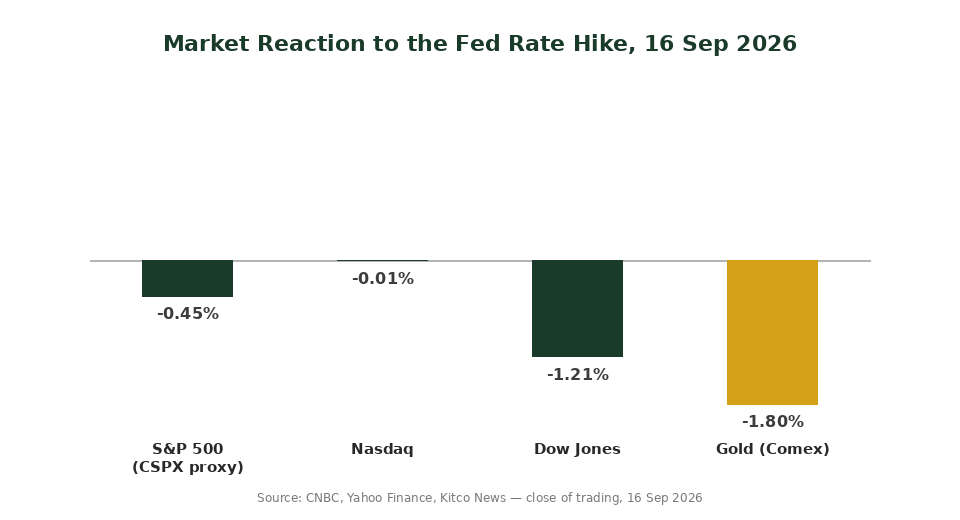
| S&P 500 (CSPX proxy) | -0.45% to 7,551.81 | Higher discount rates are a mild headwind for equity valuations |
| Nasdaq | -0.01% to 25,978.42 | Essentially flat — growth stocks shrugged off the decision |
| Dow Jones | -1.21% to 51,461.90 | Rate-sensitive industrials and financials led the decline |
Source: CNBC, Yahoo Finance, Kitco News — close of trading, 16 September 2026
Impact on VWRA, CSPX and IWDA
If you hold VWRA (Vanguard FTSE All-World UCITS ETF), CSPX (iShares Core S&P 500 UCITS ETF) or IWDA (iShares Core MSCI World), the honest answer is: not much changed on decision day itself. The S&P 500 slipped 0.45% and the Dow fell 1.21%, but the Nasdaq closed almost exactly flat. That’s a mild wobble, not a selloff.
The mechanical reason higher rates are a headwind for equities is straightforward. A stock’s value is the present value of its future earnings, and a higher “discount rate” (driven by higher risk-free rates) mathematically reduces that present value, especially for growth stocks whose profits are expected further in the future. But markets had already priced in a good chunk of this hike ahead of time — CME FedWatch showed odds above 90% going into the meeting — which is why the actual move on the day was relatively contained.
What matters more than one day’s price action is the trajectory. With 16 of 18 Fed officials expecting another hike before year-end, VWRA and CSPX holders should brace for continued rate-driven volatility rather than a single clean move. This is exactly the kind of environment where dollar-cost averaging earns its keep — you’re not trying to time each Fed decision, you’re building a position steadily through the noise.
Impact on Your STI ETF
Singapore’s STI ETF (tracking the Straits Times Index) is different from VWRA or CSPX in one important way: it’s roughly 40-45% weighted to the three local banks — DBS, OCBC and UOB. Banks generally benefit from higher interest rates because they can widen the spread between what they pay depositors and what they charge borrowers, known as the net interest margin.
That dynamic was already visible before the hike. In early September 2026, the STI closed at a record 5,801.96, with DBS, OCBC and UOB all posting weekly gains of 3-4% as the market priced in a hike. If that pattern holds after the actual decision, STI ETF holders may see relative outperformance versus global equity ETFs in the near term — though bank rallies driven by rate expectations can also reverse quickly if the Fed’s tone shifts.
The flip side: Singapore’s S-REITs, which typically make up a smaller slice of the STI than the banks but matter a great deal to income investors, tend to face pressure from higher rates as borrowing costs rise and REIT yields compete less favourably against risk-free rates. If you hold both an STI ETF and individual S-REITs or a Singapore REIT ETF, this hike is a reminder to check how concentrated your overall Singapore exposure really is.
USD/SGD and What It Means for Your Portfolio
Higher US rates typically support a stronger US dollar, since investors can earn more just parking money in USD assets. USD/SGD was trading around 1.267 in the days before the decision. Most analysts expect the pair to stay range-bound between roughly 1.25 and 1.30 in the near term — Singapore’s own economic fundamentals limit how far SGD can weaken, while the Fed’s hawkish stance limits how far it can strengthen.
For VWRA and CSPX holders, this cuts both ways. These ETFs are priced in USD, so a stronger dollar means your existing USD-denominated holdings are worth slightly more in SGD terms when you look at your portfolio value. But it also means your next SGD-to-USD purchase buys you fewer units than it would have a few months ago. Neither effect is large enough to justify timing your purchases around currency moves — the swings here are single-digit percentage points, not the kind of move that should override a long-term DCA plan.
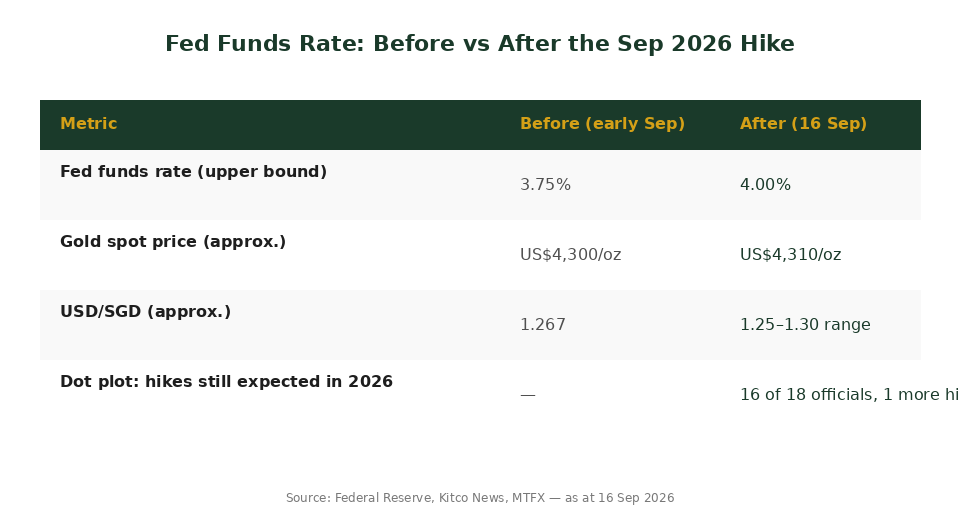
| Metric | Before (early Sep 2026) | After (16 Sep 2026) |
|---|---|---|
| Fed funds rate (upper bound) | 3.75% | 4.00% |
| Gold spot price (approx.) | US$4,300/oz | US$4,310/oz, still sliding |
| USD/SGD (approx.) | 1.267 | 1.25-1.30 expected range |
| Further 2026 hikes expected | Uncertain | 16 of 18 officials expect 1 more |
Source: Federal Reserve, Kitco News, MTFX Group — as at 16-17 September 2026
What Singapore Investors Should Do Now
Here’s the practical takeaway, broken down by what you actually hold.
If you hold VWRA, CSPX or IWDA: Keep your regular contribution schedule running. The market had already priced in most of this hike, which is why the equity reaction was mild. Don’t pause your DCA plan over a 0.45% single-day move — that’s normal volatility, not a trend reversal.
If you hold a gold ETF: Expect near-term softness as real yields rise, especially if the Fed follows through on the dot plot’s signalled second hike. This doesn’t change gold’s role as a portfolio diversifier over the long run, but it does mean this isn’t the moment to expect gold to keep climbing in a straight line.
If you hold an STI ETF: Watch DBS, OCBC and UOB’s next earnings updates for signs of how much of the rate benefit is actually flowing through to net interest margins, rather than assuming the September rally continues indefinitely.
If you’re building a new position: A hiking cycle is not, by itself, a reason to sit in cash. Historically, timing entries around Fed decisions has a poor track record versus simply staying invested and dollar-cost averaging. If you haven’t already, check our Singapore retirement calculator to see how a steady contribution schedule compounds over time, independent of any single rate decision.
For a deeper look at how the Fed’s broader rate path affects your global ETF portfolio, see our earlier piece on VWRA and CSPX after Jackson Hole 2026. And if gold is a core part of your strategy, our Gold ETF Singapore guide covers the products available to you. Diversifying beyond a single rate-sensitive asset class remains one of the simplest ways to manage this kind of macro noise — our guide to passive income in Singapore covers how S-REITs, dividend ETFs and gold can each play a different role.
Disclaimer: This article is for educational purposes only and does not constitute financial advice. Fed policy, market prices and exchange rates change constantly — always verify current figures before making investment decisions, and consider speaking to a licensed financial adviser for guidance specific to your situation.
Frequently Asked Questions
Did the Fed raise or cut interest rates in September 2026?
The Fed raised rates by 25 basis points on 16 September 2026, taking the federal funds target range to 3.75%-4.00%. This was a hike, not a cut, and it was the Fed’s first rate increase since 2023 — a surprise to markets that had spent much of the year pricing in cuts.
How does a Fed rate hike affect my VWRA or CSPX ETF?
Higher rates raise the discount rate used to value future company earnings, which is a mild headwind for equity valuations, especially growth stocks. On the day of the September 2026 hike, the S&P 500 fell 0.45% and the Nasdaq closed almost flat — a modest reaction, since markets had already priced in much of the move beforehand.
Should I sell my gold ETF after a Fed rate hike?
Not necessarily. Gold typically softens when rates rise because it pays no interest and becomes less attractive versus cash or bonds — gold fell to around US$4,310/oz after the September 2026 hike. But gold still plays a long-term diversification role in a portfolio, and short-term rate-driven dips don’t change that underlying case.
Does a Fed rate hike help or hurt my STI ETF?
It generally helps, at least for the bank-heavy part of the index. DBS, OCBC and UOB make up roughly 40-45% of the STI, and banks tend to benefit from higher rates through wider net interest margins. The STI hit a record high of 5,801.96 in early September 2026 partly on rate-hike anticipation. S-REITs, by contrast, tend to face pressure from higher borrowing costs.
Will the Fed hike rates again in 2026?
Based on the Fed’s own September 2026 projections, it’s likely. 16 of 18 FOMC officials indicated they expect at least one more 25-basis-point hike before the end of 2026, with the median dot plot projection putting the funds rate around 4.1% by year-end. This isn’t a guarantee — Fed projections change as new data comes in — but it signals the committee’s current bias.
Should I change my ETF investing strategy because of this rate hike?
For most long-term investors, no. A single rate decision, even a surprise one, is one data point in a multi-decade investing horizon. Dollar-cost averaging into diversified ETFs like VWRA or CSPX is designed to smooth out exactly this kind of short-term volatility. Rebalancing your overall asset mix — checking you’re not overly concentrated in rate-sensitive assets like gold or REITs — is a more useful response than trying to time the next Fed meeting.
Keep Building Your Portfolio Through the Noise
Rate decisions come and go. A steady, diversified ETF portfolio is built to outlast any single one.
This article was researched with the help of AI. While we strive to keep all information accurate and up to date, there may be errors. If you notice any discrepancies, please contact us.