World Ex-US ETF Singapore: How to Buy XUSE, EXUS & VXUS (2026 Guide)
A complete Singapore investor’s guide to trimming US concentration with a single LSE-listed ETF — TER, tax rules, and step-by-step buying instructions.
A world ex-US ETF holds developed-market stocks outside the United States — Europe, Japan, the UK, Canada and Australia — in one UCITS fund. Singapore investors buy iShares XUSE or Xtrackers EXUS on the London Stock Exchange through brokers like Interactive Brokers or Saxo. The main use case: your existing VWRA or CSPX holdings are already 60%+ concentrated in the US, so pairing with a world ex-US fund lets you dial that weight down on purpose.
Not financial advice. All figures are for educational reference only. Data verified as at September 2026 unless otherwise noted.
- XUSE (iShares) and EXUS (Xtrackers) both track the MSCI World ex USA index — developed markets only, TER 0.15%, no Taiwan, South Korea, China or India.
- VXUS (Vanguard) tracks the broader FTSE All-World ex US index — TER 0.12%, but it includes emerging markets and only launched in August 2026 with under EUR 20 million in assets.
- All three trade on the LSE and get the same 15% US withholding tax and zero US estate tax exposure as CSPX and VWRA. Buy them through IBKR, Saxo, or Syfe Brokerage.
Table of Contents
Contents — Click to expand
- What Is a World Ex-US ETF?
- Key Facts: XUSE vs EXUS vs VXUS
- Why Singapore Investors Buy ETFs on the LSE
- Why Add a World Ex-US Tilt? The Concentration Problem
- Expense Ratio and Total Costs
- How to Buy a World Ex-US ETF in Singapore
- XUSE vs EXUS vs VXUS: Which Should You Pick?
- Who Should Buy a World Ex-US ETF?
- Frequently Asked Questions
What Is a World Ex-US ETF?
A world ex-US ETF is a single fund that holds developed-market shares from everywhere except the United States. Think UK banks, Japanese carmakers, German industrials, Canadian energy firms and Australian miners — all in one basket. It exists because so many “global” trackers, like VWRA or CSPX, already give you heavy US exposure. A world ex-US fund is the counterweight.
Two Ireland-domiciled UCITS ETFs dominate this space on the London Stock Exchange (LSE): the iShares MSCI World ex-USA UCITS ETF (XUSE) and the Xtrackers MSCI World ex USA UCITS ETF (EXUS). Both track the same benchmark, the MSCI World ex USA Net Index, and both exclude emerging markets entirely — no Taiwan, South Korea, China or India.
A third option, the Vanguard FTSE All-World ex-U.S. UCITS ETF (VXUS), tracks a different index — the FTSE All-World ex US Index — which does include emerging markets. It launched on 18 August 2026, so it is brand new and worth treating with caution until it builds a track record and grows past its current sub-EUR 20 million size.
Key Facts: XUSE vs EXUS vs VXUS
| Metric | XUSE (iShares) | EXUS (Xtrackers) | VXUS (Vanguard) |
|---|---|---|---|
| Index Tracked | MSCI World ex USA | MSCI World ex USA | FTSE All-World ex US |
| Includes Emerging Markets? | No | No | Yes |
| Domicile | Ireland | Ireland | Ireland |
| Structure | Accumulating | Accumulating | Accumulating |
| TER (Expense Ratio) | 0.15% p.a. | 0.15% p.a. | 0.12% p.a. |
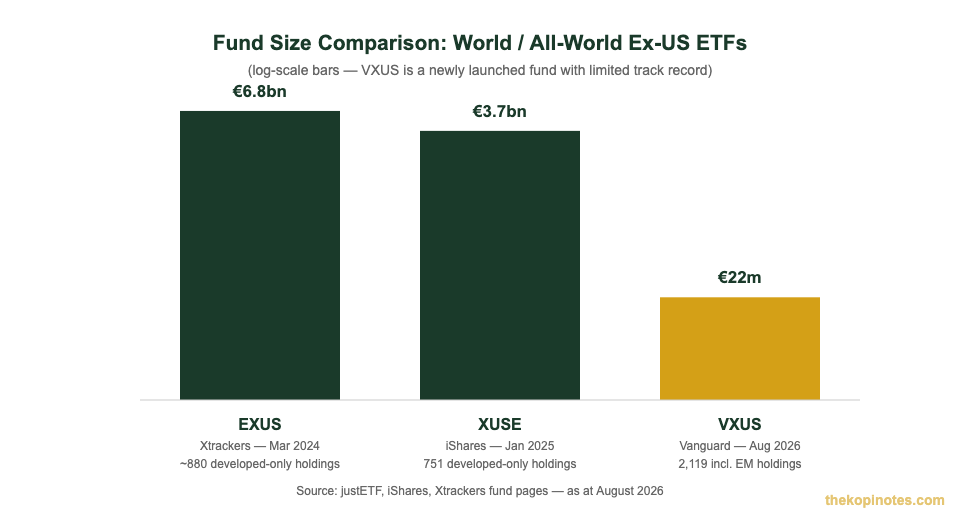
| Fund Size (AUM) | ~USD 3.7 billion | ~EUR 6.8 billion | ~EUR 19 million |
| Number of Holdings | 751 | Broadly similar to XUSE | 2,119 |
| Launch Date | 24 Jan 2025 | 6 Mar 2024 | 18 Aug 2026 |
| LSE Ticker | XUSE | EXUS | VXUS (GBP) / VXUA (USD) |
Source: iShares XUSE fund page, Xtrackers/justETF EXUS profile, Vanguard/justETF VXUS profile — data as at 28 August 2026.
Why Singapore Investors Buy ETFs on the London Stock Exchange
Ireland-domiciled UCITS ETFs like XUSE, EXUS and VXUS get better US tax treatment than US-listed alternatives such as Vanguard’s own US-domiciled VXUS-equivalent products. Under the US-Ireland tax treaty, dividends paid to an Irish fund suffer only 15% US withholding tax (WHT), versus 30% for a non-US-resident individual holding a US-domiciled ETF directly.
There is a second, bigger reason: US estate tax. If you hold US-domiciled shares or ETFs (bought on NYSE or Nasdaq) and you are not a US citizen or resident, your estate could owe US estate tax on the value above USD 60,000 — rates run as high as 40%. Ireland-domiciled ETFs bought on the LSE carry no such exposure, regardless of portfolio size. This is the single biggest reason Singapore investors avoid buying US-listed ETFs directly.
| ETF Type | Domicile | US Dividend WHT | US Estate Tax Risk |
|---|---|---|---|
| XUSE / EXUS / VXUS (LSE) | Ireland | 15% | None |
| US-domiciled equivalent (NYSE) | USA | 30% | Yes (above USD 60,000) |
Why Add a World Ex-US Tilt? The Concentration Problem
Here’s the issue in plain numbers. As at January 2026, the US made up approximately 62% of the FTSE All-World Index (FTSE Russell) that VWRA tracks — meaning most of a “globally diversified” VWRA holding is really a US bet. CSPX is 100% US by design.
Say you hold SGD 100,000 in VWRA. Roughly SGD 62,000 of that is riding on US company earnings, the US dollar, and US interest rate policy. If you’re comfortable with that, there’s no need to change anything. But if you want more control, adding a world ex-US ETF lets you rebalance the mix without selling VWRA and triggering unnecessary transaction costs.
For example, splitting a SGD 100,000 portfolio into 70% VWRA and 30% XUSE cuts your effective US weight from about 62% down to roughly 43% (70% x 62%), while still holding developed-market exposure across Europe, Japan, and the rest of the world. This is not a recommendation to hold this exact split — it’s an illustration of how the math works.
Expense Ratio and Total Costs
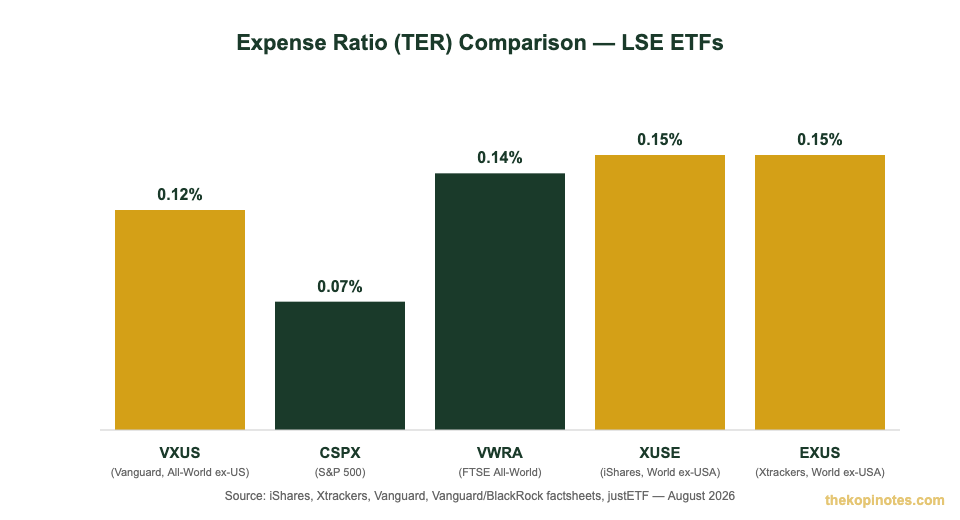
XUSE and EXUS both charge a TER of 0.15% a year. VXUS is cheaper at 0.12%, but its extremely small size (under EUR 20 million as at August 2026) means wider bid-ask spreads in practice — you may pay more on the spread than you save on the TER.
For a SGD 50,000 position in XUSE, the 0.15% TER costs you approximately SGD 75 per year in fund-level fees, deducted automatically from the fund’s NAV — you never see a separate bill. Compare this to CSPX at 0.07% (SGD 35 a year on the same amount) or VWRA at 0.14% (SGD 70 a year, down from the 0.19% VWRA charged before Vanguard’s July 2026 fee cut).
On top of the TER, factor in your broker’s commission and FX conversion spread each time you buy — these matter more for smaller, less frequent trades than the underlying TER difference between XUSE, EXUS and VXUS.
How to Buy a World Ex-US ETF in Singapore
All three ETFs trade on the LSE in the same way you’d buy CSPX or VWRA. Here’s the process broker by broker.
Interactive Brokers (IBKR): Fund your account via FAST (free SGD transfer), search “XUSE” or “EXUS” in the order ticket, select the LSE listing (currency GBP or USD line depending on the exact ticker), and place a limit order. IBKR is generally the most cost-effective choice for larger, less frequent purchases because its commission scales with trade size rather than charging a flat percentage.
Saxo Markets: Search the ticker under “Stocks & ETFs,” confirm the exchange is London, and place your order. Saxo’s platform fee tends to suit investors who also want access to a wide range of other exchanges beyond the LSE.
Syfe Brokerage: Search for the ticker in the Syfe app, confirm the LSE listing, and buy in SGD-equivalent terms — Syfe handles the FX conversion at the point of trade. This is the simplest option for beginners who want a single mobile app.
MooMoo Singapore: LSE coverage on MooMoo has historically been more limited than IBKR or Saxo — check the app’s search function for XUSE, EXUS or VXUS availability before assuming it’s listed, since MooMoo’s core strength is in US and SG-listed instruments.
Whichever broker you use, double-check you’re buying the accumulating (Acc) share class if you want dividends automatically reinvested rather than paid out as cash — all three ETFs in this guide are structured as accumulating funds.
XUSE vs EXUS vs VXUS: Which Should You Pick?
XUSE and EXUS are nearly identical — same index, same TER, same structure. The main difference is fund size and liquidity: EXUS is roughly double the size of XUSE (EUR 6.8 billion vs USD 3.7 billion as at August 2026), which can mean tighter spreads during volatile markets. In practice, either is a reasonable choice, and some investors simply pick whichever their broker shows the tightest live spread for on the day they trade.
VXUS is a different animal. Because it tracks FTSE’s index rather than MSCI’s, it classifies South Korea and Taiwan as developed markets rather than emerging — which is why Taiwan Semiconductor Manufacturing Co. is VXUS’s single largest holding at roughly 4.4% of the fund, alongside Samsung Electronics and SK Hynix. XUSE and EXUS hold none of these, because MSCI classifies Korea and Taiwan as emerging markets. This single index-methodology difference explains most of the practical gap between VXUS and its two MSCI-tracking rivals.
| ETF | TER | Index | Fund Size | Best For |
|---|---|---|---|---|
| XUSE | 0.15% | MSCI World ex USA | ~USD 3.7bn | Investors who already use other iShares products |
| EXUS | 0.15% | MSCI World ex USA | ~EUR 6.8bn | Investors wanting the deepest liquidity in this category |
| VXUS | 0.12% | FTSE All-World ex US | ~EUR 19m | Investors who want EM exposure baked in and can tolerate a brand-new, small fund |
Who Should Buy a World Ex-US ETF?
A world ex-US ETF makes sense if you already hold VWRA or CSPX and want to actively manage your US weighting, rather than accept whatever the index gives you. It also suits investors who want a simpler two-fund portfolio (a US fund plus a world ex-US fund) instead of relying on a single all-in-one global tracker.
Consider skipping it if you’re a beginner who just wants one fund and no rebalancing decisions — a single VWRA holding already gives you exposure to the whole world, US included, and is simpler to manage. It’s also not the right building block on its own: pair it with a US fund like CSPX, not as your only equity holding, since XUSE and EXUS deliberately exclude the world’s largest stock market.
Note that none of XUSE, EXUS or VXUS are CPF-investable, since they are not on the CPF Investment Scheme’s approved list of unit trusts. They are generally SRS-compatible if bought through an SRS-linked brokerage account. If you’re building a broader retirement portfolio around CPF and SRS, our CPF investment strategy guide and Singapore retirement calculator can help you see how this fits into the bigger picture.
If you already hold VWRA and want to understand its dividend and accumulation mechanics before layering on a world ex-US tilt, see our VWRA ETF Singapore guide. If your core US holding is CSPX, our guide on how to buy CSPX in Singapore covers the step-by-step broker process in more detail. For income-focused investors who prefer REITs over global equity ETFs, our Singapore REIT ETF guide is a useful complement.
Frequently Asked Questions
What is a world ex-US ETF and why do Singapore investors buy it?
A world ex-US ETF holds developed-market shares from everywhere except the United States. Singapore investors use it to reduce the heavy US weighting already built into funds like VWRA (about 62% US as at January 2026) or to complement a 100%-US CSPX holding with non-US developed-market exposure, without giving up the LSE’s favourable 15% withholding tax and zero US estate tax treatment.
Is XUSE the same as EXUS?
They are very similar but not identical funds. Both track the MSCI World ex USA index, both charge a 0.15% TER, and both are Ireland-domiciled accumulating UCITS ETFs. XUSE is run by iShares and EXUS by Xtrackers (DWS) — they compete directly, and the main practical difference is fund size, with EXUS roughly double the size of XUSE as at August 2026.
Can I buy XUSE, EXUS or VXUS using my CPF or SRS funds?
No, none of these three ETFs are on the CPF Investment Scheme’s approved list, so you cannot use CPF Ordinary Account funds to buy them. They are generally SRS-compatible if your broker supports SRS-funded trades on the LSE — check with your specific broker, since SRS-eligible instrument lists vary by platform.
Which broker is best for buying a world ex-US ETF in Singapore?
Interactive Brokers (IBKR) is typically the most cost-effective for larger, infrequent purchases because its commission structure scales with trade size. Syfe Brokerage is the simplest for beginners who want a single mobile app with built-in FX conversion. Saxo Markets suits investors who also trade across many other exchanges. Always compare live commission and FX spread figures on each platform before committing, since fee structures change.
Should I buy VXUS instead of XUSE or EXUS because it has emerging markets exposure?
Only if you understand the trade-off. VXUS gives you Taiwan, South Korea, China and India exposure that XUSE and EXUS deliberately exclude, at a slightly lower 0.12% TER. But VXUS launched in August 2026 with under EUR 20 million in assets, meaning wider bid-ask spreads and a very short track record. Investors who want emerging-market exposure without VXUS’s liquidity risk could instead pair XUSE or EXUS with a dedicated, larger emerging-markets ETF.
Do I need a world ex-US ETF if I already hold VWRA?
Not necessarily. VWRA already includes non-US developed and emerging markets alongside its roughly 62% US weighting, so it is a complete standalone global portfolio on its own. A world ex-US ETF is an optional tool for investors who specifically want to reduce that US weighting below what VWRA gives you by default — it is not a requirement for a well-diversified portfolio.
Ready to Rebalance Your Global Portfolio?
Open a brokerage account and add a world ex-US tilt today. Use our referral links for exclusive sign-up bonuses.
This article was researched with the help of AI. While we strive to keep all information accurate and up to date, there may be errors. If you notice any discrepancies, please contact us.