Sasseur REIT Dividend & DPU Guide 2026 (SGX: CRPU)
Ex-Dividend Dates, DPU History, Income Scenarios & Sustainability Analysis
Sasseur REIT (SGX: CRPU) paid a full-year DPU of 6.138 Singapore cents for FY2025, equivalent to a trailing dividend yield of approximately 9.5% at the June 2026 share price of S$0.645. Distributions are paid semi-annually — typically in September and March — via the REIT’s unique Entrusted Management Agreement (EMA) income structure. As Singapore’s only China outlet mall REIT, Sasseur REIT offers one of the highest yields in the S-REIT sector with aggregate leverage of just 24.5%, making it a distinctive high-income play for investors who understand its China retail exposure.
Not financial advice. All figures are for educational reference only. Data as at June 2026 unless noted.
- FY2025 DPU: 6.138¢ (~9.5% yield at S$0.645) — paid in 2 semi-annual tranches
- DPU has declined 3 straight years from the FY2022 peak of 7.015¢ — monitor for stabilisation
- CPF OA and SRS eligible; S$50,000 investment generates ~S$4,757/year in dividend income
Table of Contents
Contents — Click to Expand
- What Is Sasseur REIT’s Dividend Structure?
- DPU History FY2019–FY2025
- Ex-Dividend Dates & Payment Schedule
- Dividend Income Calculator by Portfolio Size
- DPU Sustainability Analysis 2026
- How the EMA Drives Dividends
- How to Buy Sasseur REIT for Dividends
- Dividend Yield vs Peer S-REITs
- Frequently Asked Questions
1. What Is Sasseur REIT’s Dividend Structure?
Sasseur REIT (SGX: CRPU) pays dividends twice a year, typically in September (for the first half of the financial year) and March (for the second half). The REIT’s financial year runs from January to December, so you would receive distributions for the period January–June in around September, and for July–December in around March.
The distributions are funded by Entrusted Management Agreement (EMA) income — Sasseur REIT does not collect traditional fixed rent from its outlet mall tenants. Instead, the Sasseur Group pays the REIT a combination of a guaranteed fixed component and a variable component tied to actual outlet mall retail sales. This is unique in the S-REIT universe and explains both the high yield and the DPU volatility you see in the history table below.
The REIT distributes 100% of taxable income available for distribution. There is no withholding tax on distributions to Singapore individual investors (as Sasseur REIT is a Singapore-listed business trust). However, the income is taxable as investment income at your personal marginal rate — unlike Singapore REITs’ distributions, which are technically tax-exempt at the investor level. Check with your tax adviser on the applicable treatment.
| Feature | Detail |
|---|---|
| Distribution Frequency | Semi-annual (twice per year) |
| H1 Distribution (Jan–Jun) | Paid around September each year |
| H2 Distribution (Jul–Dec) | Paid around March each year |
| FY2025 Total DPU | 6.138 Singapore cents per unit |
| FY2025 H1 DPU | ~3.12¢ (paid September 2025) |
| FY2025 H2 DPU | ~3.02¢ (paid March 2026) |
| Income Source | EMA — fixed base + variable outlet retail sales |
| Distribution Currency | Singapore Dollars (SGD) |
| Withholding Tax (SG individuals) | None at distribution; taxable as investment income |
| CPF OA / SRS Eligible | Yes — CPFIS-OA approved |
Source: Sasseur REIT Annual Report FY2025, SGX announcements, as at June 2026.
2. DPU History FY2019–FY2025
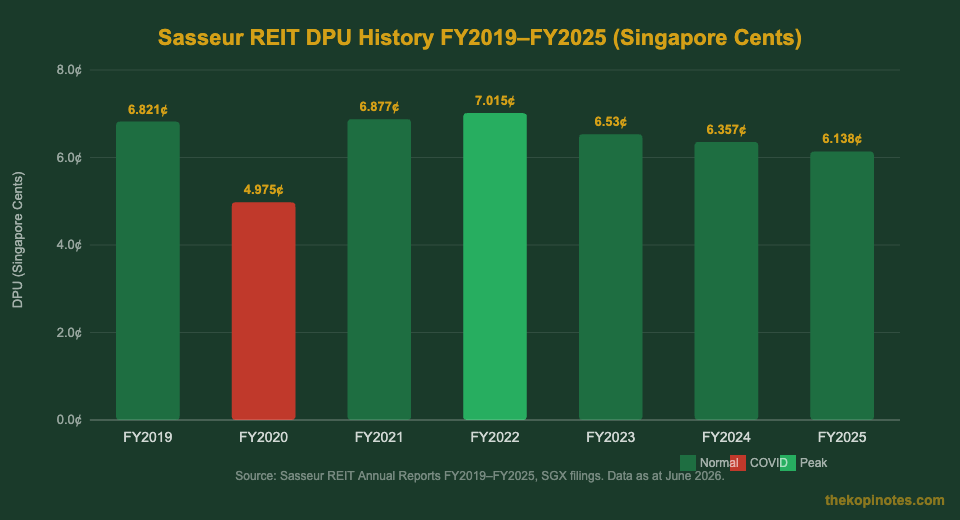
Understanding Sasseur REIT’s DPU history is essential before investing. The REIT listed in March 2018, so FY2019 represents its first full-year DPU. Since then, the history has been shaped by three distinct phases: the COVID collapse of FY2020, the strong recovery of FY2021–FY2022, and the three-year decline from FY2023 to FY2025.
The COVID year (FY2020) saw DPU collapse 27.1% as the malls were forced to close for extended periods. That risk is specific to the EMA structure — if malls cannot generate sales, the variable component of EMA income shrinks sharply. Recovery in FY2021–FY2022 was swift and surpassed pre-COVID levels, driven by pent-up consumer demand and China’s post-zero-COVID reopening. FY2022’s DPU of 7.015¢ remains the all-time high for Sasseur REIT.
Since FY2022, DPU has declined every year. The three-year declining trend (FY2023 to FY2025) reflects softening Chinese consumer sentiment, RMB/SGD currency headwinds, and weaker tenant sales at the Hefei and Kunming malls. The Chongqing properties have held up relatively better.
| Financial Year | DPU (S¢) | YoY Change | H1 DPU | H2 DPU | Key Driver |
|---|---|---|---|---|---|
| FY2019 | 6.821¢ | — | ~3.40¢ | ~3.42¢ | Pre-COVID baseline — full year operations |
| FY2020 | 4.975¢ | -27.1% | ~2.02¢ | ~2.96¢ | COVID lockdowns — malls closed Q1 2020 |
| FY2021 | 6.877¢ | +38.2% | ~3.32¢ | ~3.56¢ | Reopening + pent-up demand recovery |
| FY2022 | 7.015¢ | +2.0% | ~3.56¢ | ~3.46¢ | Strong outlet retail; post-zero-COVID peak |
| FY2023 | 6.530¢ | -6.9% | ~3.28¢ | ~3.25¢ | Consumer sentiment softened; RMB headwinds |
| FY2024 | 6.357¢ | -2.6% | ~3.19¢ | ~3.17¢ | Tepid Chinese retail; FX drag continues |
| FY2025 | 6.138¢ | -3.5% | ~3.12¢ | ~3.02¢ | Continued softness; Hefei/Kunming weaker |
Source: Sasseur REIT Annual Reports FY2019–FY2025, SGX filings. H1/H2 split is approximate based on disclosed semi-annual distributions.
3. Ex-Dividend Dates & Payment Schedule
To receive Sasseur REIT’s semi-annual distribution, you must hold units before the ex-dividend date (also called the ex-date). Buying on or after the ex-dividend date means you will NOT receive the upcoming distribution — the dividend goes to the previous holder instead.
Sasseur REIT announces its financial results and declares distributions twice a year. The table below shows the approximate schedule based on historical patterns:
| Distribution Period | Results Announcement | Ex-Div Date (Approx.) | Record Date (Approx.) | Payment Date (Approx.) |
|---|---|---|---|---|
| H1 (Jan–Jun) | Late July / Early August | Mid-August | Late August | September |
| H2 (Jul–Dec) | Late January / Early February | Mid-February | Late February | March |
| FY2025 H1 DPU: ~3.12¢ | August 2025 | ~Aug 15, 2025 | ~Aug 22, 2025 | September 2025 |
| FY2025 H2 DPU: ~3.02¢ | February 2026 | ~Feb 13, 2026 | ~Feb 20, 2026 | March 2026 |
| FY2026 H1 DPU | Expected Aug 2026 | ~Aug 2026 | ~Aug 2026 | September 2026 |
Source: Sasseur REIT SGX announcements (historical). Exact FY2026 dates to be confirmed by company announcement. Always verify on SGX InvestorHub before trading around ex-dates.
For the most accurate and up-to-date ex-dividend dates, always check the official SGX announcements or the Sasseur REIT SGX listing page. Ex-dates can shift by a few days depending on when results are announced.
4. Dividend Income Calculator by Portfolio Size
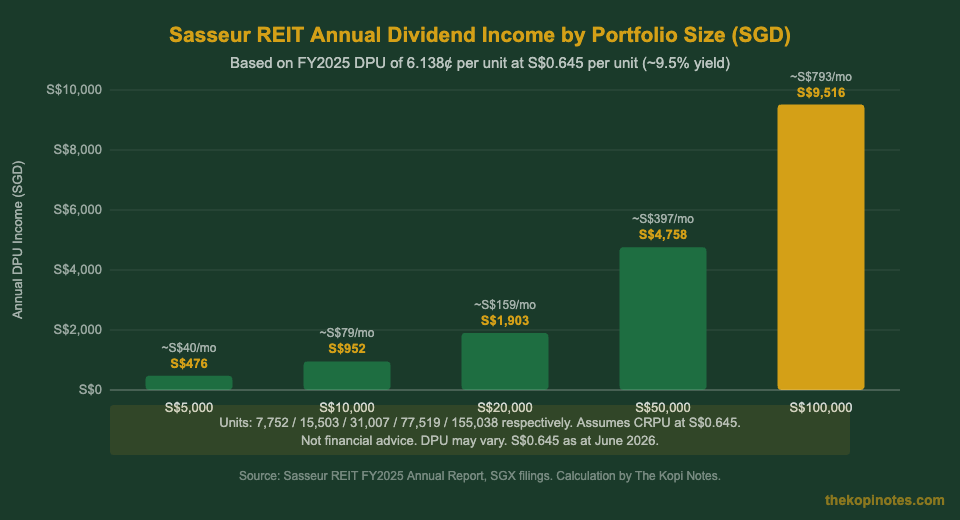
How much annual dividend income does Sasseur REIT actually generate? Here is the breakdown at different portfolio sizes, based on the FY2025 DPU of 6.138¢ per unit and an assumed entry price of S$0.645 per unit. The table shows both the total annual income and what that works out to per month.
This is a practical way to think about passive income Singapore — how much capital do you need deployed in Sasseur REIT to generate a meaningful income stream?
| Portfolio Value | Units (at S$0.645) | Annual DPU Income | Monthly Equivalent | Approx. Yield |
|---|---|---|---|---|
| S$5,000 | 7,752 units | S$476 / year | ~S$40 / month | ~9.5% |
| S$10,000 | 15,503 units | S$951 / year | ~S$79 / month | ~9.5% |
| S$20,000 | 31,007 units | S$1,903 / year | ~S$159 / month | ~9.5% |
| S$50,000 | 77,519 units | S$4,757 / year | ~S$396 / month | ~9.5% |
| S$100,000 | 155,038 units | S$9,514 / year | ~S$793 / month | ~9.5% |
Based on FY2025 DPU of 6.138¢ per unit at S$0.645 per unit. DPU is not guaranteed and may be higher or lower in future periods. Not financial advice. For indicative purposes only.
Remember that Sasseur REIT pays semi-annually, not monthly. A S$50,000 portfolio would receive approximately S$2,378 in September and S$2,379 in March each year, not S$396/month. The monthly equivalent figure is just a way to visualise the annual income rate.
5. DPU Sustainability Analysis 2026
The most important question for income investors is: can Sasseur REIT sustain its current DPU level? A 9.5% yield is only attractive if the underlying income is stable or growing. With three consecutive years of DPU decline, the sustainability question deserves careful analysis.
The key drivers of future DPU are: (1) outlet mall retail sales in China, (2) RMB/SGD exchange rates, (3) the EMA fixed component floor, and (4) operating costs and financing costs at the REIT level.
| Scenario | FY2026 DPU Estimate | Yield at S$0.645 | Key Assumption |
|---|---|---|---|
| 🐻 Bear — Further decline | ~5.5–5.7¢ | ~8.5–8.8% | Continued EMA income softness + RMB -5% |
| 📊 Base — Stabilisation | ~5.9–6.2¢ | ~9.1–9.6% | Flat-to-modest mall sales; RMB stable |
| 🐂 Bull — Recovery | ~6.4–6.8¢ | ~9.9–10.5% | China consumption stimulus + outlet mall traffic uptick |
Estimates by The Kopi Notes based on EMA income drivers and historical DPU patterns. Not financial advice. Actual DPU will depend on outlet mall performance and management’s distribution decision.
The EMA structure provides a partial floor: even in the bear scenario, the fixed component of EMA income (roughly 50–60% of total EMA income historically) means distributions are unlikely to fall below ~5.0¢ unless there is a severe macro shock equivalent to COVID-19. That gives Sasseur REIT a hard floor that most high-yield S-REITs do not have.
Aggregate leverage of 24.5% is the second positive factor. Sasseur REIT has minimal refinancing risk and very low interest costs relative to its income, so changes in SIBOR or SORA do not significantly impact distributable income. Compare this to Suntec REIT at 42.5% gearing — a 1% rise in interest rates is far more damaging for leveraged REITs than for Sasseur REIT at 24.5% gearing.
For the full investment case — including whether to buy, hold or sell at current levels — read our Sasseur REIT 2026 buy/hold/sell analysis.
6. How the EMA Structure Drives Dividends
Unlike most S-REITs where tenants pay fixed rent, Sasseur REIT’s income flows from an Entrusted Management Agreement (EMA). Understanding this is critical — it determines when and how much you get paid.
Under the EMA, Sasseur Group (the sponsor and manager of the four outlet malls) pays the REIT a monthly income with two components:
- Fixed Entitlement (FE): A set percentage of each property’s appraised value, paid monthly regardless of mall performance. This is the “floor” — it keeps distributions alive even when retail sales are soft.
- Variable Entitlement (VE): A share of actual retail sales at each mall, above the fixed entitlement level. This is the “upside” — when Chinese consumers are spending freely at the outlet malls, the REIT receives more.
The split between FE and VE has typically been roughly 55–60% fixed and 40–45% variable in recent years, based on disclosed EMA income. This means DPU has a partial anchor — it will not collapse to zero even in a severe downturn — but it will fall meaningfully if retail sales decline materially.
For Singapore investors comparing Sasseur REIT to other best S-REITs in Singapore 2026, the EMA structure is the biggest differentiating factor. Most S-REITs pay fixed rents with built-in escalation clauses — Sasseur REIT pays variable income linked to Chinese consumer spending. Different risk, different upside.
7. How to Buy Sasseur REIT for Dividends
Sasseur REIT (SGX: CRPU) trades on the Singapore Exchange in minimum lots of 100 units. At ~S$0.645 per unit, a minimum lot costs just S$64.50 — making it accessible for most retail investors. Here is the step-by-step guide to starting your dividend income stream.
Step 1: Open a brokerage account. Use FSMOne referral code P0544985 for access to SGX stocks at 0.08% commission (min S$10). FSMOne also supports CDP ownership, meaning you hold the units directly in your own CDP account — not in a custodian. Alternatively, Syfe referral code SRPRFFFCD gives commission-free fractional S-REIT access via Syfe Brokerage.
Step 2: Fund your account and search CRPU. Transfer SGD via FAST from any Singapore bank. Search “CRPU” on the SGX market through your brokerage platform. Use a limit order rather than a market order to control your entry price — Sasseur REIT’s lower daily liquidity means market orders can sometimes fill at wider spreads.
Step 3: Buy before the ex-dividend date. For the next H1 FY2026 distribution (expected September 2026), you need to be on the shareholder register before the ex-dividend date (typically mid-August 2026). Always confirm the exact ex-date via SGX InvestorHub or your brokerage’s corporate actions calendar.
CPF OA Strategy: Sasseur REIT is CPFIS-OA approved. You can use CPF Ordinary Account savings (minimum S$20,000 balance, retain S$20,000 post-investment) to earn ~9.5% DPU yield vs the CPF OA’s base 2.5% rate. For how to integrate CPFIS into your retirement plan, see our CPF investment strategy guide.
SRS Strategy: SRS-eligible investors can purchase Sasseur REIT using Supplementary Retirement Scheme funds. Every S$15,300 you contribute to SRS (the annual cap for Singapore citizens and PRs) gets a tax deduction at your marginal rate — and then earns ~9.5% p.a. in distributions while in the SRS account. Use our Singapore retirement calculator to model the compounding benefit.
| Broker | Commission | Min Commission | CDP / Custodian | CPF / SRS |
|---|---|---|---|---|
| FSMOne (P0544985) | 0.08% | S$10 | CDP | Yes / Yes |
| Syfe Brokerage (SRPRFFFCD) | Commission-free | — | Custodian | No / No |
| IBKR (jianxiong368) | ~S$1.50 flat | S$1.50 | Custodian | No / No |
| DBS Vickers | 0.18% | S$18 | CDP | Yes / Yes |
Source: Broker websites as at June 2026. Commissions subject to change. CDP ownership means you hold units directly and receive dividends directly — preferred for CPFIS/SRS investing.
8. Dividend Yield vs Peer S-REITs
To put Sasseur REIT’s 9.5% yield in context, here is how it compares to other S-REITs across different sectors in 2026. The comparison shows clearly that Sasseur REIT’s yield premium comes with specific risk factors — China concentration, EMA complexity, declining DPU trend — that lower-yielding peers do not carry.
| S-REIT | Sector | FY2025 DPU Yield | Gearing | DPU Trend | Geography |
|---|---|---|---|---|---|
| Sasseur REIT (CRPU) | Outlet Retail | ~9.5% | 24.5% | ↓ Declining | China only |
| AIMS APAC REIT (O5RU) | Industrial | ~6.9% | 26.8% | ↑ Rising | SG + AU |
| Sabana REIT (M1GU) | Industrial | ~7.5% | 37.8% | → Flat | Singapore |
| iREIT Global (UD1U) | Office | ~6.9% | 44.6% | ↓ Declining | Europe |
| OUE REIT (TS0U) | Office/Hotel | ~7.2% | 35.5% | → Stable | SG + China |
| Starhill Global (P40U) | Retail | ~6.8% | 35.5% | → Stable | Multi-Asia |
| Mapletree Pan Asia (N2IU) | Commercial | ~6.0% | 36.5% | → Stable | Multi-Asia |
| CapitaLand Ascendas (A17U) | Industrial | ~5.3% | 38.8% | → Stable | SG + Global |
Source: SGX filings, company announcements, as at June 2026. DPU yield based on trailing 12-month DPU divided by June 2026 share prices. Not financial advice.
For income investors, Sasseur REIT offers the highest yield by a significant margin. But the declining DPU trend, China-only geography, and EMA structure mean the risk-adjusted yield — factoring in the probability of further DPU cuts — is closer to the sector average than the raw 9.5% headline suggests.
For a complete ranking including balance sheet quality, DPU sustainability, and analyst ratings, see our highest yield REITs in Singapore 2026 guide.
9. Frequently Asked Questions
What is Sasseur REIT's current dividend yield?
Sasseur REIT’s trailing dividend yield is approximately 9.5% as at June 2026, based on the FY2025 full-year DPU of 6.138 Singapore cents and a share price of approximately S$0.645 per unit. This is one of the highest yields in the Singapore REIT sector. However, because DPU has declined for three consecutive years (FY2023–FY2025), the forward yield may be lower if this trend continues. Always use the trailing yield as a reference, not a guarantee of future income.
When does Sasseur REIT pay its dividend?
Sasseur REIT pays distributions twice a year — semi-annually. The H1 distribution (covering January to June) is typically paid in September, and the H2 distribution (covering July to December) is typically paid in March. For FY2025, the H1 distribution of approximately 3.12¢ was paid in September 2025, and the H2 distribution of approximately 3.02¢ was paid in March 2026. The next distribution (H1 FY2026) is expected in September 2026, subject to results announced in August 2026.
Is Sasseur REIT's dividend sustainable at 9.5%?
The sustainability of Sasseur REIT’s ~9.5% yield is the key question for 2026. The base case (stabilisation) projects FY2026 DPU of around 5.9–6.2¢ — still supporting a 9.1–9.6% yield. The bear case (continued decline) projects DPU around 5.5–5.7¢, yielding ~8.5–8.8%. The bull case (China consumption recovery) could see DPU recover to 6.4–6.8¢ and yield above 10%. The EMA fixed component (roughly 55–60% of income) provides a partial floor that prevents distributions from collapsing, but three years of declining DPU demands monitoring. Watch the H1 FY2026 results in August 2026 for early signals.
What was Sasseur REIT's DPU in FY2025?
Sasseur REIT’s full-year DPU for FY2025 was 6.138 Singapore cents per unit, paid in two semi-annual tranches: approximately 3.12¢ in H1 (paid September 2025) and approximately 3.02¢ in H2 (paid March 2026). This represents a decline of approximately 3.5% from FY2024’s DPU of 6.357¢ and continues a declining trend that started in FY2023. The FY2022 peak DPU was 7.015¢.
Can I use CPF OA to invest in Sasseur REIT for dividends?
Yes. Sasseur REIT (SGX: CRPU) is approved under the CPF Investment Scheme — Ordinary Account (CPFIS-OA). To invest using CPF OA funds, you need a minimum of S$20,000 in your CPF OA and must retain at least S$20,000 after the investment. At ~9.5% yield, using CPF OA to invest in Sasseur REIT offers a significant yield pickup over the CPF OA’s base 2.5% p.a. interest rate. However, CPFIS investments carry capital risk — if Sasseur REIT’s unit price falls, your CPF savings are reduced. Assess carefully against your risk tolerance and retirement timeline.
How much Sasseur REIT do I need to earn S$500/month in dividends?
To generate S$500 per month (S$6,000 per year) in dividend income from Sasseur REIT at the FY2025 DPU of 6.138¢ and share price of S$0.645, you would need approximately 97,747 units, or an investment of approximately S$63,047. At a 9.5% yield, that equates to roughly S$6,000 per year in DPU income. Note that because Sasseur REIT pays semi-annually (not monthly), you would actually receive two lump-sum payments of approximately S$3,000 each in September and March, rather than S$500 every month.
Does Sasseur REIT have a Dividend Reinvestment Plan (DRP)?
Sasseur REIT does not currently operate a formal Dividend Reinvestment Plan (DRP) that automatically converts cash distributions into new units. Distributions are paid in cash to unitholders’ bank accounts (for CDP holders) or through broker custodian accounts. If you want to reinvest dividends, you would need to manually purchase additional CRPU units on the SGX open market using the cash received. Some brokerages offer auto-reinvestment features — check with your specific broker. AIMS APAC REIT, by comparison, does offer a DRP — see our full comparison of S-REITs for income investors.
How does the EMA structure affect dividend stability?
The Entrusted Management Agreement (EMA) structure means Sasseur REIT’s distributions are partly tied to actual outlet mall retail sales in China, rather than fixed contractual rent. This makes DPU more volatile than a standard S-REIT. In good years (FY2021–FY2022), the variable component boosted DPU above 6.8¢. In weak years (FY2020 COVID, FY2023–FY2025 softness), the variable component dragged DPU lower. The fixed component of EMA income (approximately 55–60% of total) acts as a partial floor, limiting the downside. But investors must accept that Sasseur REIT’s dividend is inherently less predictable than a Singapore-listed industrial or commercial REIT with long-term fixed-rent leases.
Is Sasseur REIT a good choice for retirement income?
Sasseur REIT can play a role in a retirement income portfolio, but it should not be a core holding for investors who need predictable, stable income. The ~9.5% yield is attractive — but three years of declining DPU, 100% China concentration, and EMA income complexity mean Sasseur REIT suits a small satellite allocation (5–8% of a diversified REIT portfolio) rather than a core anchor. For retirement income planning, use our retirement planning calculator to model how Sasseur REIT’s income fits into a broader CPF + S-REIT + bond ladder strategy. Pair it with more stable core holdings like CapitaLand Ascendas REIT or Mapletree Industrial Trust for a more balanced income portfolio.
Start Building Your S-REIT Dividend Portfolio
Invest in Sasseur REIT and other high-yield S-REITs through these trusted platforms.
This article was researched with the help of AI. While we strive to keep all information accurate and up to date, there may be errors. If you notice any discrepancies, please contact us.