AIMS APAC REIT Share Price Target 2026: What DBS & Maybank Predict (SGX: O5RU)
DBS and Maybank both land on S$1.68 after AAREIT’s 1QFY27 results — here’s what it means for you.
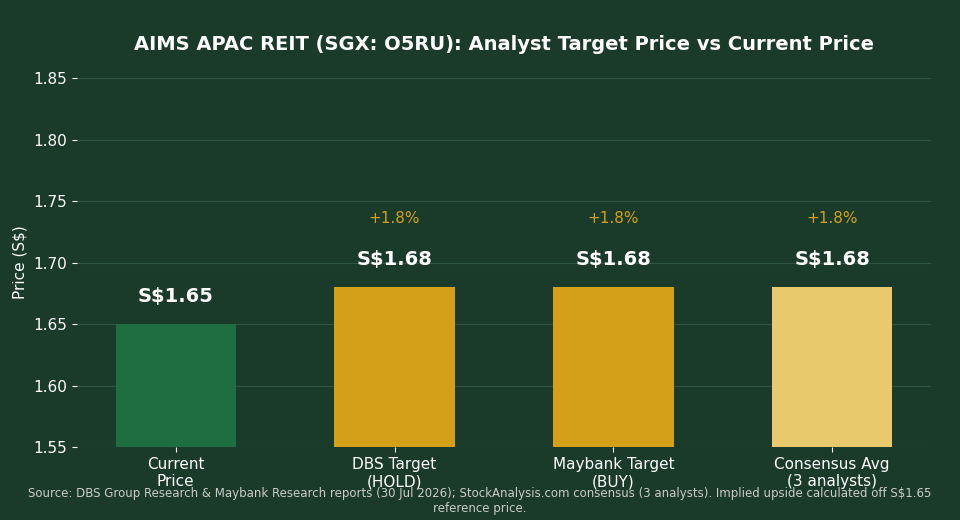
AIMS APAC REIT (SGX: O5RU) has a S$1.68 share price target from both DBS Group Research (HOLD, downgraded from BUY) and Maybank Research (BUY, maintained), each report dated 30 July 2026. That implies roughly 1.8% upside from the S$1.65 last-traded price, with a 3-analyst Strong Buy consensus averaging the same S$1.68, range S$1.66 to S$1.70.
Not financial advice. All figures are for educational reference only. Data as at 30 July 2026 broker reports unless otherwise noted.
- DBS downgraded AAREIT to HOLD (from BUY) purely on valuation — the REIT now trades at a 30% premium to NAV after a strong 2026 run-up. Maybank stayed at BUY.
- Both brokers landed on the exact same S$1.68 target — a rare convergence that signals limited near-term upside is priced in either way.
- 1QFY27 DPU grew 2.5% YoY even as occupancy dipped to a 95.2% pro-forma after Optus vacated Building A — the Hazelmere, Perth acquisition is set to plug most of that gap by 2QFY27.
Table of Contents
Contents — Click to expand
- What Is AIMS APAC REIT?
- AAREIT Share Price Target 2026: DBS vs Maybank at a Glance
- DBS Group Research: HOLD at S$1.68 (Downgraded from BUY)
- Maybank Research: BUY Maintained at S$1.68
- Why Two Different Calls Landed on the Same Price
- 1QFY27 Results: The Numbers Behind the Target
- The Optus Vacancy vs the Hazelmere Acquisition
- Is AAREIT Overvalued? The 30% Premium to NAV Question
- Risks to Watch
- Our Take: Should You Buy AAREIT at S$1.65?
- FAQ
What Is AIMS APAC REIT?
AIMS APAC REIT (AAREIT, SGX: O5RU) owns industrial, logistics and business park properties across Singapore and Australia. It’s been listed on the SGX Mainboard since 2007, making it one of the older industrial S-REITs on the exchange.
You’ll usually see AAREIT mentioned alongside CapitaLand Ascendas REIT and Mapletree Industrial Trust as one of the “old guard” Singapore industrial REITs. It’s smaller than both — a market cap of around S$1.36 billion — but it has quietly delivered one of the more resilient distribution track records in the sector, thanks to master leases with built-in rental escalations.
AAREIT Share Price Target 2026: DBS vs Maybank at a Glance
Here’s the short version. Two brokers published fresh AAREIT research on the same day — 30 July 2026 — right after the REIT’s 1QFY27 results. Both arrived at the identical S$1.68 target, but for different reasons and with different ratings.
| Broker | Rating | Target Price | Implied Upside* | Report Date |
|---|---|---|---|---|
| DBS Group Research | HOLD (down from BUY) | S$1.68 | +1.8% | 30 Jul 2026 |
| Maybank Research | BUY (maintained) | S$1.68 | +1.8% | 30 Jul 2026 |
| Consensus (3 analysts) | Strong Buy | S$1.68 (range S$1.66–S$1.70) | +1.8% | accessed 7 Aug 2026 |
Source: DBS Group Research report & Maybank Research report (30 Jul 2026), fetched via minichart.com.sg; StockAnalysis.com consensus data. *Implied upside is our own calculation, off a consistent S$1.65 reference price (last close before both reports), not each broker’s own quoted upside figure.
DBS Group Research: HOLD at S$1.68 (Downgraded from BUY)
DBS downgraded AAREIT to HOLD on 30 July 2026, even while raising its target price slightly to S$1.68 (from S$1.66). That combination — higher target, lower rating — tells you exactly what’s going on: DBS thinks the business is fine, but the share price has run ahead of it.
DBS was explicit that this is “purely on valuation grounds” after a strong share price outperformance, not because anything’s broken. Here’s what DBS flagged as fundamentally healthy:
- Portfolio occupancy at 96.1%, with positive rental reversions of 6.5%
- Master leases that include built-in rental escalations, giving income visibility
- The logistics and warehouse segment still showing robust rental growth
- Aggregate leverage of just 24.9% — among the lowest in the S-REIT sector, leaving headroom for future acquisitions
- A forward distribution yield of around 6%
The catch: DBS notes AAREIT is trading at a 30% premium to net asset value (NAV). That’s the valuation red flag behind the downgrade — you’re paying well above the REIT’s book value of assets today.
Maybank Research: BUY Maintained at S$1.68
Maybank took the opposite stance on the rating, keeping AAREIT at BUY with the same S$1.68 target, based on a dividend discount model (DDM). Maybank’s own report claims a 9% upside from the S$1.65 reference price — that figure doesn’t reconcile with S$1.65 to S$1.68 (which works out to roughly 1.8%), so we’re using our own consistently-calculated upside throughout this article rather than repeating that number.
Maybank’s bull case leans on near-term catalysts rather than current valuation:
- 1QFY27 DPU up 2.5% YoY to 2.337 cents, even with the Optus vacancy drag (more on this below)
- The Hazelmere, Perth acquisition in Australia, expected to complete in 2QFY27 and add 0.3% to pro-forma DPU
- Resilient Singapore industrial demand, particularly in precision engineering and AI-related sectors
- Longer-term redevelopment potential, including data-centre conversion optionality on parts of the portfolio
- A strong balance sheet with 24.9% leverage and 4.1% stable funding cost
Why Two Different Calls Landed on the Same Price
It’s unusual for two brokers to hit the exact same target price on the same day, especially with opposite ratings. Here’s the simplest way to think about it: DBS and Maybank agree on where AAREIT’s fair value sits. They just disagree on whether today’s price already reflects it.
DBS says the share price got there first — so there’s limited reason to keep buying now, hence HOLD. Maybank says the fundamentals (DPU growth, the Hazelmere deal, redevelopment upside) justify holding or adding, hence BUY. Both are looking at the same S$1.68 fair value; they just weigh the risk-reward from S$1.65 differently.
For you as an investor, the practical takeaway is similar either way: at S$1.65, AAREIT isn’t screamingly cheap, and the easy re-rating from undervalued to fair value has largely already happened in 2026 (the stock is up nearly 19% over the past year).
1QFY27 Results: The Numbers Behind the Target
Both brokers’ targets were published right after AAREIT released 1QFY27 results (the quarter ended June 2026). Here’s what actually happened in the numbers, in plain English.
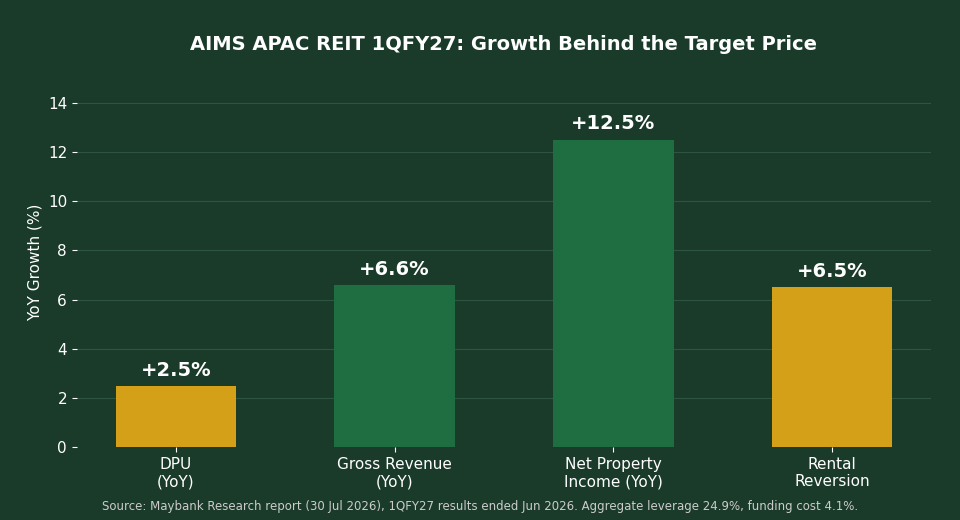
Distribution per unit (DPU) — basically how much cash each unit pays you — rose 2.5% year-on-year to 2.337 cents. Gross revenue climbed 6.6% YoY and net property income (NPI, revenue minus direct property costs) jumped a stronger 12.5% YoY, meaning AAREIT’s cost base grew slower than its income. That’s the kind of operating leverage you want to see in a REIT.
Rental reversions — the change in rent when a lease is renewed or re-let, compared to the old rent — came in at a healthy +6.5% across the portfolio. In plain terms: tenants renewing their leases are paying meaningfully more than before, which is a good sign of pricing power in AAREIT’s industrial and logistics niche.
On the balance sheet, aggregate leverage sits at 24.9% and the all-in funding cost is 4.1%. For context, MAS caps S-REIT leverage at 50%, so AAREIT has plenty of headroom below that ceiling — among the lowest-geared REITs on SGX.
| Metric | 1QFY27 | YoY Change |
|---|---|---|
| DPU | 2.337 cents | +2.5% |
| Gross Revenue | — | +6.6% |
| Net Property Income | — | +12.5% |
| Portfolio Occupancy | 96.1% (95.2% pro-forma) | — |
| Aggregate Leverage | 24.9% | — |
Source: Maybank Research & DBS Group Research reports, 30 Jul 2026, 1QFY27 results (quarter ended June 2026).
The Optus Vacancy vs the Hazelmere Acquisition
Here’s the one wrinkle in an otherwise clean quarter. Optus, a major Australian telco tenant, handed back Building A at AAREIT’s Macquarie Park property. That single move is why FY27-28E DPU forecasts got trimmed — Maybank cut them 3.4% for FY27 and 0.7% for FY28 — and why pro-forma occupancy dips to 95.2% once the vacancy is fully reflected.
AAREIT’s answer is the Hazelmere acquisition — an industrial property in Hazelmere, a suburb of Perth, Western Australia. DBS describes this Perth acquisition as expected to be DPU-accretive and to “mostly offset” the Optus vacancy. Maybank pins the completion at 2QFY27, with 0.3% pro-forma DPU accretion once it closes.
So the practical story is: a real, temporary income gap now, with a specific, already-announced deal lined up to close most of it within two quarters. That’s a meaningfully different risk profile than a REIT with an open-ended vacancy problem and no visible fix.
Is AAREIT Overvalued? The 30% Premium to NAV Question
Price-to-NAV (P/NAV) tells you whether a REIT trades above or below the accounting value of its underlying properties. A REIT above 1.0x P/NAV (a premium) means the market is paying more than book value — usually because it trusts the manager to keep growing income faster than the portfolio’s static valuation.
At a 30% premium to NAV, AAREIT is priced well above most Singapore industrial REITs, many of which trade at a discount to NAV in 2026. That premium is exactly why DBS downgraded to HOLD despite liking the business — you’re paying up for quality and a low-leverage balance sheet, and there’s less margin of safety if sentiment turns.
It’s not automatically a red flag. Investors have historically paid premiums for REITs with strong track records of accretive acquisitions and rental growth, like AAREIT’s. But it does mean the “easy money” from a valuation re-rating has likely already been made in 2026, and further upside needs to come from actual DPU growth — not multiple expansion.
Risks to Watch
Neither broker is calling this a risk-free hold. Here’s what could push AAREIT below either target:
- Lack of new acquisitions: DBS flags this explicitly — AAREIT’s growth story depends on continuing to find accretive deals. A quiet acquisition pipeline would remove a key catalyst.
- Elevated costs impeding AEIs: Asset enhancement initiatives (AEIs) drive organic rental growth, but rising construction and financing costs could squeeze the returns on future projects.
- Valuation compression: a 30% NAV premium can shrink quickly if interest rates rise or sentiment sours on industrial REITs broadly — premiums are the first thing to go in a risk-off market.
- Execution risk on Hazelmere: the acquisition is still pending completion in 2QFY27; any delay pushes back the DPU offset to the Optus vacancy.
Our Take: Should You Buy AAREIT at S$1.65?
If you already hold AAREIT for its ~6% forward yield and low-leverage balance sheet, nothing in this results season changes the thesis. DPU is still growing, leverage is still conservative, and the Hazelmere deal addresses the one real soft spot (the Optus vacancy).
If you’re deciding whether to start a position today, the DBS-vs-Maybank split is a useful frame: you’re not buying a bargain at S$1.65 — both brokers agree fair value is close by, around S$1.68. What you’re buying is a quality, low-risk industrial REIT at roughly fair value, with modest near-term upside baked in. That’s a reasonable trade-off for income-focused investors, but not a compelling one if you’re specifically hunting for deep-discount S-REITs in 2026.
For a broader view of where AAREIT ranks against Singapore’s other REITs on yield and quality, see our best S-REITs in Singapore 2026 guide, and our Keppel DC REIT share price target article for a comparison against a higher-growth, higher-premium data centre REIT.
Want to build a diversified S-REIT income portfolio without picking single names? You can start investing in a basket of REITs through platforms like Syfe, and use our retirement calculator to see how a ~6% yielding REIT allocation fits into your broader retirement plan. If you’re funding REIT purchases through CPF, our CPF investment strategy guide covers how S-REITs fit into a CPFIS portfolio, and our passive income Singapore guide walks through building a full income stack beyond just REITs.
Frequently Asked Questions
What is AIMS APAC REIT's share price target for 2026?
DBS Group Research and Maybank Research both set a S$1.68 target as at their 30 July 2026 reports — DBS rates it HOLD (downgraded from BUY) and Maybank rates it BUY (maintained). The 3-analyst consensus is also S$1.68, ranging S$1.66 to S$1.70, against a S$1.65 last-traded price.
Why did DBS downgrade AIMS APAC REIT to HOLD?
DBS says the downgrade is purely on valuation, not fundamentals. AAREIT’s share price has outperformed strongly through 2026, pushing it to a 30% premium to NAV. DBS still likes the underlying business — 96.1% occupancy, 6.5% positive rental reversions, and 24.9% leverage — but sees limited further upside from S$1.65.
What is AIMS APAC REIT's dividend yield?
DBS estimates AAREIT’s forward distribution yield at around 6% based on current guidance. Separately, trailing yield data shows roughly 5.9% based on the last 12 months of distributions, though forward yield is the more relevant figure for new investors since it reflects expected DPU growth from the Hazelmere acquisition.
Is AIMS APAC REIT overvalued at a 30% premium to NAV?
It’s expensive relative to most Singapore industrial REITs, many of which trade at or below NAV in 2026. Whether that’s “overvalued” depends on your view of AAREIT’s low leverage (24.9%) and consistent rental reversions — qualities the market has historically been willing to pay up for. It’s a valid reason for caution, which is exactly why DBS downgraded to HOLD.
What is the Optus vacancy issue at AIMS APAC REIT?
Optus, a major Australian tenant, handed back Building A at AAREIT’s Macquarie Park property. This trimmed FY27-28E DPU forecasts (Maybank: -3.4%/-0.7%) and lowered pro-forma portfolio occupancy to 95.2%. AAREIT’s Hazelmere, Perth acquisition, expected to complete in 2QFY27, is projected to mostly offset this gap.
How does the Hazelmere acquisition affect AAREIT's DPU?
Maybank estimates the Hazelmere, Perth industrial property acquisition will add 0.3% to pro-forma DPU once it completes in 2QFY27. DBS separately notes the deal should be DPU-accretive and help offset the income lost from Optus vacating Building A at Macquarie Park.
Is AIMS APAC REIT a good buy for passive income in Singapore?
For income-focused investors, AAREIT’s ~6% forward yield, low 24.9% leverage, and positive rental reversions make it a reasonably defensive industrial REIT holding. At S$1.65, you’re paying close to both brokers’ S$1.68 fair value estimate rather than buying at a discount — so it suits investors prioritising yield stability over deep-value upside.
This article was researched with the help of AI. While we strive to keep all information accurate and up to date, there may be errors. If you notice any discrepancies, please contact us.