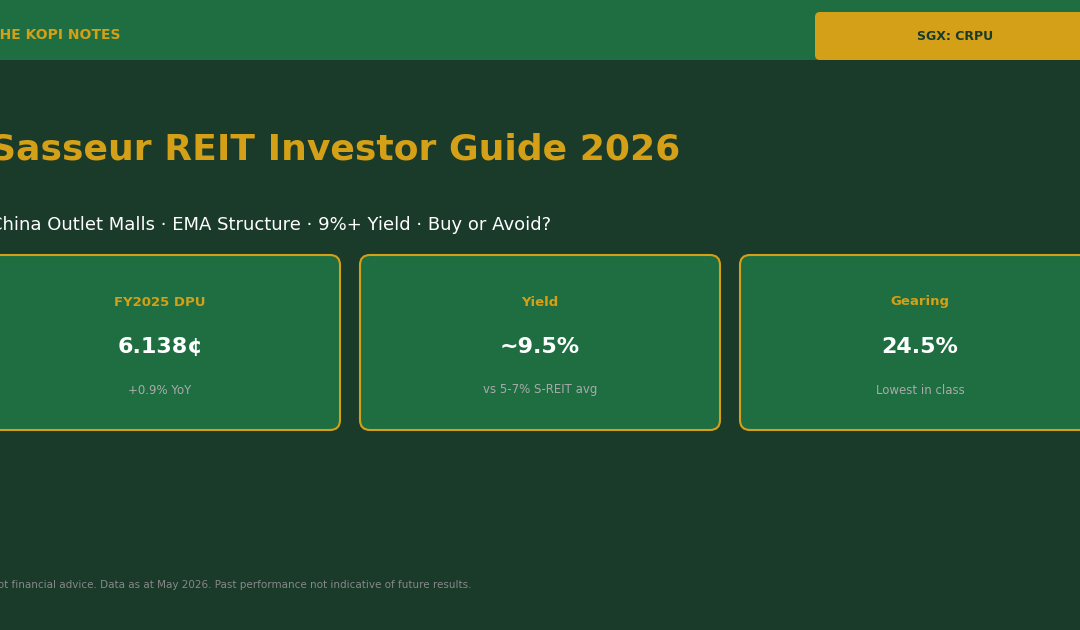
Sasseur REIT Investor Guide 2026 (SGX: CRPU)
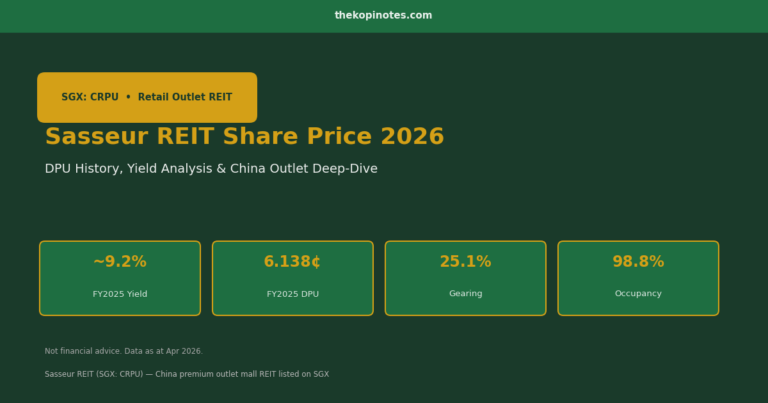
China’s largest listed outlet mall REIT offers Singapore investors a ~9.5% yield, ultra-low 24.5% gearing, and a unique EMA income structure. But is Sasseur REIT worth buying in 2026? This guide covers the FY2025 financials, DPU history, EMA mechanics, key risks, and a buy-or-avoid verdict — with data sourced directly from SGX filings as at May 2026.
Not financial advice. Always do your own research before investing.
Sasseur REIT (SGX: CRPU) is Singapore’s only listed pure-play China retail outlet REIT. Since its 2018 IPO, it has delivered consistent semi-annual distributions backed by a guaranteed floor income under an Entrusted Management Agreement (EMA) — a structure unique in the S-REIT universe. With a FY2025 DPU of 6.138 Singapore cents and a share price hovering around S$0.64, the forward yield sits at approximately 9.5% — roughly double the S-REIT sector average.
Yet Sasseur REIT trades at a persistent discount to NAV (P/NAV ~0.62x as at Q1 2026), reflecting two key concerns: RMB/SGD exchange rate volatility and short remaining land leases in China. Understanding whether these risks are already priced in is the crux of the Sasseur REIT investment thesis in 2026.
Table of Contents
Contents — Click to expand
What Is Sasseur REIT?
Sasseur REIT was listed on the Singapore Exchange (SGX) on 28 March 2018, making it the first outlet mall REIT in Asia. Sponsored by Sasseur Cayman Holding Limited — part of the Sasseur Group, one of China’s largest outlet mall operators — the REIT holds a portfolio of four premium outlet malls in mainland China. Its units trade under the ticker CRPU on SGX. As at May 2026, Sasseur REIT has a market capitalisation of approximately S$900 million and total assets of around S$1.6 billion.
Key Facts at a Glance
| Metric | Value |
|---|---|
| SGX Ticker | CRPU |
| Share Price (May 2026) | ~S$0.640 |
| FY2025 DPU | 6.138 Singapore cents |
| Indicative Yield | ~9.5% |
| Distribution Frequency | Semi-annual |
| Gearing Ratio | 24.5% |
| P/NAV | ~0.62x |
| Number of Properties | 4 outlet malls in China |
| Analyst Consensus | BUY — avg target S$0.92 |
How the EMA Income Structure Works
Sasseur REIT’s income model is fundamentally different from other S-REITs. Instead of collecting rent directly from tenants, the REIT receives EMA rental income under an Entrusted Management Agreement with the Entrusted Manager (Sasseur Group’s operating subsidiary). This structure has two components:
1. Fixed Component (~70%): A guaranteed base income based on a fixed RMB amount with a 3% annual escalation rate built in until 2028. This provides income stability even if outlet sales fall.
2. Variable Component (~30%): Linked to a percentage of the outlet malls’ gross tenant sales. Strong consumer spending in China directly lifts Sasseur’s DPU.
All operating expenses of the malls — including staff, utilities, and marketing — are borne entirely by the Entrusted Manager, not the REIT. This creates an asset-light income stream for unitholders. For FY2025, total EMA income rose 2.7% year-on-year to RMB 682.3 million, a sign that China outlet sales remained resilient despite broader macro headwinds.
Portfolio Overview: 4 China Outlet Malls
As at May 2026, Sasseur REIT’s portfolio spans four Tier-1 and Tier-2 Chinese cities. Overall occupancy stands at a remarkable 98.8%, with Chongqing Liangjiang Outlet hitting 100% as at Q4 2025.
| Property | City | GFA (sqm) | Occupancy |
|---|---|---|---|
| Sasseur (Chongqing) Outlets | Chongqing | ~94,000 | 99.0% |
| Sasseur (Chongqing) Liangjiang Outlets | Chongqing | ~52,000 | 100.0% |
| Sasseur (Hefei) Outlets | Hefei | ~111,000 | 98.5% |
| Sasseur (Kunming) Outlets | Kunming | ~96,000 | 97.7% |
All four malls offer discounted branded merchandise at 30–70% below RRP — a format proven resilient across economic cycles. China’s outlet mall sector has grown faster than traditional retail as consumers seek value without compromising on brand names.
FY2025 Financial Highlights
Sasseur REIT reported FY2025 results in February 2026, delivering a positive recovery in distributions after FY2024’s dip.
| Metric | FY2025 | FY2024 | Change |
|---|---|---|---|
| EMA Income (RMB million) | 682.3 | 664.4 | +2.7% |
| Distributable Income (S$M) | 85.7 | 83.4 | +2.8% |
| Full Year DPU (cents) | 6.138¢ | 6.082¢ | +0.9% |
| 1H DPU (cents) | 3.055¢ | 3.153¢ | -3.1% |
| 2H DPU (cents) | 3.083¢ | 2.929¢ | +5.3% |
| Cost of Debt | 4.4% | 4.8% | -40bps |
| Gearing Ratio | 24.5% | 26.1% | Improved |
| Portfolio Occupancy | 98.8% | 98.2% | Improved |
The strong 2H2025 DPU (+5.3% YoY) was driven by lower finance costs (cost of debt fell 40bps to 4.4%) and reduced tax expenses. The full-year recovery to 6.138¢ signals that FY2024 may have been the cycle trough.
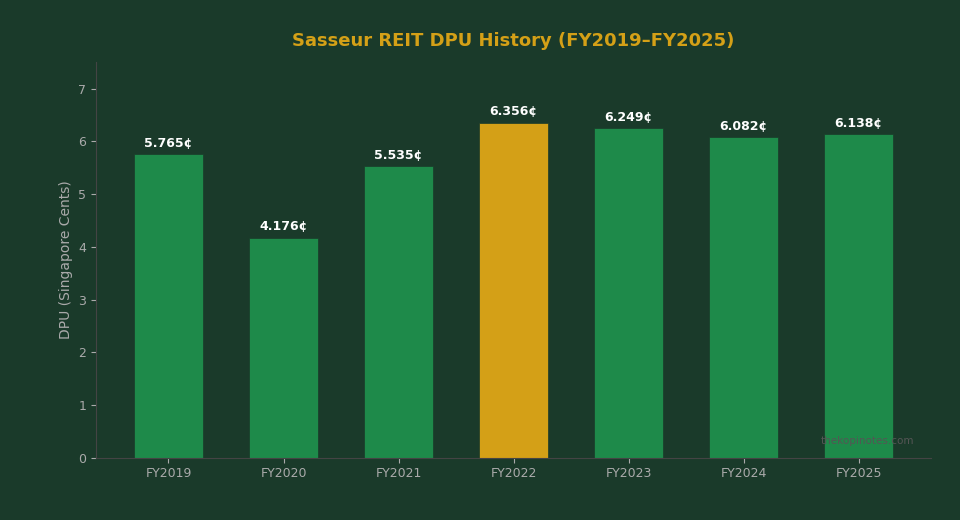
DPU History (FY2019–FY2025)
The DPU peaked in FY2022 at 6.356¢ on China’s post-lockdown rebound. FY2020 was the worst year (4.176¢) due to COVID-19 and RMB weakness — but the EMA fixed floor prevented a total collapse.
| FY | DPU (¢) | YoY | Key Driver |
|---|---|---|---|
| FY2019 | 5.765¢ | — | First full year post-IPO |
| FY2020 | 4.176¢ | -27.6% | COVID-19; RMB weakness |
| FY2021 | 5.535¢ | +32.5% | China retail recovery |
| FY2022 | 6.356¢ | +14.8% | Peak DPU; strong outlet sales |
| FY2023 | 6.249¢ | -1.7% | RMB softness; China slowdown |
| FY2024 | 6.082¢ | -2.7% | Higher finance costs; FX headwinds |
| FY2025 | 6.138¢ | +0.9% | Lower debt costs; EMA growth |
The 3% annual EMA fixed-component escalation locked until 2028 acts as a built-in DPU growth mechanism. Beyond 2028, the escalation rate will be renegotiated — an important event for longer-term investors to monitor.
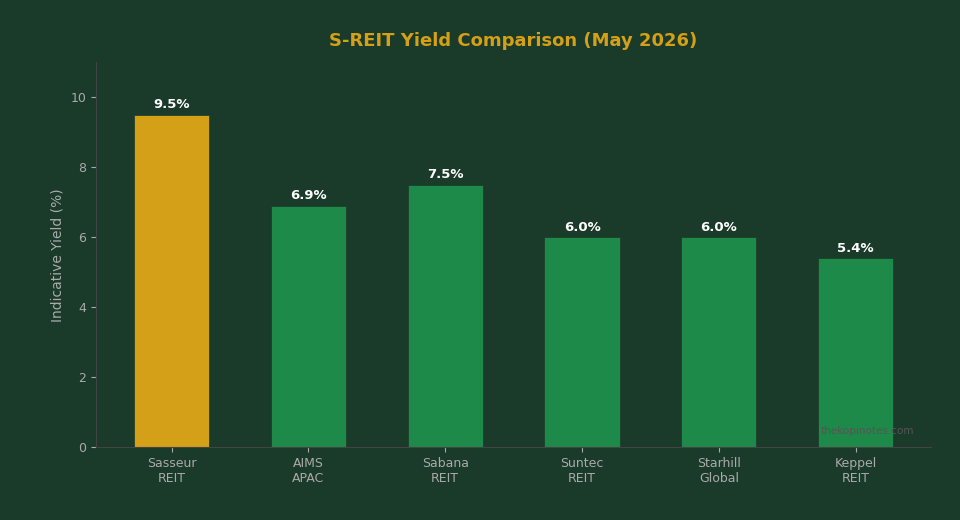
Yield vs S-REIT Peers
Sasseur’s ~9.5% yield is the highest among mid-cap S-REITs. The yield premium reflects the risk premium investors demand for China exposure and lease decay. As at May 2026:
| REIT | Sector | Yield | Gearing | Geo |
|---|---|---|---|---|
| Sasseur REIT | Retail (Outlet) | ~9.5% | 24.5% | China |
| Sabana REIT | Industrial | ~7.5% | 37.8% | Singapore |
| AIMS APAC REIT | Industrial | ~6.9% | 26.8% | SG + AU |
| Suntec REIT | Office/Retail | ~6.0% | 42.5% | SG + AU |
| Starhill Global | Retail | ~6.0% | 35.6% | SG + AU + MY |
| Keppel REIT | Office | ~5.4% | 38.0% | SG + AU + KR |
For a broader view, see our Best S-REITs Singapore 2026 guide. Model your position using the REITs Dividend Yield Calculator or the S-REIT Yield vs SGS Bond Spread Calculator.
Key Risks: RMB, Lease Decay & China Macro
1. RMB/SGD Exchange Rate Risk
All of Sasseur’s income is generated in RMB. When the RMB weakens against the SGD, DPU falls even if outlet sales are flat. This is the single biggest driver of DPU swings in FY2020, FY2023, and FY2024. Sasseur hedges a portion of FX exposure, but residual currency risk remains significant.
2. Short Land Lease Remaining (Lease Decay)
The underlying land leases for Sasseur’s China properties are shorter than typical Singapore property leases. As leases shorten, valuations decline — this explains why Sasseur trades at a ~38% discount to NAV (P/NAV ~0.62x). See our Lease Decay Calculator for an illustration of how lease shortening affects asset value over time.
3. China Consumer Macro Risk
If China’s consumer spending deteriorates sharply, the variable EMA component shrinks. Beyond 2028, when the fixed EMA escalation terms expire and must be renegotiated, there is also re-contracting risk. Monitor China retail sales data and Sasseur’s quarterly SGX filings closely.
4. Sponsor Concentration & Related Party Risk
The EMA is with Sasseur Group, which is also the REIT’s sponsor. Income reliability is partly dependent on a single private sponsor’s operating health — higher related-party risk than most Singapore-based S-REITs with diversified tenant bases.
How to Buy Sasseur REIT (CPF & SRS)
Via Cash (CDP Account)
Buy CRPU through FSMOne (code P0544985 — Singapore’s cheapest CDP broker). Minimum board lot is 100 units (~S$64). FSMOne charges 0.08% (min S$10) for SGX stocks.
Via CPF Investment Scheme (CPFIS)
Sasseur REIT is CPFIS-OA eligible. CPF members can invest up to 35% of OA investible savings (above S$20,000) in CRPU. The CPF OA earns a guaranteed 2.5% p.a. — investing in Sasseur at ~9.5% yield has a significant spread, but carries higher risk. Use our CPFIS Calculator to model the decision, and see our full CPF investment strategy guide.
Via SRS (Supplementary Retirement Scheme)
SRS account holders can buy Sasseur REIT with pre-tax dollars. SRS contributions receive a dollar-for-dollar income tax deduction (up to S$15,300/year for Singapore citizens/PRs). S-REIT distributions in an SRS account are generally tax-exempt until withdrawal. Use our SRS Tax Savings Calculator to estimate your savings.
Via Robo-Advisors (Indirect Exposure)
For diversified S-REIT exposure without single-stock risk, Syfe REIT+ (code TKNSG for up to S$50 bonus) and Endowus (code TKNSG for S$20 fee credits) offer managed S-REIT portfolios.
Buy, Hold or Avoid? 2026 Verdict
The analyst consensus heading into mid-2026 is a clear BUY — 5 out of 5 covering analysts rate CRPU Buy or Add, with an average 12-month target of S$0.92 (vs current ~S$0.64). That implies ~44% price upside on top of the ~9.5% yield — total return potential exceeding 50% on a 12-month view.
Bull case: (1) EMA fixed floor with 3% annual escalation until 2028 provides DPU visibility; (2) 24.5% gearing is lowest in peer group, providing safety and acquisition headroom; (3) P/NAV 0.62x and 9.5% yield suggest a significant margin of safety already priced in against China and FX risks.
Bear case: Structural lease decay eroding NAV, persistent RMB volatility, and the 2028 EMA renewal cliff.
Our view (not financial advice): Sasseur REIT suits income-focused investors who accept China exposure, have a 3–5 year horizon before the 2028 EMA renewal, and are comfortable sizing CRPU as a satellite holding (5–10% of a REIT portfolio) rather than a core position. At current yields, the income compensates meaningfully — but eyes wide open on RMB and lease decay.
Frequently Asked Questions
What is Sasseur REIT's current yield?
As at May 2026, Sasseur REIT (SGX: CRPU) trades at ~S$0.640, giving an indicative forward yield of ~9.5% based on FY2025 DPU of 6.138 Singapore cents. Distributions are paid semi-annually, typically in June and December.
Is Sasseur REIT a good buy in 2026?
All 5 covering analysts rate Sasseur REIT Buy or Add, with an average 12-month target of S$0.92. The investment case rests on a 9.5% yield, 24.5% gearing (lowest in class), and 3% annual EMA escalation locked until 2028. Key risks are RMB/SGD volatility and lease decay. It suits income investors sizing it as a satellite position (5–10% of portfolio).
What is the EMA structure in Sasseur REIT?
The Entrusted Management Agreement (EMA) is Sasseur’s unique income mechanism. The REIT receives income from Sasseur Group consisting of a fixed component (~70%, escalating 3% annually until 2028) plus a variable component (~30%) linked to outlet mall gross sales. All operating costs are borne by the Entrusted Manager — not the REIT.
Can I buy Sasseur REIT using CPF?
Yes. Sasseur REIT is CPFIS-OA eligible. You can invest CPF OA savings (above S$20,000 and up to 35% of investible savings) in CRPU through a CPFIS-linked brokerage. Distributions are paid back to your CPF account. CPF OA earns a guaranteed 2.5% p.a. — Sasseur at ~9.5% yield has a significant spread, but carries market and currency risk.
Why does Sasseur REIT trade at a discount to NAV?
Sasseur trades at ~0.62x book NAV (Q1 2026) due to: (1) shorter China land leases causing structural NAV decay over time; and (2) a China macro and RMB/SGD currency risk premium. This discount inflates the headline yield relative to Singapore-based REITs.
What is Sasseur REIT's gearing ratio?
FY2025 gearing is 24.5% — lowest among S-REIT peers. Singapore’s MAS regulatory limit is 50% (55% with investment grade rating). This provides significant debt headroom for potential acquisitions and low refinancing risk.
How often does Sasseur REIT pay dividends?
Twice a year — 1H (typically paid September) and 2H (typically paid March). For FY2025: 1H DPU was 3.055¢ and 2H DPU was 3.083¢, totalling 6.138¢ for the full year. Ex-dividend dates are announced via SGXNet.
What are the main risks of investing in Sasseur REIT?
Main risks: (1) RMB/SGD currency risk — all income in RMB, so a weaker RMB reduces DPU; (2) lease decay — shorter China land leases depress NAV over time; (3) China consumer macro risk — slowdown reduces variable EMA income; (4) EMA re-contracting risk — the 3% escalation structure expires 2028 and must be renegotiated with Sasseur Group.
This article was researched with the help of AI. While we strive to keep all information accurate and up to date, there may be errors. If you notice any discrepancies, please contact us.