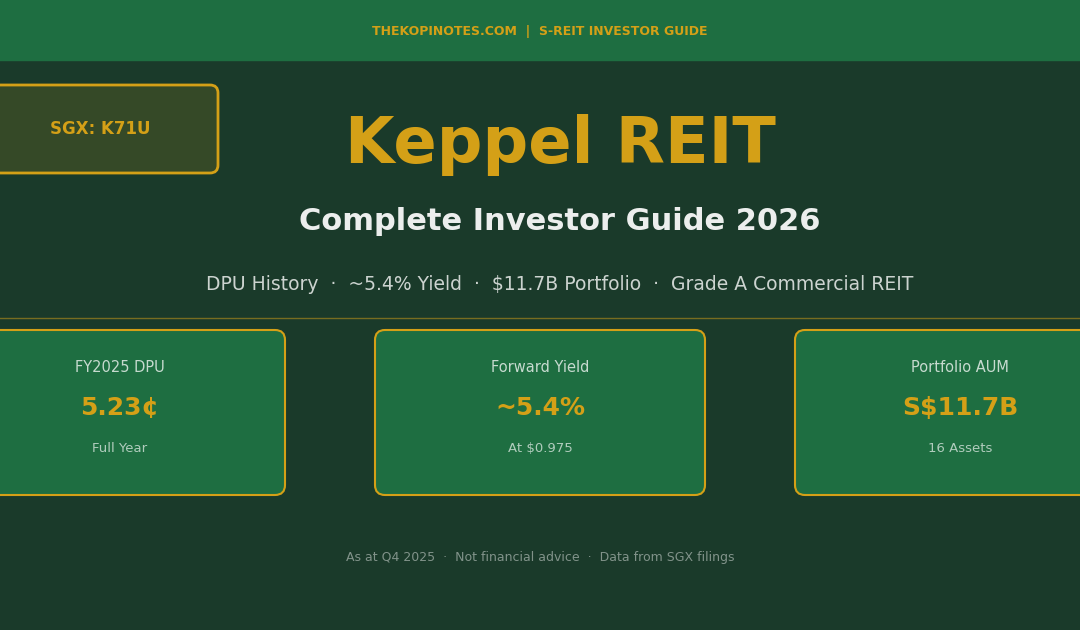
Keppel REIT (SGX: K71U) — Complete Investor Guide 2026
Keppel REIT is one of Singapore’s flagship commercial S-REITs, owning a S$11.7 billion portfolio of Grade A offices and mixed-use assets across Asia Pacific. This guide covers FY2025 DPU, yield, gearing, portfolio breakdown, and the 2026 growth outlook — everything a Singapore investor needs to know before buying or holding K71U.
Data as at Q4 2025 / Q1 2026. Not financial advice. Always do your own due diligence.
Table of Contents
Contents — Click to expand
- What Is Keppel REIT?
- Portfolio Overview — 16 Assets, S$11.7B AUM
- DPU History & Distribution Track Record
- FY2025 Financial Results & Q1 2026 Update
- Gearing, Debt & ICR
- Dividend Yield vs S-REIT Peers
- 2026 Outlook — Singapore Office Market & Growth Drivers
- Buying Keppel REIT with CPF or SRS
- Frequently Asked Questions
What Is Keppel REIT?
Keppel REIT (SGX: K71U) is a Singapore-listed commercial real estate investment trust that was listed on the SGX on 28 April 2006. It is sponsored by Keppel Ltd — one of Singapore’s largest diversified conglomerates — and managed by Keppel REIT Management Limited.
Unlike industrial or logistics S-REITs, Keppel REIT focuses exclusively on Grade A commercial office and mixed-use assets in prime CBD locations across Asia Pacific. Its anchor assets include Ocean Financial Centre and stakes in Marina Bay Financial Centre (MBFC) — two of the most recognisable office towers in Singapore’s Marina Bay district.
As at 31 December 2025, Keppel REIT holds a total portfolio value of approximately S$11.7 billion across 16 assets in Singapore, Australia, South Korea, and Japan. The REIT distributes 100% of its taxable income to unitholders semi-annually.
Key identifiers: SGX ticker K71U, ISIN SG1V74926671, listed on the Main Board of SGX-ST. For a broader comparison of Singapore’s top S-REITs, see our Best S-REITs Singapore 2026 guide.
Portfolio Overview — 16 Assets, S$11.7B AUM
Keppel REIT’s portfolio spans four countries with a clear emphasis on Singapore’s Grade A office market as its core income engine. Here is a full breakdown of its 16 assets as at 31 December 2025:
Singapore (Core Assets)
| Property | Interest | Location |
|---|---|---|
| Ocean Financial Centre | 79.9% | Raffles Place, CBD |
| Keppel Bay Tower | 100% | HarbourFront |
| MBFC Towers 1 & 2 + Marina Bay Link Mall | 1/3 | Marina Bay, CBD |
| MBFC Tower 3 (acquired additional 1/3 stake Dec 2025) | 2/3 | Marina Bay, CBD |
| One Raffles Quay | 1/3 | Marina Bay, CBD |
Australia (Diversification)
8 assets across Sydney, Melbourne and Perth — including 8 Chifley Square, 8 Exhibition Street, Victoria Police Centre, Pinnacle Office Park, 255 George Street, and the newly acquired Top Ryde City Shopping Centre (75% stake, acquired December 2025). This retail addition represents a strategic pivot to diversify beyond pure office income.
South Korea & Japan
T Tower in Seoul (99.4% interest) provides exposure to the Korean premium office market, while KR Ginza II in Tokyo (98.5% interest) taps into Japan’s tight Grade A office market — where CBD occupancy in the central five wards reached 99.3% in Q4 2025 per JLL Research.
The geographic diversification reduces single-market risk while keeping Singapore CBDs as the dominant income contributor. Learn how to evaluate REIT portfolios with our S-REIT Gearing Ratio Calculator.
DPU History & Distribution Track Record
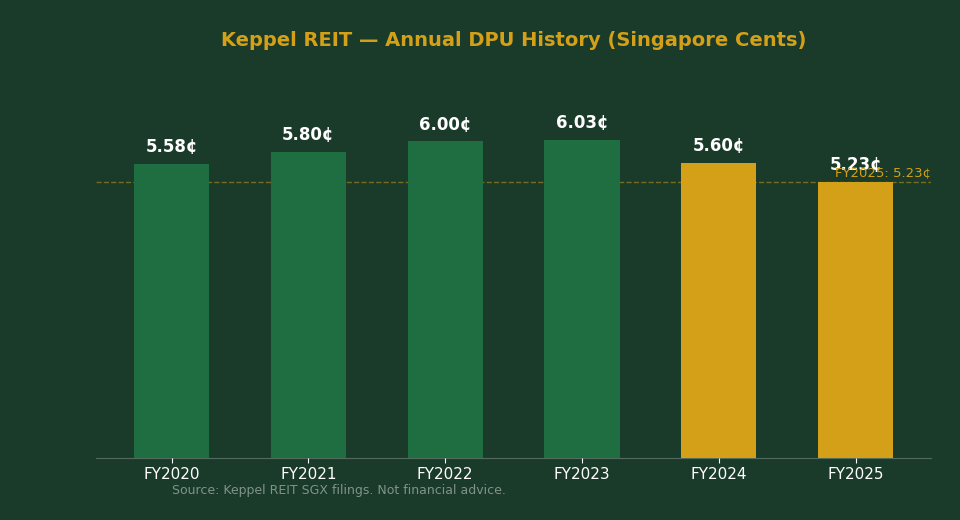
Keppel REIT has paid distributions semi-annually since its listing in 2006. Below is the annual DPU trend from FY2020 to FY2025, sourced directly from SGX filings:
| Financial Year | DPU (Singapore Cents) | YoY Change |
|---|---|---|
| FY2020 | 5.58¢ | — |
| FY2021 | 5.80¢ | +3.9% |
| FY2022 | 6.00¢ | +3.4% |
| FY2023 | 6.03¢ | +0.5% |
| FY2024 | 5.60¢ | -7.1% |
| FY2025 | 5.23¢ | -6.6% |
The DPU decline in FY2024 and FY2025 reflects two headwinds: the dilutive effect of the preferential offering (new units issued in October 2025 and January 2026 for the MBFC Tower 3 acquisition), and higher interest costs from elevated global rates. Positively, Keppel REIT includes a S$20 million Anniversary Distribution per year (S$100M total over five years, announced Oct 2022), which supports distributions during the acquisition integration phase.
Q1 2026 distributable income jumped 19.7% YoY to S$57.9 million (including Anniversary Distribution: S$62.9M, +17.8% YoY), with an estimated Q1 2026 DPU of approximately 1.27 cents. This annualises to roughly 5.1 cents, suggesting the MBFC Tower 3 and Top Ryde acquisitions are already contributing meaningfully.
FY2025 Financial Results & Q1 2026 Update
Keppel REIT released its FY2025 unaudited results on 4 February 2026. Key highlights:
| Metric | FY2025 | FY2024 | YoY |
|---|---|---|---|
| Property Income | S$274.5M | S$261.6M | +4.9% |
| Net Property Income (NPI) | S$215.9M | S$201.9M | +6.9% |
| Share of Associates / JVs | S$124.6M | S$110.0M | +13.3% |
| Distributable Income | S$212.4M | S$214.5M | -1.0% |
| DPU | 5.23¢ | 5.60¢ | -6.6% |
| NAV per Unit | S$1.28 | S$1.27 | +0.8% |
NPI growth of 6.9% was driven by Ocean Financial Centre (higher occupancy), Keppel Bay Tower, 2 Blue Street (Australia), and the first contribution from Top Ryde City Shopping Centre. The DPU decline was primarily unit-dilution driven — total distributable income fell only 1.0%.
Q1 2026 Business Update (April 2026)
Property income for Q1 2026 rose 14.4% YoY to S$78.6 million, with NPI up 9.7% YoY. Distributable income from operations increased 19.7% to S$57.9M. The Q1 2026 estimated DPU is approximately 1.27 cents, paid from an enlarged unit base of ~4,955 million units following the preferential offering completed January 2026.
Singapore CBD Grade A average office rents reached S$12.30 psf per month in Q4 2025 (CBRE), while core CBD Grade A occupancy improved from 94.9% in Q3 2025 to 95.5% in Q4 2025 — a tailwind for Keppel REIT’s Singapore portfolio. Use our S-REIT Dividend Yield Calculator to model your own yield estimates.
Gearing, Debt & Interest Coverage Ratio
As at 31 December 2025, Keppel REIT’s aggregate leverage stood at 47.9%, elevated due to equity bridge loans taken to fund the MBFC Tower 3 acquisition. Critically, these bridge loans were fully repaid on 20 January 2026 using proceeds from the preferential offering. Post-repayment, gearing has normalised significantly.
| Metric | 31 Dec 2025 | 31 Dec 2024 |
|---|---|---|
| Aggregate Leverage (Gearing) | 47.9% | 41.2% |
| Interest Coverage Ratio (ICR) | 2.6× | 2.5× |
| Weighted Average Cost of Debt | 3.41% p.a. | 3.40% p.a. |
| Total Borrowings | S$3.76B | S$2.66B |
Both the 47.9% gearing and 2.6× ICR remain within MAS CIS Code limits (50% gearing cap; 1.5× ICR minimum). The Manager has publicly ruled out near-term equity fundraising and is targeting a reduced cost of borrowing in 2026 as interest rates moderate. At 3.41% weighted average cost of debt, Keppel REIT’s interest costs are well-managed relative to its NPI yield.
Singapore investors can model gearing and ICR impacts with our free S-REIT Gearing & ICR Calculator.
Dividend Yield vs S-REIT Peers (2026)
At a unit price of approximately S$0.975 (as at 31 December 2025) and FY2025 DPU of 5.23 cents, Keppel REIT’s trailing yield is approximately 5.4%. Here’s how it compares with commercial and diversified S-REIT peers:
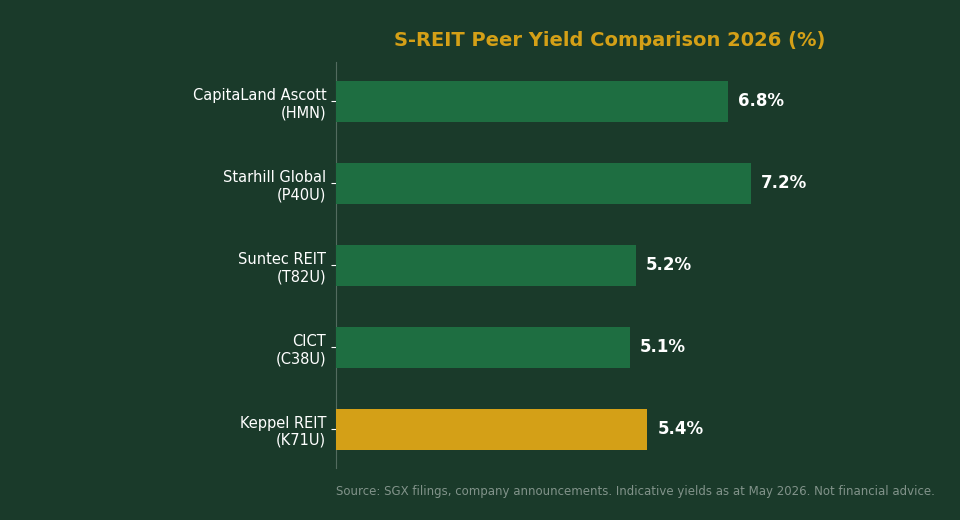
Keppel REIT’s ~5.4% yield positions it in the middle of the commercial S-REIT pack. Starhill Global REIT and CapitaLand Ascott REIT offer higher trailing yields but carry different risk profiles (retail/hospitality vs. Grade A office). CICT and Suntec REIT are direct comparables given their Singapore CBD office exposure.
For income-focused investors, Keppel REIT’s yield spread over the Singapore 10-year government bond (approximately 2.8–3.0% as at Q1 2026) of roughly 240–260 basis points remains reasonable — though tighter than the long-run average of 300+ bps. Use the S-REIT Yield vs Bond Spread Calculator to run your own spread analysis.
You can also model the total return potential of holding K71U with our S-REIT Total Return Calculator.
2026 Outlook — Singapore Office Market & Growth Drivers
Keppel REIT’s investment thesis for 2026 rests on three pillars:
1. Singapore Grade A Office Recovery
Singapore’s core CBD Grade A office occupancy reached 95.5% in Q4 2025, up from 94.9% a quarter earlier (CBRE). Average rents hit S$12.30 psf per month — the highest since 2015. Ocean Financial Centre specifically saw occupancy improvement cited as a key Q1 2026 NPI driver. With limited new Grade A supply expected in 2026–2027, rental upside remains intact.
2. MBFC Tower 3 Contribution Ramp-Up
The additional one-third stake in MBFC Tower 3 (acquired December 2025, bringing Keppel REIT’s stake to two-thirds) was funded at a relatively attractive cap rate given the quality of the asset. As bridge loans have been repaid, the full distributable income contribution will flow through from Q1 2026 onwards. Management has indicated this acquisition is expected to be DPU-accretive as occupancy and operating leverage build.
3. Top Ryde City Shopping Centre — Retail Diversification
Top Ryde City, acquired at a 75% stake in December 2025, adds a high-quality Sydney suburban retail asset generating consistent consumer spending income. Australian household spending growth of 6.3% YoY in November 2025 (per JLL) supports near-term income stability from this asset.
4. Falling Borrowing Costs
The RBA and potential Fed rate adjustments in 2026 could reduce Keppel REIT’s weighted average cost of debt below its current 3.41% p.a., improving distributable income margins. Management has set explicit 2026 cost-of-borrowing reduction targets.
Risks to watch include Australian office market softness in Macquarie Park / North Sydney, FX headwinds from AUD/KRW/JPY weakness, and any new equity fundraising that could be unit-dilutive. For more context on macro risks, see our Best S-REITs 2026 guide.
Buying Keppel REIT with CPF or SRS
Keppel REIT (K71U) is an SGX-listed S-REIT, which means Singapore investors can purchase it using:
CPF Investment Scheme (CPFIS-OA): K71U is approved for purchase using CPF Ordinary Account funds via the CPFIS. This allows you to invest idle OA savings (beyond the first S$20,000) into K71U directly through CPFIS-approved brokerages. Note the OA interest rate is 2.5% p.a. — your REIT yield needs to sustainably exceed this to justify the investment.
Supplementary Retirement Scheme (SRS): K71U can be purchased using SRS funds. SRS contributions receive a tax deduction in the year of contribution, and withdrawals at or after 62 are taxed at 50% of the applicable rate — making it a tax-efficient vehicle for REIT income.
Cash (Regular Brokerage): Available via all SGX-connected brokerages including DBS Vickers, Moomoo, Tiger Brokers, and others. The minimum lot size is 1 lot (1,000 units).
If you are looking for a more hands-off approach to Singapore REITs, robo-advisors like Endowus and Syfe offer REIT-focused portfolios that can be funded with both cash and CPF/SRS. Use our CPFIS Calculator to model whether using CPF OA makes sense for your situation.
For a breakdown of all CPF investment options, see our CPF Investment Strategy guide.
Frequently Asked Questions
What is Keppel REIT's current DPU and yield?
For FY2025, Keppel REIT paid a total DPU of 5.23 Singapore cents. At a unit price of approximately S$0.975 (as at 31 December 2025), this represents a trailing dividend yield of approximately 5.4%. Q1 2026 DPU is estimated at approximately 1.27 cents based on the enlarged unit base post-preferential offering.
What assets does Keppel REIT own in Singapore?
Keppel REIT owns five Singapore commercial assets: Ocean Financial Centre (79.9%), Keppel Bay Tower (100%), Marina Bay Financial Centre Towers 1 & 2 plus Marina Bay Link Mall (1/3 interest), MBFC Tower 3 (2/3 interest, acquired additional stake December 2025), and One Raffles Quay (1/3 interest). All Singapore assets are Grade A commercial properties in prime CBD locations.
What is Keppel REIT's gearing ratio?
As at 31 December 2025, Keppel REIT’s aggregate leverage (gearing) was 47.9%, elevated due to equity bridge loans taken to fund the MBFC Tower 3 acquisition. These bridge loans were fully repaid on 20 January 2026 using preferential offering proceeds, normalising gearing. The interest coverage ratio (ICR) is 2.6x and weighted average cost of debt is 3.41% per annum.
Is Keppel REIT safe to invest in?
Keppel REIT is a well-established, SGX-listed commercial S-REIT backed by the Keppel Group sponsor. Its portfolio of Grade A offices is resilient and Singapore CBD occupancies are improving. That said, no investment is without risk — key risks include interest rate sensitivity (gearing at ~38–40% post-offering normalisation), DPU dilution from new unit issuances, and exposure to overseas office markets (Australia, South Korea, Japan) with their own macro dynamics. This is not financial advice.
How does Keppel REIT compare to CICT and Suntec REIT?
All three are Singapore commercial S-REITs with CBD office exposure, but they differ in portfolio mix. CICT (CapitaLand Integrated Commercial Trust) is the largest Singapore-focused commercial REIT with a retail + office mix, offering a ~5.1% yield. Suntec REIT owns Suntec City plus overseas assets at a ~5.2% yield. Keppel REIT is more office-pure with its Grade A CBD portfolio, trading at ~5.4% yield. Keppel REIT’s recent Top Ryde and MBFC acquisitions add retail and office scale.
Can I buy Keppel REIT using CPF?
Yes. Keppel REIT (K71U) is approved under the CPF Investment Scheme (CPFIS-OA), allowing you to use CPF Ordinary Account funds to purchase units through an CPFIS-approved brokerage. You can also buy K71U using SRS funds for additional tax efficiency. Note that CPF OA funds earn a guaranteed 2.5% p.a. inside CPF — only invest via CPFIS if you have reasonable conviction K71U will generate higher long-term returns.
What is Keppel REIT's NAV per unit?
Keppel REIT’s NAV (Net Asset Value) per unit as at 31 December 2025 was S$1.28. At the prevailing market price of approximately S$0.975, the REIT was trading at a price-to-book (P/B) ratio of approximately 0.76x — a meaningful discount to book value, which some value investors view as attractive.
Start Investing in S-REITs Today
Whether you invest in Keppel REIT directly or through a robo-advisor, open a brokerage or investment account to get started. Use our referral codes below for exclusive sign-up bonuses.
This article was researched with the help of AI. While we strive to keep all information accurate and up to date, there may be errors. If you notice any discrepancies, please contact us.