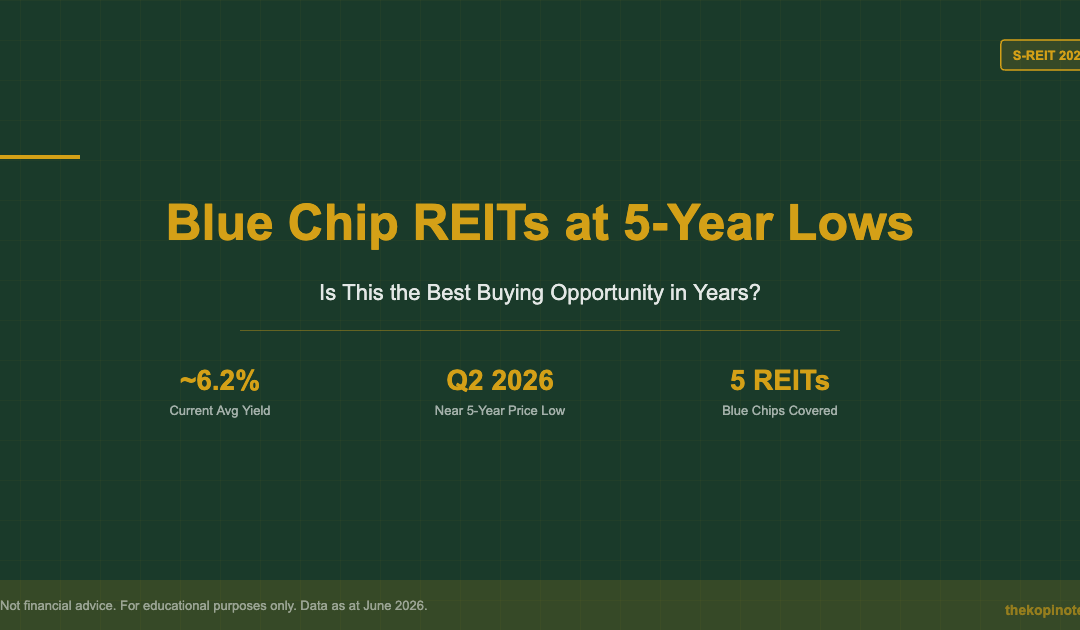
Blue Chip REITs in Singapore Near 5-Year Lows: Should You Buy in 2026?
A data-driven look at which Singapore blue chip REITs are near multi-year lows — and whether now is the time to act.
Several blue chip Singapore REITs — including Ascendas REIT, CapitaLand Integrated Commercial Trust (CICT), and Mapletree Logistics Trust — are trading near 5-year price lows in 2026, driven by elevated interest rates and global macro uncertainty. For Singapore dividend investors, this has created yield-on-cost entry points not seen since the COVID crash of 2020. Here’s which blue chip REITs are near lows, what’s driving the selloff, and whether the risk-reward makes sense for your portfolio.
Not financial advice. All figures are for educational reference only. Data as at June 2026 unless noted.
- Blue chip S-REITs are at or near 5-year price lows — yields are at multi-year highs of 5.5%–7.5%
- The selloff is driven by rate fears, not fundamentals — most blue chips maintained or grew DPU in Q1 2026
- Dollar cost averaging (DCA) into quality blue chips now could lock in historically high yield-on-cost for long-term investors
Table of Contents
Contents — Click to expand
- Why Are Blue Chip REITs at 5-Year Lows?
- Which Blue Chip REITs Are Near Their Lows?
- Current Yields vs Historical Average
- Are the Fundamentals Still Intact?
- The Bull Case: Why Long-Term Investors Are Buying
- The Bear Case: Risks to Watch
- How to Buy Blue Chip REITs in Singapore
- Frequently Asked Questions
Why Are Blue Chip REITs at 5-Year Lows?
S-REIT unit prices have been under pressure since late 2022, when the US Federal Reserve began one of its most aggressive rate-hiking cycles in decades. Higher interest rates hurt REITs in two ways. First, their cost of debt rises — reducing distributable income (DPU). Second, higher risk-free rates (like the Singapore T-bill yield at around 2.8–3.2% in early 2026) make REITs’ yield spreads look less attractive to investors who want income.
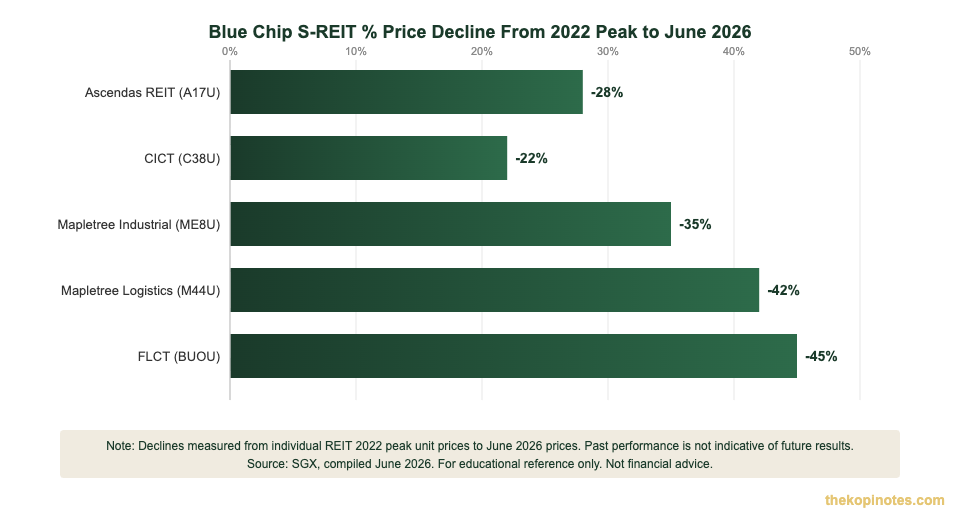
The result? Unit prices have drifted lower over three years, even as most REITs’ actual property fundamentals — occupancy, rental reversions, tenant quality — have held up well or improved. You’re essentially getting high-quality commercial, industrial, and retail property portfolios at prices last seen during the COVID crash in March 2020.
For long-term Singapore dividend investors, this is a classic “price vs value” divergence. The question is whether rates will stay high long enough to damage DPU — or whether today’s prices represent a rare window to lock in above-average yield-on-cost.
Which Blue Chip REITs Are Near Their Lows?
Not all S-REITs are created equal. “Blue chip” in the S-REIT context typically refers to the largest, most liquid REITs with strong sponsor backing, diversified tenant bases, and a track record of stable or growing DPU through multiple market cycles. Here are the ones trading closest to multi-year lows as at June 2026:
| REIT | Sector | Approx. Price (Jun 2026) | 52-Wk Low | 5-Yr Low | Current Yield |
|---|---|---|---|---|---|
| Ascendas REIT (A17U) | Industrial | ~S$2.50 | S$2.45 | S$2.20 (2020) | ~6.0% |
| CICT (C38U) | Retail/Office | ~S$1.85 | S$1.80 | S$1.57 (2020) | ~5.8% |
| Mapletree Logistics Trust (M44U) | Logistics | ~S$1.28 | S$1.22 | S$1.10 (2020) | ~7.0% |
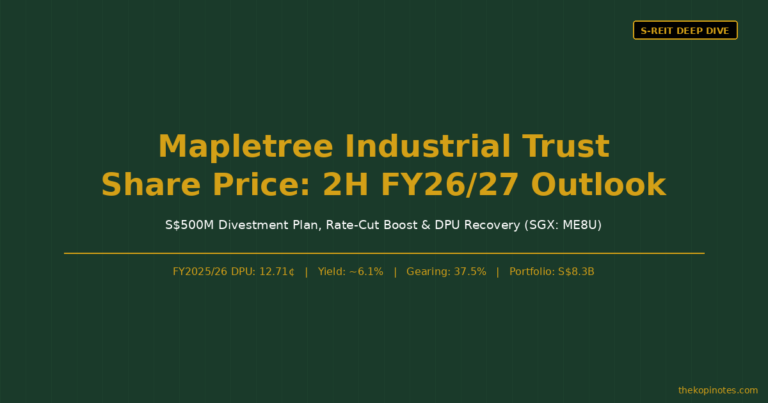
| Mapletree Industrial Trust (ME8U) | Industrial/DC | ~S$2.05 | S$2.00 | S$2.00 (2020) | ~6.5% |
| Frasers Logistics & Commercial Trust (BUOU) | Logistics/Office | ~S$0.98 | S$0.93 | S$0.80 (2020) | ~7.4% |
Source: SGX, compiled June 2026. Prices approximate. Yields based on trailing 12-month DPU. Not investment advice.
Current Yields vs Historical Average
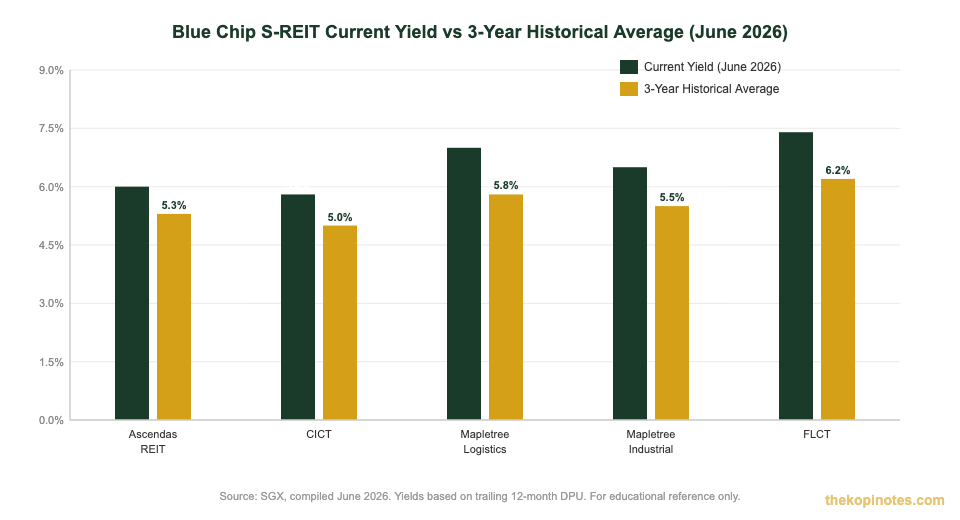
One of the strongest signals that blue chip REITs are cheap relative to history is the yield spread over the Singapore 10-year government bond. Historically, S-REITs trade at a 2.5–3.5% yield premium over the risk-free rate. With 10-year SGS bonds at around 3.0% in mid-2026, a “fair value” REIT yield would be roughly 5.5–6.5%. Several blue chips are currently trading at 6.5–7.5% — implying prices could be 10–20% below intrinsic value.
| REIT | Current Yield | 3-Year Avg Yield | Premium to SGS 10Y | Assessment |
|---|---|---|---|---|
| Ascendas REIT | ~6.0% | 5.3% | +3.0% | Above avg |
| CICT | ~5.8% | 5.0% | +2.8% | Near avg |
| Mapletree Logistics | ~7.0% | 5.8% | +4.0% | Well above avg |
| Mapletree Industrial | ~6.5% | 5.5% | +3.5% | Above avg |
| FLCT | ~7.4% | 6.2% | +4.4% | Well above avg |
Source: SGX, MAS, compiled June 2026. SGS 10Y benchmark approximately 3.0% as at June 2026. Historical averages are indicative only.
Are the Fundamentals Still Intact?
Price is what you pay. Value is what you get. The key question: are the underlying property fundamentals still sound?
The short answer, based on Q1 2026 results, is yes — with some nuance by sector.
Industrial and Logistics REITs (Ascendas, Mapletree Industrial, MLT, FLCT): Occupancy rates remain at 90–96% across Singapore, Australia, and Europe portfolios. Rental reversions are mostly positive — typically +3% to +8% in Singapore. E-commerce and data centre demand continues to underpin logistics assets.
Retail REITs (CICT, Frasers Centrepoint Trust): Singapore retail occupancy is near 98–99% for prime suburban malls. Shopper traffic and tenant sales have recovered above pre-COVID levels. The risk here is office vacancy — CICT’s office component faces mild pressure as remote work continues.
Key risk: Gearing levels. Most blue chip REITs are running gearing at 35–40% (close to MAS limits). If interest rates stay elevated, refinancing costs will eat into DPU when fixed-rate debt matures. Watch for REITs with more than 20% of debt up for refinancing in the next 12 months.
The Bull Case: Why Long-Term Investors Are Buying
The case for buying blue chip S-REITs now rests on three pillars.
1. Rates are close to their peak. Market consensus in mid-2026 is that the US Fed will begin cutting rates in H2 2026 or early 2027. When rates fall, REIT financing costs drop, yield spreads compress, and the sector typically re-rates upward. Buying before the rate cut cycle means locking in high current yield AND potential capital appreciation.
2. Yield-on-cost is historically high. If you buy Ascendas REIT today at ~6.0% yield and hold for 10 years while DPU grows at 2–3% per annum, your yield-on-cost in year 10 could be 8–9%. That’s exceptional for a Singapore-listed, SGD-denominated income stream with no capital gains tax.
3. Sponsor quality provides a backstop. Blue chip S-REITs like Ascendas (CapitaLand), CICT (CapitaLand), and Mapletree REITs are backed by Singapore government-linked sponsors. In downturns, sponsors have historically injected capital rather than letting REITs fail.
For Singapore investors building passive income in Singapore, blue chip REITs at these valuations are a rare opportunity. The combination of high current yield, reliable DPU history, and sponsor support makes them a core holding for most dividend portfolios.
The Bear Case: Risks to Watch
No investment is risk-free. Here are the key risks for blue chip REITs in 2026:
Rates staying higher for longer. If Singapore’s 3-month SORA and SGS yields stay elevated through 2027, REIT DPU growth will be muted as debt refinancing costs bite. Some REITs may cut DPU — particularly those with high gearing and near-term debt maturity walls.
FX headwinds for overseas portfolios. Ascendas REIT, MLT, and Mapletree Industrial all have significant AUD, EUR, and USD-denominated assets. A stronger SGD erodes DPU when converted back. Currency risk is real and often underappreciated by retail investors.
Rights issue dilution. If credit conditions tighten, REITs needing to refinance may launch rights issues where existing unitholders must buy new units or face dilution. Always check gearing ratios and debt maturity profiles before investing.
Sector-specific headwinds. Office demand faces long-term structural pressure from hybrid work. Retail in suburban Singapore is strong, but high street retail remains patchy.
How to Buy Blue Chip REITs in Singapore
Blue chip S-REITs trade on the Singapore Exchange (SGX) in SGD. Here are the most popular options for Singapore retail investors in 2026:
moomoo Singapore: Low commission (from S$0.99/trade) and a clean mobile app. Good for regular DCA purchases. Check the moomoo Singapore review for current promotions.
Interactive Brokers (IBKR): Best for larger portfolios (S$50,000+). Very low FX costs and access to SGX REITs, LSE ETFs, and US equities in one account.
Syfe Brokerage: Simple fee structure (0.06% per trade, min S$1.50), no custodian fees. Use our Syfe referral code SRPRFFFCD for a cashback bonus on your first trade.
FSMOne: Good for investors who want S-REITs plus bonds and funds on one platform. Use the FSMOne referral code P0544985 for fee waivers.
You can also invest in a basket of S-REITs through the Singapore REIT ETF — no stock picking required. Check our full Singapore REIT ETF guide for a comparison of all REIT ETFs on SGX.
For broader portfolio context, use the Singapore retirement calculator to see how a blue chip REIT allocation fits into your retirement income plan.
Want to know which of these blue chip REITs make our shortlist for 2026? See our best S-REITs in Singapore 2026 guide for a ranked comparison with yield, gearing, and DPU growth data.
Disclaimer: The Kopi Notes does not provide personalised financial advice. The content on this page is for educational purposes only. REITs carry investment risk including loss of principal. Always do your own research or consult a licensed financial adviser before investing.
Frequently Asked Questions
Why are blue chip REITs in Singapore near 5-year lows in 2026?
The main driver is rising interest rates since 2022. Higher rates increase REITs’ borrowing costs (reducing DPU) and also make risk-free alternatives like T-bills and SGS bonds more attractive to yield-seeking investors. This has pushed REIT unit prices down even though most REITs’ underlying property fundamentals — occupancy rates, rental income — have remained healthy. The selloff is largely sentiment and rate-driven, not a fundamental deterioration in the properties themselves.
Is now a good time to buy blue chip REITs in Singapore?
Current yields of 5.5%–7.5% on blue chip S-REITs are historically high, and prices are near multi-year lows. If you have a long investment horizon (5+ years) and can tolerate short-term price volatility, dollar cost averaging into quality blue chips now could lock in above-average yield-on-cost. However, if rates stay elevated longer than expected, DPU growth may be muted in the near term. This is not financial advice — always assess your own risk tolerance and financial situation before investing.
Which blue chip REITs are nearest to their 5-year lows?
As at June 2026, Mapletree Logistics Trust (M44U), Frasers Logistics & Commercial Trust (BUOU), and Mapletree Industrial Trust (ME8U) are among those trading closest to their 5-year lows, with yields in the 6.5%–7.4% range. Ascendas REIT (A17U) and CICT (C38U) are slightly further from their 5-year lows but still offer yields above their 3-year historical averages.
Can I use my CPF to buy blue chip REITs?
Yes, some SGX-listed S-REITs are eligible under the CPF Investment Scheme (CPFIS). Ascendas REIT, CICT, and Mapletree Industrial Trust have historically been CPFIS-eligible, but you should verify the current approved list on the CPF Board website before investing, as eligibility can change. Note that you can only use CPF-OA funds for CPFIS investments, and your OA balance must exceed S$20,000 before you can invest the excess.
What is gearing and why does it matter for REIT investors?
Gearing is the ratio of a REIT’s total debt to its total assets. In Singapore, MAS caps REIT gearing at 50% (or 45% without a credit rating). Higher gearing means more debt — which costs more to service when rates rise, eating into the DPU paid to unitholders. Blue chip REITs currently run gearing at 35–42%. Watch for REITs close to 42–45% gearing with significant near-term debt refinancing needs — these face the most DPU pressure if rates stay high.
What is the difference between investing in REITs directly vs a REIT ETF?
Buying individual REITs (like Ascendas REIT on SGX) lets you concentrate in specific REITs you like and potentially earn higher yields. A REIT ETF gives you instant diversification across 30–50 REITs for a small annual fee (0.5–0.6% TER). REIT ETFs are simpler and lower risk; individual REITs offer more control and potentially higher yield if you pick well. Many Singapore investors do both.
Ready to Build Your REIT Portfolio?
Use our referral links to open a brokerage account and start buying blue chip REITs today.
This article was researched with the help of AI. While we strive to keep all information accurate and up to date, there may be errors. If you notice any discrepancies, please contact us.