Does VWRA Pay Dividends? VWRA ETF Singapore Guide 2026
A complete Singapore investor’s guide — VWRA’s accumulating structure, tax advantages, and how to buy it cost-efficiently in 2026.
VWRA (Vanguard FTSE All-World UCITS ETF Accumulating) does not pay cash dividends. It is an accumulating ETF listed on the London Stock Exchange (LSE), meaning all dividends from its 3,700+ global holdings are automatically reinvested into the fund. For Singapore investors, this is a key advantage: no dividend income to declare, no withholding tax on distributions, and tax-free compounding under Singapore’s zero-capital-gains regime.
Not financial advice. All figures are for educational reference only. Data as at June 2026 unless noted.
Table of Contents
What Is VWRA?
VWRA is the ticker for the Vanguard FTSE All-World UCITS ETF (USD) Accumulating, managed by Vanguard and listed on the London Stock Exchange (LSE) under the ticker VWRA. It tracks the FTSE All-World Index, giving investors exposure to approximately 3,700 large- and mid-cap stocks across 49 developed and emerging market countries.
VWRA is domiciled in Ireland, making it a UCITS-compliant ETF under European regulations. This Ireland domicile is critically important for Singapore investors: it means VWRA benefits from Ireland’s tax treaty with the United States, reducing withholding tax on US dividends from 30% (for US-domiciled ETFs) to just 15%. The fund holds roughly 60% in US stocks, so this WHT advantage is significant.
The ETF is structured as accumulating — all dividends received from the underlying holdings are reinvested automatically within the fund. Investors do not receive cash payouts. This is distinct from VWRD (the distributing share class), which pays quarterly dividends in USD.
VWRA is traded in USD on the LSE and is one of the most popular global ETFs among Singapore retail investors seeking diversified, low-cost, long-term wealth accumulation. As at Q1 2026, VWRA’s AUM exceeded USD 22 billion, reflecting its status as a flagship global equity ETF.
Does VWRA Pay Dividends?
No — VWRA does not pay cash dividends. As an accumulating ETF, all income generated by the fund’s holdings (dividends, interest) is reinvested back into the fund automatically. This reinvestment happens at the fund level — you will not see a cash credit in your brokerage account.
Instead, VWRA’s share price reflects the accumulated value of all reinvested income over time. If the underlying index yields 2% per year in dividends, that 2% is folded back into VWRA’s NAV (Net Asset Value) rather than paid out to you in cash.
Why this matters for Singapore investors:
- No dividend income to report: Singapore has no dividend tax, but accumulating ETFs eliminate the administrative step of tracking dividend receipts entirely.
- Tax-free compounding: Reinvested dividends grow tax-free within the fund structure, since Singapore levies zero capital gains tax.
- Reduced drag from reinvestment friction: In a distributing ETF, you receive cash and must manually reinvest it — incurring transaction costs each time. VWRA’s accumulating structure eliminates this friction.
- WHT still applies at fund level: VWRA’s Ireland domicile means dividends from US stocks within the fund are subject to 15% withholding tax before reinvestment (not 30% as for US-domiciled ETFs). This WHT is already reflected in the fund’s performance — you don’t pay it separately.
If you specifically want regular cash income from your global equity exposure, consider VWRD (the distributing version), which pays quarterly dividends. However, for most Singapore investors in wealth-accumulation mode, VWRA’s structure is optimal.
Planning your retirement income needs? Use our Singapore retirement calculator to model when you might switch from accumulating to distributing holdings.
VWRA Key Facts at a Glance
| Metric | Detail |
|---|---|
| Full Name | Vanguard FTSE All-World UCITS ETF (USD) Accumulating |
| Ticker (LSE) | VWRA |
| Index Tracked | FTSE All-World Index (~3,700 stocks, 49 countries) |
| Domicile | Ireland (UCITS-compliant) |
| Structure | Accumulating (no cash dividends paid out) |
| TER (Expense Ratio) | 0.22% p.a. |
| AUM | USD 22+ billion (as at Q1 2026) |
| Number of Holdings | ~3,700 |
| Currency | USD (traded in USD on LSE) |
| US Dividend WHT | 15% (Ireland-US tax treaty) vs 30% for US-domiciled ETFs |
| US Estate Tax Risk | None (Ireland domicile protects non-US investors) |
Source: Vanguard VWRA factsheet, Q1 2026
Why Singapore Investors Buy VWRA on the London Stock Exchange
Singapore investors overwhelmingly prefer LSE-listed, Ireland-domiciled ETFs like VWRA over their US-domiciled equivalents (such as VT by Vanguard on NYSE). There are three compelling reasons.
1. Lower Withholding Tax on US Dividends
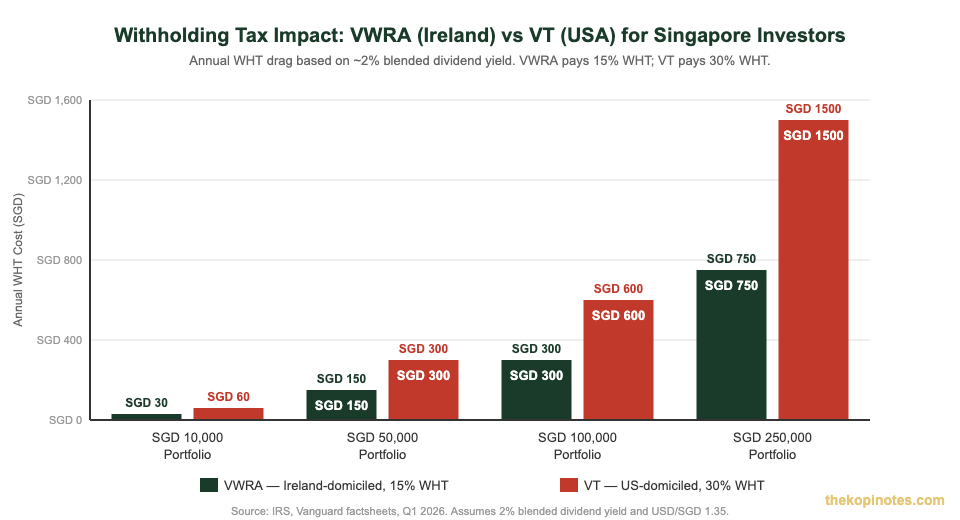
The US imposes a 30% withholding tax on dividends paid to non-US investors who hold US-domiciled ETFs. However, Ireland has a tax treaty with the US that reduces this rate to 15% for Ireland-domiciled funds. Since ~60% of VWRA’s holdings are US stocks, this difference meaningfully affects net returns. On a SGD 100,000 VWRA portfolio assuming a 2% blended dividend yield, the WHT saving is approximately SGD 150 per year compared to holding VT — that’s SGD 1,500 over 10 years, before compounding.
2. No US Estate Tax Exposure
US-domiciled ETFs (held directly by non-US persons) are subject to US estate tax above a USD 60,000 threshold. For a Singapore investor with a USD 200,000 portfolio in VT, the estate could face a US estate tax bill on USD 140,000 worth of assets. Ireland-domiciled ETFs like VWRA are not US situs assets — they are completely outside the US estate tax regime, regardless of portfolio size.
3. Singapore’s Zero Capital Gains Tax
Singapore does not impose capital gains tax on investment returns. This means VWRA’s price appreciation accumulates entirely tax-free in your hands. Combined with the accumulating structure (no dividend payouts to track), VWRA is as clean a tax wrapper as exists for a Singapore-based investor.
| Feature | VWRA (LSE, Ireland) | VT (NYSE, USA) |
|---|---|---|
| US Dividend WHT | 15% | 30% |
| US Estate Tax Risk | None | Yes (above USD 60k) |
| Structure | Accumulating (no cash div) | Distributing (quarterly) |
| TER | 0.22% p.a. | 0.07% p.a. |
Source: Vanguard factsheets, IRS Publication 515, Q1 2026
VWRA Expense Ratio and Total Costs
VWRA’s Total Expense Ratio (TER) is 0.22% per annum. This is deducted from the fund’s assets daily — it is not charged to your brokerage account separately. The TER covers Vanguard’s management fee, custody, administration, and audit costs.
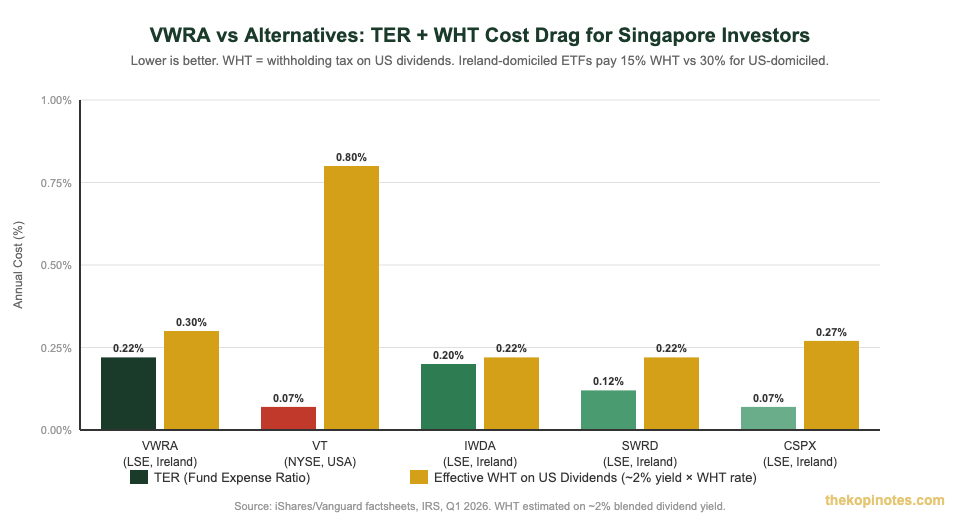
At first glance, 0.22% looks higher than VT’s 0.07%. But for a Singapore investor, the WHT advantage flips this comparison:
- VT (US-domiciled): 0.07% TER + ~0.60% effective WHT drag (30% × ~2% yield) = ~0.67% total annual cost
- VWRA (Ireland-domiciled): 0.22% TER + ~0.30% effective WHT drag (15% × ~2% yield) = ~0.52% total annual cost
In dollar terms: on a SGD 50,000 VWRA portfolio, the annual cost is approximately SGD 110 in TER plus SGD 75 in WHT drag — SGD 185 total. The equivalent VT portfolio would cost approximately SGD 35 in TER but SGD 150 in WHT drag — SGD 185 total at parity, but rises as the portfolio grows and WHT drag compounds.
Beyond the TER, watch for broker-side costs: brokerage commission per trade, FX conversion spread (SGD to USD), and custody fees if applicable. Interactive Brokers typically offers the lowest all-in cost for VWRA purchases among Singapore-available brokers.
Looking for a broker that keeps ETF costs low? The Syfe referral code gets you a sign-up bonus when opening a Syfe Trade account for ETF investing.
How to Buy VWRA in Singapore (Step-by-Step)
VWRA is available through several brokers accessible to Singapore residents. Here is how to buy it on the four most popular platforms.
Interactive Brokers (IBKR) — Recommended for larger portfolios (SGD 20,000+)
IBKR offers the lowest commission for LSE-traded ETFs among Singapore-available brokers. To buy VWRA: open and fund your IBKR account in SGD → convert SGD to USD using IBKR’s FX tool (Ideal Pro gives mid-market rates for trades above USD 25,000, or Ideal for smaller amounts) → search for “VWRA” in the trading platform → select “LSE” as the exchange → enter your share quantity and place a limit order during LSE trading hours (3pm–11pm SGT). Commission is typically USD 1.70 per trade (minimum), making it highly cost-effective at scale. Visit the moomoo Singapore review to compare broker fee structures.
Saxo Markets — Good for intermediate portfolios
Saxo allows Singapore residents to trade LSE-listed ETFs directly. Search “VWRA” and select the London Stock Exchange. Saxo’s custody fees can add up for smaller portfolios, so check the current fee schedule on their website before opening an account.
moomoo Singapore — Good for beginners and smaller amounts
moomoo supports LSE ETF trading and has a clean mobile interface. Commissions are higher than IBKR for larger trades, but the platform is more beginner-friendly. Check for any current promotional zero-commission periods on their website.
Syfe Trade — Simplest option for new investors
Syfe Trade offers VWRA trading with a straightforward interface. It’s an excellent starting point for investors new to ETF investing who want a simple, regulated Singapore broker. Use our Syfe referral code and sign-up bonus to get started with a cash reward.
Can I buy VWRA with CPF or SRS? VWRA listed on the LSE is not eligible for CPF Investment Scheme (CPFIS). However, it may be purchased using Supplementary Retirement Scheme (SRS) funds through brokers that support SRS accounts for overseas securities trading. Check with your specific broker for SRS eligibility. For CPF-investable ETFs, see our guide on CPF investment strategy Singapore.
Note on trading hours: The LSE operates Monday–Friday, 9:00am–5:30pm UK time, which is 3:00pm–11:30pm Singapore time (4pm–12:30am during British Summer Time, April–October). Plan your orders accordingly.
VWRA vs Alternatives
VWRA competes with several other ETFs popular among Singapore investors. The right choice depends on whether you want global diversification, developed-markets-only exposure, or a different cost structure. Here is a direct comparison of the most relevant options.
| ETF | TER | Index | Structure | Exchange | Best For |
|---|---|---|---|---|---|
| VWRA | 0.22% | FTSE All-World (DM+EM) | Accumulating | LSE (USD) | Global coverage, no dividends |
| VWRD | 0.22% | FTSE All-World (DM+EM) | Distributing | LSE (USD) | Quarterly cash dividends |
| IWDA | 0.20% | MSCI World (DM only) | Accumulating | LSE (USD) | Developed markets only, no EM |
| CSPX | 0.07% | S&P 500 (US large-cap) | Accumulating | LSE (USD) | US-only focus, lowest TER |
| SWRD | 0.12% | MSCI World (DM only) | Accumulating | LSE (USD) | Cheapest DM ETF on LSE |
| VT | 0.07% | FTSE All-World (DM+EM) | Distributing | NYSE (USD) | Avoid — US estate tax + 30% WHT |
Source: iShares, Vanguard, SSGA factsheets, Q1 2026
VWRA vs VWRD: Same fund, same index, same TER — the only difference is payout structure. VWRA reinvests dividends; VWRD pays them out quarterly. For accumulation-phase investors, VWRA wins on simplicity and compounding. For income-focused investors (e.g. retirees), VWRD may be preferable. Considering how S-REITs and ETFs fit into your income plan? Read our guide on passive income Singapore strategies.
VWRA vs IWDA: IWDA only covers developed markets (no China, India, Brazil, etc.). VWRA is more diversified but adds emerging market risk. IWDA has a marginally lower TER (0.20% vs 0.22%). For most long-term investors, VWRA’s EM exposure is a feature, not a bug — emerging markets have historically contributed meaningfully to global returns over 20-year cycles.
VWRA vs CSPX: CSPX gives pure S&P 500 exposure at a very low 0.07% TER. VWRA is more diversified across global markets. If you want US-only growth with the lowest possible cost, CSPX is the pick. If you want global diversification in a single ETF, VWRA is the answer. Many Singapore investors hold both — CSPX as the core US holding and VWRA or IWDA for international diversification.
Who Should Buy VWRA?
VWRA is ideal if you:
- Want a single ETF covering the entire global stock market (developed + emerging)
- Are in the accumulation phase and prefer not to receive dividend income (simpler tax management)
- Want Ireland-domiciled protection against US estate tax
- Have a long-term investment horizon of 10+ years
- Are comfortable trading on the LSE during Singapore evenings (3pm–11:30pm SGT)
- Want exposure to emerging market growth alongside US and European markets
Consider alternatives if you:
- Need regular cash income — consider VWRD (distributing) instead, which pays quarterly dividends
- Want only US large-cap exposure at the lowest possible cost — consider CSPX (0.07% TER)
- Need CPF-investable options — VWRA is not CPFIS-eligible; look at SGX-listed ETFs for CPF
- Already have significant US-only exposure and want a developed-markets-ex-US tilt
- Prefer SGD-traded ETFs to avoid FX conversion costs — SGX-listed ETFs in SGD exist but are fewer in number
If you’re building a retirement portfolio combining ETFs with S-REITs, take a look at the Singapore REIT ETF guide to understand how dividend-paying REIT ETFs complement VWRA’s accumulating structure. For higher-yield alternatives in the Singapore market, our analysis of the best S-REITs in Singapore 2026 is a good starting point.
Platforms like FSMOne referral code and Endowus referral code also offer regular savings plan (RSP) options for ETF investing, which can be useful for dollar-cost averaging into VWRA or similar funds over time.
Not financial advice. Always consider your personal financial situation, risk tolerance, and investment horizon. Data as at June 2026.
Frequently Asked Questions
Does VWRA pay dividends to Singapore investors?
No. VWRA is an accumulating ETF, which means it does not pay cash dividends. Instead, all income from the fund’s 3,700+ holdings is automatically reinvested within the fund, increasing VWRA’s Net Asset Value (NAV) over time. If you want cash dividends from the same underlying index, consider VWRD — the distributing share class of the same fund, which pays quarterly dividends in USD.
What is the difference between VWRA and VWRD?
VWRA and VWRD track the identical index (FTSE All-World) with the identical TER (0.22% p.a.) and domicile (Ireland). The only difference is the distribution policy: VWRA is accumulating (dividends reinvested automatically within the fund) while VWRD is distributing (dividends paid out quarterly in USD). For investors in the accumulation phase, VWRA simplifies portfolio management and maximises compounding. For retirees who need regular income, VWRD is more suitable.
Can I buy VWRA using my CPF or SRS funds?
VWRA listed on the London Stock Exchange is not eligible for the CPF Investment Scheme (CPFIS). For CPF investing, you are restricted to SGX-listed ETFs on the CPFIS-approved list. However, VWRA may be purchasable using Supplementary Retirement Scheme (SRS) funds through brokers that support SRS accounts for overseas securities — confirm with your broker directly. For a full guide on CPF-investable options, see our CPF investment strategy guide.
Why do Singapore investors prefer VWRA over VT (Vanguard's US-listed equivalent)?
Singapore investors prefer VWRA over VT for two key reasons. First, VWRA is Ireland-domiciled, which means dividends from US stocks within the fund are subject to only 15% withholding tax (via Ireland’s treaty with the US), versus 30% for VT held directly. Second, VT is a US-domiciled ETF — non-US investors holding it directly face potential US estate tax exposure above a USD 60,000 threshold. VWRA, being an Irish-domiciled ETF, is completely outside the US estate tax regime, regardless of portfolio size.
What is VWRA's expense ratio and how does it compare to alternatives?
VWRA’s Total Expense Ratio (TER) is 0.22% per annum. This is slightly higher than CSPX (0.07%), SWRD (0.12%), and IWDA (0.20%), but VWRA offers broader global coverage including emerging markets. When you factor in the withholding tax advantage of Ireland-domicile — 15% WHT vs 30% for US-domiciled ETFs like VT — VWRA’s all-in effective annual cost for a Singapore investor is approximately 0.52%, compared to VT’s approximately 0.67%. The TER alone does not tell the full cost story for Singapore-based investors.
Which broker is cheapest for buying VWRA in Singapore?
Interactive Brokers (IBKR) is generally the most cost-effective broker for buying VWRA in Singapore, particularly for portfolio sizes above SGD 20,000. IBKR offers low commissions (around USD 1.70 per trade minimum for LSE ETFs) and near mid-market FX rates for currency conversion. For smaller portfolios or beginners, Syfe Trade and moomoo Singapore are more user-friendly alternatives, though their per-trade costs may be higher. Always check the current fee schedule on each broker’s Singapore website before opening an account.
Ready to Start Investing in VWRA?
Open a brokerage account and buy your first ETF today. Use our referral links for exclusive sign-up bonuses.
This article was researched with the help of AI. While we strive to keep all information accurate and up to date, there may be errors. If you notice any discrepancies, please contact us.