Singapore Retirement Age 2026: Should You Retire at 63 or Keep Working Until 68?
A practical financial planning guide for Singapore workers approaching retirement — CPF, SRS, and income strategy.
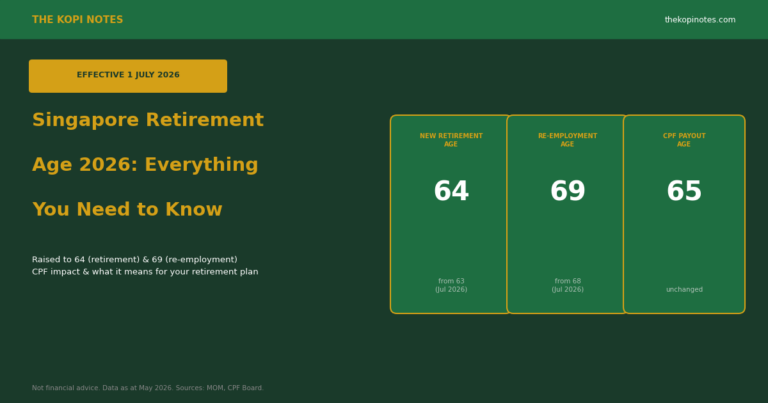
Singapore’s statutory retirement age is 63, and the re-employment age is 68 as of July 2022. Workers cannot be dismissed on age grounds before 63, and eligible employees must be offered re-employment contracts until 68. For Singapore workers approaching their 60s, the decision of whether to retire at 63 or stay employed until 68 is one of the most consequential financial choices they will make — with direct implications for CPF Life payouts, employer CPF contributions, and SRS tax savings.
Not financial advice. All figures are for educational reference only. CPF payout estimates are illustrative. Data as at October 2026 unless noted.
Table of Contents
Contents — Click to expand
- Retirement Age vs Re-employment Age in Singapore
- Key Age Milestones Every Worker Must Know
- The Financial Impact: Retire at 63 vs Stay Till 68
- How Extra CPF Contributions Affect CPF Life Payouts
- Income Bridge Strategy: Covering Ages 63–65
- SRS Withdrawal Strategy Around Retirement
- Who Should Retire at 63 (and Who Should Stay)
- Frequently Asked Questions
Retirement Age vs Re-employment Age in Singapore
Singapore operates a two-tier age framework under the Retirement and Re-employment Act (RRA):
- Retirement Age (63): Employers cannot dismiss an employee solely on grounds of age before this age. Once reached, the employer can legally not renew a contract — but must first offer re-employment if the worker is eligible.
- Re-employment Age (68): Employers must offer eligible workers re-employment contracts in the same or suitable alternative roles until this age. Workers can decline, but the offer must be made.
Both ages were raised on July 1, 2022 — retirement age from 62 to 63, and re-employment age from 67 to 68. The government has signalled further increases: retirement age to 65 and re-employment age to 70, targeted around 2030.
| Age Framework | Current Age (2026) | Planned Increase | Target Year |
|---|---|---|---|
| Retirement Age | 63 | 65 | ~2030 |
| Re-employment Age | 68 | 70 | ~2030 |
| CPF Life Payout Start | 65 (can defer to 70) | — | — |
Source: Ministry of Manpower (MOM) Singapore, CPF Board, October 2026.
The five-year gap between retirement age (63) and re-employment age (68) is the critical planning window. Workers who are offered and accept re-employment during this period continue to receive employer CPF contributions, salary income, and can keep building their retirement nest egg. Those who retire at 63 lose these accumulation years — and the compounding effect can be significant.
Key Age Milestones Every Singapore Worker Must Know
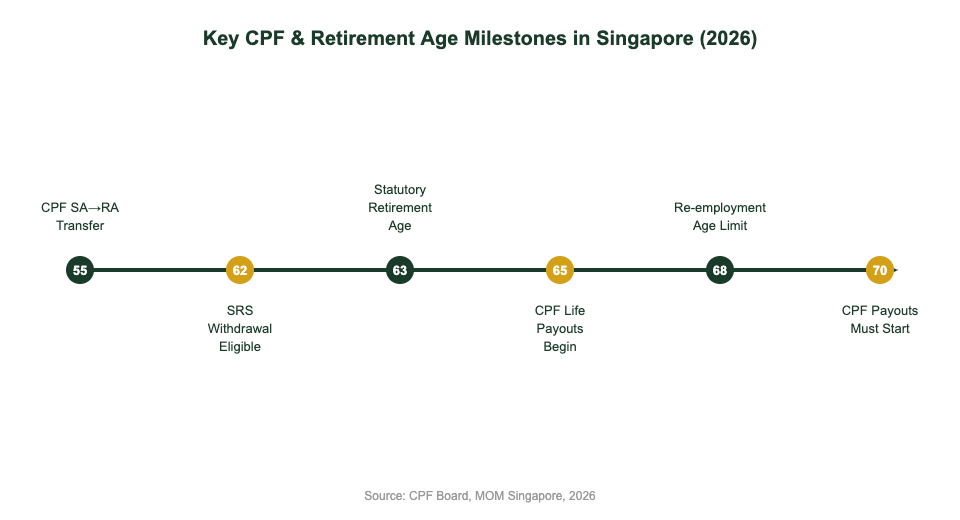
Understanding the full retirement timeline helps workers plan their finances in advance. Here are the key milestones that affect your CPF, SRS, and income:
| Age | What Happens | Action Needed |
|---|---|---|
| 55 | CPF Special Account (SA) closes; funds transfer to Retirement Account (RA) up to Full Retirement Sum (FRS). Excess OA/SA can be withdrawn. | Decide whether to withdraw excess or leave in CPF OA (earning 2.5%). |
| 62 | SRS withdrawal eligibility begins (based on retirement age when SRS was opened, usually 62). First 10 years of withdrawal: 50% of withdrawals are tax-exempt. | Plan SRS withdrawal schedule — spread over 10 years to minimise tax. Use our Singapore retirement calculator to model scenarios. |
| 63 | Statutory retirement age. Employer may not dismiss on age alone, but can restructure role or offer re-employment contract. | Review re-employment offer terms; compare to retirement income from savings and CPF OA. |
| 65 | CPF Life payouts can begin. Choosing to draw down at 65 locks in the payout based on RA balance at that point. | Consider deferring to 70 for ~6–7% higher monthly payout per additional year deferred. |
| 68 | Re-employment age limit. Employers no longer legally required to re-employ. Most workers fully retire by this point. | Final salary income stops. Ensure passive income streams (CPF Life, SRS, dividends, REITs) are in place. |
| 70 | CPF Life payouts must begin if not already started. No further deferment allowed. | CPF Life payouts automatically begin. Review and consolidate all income sources. |
Source: CPF Board, Ministry of Manpower, October 2026.
The Financial Impact: Retire at 63 vs Stay Till 68
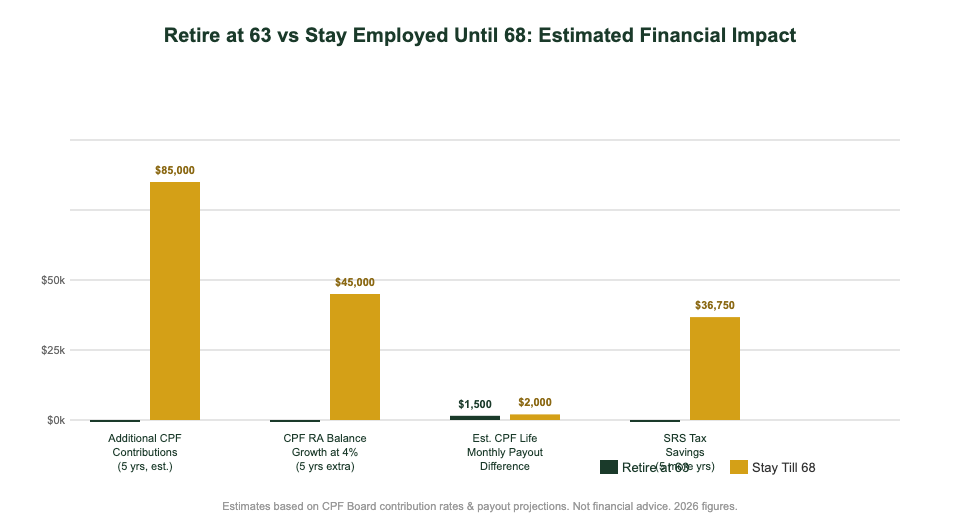
The financial case for staying employed until 68 is compelling for most workers, assuming good health and job availability. Here is a worked example for a Singapore employee earning SGD 4,500 per month at age 63:
CPF contributions during re-employment (ages 63–65):
For employees aged 60–65, the combined CPF contribution rate is approximately 20.5% (employee: 9%, employer: 11.5%). On a salary of SGD 4,500/month, that’s SGD 922.50/month in total CPF contributions, or approximately SGD 11,070 per year. Over the two years from 63 to 65, this adds roughly SGD 22,140 to the worker’s CPF accounts — before interest.
CPF contributions during re-employment (ages 65–68):
For employees aged 65–70, the combined contribution rate falls to approximately 16.5% (employee: 7.5%, employer: 9%). On SGD 4,500/month, that’s approximately SGD 742.50/month, or SGD 8,910 per year. Over three years (65–68), this adds roughly SGD 26,730.
Total additional CPF: approximately SGD 48,870 over 5 years (before the 4–5% interest earned on these balances). This is money that would not exist if the worker retired at 63.
For a fuller picture of how to deploy these CPF savings, see our guide on CPF investment strategy Singapore.
How Extra CPF Contributions Affect CPF Life Payouts
CPF Life monthly payouts are determined by the balance in your Retirement Account (RA) when payouts begin. Every additional dollar in the RA at 65 translates to a higher lifelong monthly income. Here is a simplified comparison:
| Scenario | RA Balance at 65 | Est. CPF Life Payout/Month (Enhanced Plan) | Lifetime Benefit (to age 85) |
|---|---|---|---|
| Retired at 63 | SGD 200,000 | ~SGD 1,450/month | ~SGD 348,000 |
| Worked till 65 | SGD 240,000 | ~SGD 1,740/month | ~SGD 417,600 |
| Worked till 68 | SGD 265,000 + deferred payout | ~SGD 2,050/month | ~SGD 492,000 |
Estimates only. Actual CPF Life payouts depend on plan type, RA balance at 65, and deferment decisions. Source: CPF Board CPF Life estimator projections, 2026.
The difference between retiring at 63 versus working until 68 could amount to an additional SGD 144,000 in lifetime CPF Life income (over 20 years). Workers who are healthy and have employable skills should weigh this figure carefully before deciding.
Income Bridge Strategy: Covering Ages 63–65
One concern workers have about early retirement (at 63) is the income gap between 63 and 65 — the two years before CPF Life payouts can begin. Even those who stay employed until 65 face this gap if they retire at 65 before CPF Life starts.
There are several income bridge strategies to consider:
1. CPF Ordinary Account (OA) withdrawals: If you did not meet the Full Retirement Sum at age 55, you can still withdraw from the CPF OA (funds above the Basic Retirement Sum). The OA earns 2.5% per annum, so leaving funds there until needed is an option.
2. Singapore Savings Bonds or T-bills: For workers approaching retirement, allocating some cash savings to Singapore T-bills 2026 or SSBs during working years provides a liquid, low-risk income supplement during the gap years. T-bills yield 1.8–2.2% as at October 2026 for 6-month bills.
3. Investment income: Dividend-paying REITs and ETFs can provide regular income during the gap. A SGD 200,000 portfolio in S-REITs yielding 5.5% would generate approximately SGD 11,000 per year — or around SGD 917 per month — to bridge the gap. For ideas on building passive income Singapore with REITs, TKN has a dedicated guide.
4. SRS withdrawals: If you have built up an SRS account, drawing down from age 62 at a measured pace (to stay within tax-free thresholds) can supplement income during the bridge years.
SRS Withdrawal Strategy Around Retirement
The Supplementary Retirement Scheme (SRS) is an often-overlooked pillar of Singapore retirement planning. The key rules for SRS withdrawals are:
- Withdrawals can begin from the statutory retirement age that was in effect when you opened your SRS account. For most accounts opened before 2022, this is still 62.
- Only 50% of withdrawals are taxable — making SRS tax-efficient in retirement.
- The tax-exempt withdrawal window lasts 10 years from the first withdrawal.
- Annual SRS contribution limit for Singapore Citizens and PRs: SGD 15,300, with full tax deductibility in the year of contribution.
The optimal SRS withdrawal strategy is to spread withdrawals over the 10-year window, keeping the taxable 50% below the personal income tax threshold (SGD 20,000 for zero tax, or SGD 30,000 for 2% tax rate). Many retirees can withdraw SGD 40,000/year from SRS (SGD 20,000 taxable, zero tax owed) — a highly efficient way to access the accumulated fund.
Platforms like Endowus and FSMOne referral code allow SRS funds to be invested in unit trusts and ETFs up until withdrawal — keeping the money working rather than sitting idle.
Who Should Retire at 63 (and Who Should Stay Until 68)
There is no universal right answer — but the financial and personal circumstances that tip the scales in each direction are clear:
Consider retiring at 63 if:
- Your health is declining and continued employment is difficult or stressful
- You have sufficient passive income (CPF Life, REITs, SRS, savings) to fund a comfortable lifestyle
- You have a CPF RA balance already above the Enhanced Retirement Sum (ERS)
- You have non-work goals — travel, family, volunteering — that have higher priority than additional income
- Your employer is making re-employment terms unattractive (lower salary, reduced role)
Consider staying employed until 65 or 68 if:
- You enjoy your work and it provides purpose and social connection
- Your CPF RA balance is below the Basic Retirement Sum (BRS) or Full Retirement Sum (FRS)
- You have not yet started SRS contributions, or your SRS balance is low
- Your employer offers a reasonable re-employment contract with fair compensation
- You are in good health and capable of continued work
Use TKN’s Singapore retirement calculator to model how different retirement ages affect your total income in retirement — adjusting for CPF Life payouts, SRS drawdowns, and investment income. You can also explore Syfe’s managed portfolios for a passive way to grow retirement savings in the years before you step down.
Frequently Asked Questions
What is Singapore's retirement age in 2026?
Singapore’s statutory retirement age is 63 as of July 2022. This means employers cannot dismiss an employee on grounds of age before the employee reaches 63. The re-employment age is 68 — eligible employees must be offered re-employment contracts until this age. The government plans to raise the retirement age to 65 and re-employment age to 70 around 2030.
Can my employer force me to retire at 63 in Singapore?
Not directly. Under the Retirement and Re-employment Act, an employer cannot dismiss a worker solely on grounds of age before the retirement age of 63. When a worker turns 63, the employer must first offer re-employment in the same or a suitable alternative role before ending the employment contract. Only if no suitable role exists can the employer end employment — and even then, an Employment Assistance Payment (EAP) must be offered.
How much more CPF Life payout do I get by working until 68 instead of retiring at 63?
The exact amount depends on your salary and CPF RA balance, but working five additional years (63 to 68) typically adds SGD 48,000–80,000 to your CPF accounts through employer and employee contributions, plus interest earned. On a CPF RA balance of SGD 200,000 at 65, this could translate to an additional SGD 300–600 per month in CPF Life payouts for life — potentially over SGD 100,000 in additional lifetime income over a 20-year retirement.
When can I withdraw from SRS in Singapore?
SRS withdrawals can begin from the statutory retirement age that was in effect when you first opened your SRS account — typically 62 for most existing account holders. Only 50% of withdrawals are subject to income tax. The 10-year withdrawal window begins on the date of your first withdrawal, so it is important to plan the withdrawal schedule carefully to minimise tax paid on the taxable 50% of each withdrawal.
What happens to my CPF at age 55 in Singapore?
At age 55, CPF creates a new Retirement Account (RA) for you. Funds from your Special Account (SA) and Ordinary Account (OA) are automatically transferred to the RA up to the Full Retirement Sum (FRS) — SGD 213,000 in 2026. Any balances above the Basic Retirement Sum (BRS) in the OA can be withdrawn. The SA is closed at 55 and no longer earns the higher 4% interest — funds become part of the RA.
Is the re-employment age in Singapore 68 or 70?
The re-employment age in Singapore is currently 68 (as of July 2022, raised from 67). The Singapore government has announced plans to increase the re-employment age to 70 and the retirement age to 65, targeted around 2030 as part of the broader workforce longevity strategy. Until those changes are legislated and implemented, the operative re-employment age remains 68.
Start Planning Your Retirement Income Now
Use our free tools and referral bonuses to build your retirement income portfolio in Singapore.
This article was researched with the help of AI. While we strive to keep all information accurate and up to date, there may be errors. If you notice any discrepancies, please contact us.