TL;DR — Majulah Package in 60 Seconds
- Who: Singapore Citizens born on or before 31 December 1973 (~1.6 million people).
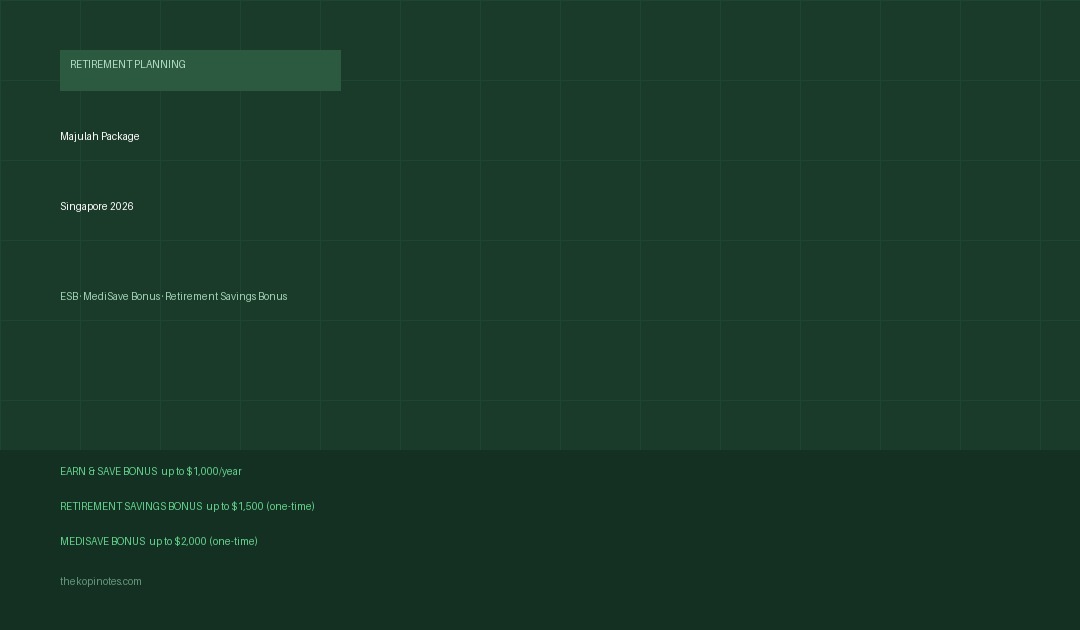
- Earn & Save Bonus (ESB): $400–$1,000 credited to your CPF every March from 2025, as long as you keep working within the income band.
- Retirement Savings Bonus (RSB): One-time $1,000 or $1,500 credited to your CPF Retirement/Special Account in December 2024.
- MediSave Bonus (MSB): One-time $1,250 or $2,000 credited to your MediSave Account in December 2024.
- No action needed: All three components are paid automatically if you qualify — no form to fill.
- Not cash: Every dollar goes into your CPF accounts, not your bank.
Singapore’s retirement landscape is dotted with schemes — CPF LIFE, the Matched Retirement Savings Scheme, the Silver Support Scheme, Workfare. The Majulah Package is different: it is the government’s largest single effort to top up CPF savings for the “young senior” generation — those in their 50s and early 60s in the 2020s — people who entered the workforce before CPF interest rates and contribution rates became as generous as they are today.
Announced at Budget 2024 and worth roughly S$8.2 billion, the package covers three components with different eligibility logic and payout timelines. This guide walks through every detail you need: amounts, thresholds, worked numbers, and how the ESB interacts with your income over the years ahead.
What Is the Majulah Package?
The word majulah means “advance” or “progress” in Malay — the same spirit as the national anthem. In retirement planning terms, it represents a government-funded top-up designed to reduce the gap between what older Singaporeans have saved and what they need to retire comfortably.
The package targets citizens born on or before 31 December 1973. That means anyone who was at least 50 years old in 2023 when the package was announced. The government estimates approximately 1.6 million Singaporeans qualify for at least one component.
Three things set this package apart from, say, the Silver Support Scheme:
- It rewards working. The ESB requires earned income — you get it as long as you stay employed.
- It tops up retirement and healthcare savings simultaneously. The RSB and MSB target CPF RA/SA and MediSave respectively.
- It is automatic. You do not need to apply. CPF Board credits your account directly if you meet the criteria.
All three components go into CPF accounts. None is paid out as cash.
Component 1: Earn and Save Bonus (ESB)
The ESB is the recurring engine of the Majulah Package — a yearly CPF top-up for working Singaporeans whose income stays within the qualifying band.
How Much You Get (ESB)
| Average Monthly Income | Annual ESB | 10-Year Total |
|---|---|---|
| $500 – $2,500 | $1,000 | $10,000 |
| Above $2,500 – $3,500 | $700 | $7,000 |
| Above $3,500 – $6,000 | $400 | $4,000 |
| Below $500 (concessionary) | $400 | $4,000 |
Source: CPF Board and govbenefits.gov.sg. ESB paid annually each March from 2025. As at October 2026.
The concessionary ESB of $400 applies to persons with disabilities, ComCare Short-to-Medium Term Assistance recipients, and caregivers of individuals with moderate-to-severe disabilities — as long as their earned income falls below $500 a month.
ESB Eligibility Criteria
To qualify for ESB in any given year, all four conditions must be met on the assessment date:
- Citizenship: Singapore Citizen born on or before 31 December 1973.
- Income: Average monthly employment or trade income between $500 and $6,000 (based on the preceding Year of Assessment).
- Property ownership: Own no more than one property.
- Property Annual Value (AV): The AV of your residence must be $31,000 or below as of 30 November of the preceding year.
Eligibility is assessed yearly. If your income rises above $6,000, you miss that year’s ESB — but you can qualify again in a future year if your income falls back into the range. Think of it as a loyalty bonus for staying in the workforce at moderate income levels.
Where ESB Lands in Your CPF
The ESB is credited in this order of priority:
- Retirement Account (RA) — if you have one (i.e., you are 55 or older)
- Special Account (SA) — if you are under 55
- Ordinary Account (OA) — for those 55 and older who have already met their Full Retirement Sum and have no remaining RA top-up capacity
From the moment it lands, the money earns CPF interest: 4% per annum in SA or RA, 2.5% in OA. For a 55-year-old receiving $1,000 in March and living another 25 years to 80, that single ESB credit compounds to roughly $2,700 at the 4% RA rate.
Component 2: Retirement Savings Bonus (RSB)
The RSB was a one-time payment made in December 2024. If you received it, it is already in your CPF Retirement or Special Account. If you missed it, you cannot claim it retrospectively — RSB eligibility was assessed at a fixed snapshot date.
RSB Amounts
| CPF Retirement Savings (as at 31 Dec 2022) | RSB Amount |
|---|---|
| Less than $60,000 | $1,500 |
| $60,000 to below $99,400 | $1,000 |
| $99,400 and above | Not eligible |
Source: CPF Board. RSB paid December 2024. $99,400 = 2023 Basic Retirement Sum. As at October 2026.
RSB Eligibility Criteria
- Citizenship: Singapore Citizen born on or before 31 December 1973.
- CPF savings: Combined OA + SA + RA balance as of 31 December 2022 must be below $99,400 (the 2023 Basic Retirement Sum).
- Property: Own no more than one property, or live in a property with Annual Value of $25,000 or below.
The RSB specifically targets Singaporeans who entered the workforce in an era of lower CPF contribution rates and accumulated less in their accounts as a result. The $99,400 cut-off is the 2023 BRS — if your combined savings were already above the Basic Retirement Sum, the government’s view is that your retirement nest egg is on track.
Component 3: MediSave Bonus (MSB)
The MSB was also a one-time payment in December 2024, credited to your MediSave Account. It helps cushion healthcare costs in retirement — MediSave can be used for hospitalisation, outpatient procedures, and MediShield Life premiums.
MSB Amounts
| Birth Year | Property Situation | MSB Amount |
|---|---|---|
| 1960–1973 | Own ≤ 1 property AND Annual Value ≤ $25,000 | $2,000 |
| 1960–1973 | Own ≤ 1 property AND Annual Value > $25,000; OR own > 1 property | $1,250 |
| 1959 or earlier | All situations (Pioneer/Merdeka Generation) | $1,250 |
Source: Budget 2024 (MOF Annex F2), CPF Board FAQs. One-time MSB paid December 2024. Includes $500 enhancement announced October 2024. As at October 2026.
Why the Two Tiers?
The higher MSB tier ($2,000) targets “young seniors” born 1960–1973 who are approaching retirement and live in HDB flats or lower-AV properties. The $1,250 tier applies to older seniors — those born 1959 and earlier — who already benefit from the Pioneer Generation Package and Merdeka Generation Package, and to younger seniors in higher-AV homes.
An October 2024 enhancement added $500 to the original MSB amounts for all qualifying recipients, reflecting updated cost-of-living assessments before the December 2024 disbursement.
Worked Example: Mdm Ng, 58, Cleaner Earning $1,800/Month
Mdm Ng was born in January 1968 and works as a hospital cleaner earning $1,800 a month. She owns one HDB flat with an Annual Value of $8,400. As of 31 December 2022, her combined CPF OA + SA balance was $42,000 — accumulated over a career that started in the mid-1980s.
One-Time Payouts (December 2024)
| Component | Eligibility Check | Amount |
|---|---|---|
| Retirement Savings Bonus | CPF savings $42,000 < $60,000 ✓ | $1,500 → RA |
| MediSave Bonus | Born 1960–1973, 1 property, AV $8,400 ≤ $25,000 ✓ | $2,000 → MA |
| One-Time Total | $3,500 |
Annual ESB (From March 2025)
| Year | Income Check | ESB Credited to CPF (March) |
|---|---|---|
| 2025 | $1,800/mth ∈ $500–$2,500 ✓ | $1,000 → SA |
| 2026 | $1,800/mth ✓ | $1,000 → SA / RA (age 58) |
| 2027–2032 | If income stays in range | $1,000/yr × 6 = $6,000 |
| ESB Total (8 years) | $8,000 |
Total Majulah Package value for Mdm Ng (one-time + 8yr ESB): S$11,500 in CPF top-ups — all without her applying for a thing.
At 4% RA interest, the $3,500 one-time payout received in December 2024 grows to approximately $7,700 by the time she turns 80, assuming it stays in CPF and earns compound interest.
All figures are illustrative. Actual amounts depend on annual eligibility reassessment. CPF interest rates are subject to change. As at October 2026.
ESB Accumulation Over 10 Years
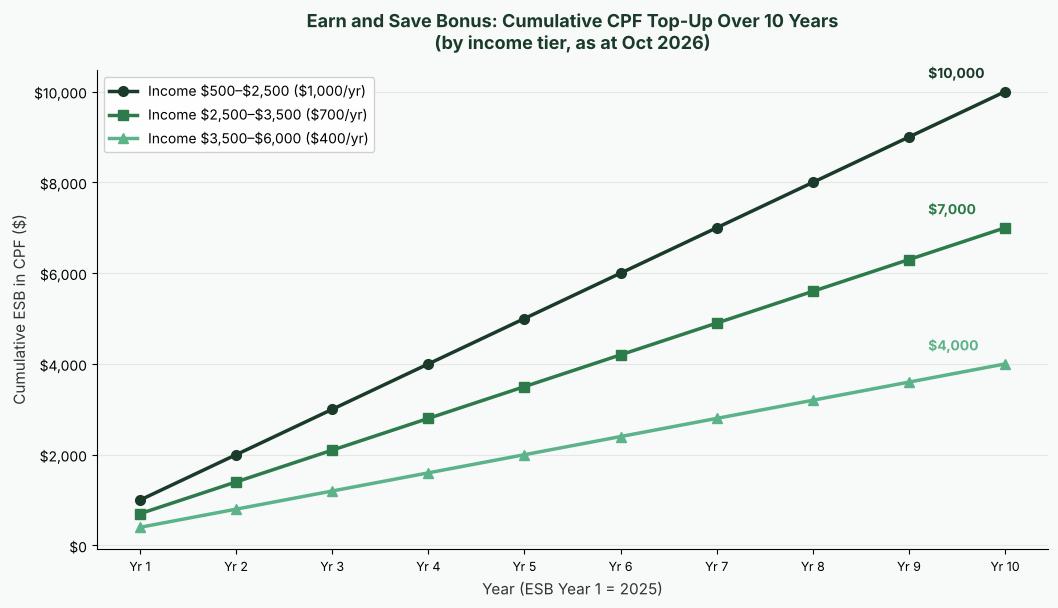
Earn and Save Bonus: Cumulative CPF top-up over 10 years by income tier. As at October 2026.
The chart illustrates a straight-forward point: the ESB compounds effort over time. A Singaporean earning $2,000 a month who keeps working until age 65 receives $10,000 in CPF credits from the ESB alone — before interest. Earning $4,000 a month still yields $4,000 over the same decade. No action required beyond staying employed within the qualifying band.
Total Package Value by Scenario
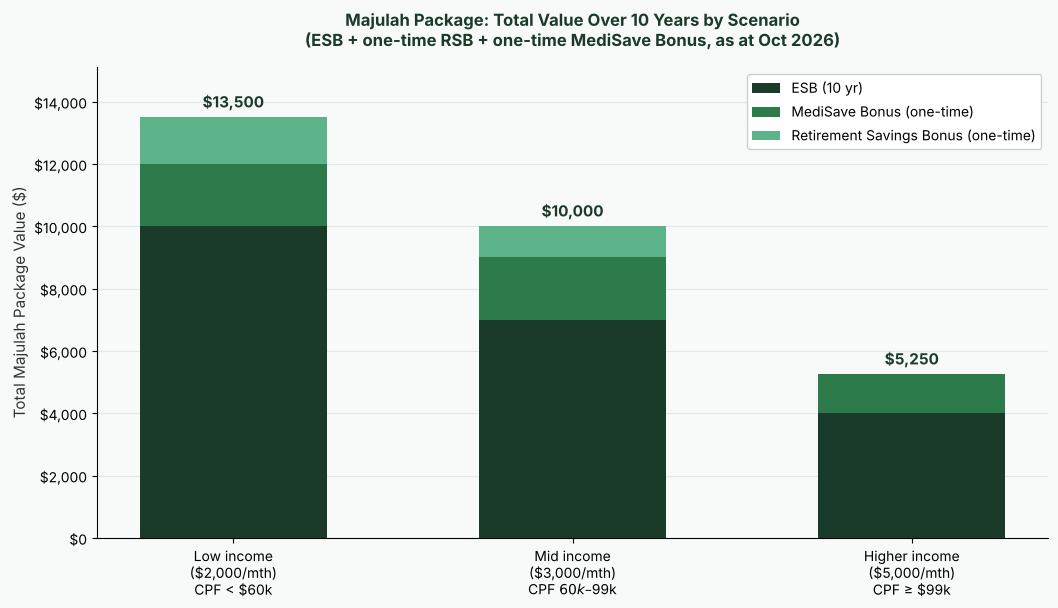
Total Majulah Package value (ESB 10yr + one-time RSB + one-time MSB) by scenario. Assumes born 1965, 1 HDB property, AV ≤ $25,000. As at October 2026.
Lower-income seniors with modest CPF savings receive the most — by design. A cleaner earning $2,000 with CPF savings under $60,000 can receive up to $13,500 in combined CPF credits over a decade. A professional earning $5,000 with savings above the 2023 BRS receives $5,250 (MSB $1,250 + 10yr ESB $4,000), with no RSB entitlement.
Majulah Package vs Silver Support Scheme vs Workfare
| Feature | Majulah Package | Silver Support Scheme | Workfare Income Supplement |
|---|---|---|---|
| Age eligibility | Born ≤ 1973 (50+) | 65 and above | 35 and above (30+ for PWD) |
| Requires employment? | ESB: Yes. RSB/MSB: No | No | Yes |
| Payment frequency | ESB: annual; RSB/MSB: one-time | Quarterly cash + CPF | Annual |
| Paid as cash? | No — CPF only | Partially (cash + MediSave) | Partially (cash + CPF) |
| Income cap | $6,000/mth (ESB) | Not income-based (CPF-based) | $2,500/mth |
| Property AV limit | $31,000 (ESB), $25,000 (MSB tier) | $13,000 | $13,000 |
| Top-up account | RA / SA / MA | MA (and cash) | CPF (all accounts) + cash |
As at October 2026. Criteria subject to change. Refer to respective scheme pages for latest details.
The three schemes are complementary, not mutually exclusive. A Singaporean who is 65+ and meets all criteria could receive Silver Support payouts, Workfare top-ups, and the ongoing ESB simultaneously. Read more about the Silver Support Scheme and the Workfare Income Supplement in the separate guides.
How to Check Your Eligibility and Track Payouts
Step 1 — Check CPF Online Services. Log in to cpf.gov.sg with your Singpass. Under “Account Overview”, you can see whether the RSB and MSB were credited in December 2024, and whether the ESB has been credited in March 2025 and March 2026.
Step 2 — Verify your income on IRAS myTax Portal. The ESB is assessed annually using your income from the preceding Year of Assessment. If you changed employers or switched to self-employment, confirm your declared income on mytax.iras.gov.sg.
Step 3 — Check your property Annual Value on IRAS VAS. The AV of your home is published at IRAS Valuation & Appeal Service. This determines both the ESB property criterion ($31,000 AV cap) and the MSB tier ($25,000 threshold).
Step 4 — Contact the Majulah Package hotline if needed. Call 1800-2222-888 (CPF Board) for queries on your specific eligibility or if a payment appears to be missing.
Important: ESB Is Reassessed Every Year
Unlike the RSB and MSB (which were fixed one-off snapshots), your ESB eligibility is freshly assessed each year. A promotion that pushes your income above $6,000 will disqualify you for that year’s ESB. Returning to the qualifying income band in a later year restores eligibility. The assessment is automatic — CPF Board uses income data from IRAS and property data from IRAS/HDB.
Linking Majulah Package to Your CPF Top-Up Strategy
If you are also making voluntary CPF top-ups under the Retirement Sum Topping-Up (RSTU) scheme, note that the ESB is credited on top of — not in place of — voluntary top-ups. The two do not interact negatively. See the full guide on CPF top-ups: SA, RA and MediSave for how voluntary and government top-ups work together, and the CPF Retirement Sum guide for how your RA balance affects CPF LIFE payouts.
Related Tools
- Retirement Planning Calculator (Singapore) — Project your CPF LIFE payout, investment portfolio, and income gap to retirement.
- CPF Retirement Sum 2026 Guide — Understand the BRS ($110,200), FRS ($220,400), and ERS ($440,800) and how they affect your payout.
- CPF Top-Up Guide: SA, RA and MediSave — Voluntary RSTU top-ups, tax relief, and how to decide which account to prioritise.
- Matched Retirement Savings Scheme (MRSS) 2026 — Dollar-for-dollar CPF top-up for ages 55–70 with CPF savings below the FRS.
Frequently Asked Questions
Does the Majulah Package ESB affect my Workfare Income Supplement (WIS)?
No. The ESB and WIS are separate schemes assessed independently. You can receive both if you meet the eligibility criteria for each. WIS requires you to be 35 or older and earn no more than $2,500 a month; it has a stricter property AV cap ($13,000) and pays a mix of cash and CPF. ESB extends to incomes up to $6,000 and is entirely in CPF. If you earn $1,500 a month and are 55+, you could receive both WIS and ESB in the same year.
I am a permanent resident, not a citizen. Do I qualify?
No. The Majulah Package is for Singapore Citizens only — born on or before 31 December 1973. Permanent Residents do not qualify for any of the three components, regardless of how long they have been resident in Singapore.
I became a citizen after 1973 (born abroad). Do I still qualify?
Yes. There is no requirement on when you attained citizenship — only that you are a Singapore Citizen at the time of assessment and were born on or before 31 December 1973. New citizens who naturalised after 1973 are eligible as long as they meet the age, income, and property criteria.
The RSB and MSB were paid in December 2024. Can I still get them if I missed them?
No. Both the Retirement Savings Bonus and the MediSave Bonus were assessed based on a fixed snapshot date (CPF savings as at 31 December 2022 for RSB; citizenship and property data at assessment date for MSB). If you qualified but the payment appears missing, contact CPF Board at 1800-2222-888. If you did not qualify at the assessment date, there is no retrospective claim.
Does the ESB count toward the CPF Annual Limit?
No. CPF Board top-ups under government schemes like the ESB, MRSS, and Silver Support are not counted toward the CPF Annual Limit (currently $37,740). You can still make voluntary contributions or top-ups up to the full Annual Limit on top of the ESB credits.
My income varies year to year — I am self-employed. How is my ESB income assessed?
For self-employed persons, average monthly income is based on your declared trade income in the preceding Year of Assessment (assessed by IRAS). Make sure your income is declared accurately on time. If your assessed income for one year falls outside the $500–$6,000 range, you miss that year’s ESB — you can qualify again in a subsequent year if your income returns to the qualifying band.
Can I withdraw the ESB as cash once it is in my CPF?
No. The ESB is expressly designed to boost retirement savings and cannot be withdrawn as a lump sum. It follows the standard CPF withdrawal rules: once in your RA, it is locked until CPF LIFE payouts begin at 65 (or later if deferred to 70). Once in your SA, it is subject to standard CPF OA/SA withdrawal rules for non-housing purposes. It effectively adds to your CPF LIFE payout stream — not to your disposable cash.
Does the Majulah Package apply if I own a private property instead of HDB?
It depends on your property’s Annual Value. For ESB, you can own one private property as long as its AV is $31,000 or below — this covers most mass-market condos. For the higher MSB tier ($2,000), the AV threshold was $25,000. Many private condos in Singapore have AVs above $25,000, so private property owners who received only the lower $1,250 MSB tier should not be surprised. Those who own two or more properties of any type do not qualify for ESB at all.
Disclaimer: This article is for general information only and does not constitute financial advice. Figures are sourced from CPF Board, Ministry of Finance (Budget 2024), Ministry of Manpower, and govbenefits.gov.sg and are accurate as at October 2026. Eligibility criteria and payout amounts are subject to change at the government’s discretion. Please refer to cpf.gov.sg or call the CPF hotline at 1800-227-1188 for the most current information. The Kopi Notes is not affiliated with CPF Board or any government agency.
This article was researched with the help of AI. While we strive to keep all information accurate and up to date, there may be errors. If you notice any discrepancies, please contact us.