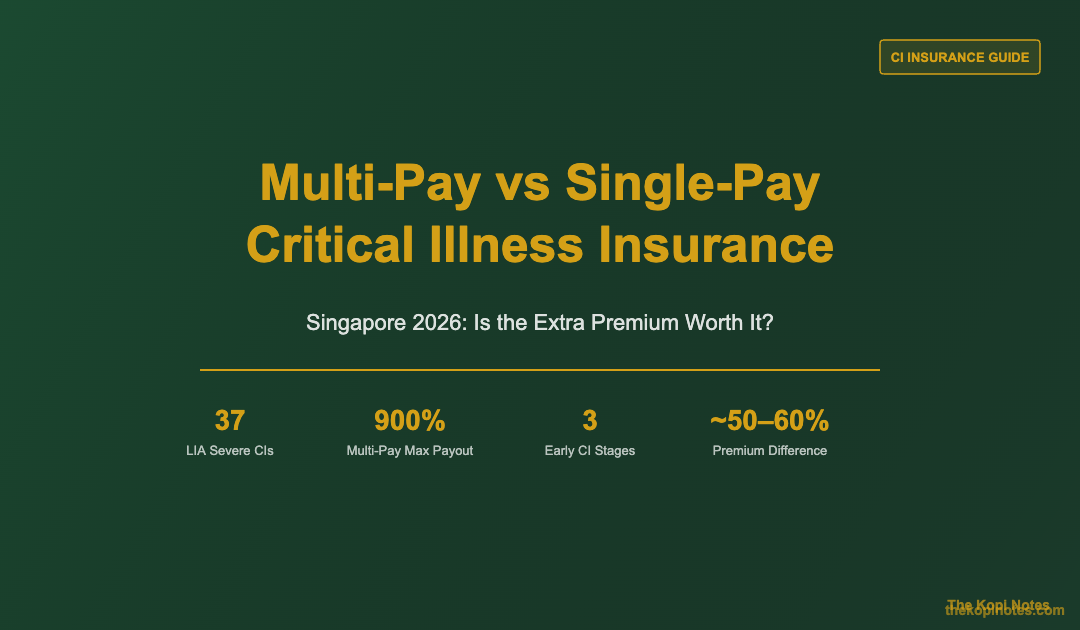
Multi-Pay vs Single-Pay Critical Illness Insurance Singapore 2026
Is the Extra Premium Worth It?
Critical illness insurance pays you a lump sum when you’re diagnosed with a serious condition like cancer, heart attack, or stroke. A standard single-pay plan pays out once at the severe stage. A multi-pay plan pays at early, intermediate, and severe stages — and for recurrent diagnoses — up to 900% of your sum assured. The question is whether those extra payouts justify premiums that are roughly 50–60% higher.
Not financial advice. Figures are indicative and for educational reference only. Data verified as at 28 August 2026. Always get a personalised quote from a licensed financial adviser before purchasing any insurance product.
- Multi-pay CI covers more stages (early to severe) and allows multiple payouts — including for recurrent CIs.
- Premiums are ~50–60% higher than standard single-pay CI for the same sum assured.
- Multi-pay is worth it if you have a family history of CI, are self-employed, or need income protection across a long recovery — not just the diagnosis moment.
Table of Contents
What Is Multi-Pay Critical Illness Insurance?
Standard CI insurance pays you once. You get a lump sum — typically equal to your sum assured — when you’re diagnosed with one of the 37 LIA-defined severe-stage critical illnesses. After that, your policy ends.
Multi-pay CI (also called multi-claim or multi-stage CI) works differently. It pays out at three stages of illness severity: early, intermediate, and severe. Each stage triggers an independent payout. Once you’ve recovered, the policy continues — you can claim again for a different or recurring CI later.
Think of it this way: a single-pay plan is like a one-time emergency fund. A multi-pay plan is more like ongoing income protection that stays with you through diagnosis, treatment, recovery, and beyond.
As at October 2025, the LIA CI Framework 2024 is in effect. This updated framework revised 7 illness definitions and 2 header names to reflect advances in medical technology. All new CI plans must align with this framework, meaning coverage terms are clearer than ever.
Key Differences: Single-Pay vs Multi-Pay CI
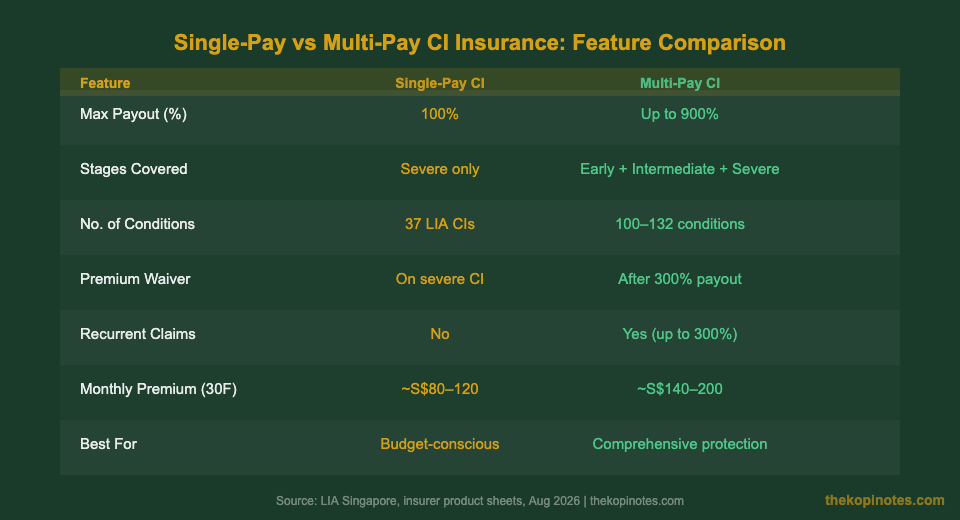
Here’s how the two types compare side-by-side:
| Feature | Single-Pay CI | Multi-Pay CI |
|---|---|---|
| Number of claims allowed | 1 | Multiple (stages + recurrences) |
| Stages covered | Severe only | Early, Intermediate, Severe |
| Max total payout | 100% of sum assured | Up to 900% of sum assured |
| Conditions covered | 37 LIA CIs (severe) | 100–132 conditions |
| Premium waiver | On severe CI diagnosis | After 300% of SA paid out |
| Policy continues after claim? | No — policy ends | Yes — until max payout reached |
| Indicative monthly premium (30F, S$300k SA) | ~S$80–120/month | ~S$130–190/month |
Source: LIA Singapore CI Framework 2024; insurer product sheets (Singlife, AIA, Prudential, Manulife), Aug 2026. Premiums are indicative — actual quotes vary by age, gender, smoker status, and health declaration.
Payout Stages Explained: How Multi-Pay CI Actually Works
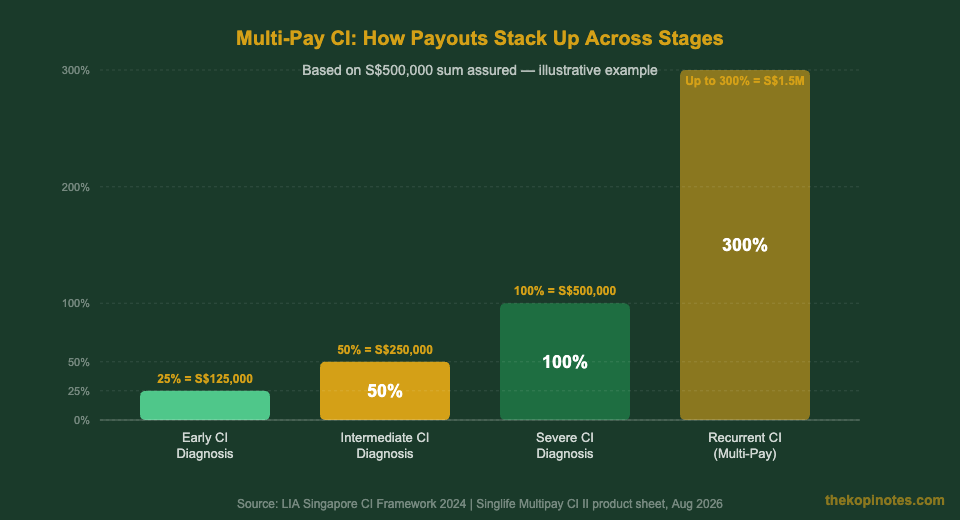
Most multi-pay CI plans split conditions into three severity stages. Here’s how a typical S$300,000 sum assured would pay out at each stage:
| Stage | Typical Payout | Example Conditions |
|---|---|---|
| Early Stage | 25–50% of SA (~S$75k–150k) | Carcinoma-in-situ, angioplasty, early-stage cancer |
| Intermediate Stage | 50% of SA (~S$150k) | Moderate brain trauma, intermediate-stage cancer |
| Severe Stage | 100% of SA (S$300k) | 37 LIA-defined major CIs: advanced cancer, heart attack, stroke, kidney failure |
| Recurrent CI | Up to 300% of SA across multiple claims | Second primary cancer, subsequent heart attack after full recovery |
Source: LIA Singapore CI Framework 2024; Singlife Multipay CI II product sheet, Aug 2026. Payout percentages vary by insurer and plan — always check your policy schedule.
The practical advantage of early-stage payouts is significant. Catching cancer at stage 1 means surgery and treatment costs now — even before it’s “severe”. A S$75,000–S$150,000 early payout can cover six to twelve months of medical leave and out-of-pocket treatment without draining your savings.
For more on how the LIA 37 CI definitions apply to claims, see our LIA CI definitions 2024 guide. For ECI-focused plans, our early critical illness insurance Singapore guide covers the full ECI landscape.
Is Multi-Pay CI Worth the Extra Premium?
This is the core question. The honest answer: it depends on your life stage, budget, and risk profile.
For a 30-year-old non-smoker female, the monthly premium difference between a standard CI plan and a multi-pay plan on S$300,000 sum assured is roughly S$50–70 per month. Over a 30-year policy term, that adds up to S$18,000–S$25,000 extra in total premiums paid.
However, consider what you get in return. Most CI claims in Singapore are cancer-related. Early-stage cancer is increasingly caught during routine screening — but many standard CI plans don’t pay at early stage. A multi-pay plan that pays 25–50% of sum assured at early-stage cancer could net you S$75,000–S$150,000 that a single-pay plan would have paid nothing for.
The counterargument: the probability of making a second CI claim is statistically lower than making a first. If you’re prioritising coverage breadth on a tight budget, a higher sum assured on a single-pay plan may give you more value per dollar than multi-pay with a lower sum assured.
The sweet spot is a multi-pay plan with a sum assured of at least S$300,000–400,000 for someone in their 30s with dependants. If your budget doesn’t allow this, prioritise sum assured first, then upgrade to multi-pay at your next policy review. Use our insurance gap calculator to work out your target coverage amount before shopping.
Who Should Consider Multi-Pay CI Insurance?
Multi-pay CI is particularly valuable if any of the following apply to you:
Family history of cancer or heart disease. If your parents or siblings have had a CI, your risk is statistically elevated. Early-stage payouts matter more because you’re more likely to screen proactively and catch conditions before they reach “severe” stage.
Self-employed or freelancers. You have no employer-paid medical leave or group insurance. A CI diagnosis — even early-stage — can halt income for months. Multi-pay’s early-stage payout acts as income replacement from the moment of diagnosis, not just at the severe stage.
Sole breadwinners. If your household depends entirely on your income, the gap between early-stage diagnosis and full disability is the most dangerous financial period. Multi-pay bridges that gap. Our best CI insurance Singapore guide compares the top plans for breadwinners specifically.
Those layering on top of existing single-pay CI. You can add a multi-pay plan on top of your existing single-pay coverage for early and intermediate stage protection, often at a lower cost than a standalone multi-pay plan. Discuss this structure with a licensed adviser. For plan comparisons, check our Singlife Multipay CI II review.
Who is better served by single-pay CI: Those on a tight budget who need maximum sum assured, retirees with substantial savings, or those with comprehensive Integrated Shield Plans. In these cases, a single-pay CI at high sum assured provides the catastrophic safety net without over-insuring early stages.
Top Multi-Pay CI Plans in Singapore 2026
The multi-pay CI market in Singapore has matured significantly. Here are the main options worth comparing (indicative — get a personalised quote before deciding):
| Plan | Max Payout | Conditions | Standout Feature |
|---|---|---|---|
| Singlife Multipay CI II | 900% of SA | 132 | Premium waiver after 300% payout |
| AIA Multi Critical Care | 500–600% of SA | 100+ | Strong cancer recurrence benefit |
| Prudential PRUMultiplier | 500% of SA | 100+ | Coverage multiplier at key life stages |
| Manulife CI FlexiProtect | 600% of SA | 100+ | Flexible premium payment terms |
Source: Insurer product sheets, MoneySense Singapore, Aug 2026. Plan names and features subject to change — verify directly with insurer or a licensed adviser.
For a fee-based, no-commission comparison, you can explore CI plan options via FSMOne’s insurance marketplace.
Bottom Line: Multi-Pay vs Single-Pay CI
Multi-pay CI insurance is not automatically better than single-pay. It is better for specific profiles: those with family CI history, self-employed individuals, and breadwinners who need income protection starting from early-stage diagnosis.
For everyone else, the priority should be maximising sum assured first. A S$500,000 single-pay CI outperforms a S$200,000 multi-pay plan in the scenarios that matter most.
If budget allows: pair a high-sum-assured single-pay CI as your base layer with a multi-pay plan for early-stage top-up. If budget is tight: go single-pay at S$400,000+ rather than multi-pay at S$200,000. Use the tool below to check your gap first.
Frequently Asked Questions
Can I claim multi-pay CI if I had a CI diagnosis before buying the plan?
Does a multi-pay CI plan replace my single-pay CI plan?
What is the waiting period for a CI claim in Singapore?
Is there a limit on how many times I can claim a multi-pay CI plan?
Is multi-pay CI more expensive than early CI (ECI) insurance?
Can I use CPF MediSave to pay for CI insurance premiums?
What is the LIA CI Framework 2024 and does it affect my existing policy?
Get Free Insurance Advice
Speak with a licensed insurance advisor. No obligation, no cost.
By submitting this form, you agree to our Privacy Policy.
This article was researched with the help of AI. While we strive to keep all information accurate and up to date, there may be errors. If you notice any discrepancies, please contact us.