How to Start Investing in Singapore: The 3-ETF Portfolio for Beginners (2026)
A step-by-step guide to building a tax-efficient, globally diversified portfolio using three LSE-listed ETFs — from SGD 500.
The 3-ETF portfolio helps Singapore beginners invest globally with just three LSE-listed, Ireland-domiciled funds: CSPX (S&P 500, TER 0.07%), EIMI (Emerging Markets, TER 0.18%), and AGGG (Global Bonds, TER 0.10%). Singapore investors prefer these over US-listed equivalents because they attract only 15% (not 30%) dividend withholding tax and carry no US estate tax risk — two advantages that meaningfully compound over a 20-year horizon.
Not financial advice. All figures are for educational reference only. Data as at May 2026 unless noted.
Table of Contents
Why Beginners Struggle to Start Investing in Singapore
Most Singaporeans know they should be investing — but paralysis sets in at the “how” stage. There are hundreds of ETFs, dozens of brokers, contradictory advice in finance forums, and a nagging fear of picking the wrong thing and losing money.
The research bears this out. A 2024 MAS Financial Literacy Survey found that while 82% of Singaporeans aged 25–45 said saving for retirement was a priority, only 41% had invested in any market-linked product. The gap between intention and action is primarily a complexity problem, not a motivation problem.
The 3-ETF portfolio solves this by reducing the decision to three building blocks: broad US equity exposure, emerging market exposure, and a bond buffer for stability. Once built, it requires no active management — just periodic rebalancing, ideally once or twice a year. For most Singapore beginners with a 15–30 year time horizon, this is both sufficient and sensible.
If you want a broader foundation before diving into ETFs, our beginner’s guide to investing in Singapore covers the full landscape — from T-bills to REITs to robos. This article focuses specifically on the three-fund approach using LSE-listed ETFs.
What Is the 3-ETF Portfolio Strategy?
The three-fund portfolio concept was popularised by the Bogleheads community — followers of Vanguard founder John Bogle — who argued that a handful of low-cost index funds is all any long-term investor needs. The Singapore version adapts this for local tax and regulatory reality.
Rather than trying to pick individual stocks or time the market, you buy the entire market at minimal cost. The three funds cover three distinct asset classes:
- CSPX — iShares Core S&P 500 UCITS ETF: exposure to the 500 largest US companies, including Apple, Microsoft, Amazon and Nvidia. This is the engine of most long-term portfolios.
- EIMI — iShares Core MSCI EM IMI UCITS ETF: exposure to nearly 3,000 companies across China, India, Taiwan, South Korea, Brazil and 20+ other emerging economies. This is the growth kicker.
- AGGG — iShares Core Global Aggregate Bond UCITS ETF: investment-grade bonds from governments and corporations worldwide. This is the stabiliser — it tends to rise when equities fall, smoothing the portfolio’s ride.
All three are UCITS-compliant, Ireland-domiciled, and listed on the London Stock Exchange (LSE). This is not accidental — it is specifically to avoid two tax traps that cost US-based ETF buyers dearly.
Why Singapore Investors Choose LSE-Listed ETFs
Singapore has no capital gains tax and no dividend income tax — but the tax treatment of the ETF’s domicile matters enormously, because it determines how much withholding tax is deducted before dividends reach your ETF.
The Withholding Tax Advantage
When a US company pays a dividend, the US IRS withholds tax before the payment leaves the country. The rate depends on the recipient’s domicile:
| ETF Type | Domicile | US Dividend WHT | US Estate Tax Risk |
|---|---|---|---|
| CSPX, EIMI, AGGG (LSE) | Ireland | 15% | None |
| VOO, SPY, IVV (NYSE) | USA | 30% | Yes (above USD 60k) |
Source: IRS Publication 515, Ireland-US Tax Treaty. Figures as at May 2026.
Ireland has a tax treaty with the US that caps the withholding rate at 15%. An Irish-domiciled ETF like CSPX receives 85% of every US dividend — while a US-domiciled ETF like VOO only retains 70% of the same dividend. For a SGD 100,000 portfolio earning a 1.5% dividend yield, this difference saves approximately SGD 225 per year — every year, indefinitely.
The US Estate Tax Trap
For non-US residents holding US-sited assets directly, the IRS imposes estate tax on holdings above USD 60,000 at death. A Singapore investor holding SGD 200,000 in VOO (approximately USD 150,000) could face estate tax on USD 90,000 of the holding — at rates reaching 40%. Ireland-domiciled ETFs like CSPX and EIMI are not US-sited assets and fall entirely outside this net.
These two structural advantages — lower withholding tax and no estate tax exposure — are why practically every cost-conscious Singapore investor building a long-term ETF portfolio chooses LSE-listed, Ireland-domiciled funds over US equivalents. Use our Singapore retirement planning calculator to model how these savings compound over your investment horizon.
CSPX, EIMI and AGGG: The Three ETFs Explained
| ETF | Full Name | Index Tracked | TER | AUM (May 2026) | Holdings |
|---|---|---|---|---|---|
| CSPX | iShares Core S&P 500 UCITS ETF | S&P 500 | 0.07% | USD ~131bn | 503 |
| EIMI | iShares Core MSCI EM IMI UCITS ETF | MSCI EM IMI | 0.18% | USD ~47bn | 2,956 |
| AGGG | iShares Core Global Aggregate Bond UCITS ETF | Bloomberg Global Aggregate | 0.10% | USD ~4bn | 10,000+ |
Source: iShares / BlackRock fund factsheets, May 2026. AUM figures are approximate and change daily.
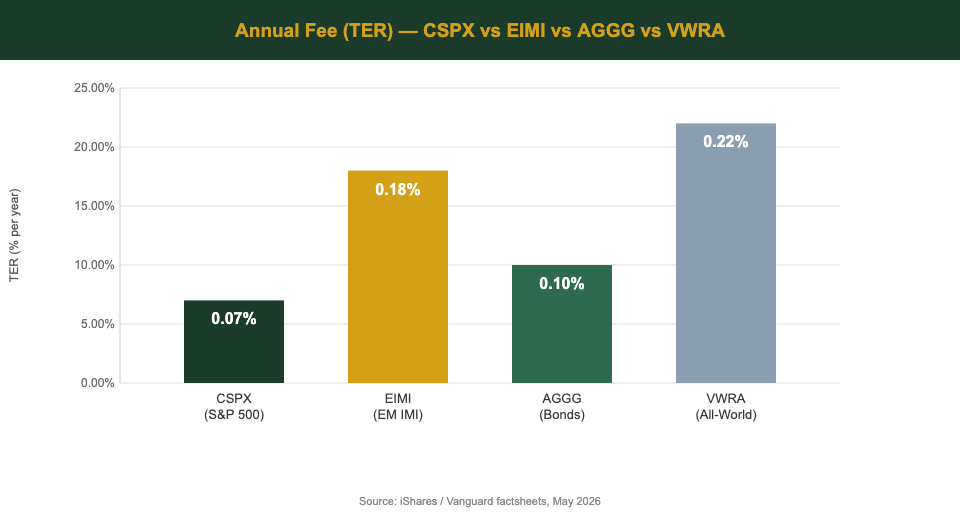
CSPX (TER 0.07% p.a.) is one of the cheapest and most liquid ETFs in the world. With AUM exceeding USD 131 billion and 503 holdings, it tracks the S&P 500 — the 500 largest US companies by market cap. CSPX is accumulating, meaning dividends are automatically reinvested. This is tax-efficient for Singapore investors because no dividend lands in your account to manage. It trades in USD on the LSE.
EIMI (TER 0.18% p.a.) provides exposure to 2,956 companies across 24 emerging market countries including China, India, Taiwan, South Korea and Brazil. It tracks the MSCI Emerging Markets Investable Market Index — capturing large, mid and small-cap companies. AUM is approximately USD 47 billion. Holding EIMI alongside CSPX means your portfolio participates in both established US growth and faster-growing emerging economies.
AGGG (TER 0.10% p.a.) tracks the Bloomberg Global Aggregate Bond Index, covering 10,000+ investment-grade bonds from global governments and corporations. Bonds tend to move inversely to equities during market stress — providing cushioning when stock markets fall. For a beginner investor who might panic-sell during a downturn, holding 15–30% in AGGG can reduce portfolio volatility enough to stay the course. Note: AGGG is distributing (pays out coupons), while CSPX and EIMI are accumulating. Singapore investors pay no tax on these distributions.
If you prefer to add Singapore property exposure, our Singapore REIT ETF guide covers how to complement the 3-ETF core with local real estate investment.
How to Build Your 3-ETF Portfolio in Singapore (Step-by-Step)
Step 1: Choose Your Allocation
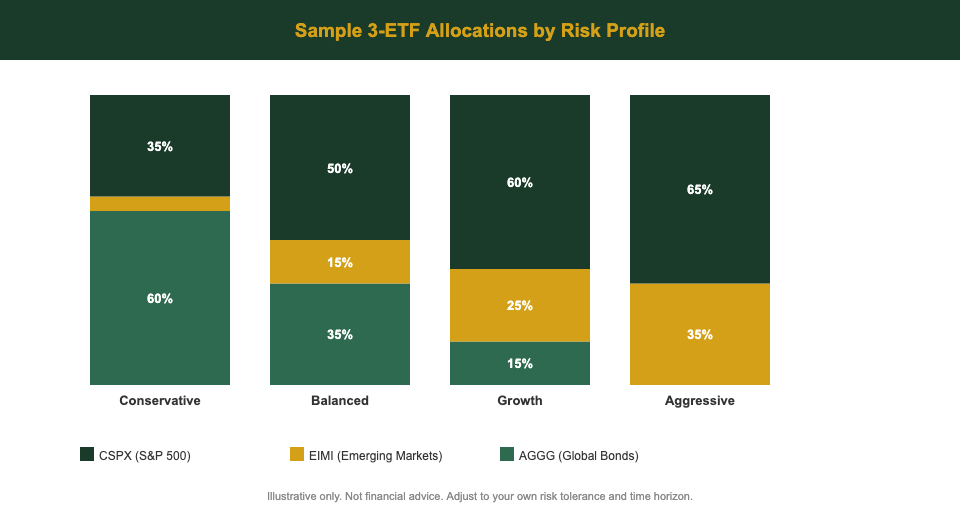
Before picking a broker, decide how to split your money across the three ETFs. Your allocation should reflect your risk tolerance and time horizon — the longer your runway, the more equity (CSPX + EIMI) you can hold.
| Risk Profile | CSPX | EIMI | AGGG | Best For |
|---|---|---|---|---|
| Conservative | 35% | 5% | 60% | Near-retirees, very low risk tolerance |
| Balanced | 50% | 15% | 35% | Mid-career investors, 10–15 year horizon |
| Growth | 60% | 25% | 15% | 30s–40s investors, 15–25 year horizon |
| Aggressive | 65% | 35% | 0% | 20s–30s, 25+ year horizon, high risk tolerance |
Illustrative only. Not financial advice. Review your own financial situation before investing.
Step 2: Open a Brokerage Account
To buy CSPX, EIMI and AGGG on the LSE, you need a broker with London Stock Exchange access. Singapore investors have four main options:
- Interactive Brokers (IBKR) — Best for cost-conscious investors with portfolios above SGD 20,000. Commissions from USD 1.70 per trade (fixed plan) or USD 0.35+ (tiered plan). FX conversion costs approximately 0.002% spread. Use referral code
jianxiong368at sign-up. - Saxo Markets — Clean interface, slightly higher fees than IBKR but easier to navigate for beginners. Minimum funding SGD 3,000.
- moomoo Singapore — App-based and beginner-friendly. See our moomoo Singapore review for current promotions and fee details.
- FSMOne — Best for Regular Savings Plans (RSP). 0.35% commission (min SGD 8.80) per trade. RSP from SGD 50/month per fund. Use FSMOne referral code P0544985 at sign-up.
Step 3: Fund Your Account and Place Orders
On IBKR or Saxo, fund in SGD and convert to USD. Then search for the ticker — CSPX, EIMI, or AGGG — and select the LSE exchange. Place a limit order at or near the current ask price. For most Singapore investors in the accumulation phase, buying monthly via dollar-cost averaging (DCA) smooths out the entry price over time.
For a Growth allocation (60/25/15) at SGD 1,000/month:
- CSPX: SGD 600/month
- EIMI: SGD 250/month
- AGGG: SGD 150/month
At IBKR’s fixed plan rate of USD 1.70 per trade (~SGD 2.30), buying three ETFs monthly costs around SGD 6.90 in commissions — less than 0.7% of the monthly investment. As the portfolio grows, this percentage falls significantly.
Consider channelling SRS contributions (up to SGD 15,300 per year for citizens and PRs) through a platform that supports SRS for ETF purchases. Our CPF investment strategy guide covers how CPF-OA funds can complement your ETF portfolio for a complete retirement plan.
Step 4: Rebalance Annually
Each year, check whether your actual allocations have drifted from target. If CSPX has outperformed and now represents 70% of a portfolio targeting 60%, sell some CSPX and buy EIMI or AGGG to restore the balance. Alternatively, direct new contributions to underweight funds to avoid triggering rebalancing events. Since Singapore has no capital gains tax, this rebalancing is clean and straightforward.
If you would rather have a robo-advisor handle rebalancing automatically, Syfe offers managed portfolio options that invest in similar global ETFs. Use Syfe referral code SRPRFFFCD for up to three months fee-free. For CPF and SRS integration, Endowus referral code 2V343 gives access to low-cost institutional funds with SGD 20 cashback for new accounts.
Data verified as at October 2026. All numbers in this article have been cross-checked against iShares factsheets and publicly available sources. This article is for educational purposes only and does not constitute financial advice. Past performance does not guarantee future results.
Frequently Asked Questions
How do I start investing in Singapore with just SGD 500?
You can start with as little as SGD 500 through a broker with LSE access. Open an account with IBKR, Saxo or moomoo, fund it in SGD, convert to USD, and buy CSPX. With a single monthly contribution to CSPX, you get exposure to 503 of the world’s largest companies at a TER of just 0.07%. Add EIMI and AGGG as your portfolio grows above SGD 3,000–5,000. FSMOne’s Regular Savings Plan lets you automate from just SGD 50/month per fund, making it accessible for very early-stage investors.
Is the 3-ETF portfolio suitable for a Singapore beginner?
Yes — it is arguably the best starting point for most Singapore beginners. The three funds (CSPX, EIMI, AGGG) provide global equity exposure, emerging market growth, and bond stability in one manageable portfolio. No active stock-picking is required. The annual TER ranges from 0.07% to 0.18%, far lower than actively managed funds (typically 1.0–1.75%). The main requirement is discipline: stick to your allocation, buy regularly, and rebalance annually. The biggest risk is not the strategy itself but abandoning it during market downturns.
Can I buy CSPX, EIMI and AGGG using my CPF or SRS funds?
CSPX, EIMI and AGGG are not directly eligible for CPF Investment Scheme (CPFIS) purchases as they are listed on the London Stock Exchange, not the SGX. However, you can invest SRS funds through brokers like IBKR or Saxo that support SRS accounts for LSE-listed ETFs. SRS contributions of up to SGD 15,300 per year (citizens and PRs) provide a tax deduction of up to SGD 3,366 for the highest tax bracket. See our CPF investment strategy guide for how to layer CPF, SRS and brokerage accounts effectively.
What is the difference between CSPX and VWRA for Singapore investors?
CSPX tracks only the S&P 500 (US large-cap), while VWRA (Vanguard FTSE All-World UCITS ETF, TER 0.22%) covers approximately 3,700 companies across developed and emerging markets in a single fund. VWRA is the simpler one-fund option for investors who want global diversification without managing separate ETFs. CSPX (TER 0.07%) is cheaper but US-only. The 3-ETF approach using CSPX + EIMI achieves global coverage at a lower blended TER than VWRA alone, while allowing independent control over emerging market weighting. Neither is wrong — VWRA wins on simplicity; the 3-ETF approach offers potential cost savings and flexibility.
How often should I rebalance my 3-ETF portfolio?
For most Singapore investors, annual rebalancing is sufficient. Check once a year whether any ETF has drifted more than 5 percentage points from your target allocation. If so, either sell the overweight ETF and buy the underweight one, or direct new contributions to the underweight position. Since Singapore has no capital gains tax, selling to rebalance creates no tax event. Avoid over-rebalancing (monthly or quarterly) — transaction costs from commissions and FX conversion will erode returns. Aim for low turnover and long holding periods.
Why choose LSE-listed ETFs over buying VOO or SPY directly?
Two key reasons for Singapore investors. First, US-domiciled ETFs like VOO and SPY attract 30% withholding tax on dividends (deducted at source), while Ireland-domiciled ETFs like CSPX are subject to only 15% under the US-Ireland tax treaty. On a SGD 100,000 portfolio with a 1.5% dividend yield, this saves approximately SGD 225 per year — indefinitely. Second, US-domiciled assets above USD 60,000 are subject to US estate tax for non-US residents — rates that can reach 40%. Ireland-domiciled ETFs fall entirely outside this estate tax net. These two advantages compound significantly over a 20–30 year investment horizon.
Start Building Your 3-ETF Portfolio Today
Ready to take action? These platforms let you invest with competitive fees and welcome bonuses:
- Syfe — managed ETF portfolios with automatic rebalancing. Syfe referral code SRPRFFFCD — up to 3 months fee-free.
- Endowus — CPF and SRS investing in institutional funds. Endowus referral code 2V343 — SGD 20 cashback on first investment.
- FSMOne — Regular Savings Plan from SGD 50/month. FSMOne referral code P0544985.
The Kopi Notes may earn referral fees when you sign up through these links. This does not affect your fees. All content is for educational purposes only and does not constitute financial advice.
This article was researched with the help of AI. While we strive to keep all information accurate and up to date, there may be errors. If you notice any discrepancies, please contact us.