Fixed Deposit Interest Rate Singapore 2026: How Rates Work & Which Banks Pay Most
Your definitive guide to fixed deposit interest rates in Singapore — October 2026 rates compared across 10 banks.
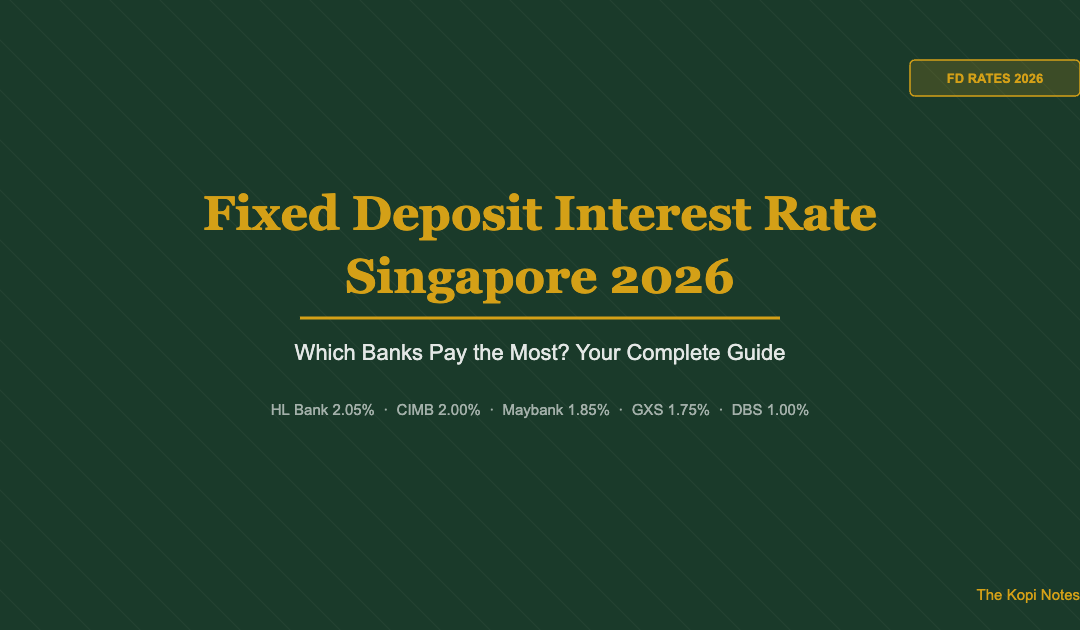
Fixed deposit interest rates in Singapore currently range from 1.00% to 2.05% p.a., depending on the bank, tenure, and minimum deposit amount. The top rate in October 2026 comes from HL Bank at 2.05% p.a. for 6- or 12-month placements with a minimum of S$10,000. Digital banks like GXS offer competitive rates of 1.75% p.a. with deposits from just S$100 — making fixed deposits accessible to most Singaporeans regardless of savings size.
Not financial advice. All figures are for educational reference only. Data verified as at 15 October 2026. Fixed deposit rates change frequently — always confirm current rates directly with your bank before placing a deposit.
What Is a Fixed Deposit Interest Rate?
A fixed deposit (FD) interest rate is the guaranteed annual return a bank pays you for locking in your money for a predetermined period. Unlike a regular savings account — where the bank can change your interest rate at any time — a fixed deposit rate is locked in for the full tenure. When you place S$10,000 in a 12-month fixed deposit at 2.00% p.a., you are guaranteed to receive exactly S$200 in interest at maturity, regardless of what happens to market interest rates during that period.
Fixed deposits in Singapore are offered in tenures ranging from 1 month to 24 months. The “sweet spot” for most Singapore banks is the 6-month or 12-month fixed deposit, which typically offers the highest promotional rates. Shorter tenures (1–3 months) often attract lower rates as they require less capital commitment from depositors.
Key Terms Every Fixed Deposit Holder Should Know
Principal — The amount you deposit. Tenure — The lock-up period, typically 1–24 months. Interest rate p.a. — The annual percentage the bank agrees to pay. Maturity — The date your term ends and funds are returned with interest. Rollover — Automatic renewal at maturity; some banks roll over at the board rate (lower than the promotional rate), so always check what rate applies on renewal.
How Fixed Deposit Rates Are Set in Singapore
Singapore fixed deposit rates are influenced primarily by the Singapore Overnight Rate Average (SORA) and broader global interest rate conditions, especially U.S. Federal Reserve policy. When central banks tighten monetary policy, Singapore FD rates tend to rise; when rate-cutting cycles begin, FD rates fall — which is broadly the trend seen from the 2023 highs through 2025 and into 2026. Banks also run promotional FD rates to attract fresh funds from new or existing customers, and these promotions often have conditions: new-to-bank customers only, or fresh funds not transferred from existing accounts with the same institution.
How Is Fixed Deposit Interest Calculated?
Fixed deposit interest in Singapore is calculated using simple interest — not compound interest. The formula is:
Worked Examples (October 2026 Rates)
Example 1 — S$10,000 at HL Bank (2.05%, 12 months):
Interest = S$10,000 × 0.0205 × (365 ÷ 365) = S$205.00
Example 2 — S$50,000 at CIMB (2.00%, 12 months):
Interest = S$50,000 × 0.0200 × 1.0 = S$1,000.00
Example 3 — S$20,000 at Maybank (1.85%, 6 months, 183 days):
Interest = S$20,000 × 0.0185 × (183 ÷ 365) = S$185.59
Example 4 — S$100 at GXS Bank (1.75%, 12 months):
Interest = S$100 × 0.0175 × 1.0 = S$1.75
Note that a 6-month fixed deposit uses approximately 182–184 calendar days — not exactly 180 — which is why example 3 uses 183 days. The exact figure depends on the specific start and end dates of your placement.
Is Fixed Deposit Interest Taxable in Singapore?
Singapore residents (citizens and permanent residents) are not subject to income tax on bank interest from fixed deposits with Singapore-licensed banks. Your full interest earnings are yours to keep without any tax deduction. This tax-free treatment is one of the key reasons fixed deposits remain a popular savings vehicle for Singapore residents. (Different rules may apply to offshore deposits or non-residents.)
Best Fixed Deposit Rates in Singapore (October 2026)
The table below ranks Singapore banks by their best available fixed deposit rate as at October 2026, together with the minimum deposit and tenure required to achieve each rate. Rates shown are the best promotional rates available and may require fresh funds or qualifying conditions.
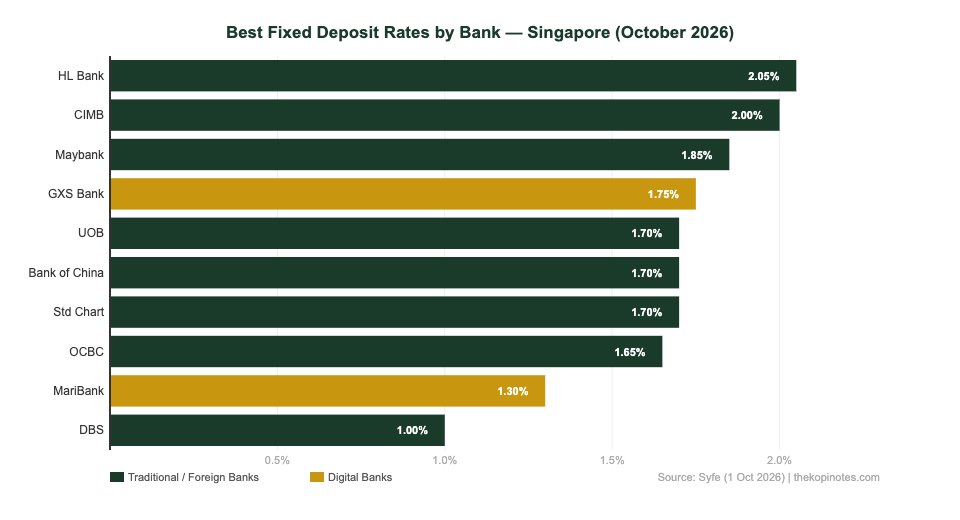
| Bank | Best Rate (p.a.) | Tenure | Min. Deposit | Type |
|---|---|---|---|---|
| HL Bank | 2.05% | 6M / 12M | S$10,000 | Foreign Bank |
| CIMB | 2.00% | 12M | S$10,000 | Foreign Bank |
| Maybank | 1.85% | 6M / 12M | S$20,000 | Foreign Bank |
| GXS Bank | 1.75% | 12M | S$100 | Digital Bank |
| Bank of China | 1.70% | 6M / 12M | S$500 | Foreign Bank |
| Standard Chartered | 1.70–1.95% | 6M | S$25,000 | Foreign Bank |
| UOB | 1.70% | 12M | S$10,000 | Local Bank |
| OCBC | 1.65% | 12M | S$20,000 | Local Bank |
| MariBank | 1.30% | 12M | S$100 | Digital Bank |
| DBS | 1.00% | 12M | S$1,000 | Local Bank |
Source: Syfe Singapore FD Rates (as at 1 October 2026). Rates shown are best promotional rates; conditions may apply. Verify current rates directly with your bank before placing a deposit.
Key takeaway: A Singapore investor placing S$10,000 in HL Bank’s 12-month fixed deposit earns S$205 at maturity — more than double the S$100 earned at DBS with the same principal. The 105-basis-point spread between the highest and lowest rate makes bank selection the single most impactful variable in your FD return.
Digital Banks vs Traditional Banks for Fixed Deposits
Singapore’s digital banks — GXS (backed by Grab and Singtel) and MariBank (backed by Sea Limited) — entered the market partly to challenge traditional banks on deposit rates and accessibility. Their FD offerings have some distinctive features worth understanding.
| Factor | Digital Banks (GXS, MariBank) | Traditional Banks (DBS, OCBC, UOB) |
|---|---|---|
| Minimum deposit | From S$100 | S$1,000–S$20,000 |
| Best 12M rate | 1.30%–1.75% | 1.00%–1.70% |
| Application channel | 100% mobile app | App, internet banking, or branch |
| SDIC protection | Yes, up to S$100,000 | Yes, up to S$100,000 |
| Branch support | No physical branches | Full branch network |
| Early withdrawal | Generally not permitted | Permitted with interest penalty |
Source: TKN research, October 2026. SDIC = Singapore Deposit Insurance Corporation.
The headline advantage of digital banks is the low minimum deposit — starting from just S$100, GXS and MariBank let smaller savers access fixed deposits that would fall below the minimum threshold at most traditional banks. Critically, both GXS and MariBank are MAS-licensed and SDIC-insured for up to S$100,000 per depositor — the same protection as DBS, OCBC, and UOB. There is no meaningful safety difference for deposits under S$100,000.
To open a GXS Bank account, use referral code YONG477. For MariBank, use referral code 2DCT80WQ. These codes may unlock sign-up bonuses for new customers. If you’re looking for a robo-advisor to pair with your FD strategy, explore the Syfe referral code and sign-up bonus (code: SRPRFFFCD) or the Endowus referral code (code: 2V343) for investing idle cash beyond your FD allocation.
5 Ways to Get the Best Fixed Deposit Interest Rate in Singapore
Picking the bank at the top of any rate table is a start — but these five strategies help Singapore savers consistently maximise their FD returns across placements.
1. Use fresh funds. Most promotional FD rates apply only to “fresh funds” — money that is new to the bank and not transferred from an existing account at the same institution. Moving funds from your DBS savings account into a DBS fixed deposit will likely earn only the standard board rate, not the promotional rate. Moving the same funds to CIMB qualifies as fresh funds at CIMB, unlocking the promotional rate.
2. Ladder your fixed deposits. Rather than placing all savings into one long-term FD, ladder them across multiple tenures — for example, allocating one-third each into 3-month, 6-month, and 12-month FDs. As each tranche matures, you reinvest at the prevailing rate. This strategy balances liquidity with access to higher longer-tenor promotional rates. Our Singapore retirement calculator can help you model how FD laddering affects your long-term savings goals.
3. Look beyond the major local banks. Singapore savers often default to DBS, OCBC, or UOB by familiarity. However, foreign banks like HL Bank and CIMB routinely offer rates 40–100 basis points higher than the Big Three for equivalent tenures. All are MAS-licensed and SDIC-protected — there is minimal risk difference for deposits under S$100,000.
4. Negotiate for large placements. For deposits above S$50,000–S$100,000, it is worth calling your preferred bank’s priority banking team to negotiate a better rate directly. Banks often have “special rates” for larger deposits or wealth management clients that are not publicly advertised — the 1.70–1.95% range at Standard Chartered reflects this tiered pricing structure.
5. Never let your FD auto-rollover at the board rate. When a fixed deposit matures, many banks automatically roll it over at the prevailing board rate — which is typically lower than the promotional rate you originally secured. Set a calendar reminder one week before your FD matures to actively compare rates and renew with the best-paying institution at that time. For broader context on passive income strategies in Singapore, see TKN’s comprehensive guide.
Fixed Deposits vs Other Cash Management Options (October 2026)
Fixed deposits do not exist in isolation. Singapore savers have several cash management options, each with different yield profiles, liquidity, and risk. The chart below compares the key alternatives available in October 2026.
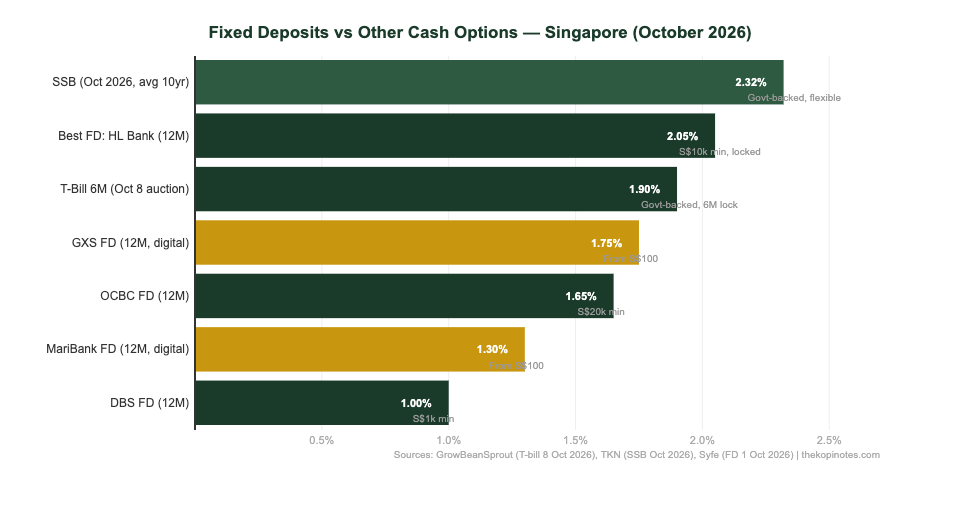
| Product | Current Rate (p.a.) | Min. Amount | Liquidity | Backing |
|---|---|---|---|---|
| SSB October 2026 Issue | 2.32% avg (10yr) | S$500 | High (redeem any month) | MAS / Govt |
| Best FD: HL Bank (12M) | 2.05% | S$10,000 | Low (locked) | SDIC (up to $100k) |
| T-Bill 6M (8 Oct auction) | 1.90% | S$1,000 | Low (held to maturity) | MAS / Govt |
| GXS FD (12M) | 1.75% | S$100 | Low (locked) | SDIC (up to $100k) |
| MariBank FD (12M) | 1.30% | S$100 | Low (locked) | SDIC (up to $100k) |
| DBS FD (12M) | 1.00% | S$1,000 | Low (locked) | SDIC (up to $100k) |
Sources: GrowBeanSprout (T-bill, 8 Oct 2026 auction); TKN SSB October 2026 article; Syfe FD data (1 Oct 2026).
The Singapore Savings Bond (SSB) advantage: The October 2026 SSB issue offers a 10-year average return of 2.32% p.a. — higher than the best FD rate (2.05% at HL Bank). More importantly, SSBs can be redeemed at any month-end with full principal and all accrued interest returned, making them the most flexible of the government-backed options. If you have a 12-month or longer horizon and value both yield and flexibility, the SSB is often the superior choice. TKN’s Singapore Savings Bonds guide covers the full application and redemption process.
The fixed deposit advantage: Despite the SSB’s higher average yield, FDs have practical advantages. SSB applications follow a monthly schedule with a closing deadline, and popular issues can be oversubscribed. Fixed deposits can be placed immediately, any day, with certainty of the full amount. For investors who need predictable cash flows at a precise future date, fixed deposits remain a compelling option. Read TKN’s Singapore T-bills 2026 guide for a complete T-bill vs FD breakdown.
Plan Your Fixed Deposit Strategy
Use TKN’s retirement planning calculator to see how different FD rates compound over your savings timeline — and decide whether fixed deposits, SSBs, T-bills, or a mix is right for your goals.
Frequently Asked Questions
Common questions about fixed deposit interest rates in Singapore.
What is the highest fixed deposit interest rate in Singapore right now?
As at October 2026, the highest fixed deposit rate in Singapore is 2.05% p.a. from HL Bank (Hong Leong Bank), available for both 6-month and 12-month tenures with a minimum deposit of S$10,000. CIMB follows at 2.00% p.a. for 12 months (S$10,000 minimum). Rates change frequently — verify the current rate on the bank’s official website before placing your deposit.
How often do fixed deposit rates change in Singapore?
Promotional fixed deposit rates can change as frequently as weekly or monthly, depending on market conditions and each bank’s funding needs. Board rates are more stable but are typically lower than the promotional rates advertised on comparison sites. As a rule of thumb, assume any rate table you see online may be 1–4 weeks old and verify the rate directly with the bank on the day you place your deposit.
Is my fixed deposit safe if the bank fails?
Yes. Fixed deposits with all Singapore-licensed banks — local banks (DBS, OCBC, UOB), foreign banks (HL Bank, CIMB, Maybank, Bank of China, Standard Chartered), and digital banks (GXS, MariBank) — are insured by the Singapore Deposit Insurance Corporation (SDIC) for up to S$100,000 per depositor per institution. If you have more than S$100,000 to deposit, spread it across multiple banks to maximise SDIC coverage on each tranche.
Should I choose a 6-month or 12-month fixed deposit?
In October 2026, several banks (HL Bank and Maybank) offer identical promotional rates for both 6-month and 12-month tenures, while others (CIMB, UOB) favour the 12-month tenure with a higher rate. Where rates are equal, the 6-month tenure is preferable because it gives you more flexibility to reinvest at potentially better rates in 6 months. If the 12-month rate is 20+ basis points higher, the longer commitment may be worth it.
Can I withdraw a fixed deposit early in Singapore?
Most Singapore banks allow early withdrawal from fixed deposits, but with a penalty — typically forfeiture of all interest earned, or a reduction to the standard board rate for the period held. Digital banks GXS and MariBank generally do not permit early withdrawal at all. If you think you may need access to your funds before maturity, consider keeping a portion in a high-yield savings account or a Singapore Savings Bond (SSB) instead, as SSBs can be redeemed at any month-end without penalty.
How does a fixed deposit compare to the Singapore Savings Bond?
The Singapore Savings Bond (SSB) October 2026 issue offers a 10-year average return of 2.32% p.a. — higher than the best FD rate of 2.05% (HL Bank). The SSB’s key advantage is full liquidity: you can redeem it at any month-end with your full principal and all interest earned. Fixed deposits can be placed instantly at any time — SSB applications follow a monthly schedule with limited window. For amounts under S$100,000 on a horizon of 12 months or more, the SSB often wins on both yield and flexibility. Read TKN’s full SSB guide for more detail.
Are digital bank fixed deposits safer than traditional banks?
Both GXS Bank and MariBank hold full digital banking licences from the Monetary Authority of Singapore (MAS) and are SDIC members. Deposits of up to S$100,000 are covered by the same government-backed deposit insurance as DBS or OCBC. For deposits under the S$100,000 threshold, there is no material safety difference between placing your money in a digital bank vs. a traditional bank. The practical difference is that digital banks have no physical branches — all service is via their mobile apps.
This article was researched with the help of AI. While we strive to keep all information accurate and up to date, there may be errors. If you notice any discrepancies, please contact us.