Key Person Insurance Singapore 2026: How Term Life Protects Your Business
Key person insurance in Singapore is a term life policy taken out by a business on a director, partner, or critical employee whose death or permanent disability would cause serious financial loss. The company pays the premiums and receives the payout — typically 5–10x the key person's annual salary — to cover lost revenue, outstanding business loans, and recruitment costs while the business recovers.
Not financial advice. All figures are for educational reference only. Consult a licensed financial adviser and tax professional before making insurance decisions. Data verified as at October 2026.
What Is Key Person Insurance?
Key person insurance (also called keyman insurance) is a life insurance policy where a company insures the life of an individual whose skills, knowledge, or relationships are critical to the business's ongoing viability and revenue generation.
Unlike personal term life insurance for your family, key person insurance pays the company. The business uses the payout to:
- Cover lost revenue and profits during the leadership transition
- Fund the search, hiring, and onboarding of a qualified replacement
- Repay outstanding business loans or bank credit lines
- Maintain confidence with clients, suppliers, and investors
- Fund a buy-sell agreement if the key person was a business partner or shareholder
Who qualifies as a “key person”? Any individual whose loss would directly and materially affect the company's financial performance — most commonly:
- Founding directors or managing directors
- Revenue-generating sales directors or top performers
- Technical specialists with irreplaceable expertise (e.g., lead engineers, key medical professionals)
- Business partners in a partnership or LLP
- Senior executives holding critical client relationships or proprietary knowledge
Why Singapore SME Owners Need Key Person Insurance
Singapore SMEs make up over 99% of all enterprises and employ approximately 70% of the workforce, according to the Enterprise Singapore website. Yet many SMEs — especially founder-led businesses — are highly dependent on one or two individuals for revenue, relationships, and day-to-day decision-making.
Consider a practical example: a 30-person engineering consultancy in Jurong generates SGD 2.8 million in annual revenue, with roughly 60% attributable to the Managing Director's technical expertise and client relationships. If the MD were to pass away unexpectedly, the business could lose its most valuable contracts before a successor is even identified — creating a financial crisis that threatens the livelihoods of all 30 employees.
Key person insurance provides the business with financial runway to survive and recover from exactly this kind of shock.
Bank loan covenants: Many Singapore banks and financial institutions require key person insurance as a condition for SME business loans above a certain threshold. If your company has an outstanding commercial loan, check your loan agreement — a keyman policy on the business owner may already be contractually required.
For business owners who also want to build long-term wealth outside the business, reviewing your CPF investment strategy is another important pillar of financial protection alongside insurance.
How Key Person Insurance Works in Singapore
The mechanics are straightforward. The company is the policyholder, premium payer, and beneficiary. The key person is the life insured.
- Application: The company applies for a term life policy on the key person. The key person undergoes medical underwriting — health declaration, and a medical examination if the coverage amount is above the insurer's non-medical limit.
- Policy issued: The insurer issues the policy with the company as owner and beneficiary. Policy terms typically range from 5 to 20 years, aligned with the business's critical growth phase or loan tenure.
- Premiums paid: The company pays premiums from business funds. Premium amounts depend on the key person's age, health status, coverage amount, and policy term.
- Claim trigger: If the key person dies or is totally and permanently disabled (if a TPD rider is added) during the policy term, the insurer pays the sum assured directly to the company.
- Business deploys payout: The company uses the funds at its discretion — to repay loans, fund recruitment, sustain operations, or execute a shareholder buyout agreement.
Most Singapore life insurers — including AIA, Prudential, Great Eastern, Income Insurance, Manulife, and FWD — offer term life policies that can be structured as key person policies. The policy is a standard term life contract; what makes it a “key person” policy is the ownership and beneficiary arrangement.
How Much Coverage Do You Need?
There is no universal formula, but financial advisers in Singapore commonly use three methods:
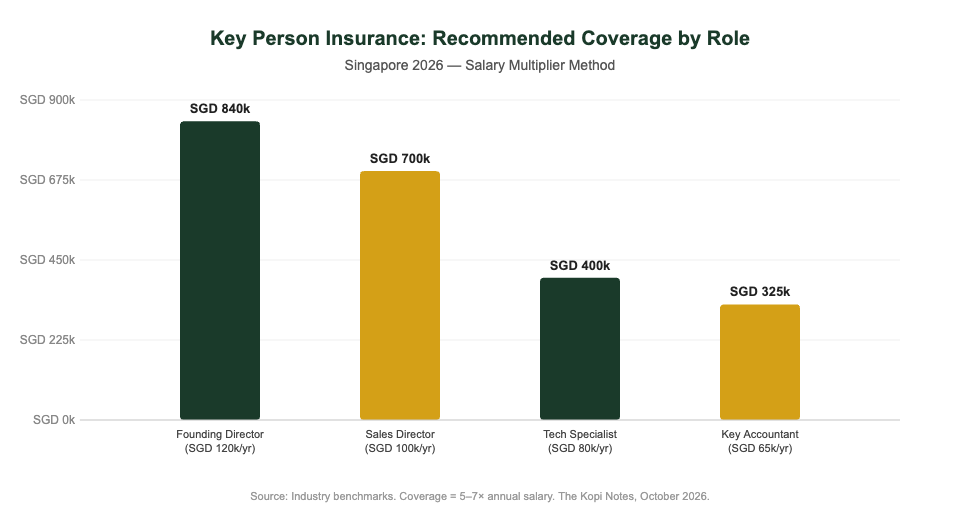
1. Salary Multiplier Method
Multiply the key person's annual total compensation (salary + bonus + employer CPF contributions) by a factor of 5–10, depending on their criticality to the business. A founding director with 80% revenue attribution warrants 8–10x; a specialist accountant might need only 5x.
2. Revenue Contribution Method
Estimate the key person's direct contribution to annual revenue, then multiply by the estimated years to replace their contribution (typically 2–3 years). A sales director generating SGD 400,000 per year in revenue = SGD 800,000 to SGD 1.2 million in coverage.
3. Loan Coverage Method
If the key person has personally guaranteed business loans or if the business has substantial outstanding credit, coverage should be at minimum equal to the outstanding loan balance — ensuring the company can repay lenders without calling on the key person's personal estate.
In practice, many businesses use a combination of all three methods and take the highest resulting figure as their coverage benchmark.
| Key Person Role | Annual Salary (SGD) | Multiplier | Recommended Coverage |
|---|---|---|---|
| Founding Director | SGD 120,000 | 7x | SGD 840,000 |
| Sales Director | SGD 100,000 | 7x | SGD 700,000 |
| Technical Specialist | SGD 80,000 | 5x | SGD 400,000 |
| Senior Accountant / CFO | SGD 65,000 | 5x | SGD 325,000 |
Source: Industry benchmark guidelines. Coverage amounts are illustrative examples only. The Kopi Notes, October 2026.
Tax Treatment of Key Person Insurance in Singapore
The tax treatment of key person insurance premiums and payouts in Singapore depends on the nature of the loss the policy is designed to compensate. The Inland Revenue Authority of Singapore (IRAS) assesses each policy on its specific facts.
Premiums: Are They Tax-Deductible?
Revenue nature: If the key person insurance policy is taken out to protect against loss of profits (i.e., the payout is meant to replace revenue lost during the period of finding a replacement), the premiums are generally deductible as a business expense under Section 14 of the Income Tax Act.
Capital nature: If the policy is designed to compensate for the loss of a capital asset (e.g., goodwill, shareholder value), the premiums are NOT deductible — they are treated as a capital outlay.
Payout: Is It Taxable?
The tax treatment of the payout mirrors the treatment of the premiums:
- If premiums were deductible (revenue nature) → the payout is likely taxable as business income
- If premiums were non-deductible (capital nature) → the payout is likely not taxable (capital receipt)
Important: IRAS's position must be assessed on a case-by-case basis. Engaging a qualified corporate tax adviser before purchasing a key person policy is strongly recommended to ensure the correct tax treatment is applied from the outset.
Key Person Insurance vs Personal Term Life Insurance
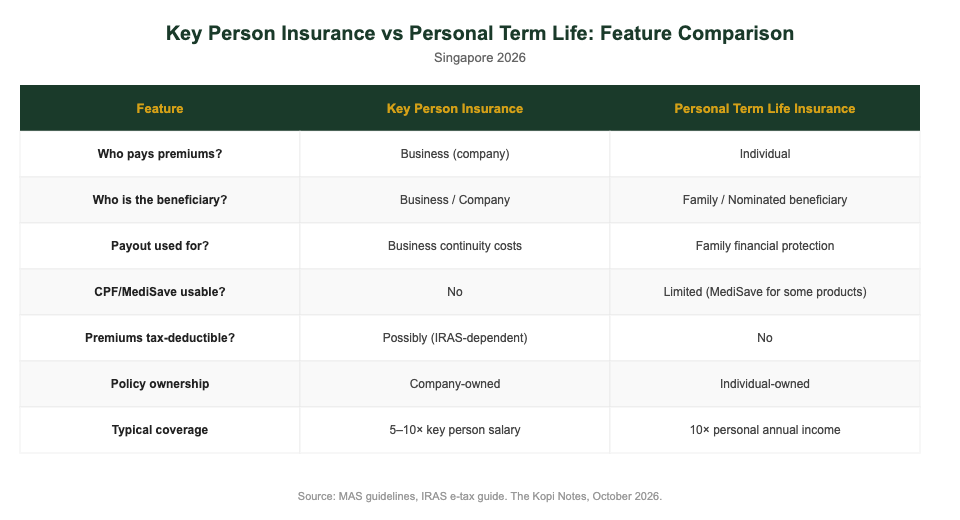
It's important not to confuse key person insurance with a director's personal life insurance protection. They serve completely different purposes and are structured differently.
| Feature | Key Person Insurance | Personal Term Life |
|---|---|---|
| Who pays premiums? | Business (company) | Individual |
| Who receives the payout? | Business / Company | Nominated family beneficiary |
| Payout purpose | Business continuity | Family financial protection |
| CPF / MediSave usable? | No | Limited (MediSave for selected plans) |
| Premiums tax-deductible? | Possibly (IRAS-dependent) | No |
| Typical coverage range | 5–10x key person salary | 10x personal annual income |
Source: MAS insurance guidelines, IRAS e-tax guide. The Kopi Notes, October 2026.
Business owners should ideally have both: key person insurance at the business level, and personal term life insurance at the individual level. These two policies protect entirely different stakeholders — the business and your family.
Use our Singapore retirement planning calculator to see how your insurance protection fits into your broader long-term financial picture.
Buy-Sell Agreement Funding with Key Person Insurance
One of the most important — and underutilised — applications of key person insurance in Singapore is funding a buy-sell agreement between business partners.
A buy-sell agreement is a legally binding contract between business co-owners that specifies what happens to a deceased or disabled owner's share of the business. Without one, a deceased partner's shares typically pass to their heirs, potentially leaving the surviving partner(s) in business with a stranger — or forcing a fire-sale of the entire company.
How It Works
Each business partner takes out a life insurance policy on the other partner(s). If Partner A dies:
- The insurance policy on Partner A's life pays out to Partner B (or the company, depending on structure)
- Partner B uses the payout to purchase Partner A's shares at a pre-agreed valuation
- Partner A's family receives a fair cash payment for the shares
- Partner B becomes the sole (or majority) owner and can continue operating the business
Two common structures:
- Cross-purchase agreement: Each partner owns a policy on every other partner's life. Best for 2–3 partners.
- Entity-purchase (company) agreement: The company owns a policy on each partner and buys back the shares. More practical for 4+ partners.
For business owners building both business protection and personal wealth, combining key person insurance with passive income investments in Singapore can provide a more balanced financial safety net beyond the business itself.
Where to Get Key Person Insurance in Singapore
Key person insurance is available through any major life insurer in Singapore. You will need to work with a licensed financial adviser or insurance agent who can assess your specific needs and structure the policy correctly.
When comparing options, consider:
- Premium affordability: Premiums vary by the key person's age, health, and coverage amount
- Policy flexibility: Can premiums and coverage be adjusted as the business grows?
- Riders available: TPD rider, waiver of premium, and accelerated terminal illness benefit
- Insurer financial strength: Check ratings and MAS licensing at the MAS Financial Institutions Directory
Business owners should also ensure personal protection is robust. Building a Singapore S-REIT portfolio or using platforms like Endowus (referral code: 2V343) for CPF and SRS investments can provide passive income that reduces personal dependence on business revenue.
Frequently Asked Questions
Is key person insurance mandatory in Singapore?
Key person insurance is not legally mandated by MAS or any Singapore regulation. However, some banks and financial institutions require it as a condition of granting commercial loans to SMEs. Always review your loan agreement for any insurance covenant clauses before taking out business financing.
Can a sole proprietor take out key person insurance on themselves?
A sole proprietor cannot take out key person insurance on themselves in the traditional sense, since the business and the owner are legally the same entity. However, a sole proprietor can take out a personal term life insurance policy and name their business creditors or estate as beneficiaries. Alternatively, restructuring as a private limited company (Pte Ltd) allows the company to hold a proper key person policy on the director.
What happens to the policy if the insured employee leaves the company?
If a key employee leaves the company, the business (as policyholder) has several options: (1) surrender the policy and receive any remaining cash value (term life typically has no surrender value), (2) transfer ownership of the policy to the departing employee as part of a severance arrangement, or (3) reassign the policy to a new key person if the insurer permits. Review your policy terms or speak to your insurer when a key person situation changes.
How long does a key person insurance claim take in Singapore?
Most Singapore life insurers process straightforward death claims within 14 to 30 business days from receipt of all required documentation, including the death certificate, policy documents, and a completed claim form. Complex cases — such as those involving inquest proceedings or disputed cause of death — may take longer. A TPD claim may involve additional medical assessment, which can extend the timeline.
Are key person insurance premiums tax-deductible in Singapore?
Whether key person insurance premiums are deductible depends on IRAS's assessment of the policy's nature. Premiums for policies taken out to protect against loss of revenue (e.g., lost profits while finding a replacement) are generally deductible under Section 14 of the Income Tax Act. Premiums for policies covering capital loss (e.g., loss of goodwill or shareholder value) are typically not deductible. Since the tax treatment also affects whether the payout itself is taxable, it is critical to get written tax advice specific to your policy structure before purchasing.
What is the difference between key person insurance and a personal life insurance policy?
Key person insurance protects the business — the company owns the policy, pays the premiums, and receives the payout to fund business continuity. A personal life insurance policy protects the individual's family — the individual owns the policy, pays premiums personally, and nominates family members as beneficiaries. Business owners typically need both: one policy to protect the business (key person insurance) and one to protect their family (personal term life insurance).
Get Free Insurance Advice
Speak with a licensed insurance advisor. No obligation, no cost.
By submitting this form, you agree to our Privacy Policy.
This article was researched with the help of AI. While we strive to keep all information accurate and up to date, there may be errors. If you notice any discrepancies, please contact us.