New ISP Rider 2026: Is the 30% Premium Saving Worth the Higher Co-Payment Risk?
MOH’s new rider rules took effect 1 April 2026 — here’s how to calculate whether switching actually saves you money.
From 1 April 2026, new Integrated Shield Plan (ISP) riders in Singapore cannot cover the minimum deductible set by MOH, and the annual co-payment cap rose from $3,000 to at least $6,000. The trade-off: new compliant riders average 30% cheaper in premiums — roughly $600/year savings for private hospital policyholders. Whether that saving justifies the higher out-of-pocket exposure depends on your health profile and hospitalisation history.
Not financial advice. All figures are for educational reference only. Data verified as at 27 October 2026 against the Ministry of Health official announcement.
Table of Contents
Contents — Click to expand
- What Changed on 1 April 2026
- How Much Will You Pay? The New Deductibles Explained
- The S$6,000 Co-Payment Cap in Practice
- The 30% Premium Saving: What That Means in Dollars
- The Real Break-Even: When Does the Legacy Rider Pay Off?
- Who Should Switch Now vs Wait Until 2028?
- How to Switch Your ISP Rider
- Frequently Asked Questions
What Changed on 1 April 2026
The Ministry of Health (MOH) announced new requirements for ISP riders in November 2025, with full implementation from 1 April 2026. From that date, insurers stopped selling old non-compliant riders and launched new compliant products instead.
The changes address two long-standing concerns: riders that covered 100% of bills with zero out-of-pocket costs were removing the financial incentive for policyholders to choose cost-effective care, and healthcare costs were rising as a result. The new rules introduce meaningful cost-sharing at every claim.
Three structural changes apply to all new riders sold from 1 April 2026:
- Deductibles not covered: New riders cannot cover the minimum Integrated Plan (IP) deductible set by MOH. Policyholders pay this amount directly, from cash or MediSave, before the rider pays anything.
- Higher co-payment cap: The minimum annual co-payment cap rose from $3,000 (the rate set in 2018) to at least $6,000 per policy year.
- 5% co-payment unchanged: The minimum 5% co-payment per eligible claim remains, subject to the annual cap.
If you already held a rider before 27 November 2025, you are not immediately affected — your existing rider can continue until your first renewal after 1 April 2028, at which point you will transition to a compliant rider. If you bought an existing non-compliant rider between 27 November 2025 and 31 March 2026, your insurer must have notified you that you will transition by that same 2028 deadline.
How Much Will You Pay? The New Deductibles Explained
The deductible is the first amount you pay before your ISP or rider kicks in. Under the old system, many riders covered this entirely. Under the new system, that is no longer allowed. The amount depends on the ward class or care setting you use — and it is applied once per policy year, meaning a second hospitalisation in the same year does not reset the deductible.
| Ward Class / Care Setting | Minimum Deductible per Year |
|---|---|
| Class A or Private Hospital | $3,500 |
| Class B1 | $2,500 |
| Class B2 | $2,000 |
| Class C | $1,500 |
| Day Surgery / Short Stay (Non-Subsidised) | $2,000 |
| Day Surgery / Short Stay (Subsidised) | $1,500 |
Source: Ministry of Health Singapore, ISP rider requirements announcement, November 2025. Effective 1 April 2026.
An important practical note: the deductible is applied based on the lower of your IP’s target coverage tier or the ward class you actually use. A policyholder with a Class A IP who voluntarily goes to Class B1 would pay the Class B1 deductible of $2,500, not the Class A rate.
Deductibles and co-payments can be paid using MediSave, subject to your prevailing annual withdrawal limit. Understanding how new ISP co-payment rules change your hospital bill is essential before deciding whether to switch riders.
The S$6,000 Co-Payment Cap in Practice
Once you’ve paid your deductible, you pay 5% of the remaining eligible claim. But this 5% is capped at $6,000 per policy year — meaning your maximum annual co-payment exposure under a new compliant rider, after the deductible, is $6,000.
There is one critical condition: the cap applies only to eligible co-payments. A claim is eligible for the cap if you use a panel doctor (one on your insurer’s panel) or obtain pre-authorisation from your insurer. If you go to a non-panel specialist without pre-authorisation for a private hospital stay, the cap may not apply — meaning you bear 5% of the entire claim with no upper limit from the rider.
This is a meaningful change from the old system. Under legacy riders with maximum coverage, many policyholders had effectively unlimited protection after a $3,000 annual co-payment cap. The new structure requires you to be aware of which doctors are on panel and when to call your insurer for pre-authorisation before a planned admission.
For a hospitalisation with a total bill of $80,000 at a private hospital, the co-payment math works as follows:
- Deductible (paid by you, not covered by new rider): $3,500
- Remaining bill after deductible: $76,500
- 5% co-payment: $3,825 — but this is below the $6,000 annual cap
- Rider covers: $76,500 × 95% = $72,675
- Your total out-of-pocket: $3,500 + $3,825 = $7,325
For a larger private hospital bill of $200,000 (e.g. a complex cardiac procedure), the cap becomes relevant:
- Deductible (not covered by new rider): $3,500
- Remaining: $196,500 × 5% = $9,825 — this exceeds the $6,000 cap
- Your co-payment: capped at $6,000
- Total out-of-pocket: $3,500 + $6,000 = $9,500
The 30% Premium Saving: What That Means in Dollars
MOH’s official announcement stated that new private hospital rider premiums are expected to be about 30% lower on average than existing riders with maximum coverage. This translates to approximately $600 per year in savings for private hospital rider policyholders, and about $200 per year for public hospital (restructured hospital) rider policyholders.
These are averages. Your actual saving depends on your age, plan tier, and current rider premium. A 35-year-old with a private hospital rider paying $1,800/year might save around $540/year. A 55-year-old paying $3,600/year might save roughly $1,080/year — though older policyholders also face higher out-of-pocket risk when hospitalised.
| Feature | Legacy Rider (Old) | New Compliant Rider |
|---|---|---|
| Covers Deductible? | Yes | No |
| Annual Co-Payment Cap | $3,000 | $6,000 |
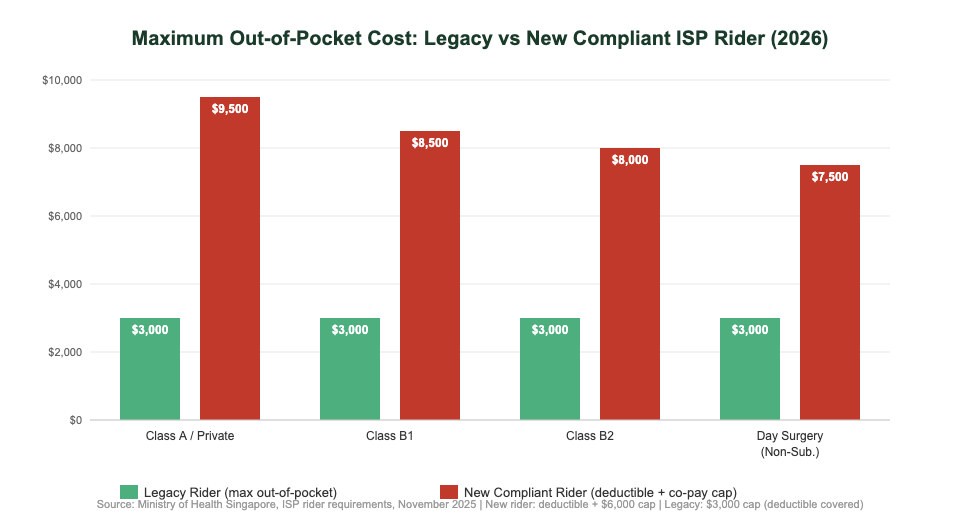
| Max Out-of-Pocket (Class A) | ~$3,000/yr | ~$9,500/yr |
| Max Out-of-Pocket (Class B1) | ~$3,000/yr | ~$8,500/yr |
| Typical Annual Premium | Baseline | ~30% lower |
| Estimated Annual Saving (Private) | — | ~$600/yr |
Source: Ministry of Health Singapore, ISP rider announcement, November 2025. Max out-of-pocket for Class A based on deductible ($3,500) plus co-payment cap ($6,000). Legacy rider max based on co-payment cap only ($3,000), as deductible was covered.
The Real Break-Even: When Does the Legacy Rider Pay Off?
The financial case for keeping your legacy rider (or for not switching) comes down to one question: how often do you expect to be hospitalised with a large bill, and how large?
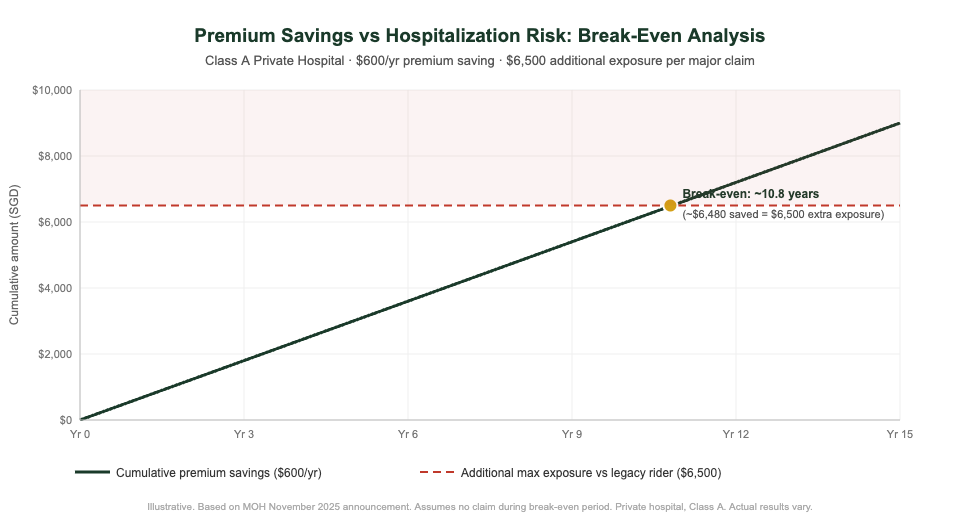
Consider a Singapore resident, age 40, holding a private hospital ISP with a legacy rider. Under the new compliant rider, they save $600/year in premiums. Their additional maximum exposure per hospitalisation under the new rider is $6,500 more than the old rider (i.e., $9,500 vs $3,000 max out-of-pocket for a Class A admission).
If they save $600/year and are never hospitalised with a bill large enough to hit the caps, they break even relative to the old rider after about 10.8 years of premium savings. If they are hospitalised once in that period with a significant Class A bill, they could pay $6,500 more out-of-pocket under the new rider than they would have under the old — wiping out about 10 years of premium savings in one admission.
However, this comparison is not complete. Two factors reduce the legacy rider’s apparent advantage:
- Deductibles can be paid from MediSave. The $3,500 Class A deductible under the new rider is not necessarily coming out of your wallet — it can be paid with MediSave funds, subject to the prevailing annual withdrawal limit. Most Singaporeans with active CPF contributions have sufficient MediSave for this.
- Not all bills are large. For day surgeries or short admissions with bills under $70,000, the 5% co-payment under the new rider (before hitting the $6,000 cap) may be less than $3,500. In those cases, your total out-of-pocket could be lower than the $9,500 maximum scenario.
The break-even analysis ultimately depends on your personal hospitalisation risk — which is why younger, healthier policyholders who are unlikely to face major hospitalisations in the near term are more likely to benefit from switching. Older policyholders or those with a history of hospitalisation should think carefully before giving up legacy rider protection.
The broader question of whether an ISP rider vs no rider actually costs less is worth reading alongside this calculation — especially if you’re considering dropping your rider entirely rather than switching to a compliant version.
Who Should Switch Now vs Wait Until 2028?
For most Singaporeans who bought their legacy rider before 27 November 2025, there is no immediate obligation to switch — you can keep your current rider until your first renewal after 1 April 2028. The decision about when to switch is entirely yours, and the right answer depends on your circumstances.
Switch to the new compliant rider now if:
- You are in your 20s or 30s, healthy, and have had no hospitalisations in the past 3 years. The premium savings are most valuable when your hospitalisation risk is low, and 10+ years of $600/year savings compound meaningfully.
- You have a healthy MediSave balance that can comfortably cover the $2,000–$3,500 deductible if you are hospitalised. Most working Singaporeans with regular CPF contributions should meet this bar.
- Your insurance agent has confirmed your new compliant rider’s co-payment cap applies to your insurer’s panel doctors, and the panel has good coverage of hospitals and specialists you would actually use.
- You value the lower monthly outgo now, rather than protection against a worst-case claim that may never materialise at this stage of life.
Consider staying on the legacy rider until 2028 if:
- You are in your 50s or 60s, or have had recent hospitalisations. The statistical likelihood of a large claim is meaningfully higher, and the $6,500 additional maximum exposure under the new rider is more likely to be relevant.
- You have a chronic condition or upcoming planned surgery that could result in a large hospital bill. Switching before that event means paying the full deductible and higher cap on the claim.
- Your MediSave balance is low, meaning the deductible would have to come from cash savings.
- You regularly use specialist care outside the insurer’s panel, which may mean the $6,000 co-payment cap does not apply to your claims — leaving you exposed to 5% of a very large bill.
For those who dropped their rider entirely amid the 2025–2026 wave of cancellations — when over 182,000 Singaporeans discontinued their ISP rider — understanding why 182,000 Singaporeans dropped their ISP rider and what you should do is a useful starting point before making any coverage decisions.
If you are a retiree or approaching retirement and concerned about rising premiums, the separate analysis on the best ISP for Singapore retirees addresses the premium shock that often occurs after 60 — a related but distinct decision.
How to Switch Your ISP Rider
Switching to a new compliant rider is a policy endorsement, not a new application — you do not need to reunderwrite your health history for the base ISP, and the rider change itself is generally straightforward. Here is the typical process:
- Contact your insurer or financial adviser. Request a switch to the new compliant rider at your next policy renewal. If you want to switch before your renewal, insurers generally allow mid-term changes at the policyholder’s request.
- Review the new rider’s panel list. Before switching, confirm that the hospitals and specialists you use are on the insurer’s panel. The $6,000 annual cap only applies to eligible claims — panel or pre-authorised — so this step directly affects how protective the new rider is for you in practice.
- Understand the new premium. Ask for a written quote showing the new annual premium, the applicable deductible amount for your ward class, and the co-payment cap conditions. Compare this explicitly to your current legacy rider premium.
- Check your MediSave balance. Confirm that your MediSave has sufficient balance to cover at least one year’s deductible at the ward class you would likely use. Your CPF statement shows your current MediSave balance.
- Confirm the effective date. Some switches take effect at the next renewal date; others can be backdated to the current month. Clarify this with your insurer to avoid a coverage gap.
If you are switching ISPs entirely rather than just the rider, a more detailed walkthrough of the process is in our guide on the complete decision checklist before switching to a lower ISP tier. The same principles apply when switching rider tiers.
For a broader look at your retirement and healthcare cost projections, the Singapore retirement calculator can help you model how much to set aside for medical expenses alongside other retirement goals.
Important: Insurers may have different specific terms, premiums, and panel lists. Always read your policy document and consult a licensed financial adviser before changing your health insurance coverage.
Frequently Asked Questions
What is the new ISP rider co-payment cap in Singapore for 2026?
From 1 April 2026, the minimum annual co-payment cap for new ISP riders in Singapore is $6,000 per policy year — up from the previous minimum of $3,000 set in 2018. This cap applies only to eligible co-payments, which typically means claims involving a panel doctor or with pre-authorisation from your insurer. The 5% minimum co-payment per claim remains unchanged.
Can new ISP riders still cover the deductible?
No. New ISP riders sold from 1 April 2026 cannot cover the minimum IP deductible set by MOH. This is a fundamental change from legacy riders, which often covered the deductible entirely. Under the new rules, you must pay the deductible yourself — from cash or MediSave. The deductible ranges from $1,500 for subsidised day surgery to $3,500 for Class A or private hospital admissions, and is applied once per policy year.
How much will I save in premiums by switching to a new compliant ISP rider?
MOH estimates that new compliant riders average about 30% lower in premiums than legacy riders with maximum coverage. For private hospital policyholders, this translates to approximately $600 per year in average savings. For public hospital (restructured hospital) rider policyholders, the average saving is around $200 per year. Your actual saving depends on your age, plan tier, and current rider premium — ask your insurer for a written quote to compare.
What happens if I don't switch my ISP rider — do I lose coverage?
If you bought your existing rider before 27 November 2025, you can keep it until your first policy renewal after 1 April 2028 without losing coverage. At that renewal, you will be transitioned to a new compliant rider by your insurer. If you bought an existing non-compliant rider between 27 November 2025 and 31 March 2026, the same 2028 transition deadline applies. You will not lose coverage during this period — the transition is mandatory only at renewal, not immediately.
Can I pay the new ISP deductible using MediSave?
Yes. Both the deductible and co-payments under your ISP and rider can be paid using MediSave, subject to your prevailing annual MediSave withdrawal limit. For most working Singaporeans with active CPF contributions, the MediSave balance should be sufficient to cover the deductible ($1,500–$3,500 depending on ward class) without needing to use cash. Check your CPF statement for your current MediSave balance and consult your insurer on the payment process.
Does the $6,000 co-payment cap apply even if I go to a non-panel doctor?
Not necessarily. The $6,000 annual co-payment cap under the new compliant rider typically applies only to eligible co-payments — that is, claims involving a panel doctor listed by your insurer, or where you have obtained pre-authorisation from the insurer before the admission. If you go to a non-panel specialist without pre-authorisation for a private hospital stay, the co-payment cap may not apply, and you would bear 5% of the entire eligible claim amount with no cap from the rider. This is one of the most important practical considerations when comparing the new rider with your legacy rider.
Who benefits most from switching to the new ISP rider immediately?
Younger, healthier policyholders in their 20s and 30s with no recent hospitalisation history are most likely to benefit from switching immediately. They are statistically less likely to make large claims in the near term, so the premium savings of approximately $600/year accumulate without being offset by higher out-of-pocket costs. Older policyholders, those with chronic conditions, or those with planned procedures should consider waiting until the 2028 transition deadline or consult a financial adviser before deciding.
Plan Your Healthcare Costs Now
Use our tools and guides to make the right ISP and financial planning decisions for your situation.
Get Free Insurance Advice
Speak with a licensed insurance advisor. No obligation, no cost.
By submitting this form, you agree to our Privacy Policy.
This article was researched with the help of AI. While we strive to keep all information accurate and up to date, there may be errors. If you notice any discrepancies, please contact us.