Medisave Limit 2026: Why 182,000 Singaporeans Dropped Their ISP Rider — What You Should Do
MOH data updated October 2026 shows record IP rider discontinuations in 2025 — and new compliant riders launched in April 2026 are 35–40% cheaper. Here is what this means for your decision before the April 2028 deadline.
In 2025, 181,800 Singaporeans downgraded or cancelled their Integrated Shield Plan riders — nearly double the 84,800 who did so in 2023. At the same time, MOH introduced new compliant IP riders from 1 April 2026 that are on average 35–40% cheaper than legacy riders, though they come with mandatory co-payments. With the medisave limit for 2026 set at a BHS of S$79,000 and rider premiums payable only in cash, understanding where your money goes is critical.
Not financial advice. All figures are for educational reference only. Data verified as at 26 October 2026 unless noted.
Table of Contents
Contents — Click to expand
- What the MOH October 2026 Data Shows
- Why Did 182,000 Singaporeans Drop Their IP Rider?
- The New Compliant Rider: What Changed from April 2026
- Legacy vs New Rider: The Real Trade-Off
- Your Medisave Limit and Rider Premiums: Key Facts
- Should You Switch Before Your April 2028 Deadline?
- Frequently Asked Questions
What the MOH October 2026 Data Shows
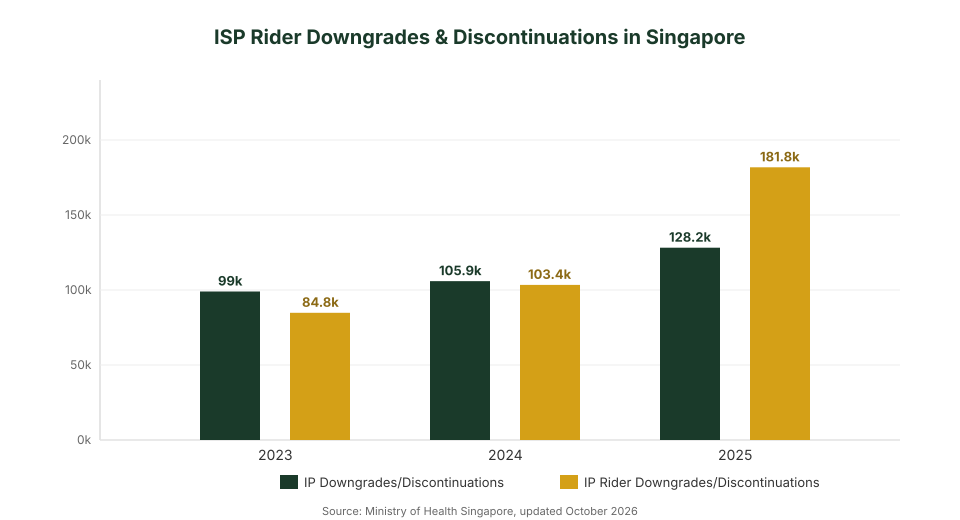
The Ministry of Health updated its data on IP downgrades and discontinuations on 24 October 2026 in response to a parliamentary question. The figures reveal a sharp acceleration in 2025, driven largely by the announcement of new rider rules that took effect on 1 April 2026.
| Year | IP Downgrades & Discontinuations | IP Rider Downgrades & Discontinuations |
|---|---|---|
| 2023 | 99,000 | 84,800 |
| 2024 | 105,900 | 103,400 |
| 2025 | 128,200 | 181,800 |
Source: Ministry of Health Singapore, updated 24 October 2026
Two figures stand out. First, rider discontinuations rose from 84,800 in 2023 to 181,800 in 2025 — a 114% jump in two years. Second, the IP discontinuation rate (128,200) is growing more slowly than the rider discontinuation rate, which means Singaporeans are keeping their base ISP but dropping the supplementary rider on top of it.
MOH notes that it does not track the specific reasons behind each downgrade or cancellation, so the data does not tell us exactly how many were driven by affordability versus a deliberate strategic switch in anticipation of the new rider rules. What it does tell us is the scale of the shift.
Why Did 182,000 Singaporeans Drop Their IP Rider?
There are several overlapping reasons for the surge in rider discontinuations in 2025.
1. Premium fatigue: Legacy IP riders — particularly full-rider or near-full-rider plans that covered deductibles and co-insurance — have seen premium increases of 20–50% over the past five years as private hospital claims rose. For a 50-year-old, legacy rider premiums in the range of S$150–S$300 per month in cash became a significant recurring expense.
2. The new rider rules were announced early: MOH announced the new IP rider requirements in late 2025, with a purchase window from 27 November 2025 to 31 March 2026 for policyholders who needed to move to compliant riders. Many who were on the fence chose to cancel before the transition window rather than commit to new riders.
3. The co-payment requirement changed the value equation: Legacy riders with maximum coverage effectively eliminated out-of-pocket costs at the point of claim. New compliant riders require policyholders to share in claims costs. For healthier policyholders who rarely claimed, the premium cost of a legacy rider no longer felt worth it once a co-payment would apply anyway.
4. Medisave limit constraints: A common misconception is that Medisave can cover rider premiums. It cannot. The medisave limit 2026 applies only to the base ISP premium (subject to age-based Additional Withdrawal Limits) — rider premiums are always a cash expense. This means every dollar of rider premium directly reduces monthly take-home cash. When premiums rose, many policyholders felt the cash drain acutely. You can read more about how the medisave limit 2026 interacts with ISP premium caps in our dedicated guide.
The New Compliant Rider: What Changed from April 2026
From 1 April 2026, all seven IP insurers launched new compliant riders designed to reduce premiums while introducing a cost-sharing element. The key changes are:
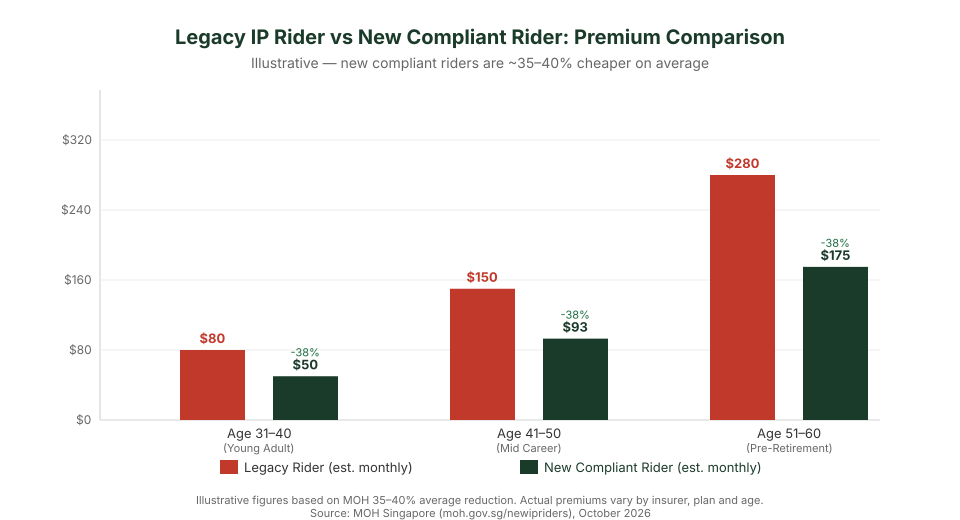
Lower premiums — meaningfully so: According to MOH, new compliant riders with maximum coverage are on average around 35–40% cheaper than legacy riders with comparable coverage levels. At an average 38% reduction, a policyholder paying S$200 per month in cash for their legacy rider could expect to pay around S$124 per month for the new equivalent. Across 12 months, that is a saving of roughly S$912 per year in cash outlay.
Mandatory co-payment: The new riders require policyholders to share in claims costs — either as a percentage of the claim or as a fixed co-payment per claim event. The exact structure varies by insurer and plan tier. This is the key trade-off: you pay less in premiums every month, but you will pay more if you make a claim.
Transition timeline: Policyholders on legacy riders are not required to switch immediately. The deadline for transitioning to new compliant riders is April 2028 — specifically, at the policyholder’s next policy renewal on or before that date. Existing legacy riders remain valid until their renewal date, or until April 2028, whichever comes first. Our guide on the legacy rider transition timeline to 2028 explains the exact milestones for each insurer.
What “compliant” means: A compliant rider is one that meets MOH’s new requirements — it cannot fully eliminate the policyholder’s share of the claim. This is a deliberate policy to ensure policyholders have skin in the game when choosing treatment, which MOH believes will moderate private hospital cost inflation over time.
Legacy vs New Rider: The Real Trade-Off
The decision between staying on your legacy rider until April 2028 versus switching to a new compliant rider now depends heavily on your claims history and risk tolerance. Here is a structured comparison.
| Feature | Legacy Rider | New Compliant Rider |
|---|---|---|
| Monthly Premium (est.) | Higher (100% baseline) | 35–40% lower |
| Out-of-Pocket at Claim | Near zero (full rider) | Co-payment applies |
| Valid Until | Must transition by April 2028 | Ongoing, fully compliant |
| Medisave Usable? | No — cash only | No — cash only |
| Best For | Frequent claimers, older policyholders | Younger, healthy policyholders |
| MOH Compliant? | No — must switch by deadline | Yes |
Source: Ministry of Health Singapore (moh.gov.sg/newipriders), October 2026. Illustrative cost figures.
The break-even analysis is intuitive: if you claim often enough that the co-payment you avoid by staying on a legacy rider exceeds the premium premium you are paying to keep it, staying on the legacy rider makes financial sense — until April 2028. If you rarely claim, switching to the new rider and banking the 35–40% premium saving is likely the better call. For more on this comparison, see our article on the ISP rider vs no rider trade-off under the 2026 rules.
Your Medisave Limit and Rider Premiums: Key Facts
One reason so many Singaporeans feel the sting of ISP rider premiums is a misunderstanding of what Medisave can and cannot pay for. Here is the exact picture for 2026.
Basic Healthcare Sum (BHS) for 2026: S$79,000
The BHS is the maximum balance you can hold in your Medisave Account if you are below 65. Any contributions above this are swept to your Special Account or Retirement Account. The BHS of S$79,000 for 2026 is an increase from S$75,500 in 2025. This figure matters for long-term planning but is not a withdrawal limit.
Additional Withdrawal Limit (AWL) for the private ISP component:
The AWL determines how much Medisave you can use each year to pay the private-insurer component of your base ISP premium (above the MediShield Life portion). In 2026, the AWL tiers are:
| Age Band | Medisave AWL (per year) | What It Covers |
|---|---|---|
| Ages 1–40 | S$300 | Private insurer ISP base premium (above MediShield Life) |
| Ages 41–70 | S$600 | Private insurer ISP base premium (above MediShield Life) |
| Ages 71 and above | S$900 | Private insurer ISP base premium (above MediShield Life) |
Source: CPF Board (cpf.gov.sg), 2026
Rider premiums: always cash, never Medisave. Regardless of your Medisave balance or BHS, you cannot use Medisave to pay for your IP rider premium. The full rider premium must be paid in cash (via GIRO or cheque). For a policyholder with a S$200 per month legacy rider, that is S$2,400 per year out of pocket — entirely separate from the Medisave-eligible portion of their base ISP.
This cash-only rule is one reason the new compliant rider’s lower premiums are particularly attractive: a 38% reduction on a S$200 per month rider saves approximately S$912 per year in actual cash expenditure. That is money that stays in your bank account rather than going to an insurer for a legacy product you are required to move away from by April 2028 anyway. For a deeper look at how the new ISP rider co-payment structure works in practice, including worked examples of how claims are split, see our dedicated breakdown.
Should You Switch Before Your April 2028 Deadline?
You are not required to switch immediately, but the data and economics suggest most Singaporeans will be better off switching sooner rather than later. Here is a practical framework for the decision.
Switch now if:
- You are below 50 and in good health — you are unlikely to make large claims in the near term, so the lower premium saves cash with limited downside risk from the co-payment.
- Your legacy rider premium feels disproportionately high relative to your claims history over the past three years.
- You want certainty — the new rider is fully compliant and you will not face any mid-cycle disruption or forced switching at an inconvenient time.
Wait until closer to the April 2028 deadline if:
- You are 60 or older and have a planned procedure or ongoing treatment where zero co-payment under your legacy rider has significant value.
- You are mid-claim or have a pending pre-authorisation under your legacy rider terms.
- Your insurer has not yet finalised the terms of its compliant rider and you want to compare final options across all providers before committing.
Consider dropping your rider entirely if:
- You are young, healthy, and your ISP base plan already covers B1 or A class ward treatment.
- You are comfortable managing a co-payment out of pocket and would rather bank the full premium savings.
- You are holding a rider primarily out of habit rather than based on a conscious assessment of your healthcare utilisation.
If you are unsure where to start, our ISP downgrade decision checklist walks through the key questions step by step. You can also review our analysis of the real cost of an ISP rider in Singapore to see how premium, co-payment and claims probability combine into a true cost-of-coverage figure.
Not financial advice. Speak to a licensed financial adviser before changing your insurance coverage. All figures are for educational reference only. Data verified as at 26 October 2026.
Frequently Asked Questions
Why did so many Singaporeans drop their ISP rider in 2025?
The spike in rider discontinuations in 2025 was driven by a combination of factors: rising legacy rider premiums, the announcement of new compliant riders that would launch in April 2026 at 35–40% lower cost, and the upcoming mandatory transition deadline of April 2028. Some policyholders chose to cancel early rather than continue paying high legacy premiums for a product they would eventually have to move away from. According to MOH data updated in October 2026, 181,800 IP riders were downgraded or cancelled in 2025, up from 84,800 in 2023.
Can I use Medisave to pay for my ISP rider premium?
No. IP rider premiums cannot be paid using Medisave under any circumstances. Medisave can only be used to pay the private-insurer component of your base ISP premium, subject to age-based Additional Withdrawal Limits of S$300 (ages 1–40), S$600 (ages 41–70) or S$900 (ages 71 and above) per year. Any amount above the AWL, and all rider premiums, must be paid in cash. This is why rising rider premiums directly impact your monthly cash outflow.
What is the deadline for switching from a legacy rider to a new compliant rider?
The transition deadline is April 2028 — specifically, at your next policy renewal on or before that date. You are not required to switch immediately. Your legacy rider remains valid until your renewal date or April 2028, whichever comes first. However, given that new compliant riders are 35–40% cheaper on average, many policyholders may find it financially advantageous to switch before the deadline rather than continue paying higher legacy premiums.
What is the Medisave Basic Healthcare Sum (BHS) for 2026?
The BHS for 2026 is S$79,000. This is the maximum balance you can hold in your Medisave Account if you are below 65. Members who turn 65 in 2026 will have their BHS fixed at S$79,000 for life, regardless of future BHS adjustments. The BHS is an accumulation cap — it is not a withdrawal limit and does not directly restrict how much you can spend on healthcare in any given year.
Are new compliant ISP riders available from all insurers?
Yes. All seven IP insurers launched new compliant riders from 1 April 2026, as required by MOH. The specific products, premium rates, co-payment structures, and coverage tiers vary between insurers. Before switching, compare the new rider options from your current insurer as well as alternatives — you can switch your base ISP and rider to a different insurer if a better product exists, subject to any pre-existing condition exclusions and underwriting.
Is it better to drop my ISP rider entirely or switch to a new compliant rider?
It depends on your health status, age, claims history, and risk tolerance. If you are younger and rarely claim, dropping the rider and paying co-payments out of pocket when claims arise may be cheaper over time than paying monthly premiums for coverage you rarely use. If you are older or have chronic conditions, keeping a compliant rider with predictable co-payments provides valuable protection against large unexpected bills. Run a break-even analysis: if your expected annual co-payment savings (from keeping a rider) exceed the annual premium cost, keep the rider. If not, dropping it is worth considering.
Review Your ISP Coverage Before the April 2028 Deadline
Use our guides to make an informed decision on your Integrated Shield Plan and rider before the transition window closes.
Get Free Insurance Advice
Speak with a licensed insurance advisor. No obligation, no cost.
By submitting this form, you agree to our Privacy Policy.
This article was researched with the help of AI. While we strive to keep all information accurate and up to date, there may be errors. If you notice any discrepancies, please contact us.