EV & Battery ETF Singapore: How to Invest in Electric Vehicle Growth (2026 Guide)
iShares ECAR, L&G BATT, KraneShares KARS and Global X LIT compared — expense ratios, tax treatment, and how Singapore investors buy each.
Singapore investors can access the global EV and battery supply-chain boom through Ireland-domiciled, LSE-listed UCITS ETFs such as iShares ECAR and L&G BATT — which carry lower US withholding tax and no US estate tax exposure — or through US-listed alternatives like KraneShares KARS and Global X LIT, which carry 30% dividend withholding tax and estate tax risk above USD 60,000.
Not financial advice. All figures are for educational reference only. Data verified as at October 2026 unless otherwise noted.
What Is EV & Battery Investing?
EV and battery ETFs give Singapore investors diversified exposure to the companies building electric vehicles and the supply chain behind them — lithium miners, battery cell manufacturers, charging infrastructure firms, and the automakers themselves — without having to pick individual winners in a fast-moving, capital-intensive sector. Rather than betting on a single automaker, a basket approach spreads the risk across dozens of holdings in carmaking, battery chemistry, and raw materials extraction.
Two broad approaches exist. The first tracks pure EV makers and driving technology, like the iShares Electric Vehicles and Driving Technology UCITS ETF (ECAR), which follows the STOXX Global Electric Vehicles & Driving Technology index across roughly 112 holdings. The second tracks the upstream battery value chain — lithium, cobalt, battery cell makers — like the L&G Battery Value-Chain UCITS ETF (BATT) and Global X Lithium & Battery Tech ETF (LIT). Singapore investors buying on margin should also understand that these are thematic, satellite-style holdings — not a substitute for a core broad-market ETF like a diversified factor investing ETF or a global tracker.
Why EV & Battery ETFs Are Trending in 2026
The International Energy Agency projects roughly 23 million electric cars sold globally in 2026, close to 30% of new car sales worldwide, with growth concentrated outside the US as Europe, India, and Latin America accelerate adoption. (IEA Global EV Outlook, 2026). On the supply side, analysts forecast global lithium demand growing 17–30% in 2026 as energy storage — not just EV batteries — becomes the fastest-growing source of lithium-ion battery demand, with China’s battery shipments alone expected to exceed 2.3 TWh this year.
For a Singapore investor, this creates a two-sided opportunity: upside from EV adoption curves in under-penetrated markets, and upside from the metals and manufacturing bottleneck feeding that adoption. The risk, covered in the Risks section below, is that this is a cyclical, policy-sensitive, and currently loss-making sector for many constituent companies — it behaves nothing like a S-REIT dividend play such as those covered in our best S-REITs in Singapore 2026 roundup.
Best EV & Battery ETFs for Singapore Investors
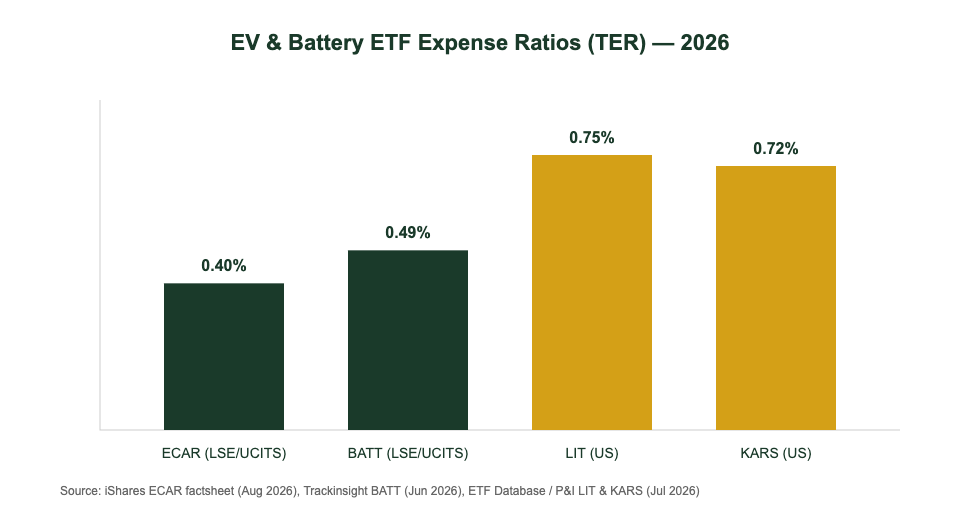
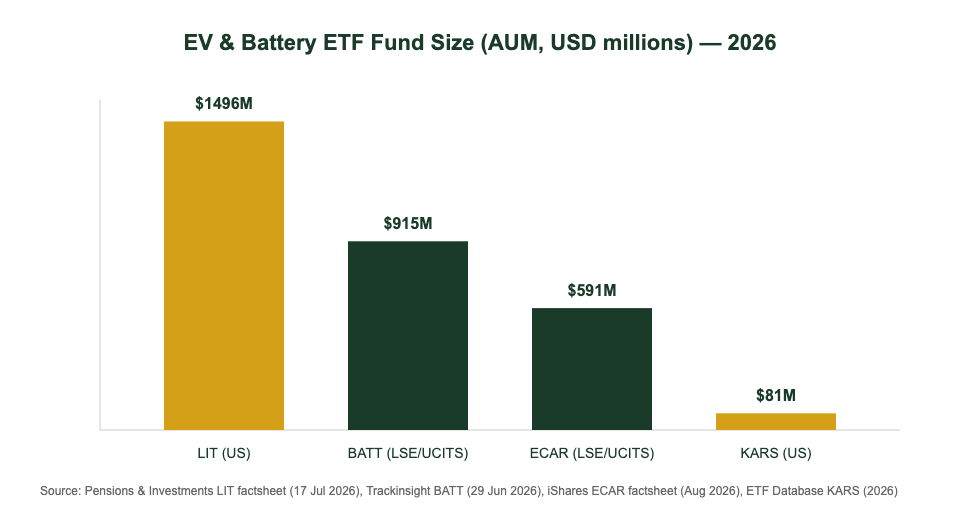
The table below compares the four most accessible EV and battery ETFs for Singapore-based investors — two Ireland-domiciled UCITS funds listed on the London Stock Exchange, and two US-domiciled funds listed in New York.
| ETF | Focus | TER | Domicile / Exchange | AUM |
|---|---|---|---|---|
| ECAR | EV makers & driving tech | 0.40% | Ireland / LSE | ~USD 591m |
| BATT | Battery value chain | 0.49% | Ireland / LSE | ~USD 915m |
| LIT | Lithium & battery tech miners | 0.75% | USA / NYSE Arca | ~USD 1,496m |
| KARS | EV & future mobility | 0.72% | USA / NYSE Arca | ~USD 81m |
Source: iShares ECAR factsheet (Aug 2026); Trackinsight BATT data (29 Jun 2026); Pensions & Investments LIT factsheet (17 Jul 2026); ETF Database KARS data (2026).
Tax & Estate Risk Comparison
Unlike broad-market ETFs such as CSPX or VWRA, EV and battery stocks pay minimal dividends — most constituent companies reinvest earnings into capacity expansion rather than distributing cash — so the usual 15% vs 30% withholding-tax gap between UCITS and US-domiciled funds matters less here than the dividend drag it creates on dividend-heavy funds. What still matters a great deal is US estate tax exposure: a non-resident alien (which includes Singapore citizens and PRs) holding US-situs assets — including US-listed ETFs like LIT and KARS — above USD 60,000 in total US assets at death can face US federal estate tax of up to 40% on the excess, per IRS rules for non-resident aliens. ECAR and BATT, as Ireland-domiciled funds listed on the LSE, carry no such exposure regardless of portfolio size.
| ETF | Domicile | US Dividend WHT | US Estate Tax Risk |
|---|---|---|---|
| ECAR / BATT (LSE) | Ireland | 15% | None |
| LIT / KARS (NYSE Arca) | USA | 30% | Yes (above USD 60k) |
Source: IRS — Nonresidents with US assets (estate tax rules, accessed Oct 2026); US-Ireland double tax treaty (dividend withholding rate).
A worked example: a Singapore investor who builds a SGD 100,000 position in LIT or KARS alongside other US-listed holdings runs a real (if currently below-threshold) estate tax clock the moment combined US-situs assets cross roughly SGD 81,000 (USD 60,000 at current rates) — a threshold that is easy to breach once CSPX, VWRA-adjacent US holdings, and individual US stocks are added up. Routing the EV/battery allocation through ECAR or BATT on the LSE removes that risk entirely, which is the same logic covered in more depth in our rare earth ETF Singapore guide for the broader critical-minerals theme.
How to Buy EV & Battery ETFs in Singapore
All four ETFs are accessible to Singapore-based investors, but the broker and exchange routing differs:
For ECAR and BATT (LSE-listed): Interactive Brokers (IBKR) and Saxo Markets both offer direct LSE access — fund the account in SGD or USD, search the ticker (ECAR or BATT), select the London Stock Exchange as the listing venue, and place a limit order in GBP or USD depending on the trading line. MooMoo Singapore does not currently offer LSE access for all UCITS tickers, so IBKR or Saxo is the more reliable route for these two.
For LIT and KARS (NYSE Arca-listed): Any broker with US market access works — Syfe Brokerage offers commission-free US trades up to a monthly cap, which suits investors building a small satellite position without racking up transaction costs. IBKR remains the lower-cost option for larger, repeated trades once that free quota is used up.
A practical sizing note: because this is a cyclical thematic sector, most advisors would frame EV/battery ETFs as a 2–5% satellite allocation within a broader portfolio, not a core holding. Our Singapore retirement calculator can help size how much satellite risk a long-horizon portfolio can absorb without derailing a retirement target.
Risks to Consider
EV and battery ETFs carry concentration risk that broad-market trackers don’t: ECAR and KARS are dominated by a handful of large automakers and battery suppliers, so stock-specific news (a product recall, a tariff announcement, a single company’s earnings miss) can move the whole fund. Commodity-linked funds like LIT add lithium and cobalt price cyclicality on top — lithium prices fell sharply in 2024–2025 before the current partial recovery, and a similar swing could recur if EV demand growth disappoints. Currency risk is also real: these funds trade in USD or GBP, and SGD movements against either currency affect realised returns independent of the underlying ETF’s performance. Finally, many constituent companies are not yet consistently profitable, which makes this a higher-volatility holding than a dividend-focused S-REIT ETF or a broad index fund — size the position accordingly and treat it as satellite exposure, not a core holding, as outlined in a sound CPF investment strategy that keeps thematic bets outside CPF-restricted funds.
Frequently Asked Questions
What is the best EV ETF for Singapore investors?
There is no single “best” — it depends on tax structure and focus. For Singapore investors prioritising tax efficiency, the Ireland-domiciled, LSE-listed iShares ECAR (pure EV makers) or L&G BATT (battery value chain) avoid US estate tax exposure entirely. For investors comfortable with US-listed funds and wanting the largest, most liquid option, Global X LIT (~USD 1.5 billion AUM) tracks the broader lithium and battery supply chain.
Is LIT the same as BATT?
No. Both target the battery supply chain, but LIT is US-domiciled and NYSE Arca-listed with a 0.75% TER, while BATT is Ireland-domiciled and LSE-listed with a 0.49% TER. BATT carries no US estate tax exposure for Singapore investors; LIT does above USD 60,000 in combined US-situs assets.
Can I buy EV ETFs using my CPF or SRS funds?
None of ECAR, BATT, LIT, or KARS are on the CPF Investment Scheme (CPFIS) approved list, so they cannot be bought with CPF Ordinary or Special Account funds. SRS funds can be used if your SRS-linked brokerage offers access to the relevant exchange — check with your broker, as not all SRS accounts have LSE or full US market access.
Which broker is best for buying ECAR or BATT in Singapore?
Interactive Brokers (IBKR) and Saxo Markets both offer direct London Stock Exchange access, which is required for ECAR and BATT. IBKR generally has lower commissions for larger or more frequent trades, while Saxo’s platform may suit investors who prefer a simpler fee structure for occasional purchases.
Are EV and battery ETFs risky?
Yes, more so than a broad-market ETF. They are concentrated in a single theme, exposed to commodity price swings (especially lithium), and many constituent companies are not consistently profitable. Most financial planners would treat this as a small satellite position — commonly 2–5% of a portfolio — rather than a core holding.
What's driving EV ETF demand in 2026?
The IEA projects roughly 23 million global EV sales in 2026, nearly 30% of new car sales, with growth concentrated in Europe, India, and Latin America. On the supply side, rising demand for grid-scale energy storage batteries — not just EVs — is pushing lithium demand up an estimated 17–30% in 2026, supporting both EV-maker and battery-supply-chain ETFs.
Ready to Start Investing in EV & Battery ETFs?
Open a brokerage account and build a satellite EV/battery position alongside your core portfolio.
Not financial advice. All figures are for educational reference only. Data verified as at October 2026 unless otherwise noted.
This article was researched with the help of AI. While we strive to keep all information accurate and up to date, there may be errors. If you notice any discrepancies, please contact us.