How to Invest in Singapore When You’re Self-Employed or Freelancing (2026)
No employer CPF, no fixed paycheck — here’s how to build a real investment plan anyway.
Table of Contents
If you freelance, run your own business, or drive for a platform in Singapore, investing works differently for you. You don’t get automatic CPF Ordinary and Special Account contributions from an employer — only mandatory MediSave once your net trade income tops $6,000 a year. That means building a bigger buffer, opting into your own tax reliefs, and investing a percentage of irregular income instead of a fixed sum.
Not financial advice. All figures are for educational reference only. Data verified as at 1 August 2026 unless otherwise noted.
- You don’t get automatic CPF OA/SA growth as a self-employed person — only mandatory MediSave once your Net Trade Income (NTI) tops $6,000/year, capped at $10,700/year.
- Build a 6-12 month income buffer before investing seriously — irregular income makes fixed monthly contributions risky.
- Voluntary CPF top-ups and SRS (up to $15,300 or $35,700 a year) are the tax reliefs employees get automatically — as a self-employed person, you have to opt in yourself.
Why Self-Employed Investors Need a Different Playbook
Most “how to invest in Singapore” guides assume a steady monthly paycheck, with an employer quietly topping up your CPF every month in the background. If you’re self-employed, neither of those things happens automatically.
CPF Board defines a self-employed person (SEP) broadly: anyone who runs their own business, works for themselves, and stands to make a profit or loss from it. That covers freelance designers and consultants, hawkers, taxi and private-hire drivers, insurance agents, tuition teachers, and small business owners alike.
The financial mechanics are genuinely different for this group. Your income arrives in irregular chunks instead of a predictable salary. Nobody is automatically setting aside CPF Ordinary Account (OA) or Special Account (SA) savings on your behalf. Your only mandatory CPF obligation is to MediSave — and you have to actively manage that yourself once tax season arrives.
None of this makes investing harder for you — it just means the standard playbook needs adjusting. This guide builds on our beginner investing guide for Singapore and risk profile framework, but focuses on what those guides assume away: the CPF gap, the income buffer, and how to invest without a fixed paycheck.
The Big Gap: No Employer CPF Contributions
Here’s the single biggest difference between investing as an employee and investing as a self-employed person: the CPF math.
An employee below 55 earning a monthly wage has 37% of that wage credited to CPF automatically every month — 20% from their own salary, 17% from their employer — split across the Ordinary, Special, and MediSave Accounts. Nobody has to remember to do this. It just happens.
As a self-employed person, none of that is automatic. Your only mandatory CPF obligation is MediSave, once your Net Trade Income (NTI) exceeds $6,000 a year. The rate you owe depends on your age, ranging from roughly 6% to 10.5% of NTI, capped at $10,700 a year regardless of how much you earn above that. Everything else — Ordinary Account, Special Account, even MediSave beyond the mandatory minimum — is entirely voluntary and 100% funded by you. There’s no employer match to lean on.
| Account | Employee (Below 55) | Self-Employed Person |
|---|---|---|
| Ordinary Account (OA) | Automatic, part of 37% CPF rate | Voluntary only — no automatic contributions |
| Special Account (SA) | Automatic, part of 37% CPF rate | Voluntary only — no automatic contributions |
| MediSave Account (MA) | Automatic, part of 37% CPF rate | Mandatory once NTI > $6,000/yr; ~6%-10.5% of NTI, capped $10,700/yr |
| Who funds it | 20% you + 17% employer | 100% you — no employer match |
Source: CPF Board Self-Employed Scheme (official); CPF Board interest rate notice, 1 Jul-30 Sep 2026 — verified 1 August 2026.
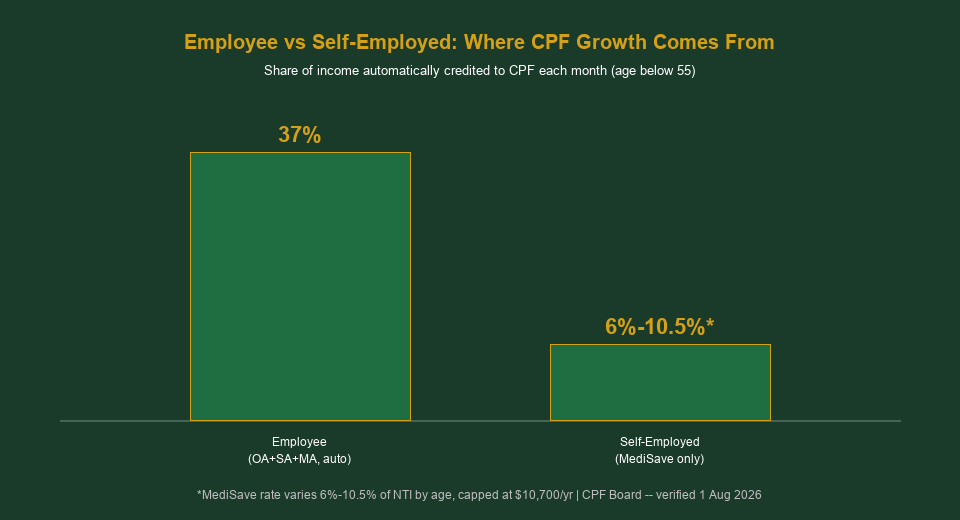
That gap matters for your investment plan, because two of the “safe floor” building blocks employees take for granted — a growing CPF OA and SA — won’t build themselves for you. If you want that safety net, you have to fund it yourself through voluntary contributions, which we cover further down. For a deeper look at how CPF fits into a broader portfolio, see our CPF investment strategy guide, and our glossary breakdown of self-employed CPF contribution rates.
Your MediSave Obligations as a Self-Employed Person
Unlike an employee, you don’t pay MediSave monthly through payroll. Instead, the process runs through your annual tax filing.
Here’s how it works. You declare your Net Trade Income (NTI) to IRAS when you file your income tax return — there’s no separate declaration needed for CPF Board. Once IRAS finishes assessing your income for the year, CPF Board sends you a Notice of CPF Contributions for self-employed persons, showing exactly how much MediSave you owe. You can view this digitally on the CPF self-employment dashboard after logging in with Singpass.
Payment is due within 30 days of that notice. If a lump sum is inconvenient given your irregular income, CPF Board lets you request an instalment plan, or use Contribute As You Earn (CAYE), which spreads MediSave contributions across the year as your clients or platforms pay you — rather than facing one large bill after tax season.
There’s a genuine upside here: your mandatory MediSave contributions are fully tax-deductible, and voluntary contributions to your CPF accounts on top of that count toward the same $37,740 CPF Annual Limit that applies to employees for 2026 — useful if you have a high-earning year and want to shelter more income from tax. Just remember MediSave balances themselves are capped at the Basic Healthcare Sum, which is $79,000 for 2026; anything you contribute above that overflows into your Special or Retirement Account instead. Our CPF Annual Limit Calculator can help you track exactly how much voluntary contribution room you have left in a given year.
Build a Bigger Buffer Before You Start Investing
Every “how to invest” guide tells you to build an emergency fund first. For self-employed investors, that advice needs an upgrade.
If you’re an employee with a stable paycheck, three to six months of expenses in cash is typically enough. If your income genuinely swings between a $2,000 month and an $8,000 month, that same buffer can run dry faster than expected — right when you also need to cover a MediSave bill or a slow client quarter. Aim for six to twelve months of essential expenses instead, held somewhere liquid and low-risk.
This is exactly where the short-term instruments from our goal-based investing guide earn their keep. Singapore Savings Bonds let you redeem penalty-free in any month, which suits unpredictable cash needs. T-bills lock your money up for a fixed 6 or 12-month term, so they’re better suited to a portion of your buffer you’re confident you won’t need on short notice. Model your options with our SSB Interest Calculator.
Only once that buffer is solidly in place should you start directing surplus income toward longer-term investments. Investing before your buffer is secure means you risk being forced to sell investments at a bad time, just to cover a lean month — exactly the scenario a buffer exists to prevent.
Invest a Percentage, Not a Fixed Dollar Amount
Most investing guides tell you to automate a fixed monthly transfer — say, $500 every month, rain or shine. That works fine for a salaried employee. It doesn’t work well if your income genuinely varies from $2,000 in a slow month to $8,000 in a good one.
A fixed dollar amount either forces you to invest money you don’t have in a lean month, or leaves easy money on the table in a good one. The fix is simple: invest a consistent percentage of net income every time you get paid, instead of a fixed sum every month.
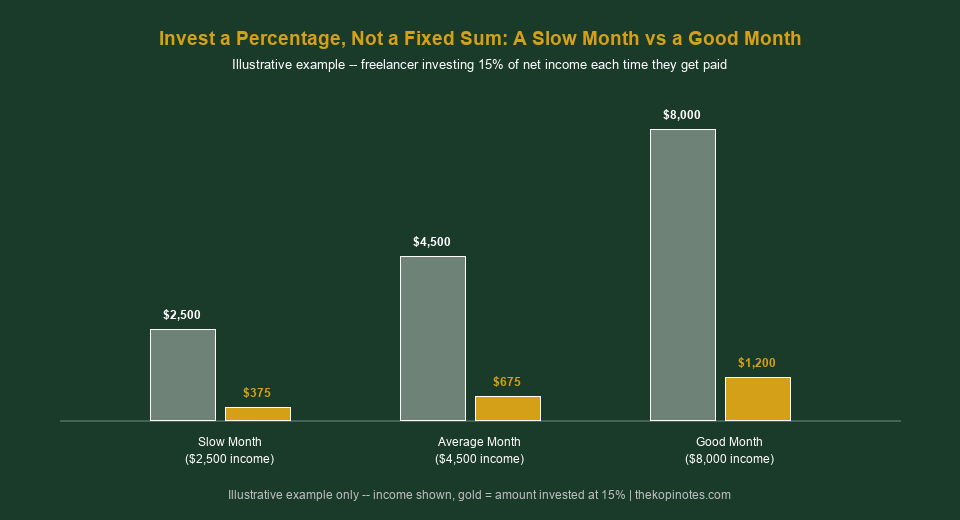
In the example above, a freelancer investing 15% of net income invests $375 in a slow month and $1,200 in a good one — proportional to what actually came in, rather than a number picked in advance. Most robo-advisors and brokerages in Singapore, including Syfe and Endowus, support ad-hoc top-ups alongside or instead of a fixed recurring plan, which makes this approach straightforward to implement in practice. If you’re weighing whether a robo-advisor, DIY brokerage, or licensed financial adviser fits your irregular income best, our DIY vs robo-advisor vs financial adviser guide breaks down the cost and effort trade-offs of each.
Pick a percentage that still lets you fully fund your buffer and MediSave bill first — 10% to 20% of net income is a reasonable starting range for most self-employed investors, adjusted up or down based on how volatile your income actually is.
Voluntary CPF and SRS: Your Best Tax-Efficient Tools
As a self-employed person, the tax reliefs employees get automatically through payroll are entirely opt-in for you. Two are worth understanding well.
Voluntary CPF contributions — either topping up your MediSave (VC-MA) or your Special and Retirement Accounts via the Retirement Sum Topping-Up Scheme (RSTU) — earn the same guaranteed CPF interest rates as any employee’s savings: 2.5% for the Ordinary Account, 4% for Special, MediSave and Retirement Accounts, both confirmed as the floor rate for 1 July to 30 September 2026 by CPF Board’s official rate notice. These count toward the shared $37,740 CPF Annual Limit for 2026, alongside your mandatory MediSave contributions.
The Supplementary Retirement Scheme (SRS) is arguably even more useful for self-employed investors with lumpy income, because you control exactly when and how much you contribute. You can contribute up to $15,300 a year as a citizen or PR, or $35,700 as a foreigner, and every dollar contributed reduces your taxable income for that year. That makes SRS a natural tool for a strong year — put in more when business is good, skip a contribution in a lean year, with no penalty for varying the amount year to year. Money inside SRS can then be invested in unit trusts, ETFs, or fixed income, rather than sitting idle.
If you’re still deciding how to sequence CPF, SRS, and cash investments, our account-sequencing guide and CPF investment strategy guide walk through that decision in more depth.
Worked Example: A Freelance Designer’s Year
Here’s how this comes together for a hypothetical freelance graphic designer earning an average of $4,500 a month, with real income swinging between $2,000 and $8,000 depending on client work.
| Item | Basis | Illustrative Amount* |
|---|---|---|
| Annual Net Trade Income (NTI) | Reported to IRAS | ~$54,000/year ($4,500/mo average) |
| Mandatory MediSave | ~6%-10.5% of NTI, capped $10,700/yr | ~$3,200-$5,670/year (age-dependent) |
| Income buffer (6-12 months) | Held in SSB, T-bills, fixed deposits | $27,000-$54,000 target |
| Voluntary SRS (good year) | Up to $15,300/year cap | $0-$15,300/year, flexed by income |
| Percentage-based investing | 15% of net income, per payment | $300-$1,200/month depending on income that month |
*Illustrative example only, based on a hypothetical freelancer. Not a guarantee — actual MediSave owed depends on your individual age and IRAS-assessed NTI.
Notice that MediSave comes first and isn’t optional — it’s sized off annual NTI, not monthly cash flow, so it’s worth setting aside for year-round rather than being surprised by one lump bill. The buffer and percentage-based investing then flex naturally with whatever income actually shows up that month, rather than assuming a salary that doesn’t exist.
Mistakes Self-Employed Investors Make
Mistake 1: Treating gross income as investable income. Forgetting to set aside for income tax and your MediSave bill before investing the rest is one of the most common — and most painful — mistakes. Set aside for taxes and MediSave first, then apply your investing percentage to what’s left.
Mistake 2: Skipping SRS because income feels unpredictable. SRS is actually most valuable in your best years, since it directly reduces tax on a higher income. You’re not obligated to contribute every year — use it when it counts.
Mistake 3: Auto-debiting a fixed sum that doesn’t flex with income. A recurring $500 monthly transfer, set up once and forgotten, can quietly overdraw your account in a slow month. A percentage-based approach avoids this entirely.
Mistake 4: Ignoring MediSave payable until the CPF Board notice arrives. Because your MediSave bill is assessed only after you file taxes, it’s easy to forget about until a lump-sum notice shows up. Setting aside a rough estimate throughout the year, or using CAYE to spread contributions as you’re paid, avoids that surprise.
If you’re still working out how much you can realistically set aside each month before splitting it across buffer, MediSave, and investments, our guide to minimum investment amounts in Singapore is a useful starting point.
Ready to Put Your CPF and SRS Gaps to Work?
Since your CPF and SRS contributions are entirely opt-in as a self-employed person, open the accounts and set your own pace. Use these referral codes for sign-up perks on your first qualifying deposit.
Frequently Asked Questions
Do self-employed people in Singapore get CPF contributions automatically?
No — only mandatory MediSave contributions apply, once your Net Trade Income exceeds $6,000 a year. Ordinary Account and Special Account contributions are entirely voluntary and self-funded, with no employer match.
How much MediSave do I need to pay as a self-employed person?
It depends on your age and Net Trade Income, roughly 6% to 10.5% of NTI, capped at $10,700 a year. CPF Board calculates your exact amount after IRAS assesses your annual tax return.
Should I still open an SRS account if my income is irregular?
Yes — SRS works well precisely because you choose how much to contribute each year, up to $15,300 for citizens and PRs or $35,700 for foreigners. Contribute more in strong years and skip or reduce it in lean ones.
How big should my emergency buffer be if I'm self-employed?
Aim for six to twelve months of essential expenses, roughly double what’s typically recommended for salaried employees, held in liquid, low-risk instruments like Singapore Savings Bonds or fixed deposits.
What's a reasonable percentage of income to invest each month?
Most self-employed investors start around 10% to 20% of net income, applied every time they’re paid rather than as a fixed monthly sum, adjusted based on how much their income actually varies.
Can I spread out my MediSave payments instead of paying a lump sum?
Yes — CPF Board offers an instalment plan, or you can use Contribute As You Earn (CAYE), which deducts MediSave contributions gradually as clients or platforms pay you throughout the year.
Not financial advice. CPF contribution rates, NTI thresholds, MediSave caps, CPF interest rates, the CPF Annual Limit, Basic Healthcare Sum, and SRS contribution caps verified as at 1 August 2026 against CPF Board’s official Self-Employed Scheme and interest rate pages, and IRAS’s SRS contributions and MediSave relief pages. The MediSave contribution rate range (6%-10.5% of NTI) is corroborated across CPF Board’s official guidance and independent Singapore tax and finance publications, since CPF Board’s exact rate table is served via an interactive calculator rather than a static page. The CPF Annual Limit ($37,740) and Basic Healthcare Sum ($79,000 for members under 65) for 2026 are confirmed against CPF Board’s official published figures. Illustrative worked examples are simplified estimates for educational purposes only and are not guaranteed. The Kopi Notes may earn referral fees when you sign up using our codes.
This article was researched with the help of AI. While we strive to keep all information accurate and up to date, there may be errors. If you notice any discrepancies, please contact us.