How to Invest in Singapore for Beginners: Step-by-Step Guide (2026)
The complete roadmap for Singapore residents starting their investment journey — from emergency funds to ETFs, CPF and SRS strategy.
To invest in Singapore, open a brokerage or platform account, build an emergency fund first, then put money to work in low-cost global ETFs, Singapore Savings Bonds, T-bills, or S-REITs based on your risk tolerance. Singapore residents pay zero capital gains tax and zero dividend tax — one of the most investor-friendly environments in Asia. Most beginners can start with as little as SGD 100 via a Regular Savings Plan (RSP).
Not financial advice. All figures are for educational reference only. Data verified as at October 2026 unless noted.
Table of Contents
Contents — Click to expand
Step 1: Set Your Financial Goals Before You Invest
Most Singaporeans dive into investing before asking the most important question: what am I investing for? Without a clear goal, you will not know what to invest in, for how long, or how much risk to take — and you risk making emotionally driven decisions when markets move.
Your goals will fall into three broad timeframes:
- Short-term (0–3 years): Saving for a renovation, car, holiday, or emergency top-up. Capital preservation matters most here — Singapore T-bills and Singapore Savings Bonds are better choices than equities for money you need within three years.
- Medium-term (3–10 years): Building a housing downpayment, growing a child’s education fund. A balanced approach — a mix of bonds and diversified equity ETFs — suits this horizon.
- Long-term (10+ years): Retirement or generational wealth. This is where low-cost global equity ETFs (like VWRA or CSPX listed on the London Stock Exchange) shine, as compounding over time smooths out market volatility.
Write down your goal, target amount, and target date before opening any investment account. This one exercise will do more for your actual investment returns than any stock tip or market forecast.
Step 2: Build Your Emergency Fund Before Investing in Singapore
Before you invest a single dollar in the stock market, you need 3–6 months of essential expenses sitting in a liquid, low-risk account. In Singapore, that means a high-yield savings account (HYSA) like DBS Multiplier, UOB One, or OCBC 360 — not a brokerage account or CPF.
Why does this matter so much? Because markets fall. If your portfolio drops 30% during a correction and you simultaneously face a job loss, medical bill, or urgent household expense, you will be forced to sell your investments at the worst possible moment. An emergency fund is what lets you stay invested through volatility — and staying invested is the real edge of long-term investors.
Singapore household benchmark: A household spending SGD 5,000 per month should hold SGD 15,000–30,000 in liquid savings before starting equity investing. If you are single and spending SGD 2,500 per month, aim for SGD 7,500–15,000 as your target before opening a brokerage account.
Once your emergency fund is fully funded, you are ready to invest surplus income rather than money you might need urgently — and that mental security makes it far easier to stay the course through market downturns.
Step 3: How to Invest in Singapore — Understanding Your Options
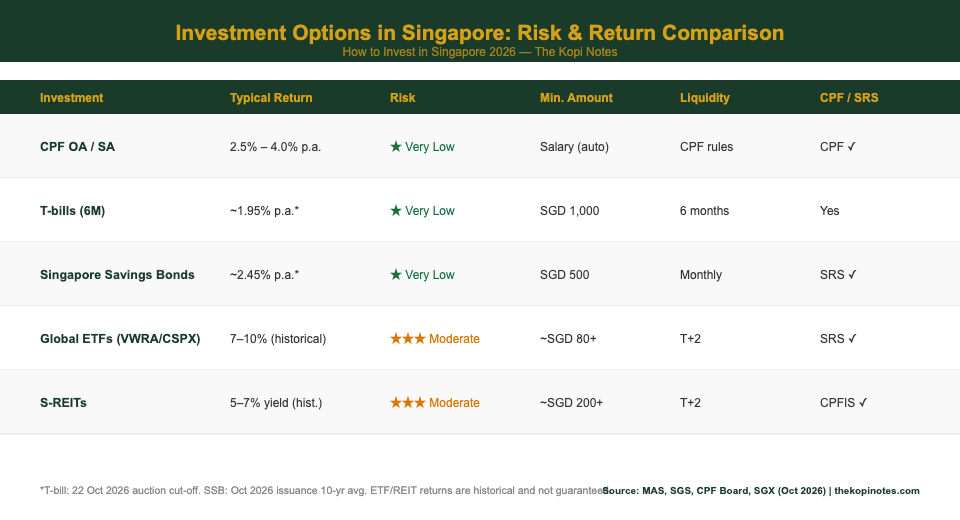
Singapore offers one of the widest ranges of investment options in Asia, from government-guaranteed bonds to global equity ETFs tracking 3,000+ companies. Here is how the main asset classes compare for a Singapore resident investor:
| Investment | Typical Return | Risk Level | Minimum | Liquidity |
|---|---|---|---|---|
| CPF OA / SA | 2.5%–4.0% p.a. | Very Low | Salary (auto) | CPF rules apply |
| T-bills (6-month) | ~1.95% p.a.* | Very Low | SGD 1,000 | 6 months |
| Singapore Savings Bonds | ~2.45% p.a.* | Very Low | SGD 500 | Monthly redemption |
| Global ETFs (VWRA / CSPX) | 7–10% (historical) | Moderate | ~SGD 80–150+ | T+2 any trading day |
| S-REITs | 5–7% yield (hist.) | Moderate | ~SGD 200+ | T+2 any trading day |
*T-bill rate from 22 Oct 2026 auction cut-off yield. SSB rate is the 10-year average return for Oct 2026 issuance. ETF and REIT historical returns are not guaranteed. Source: MAS, SGS, CPF Board, SGX (October 2026).
CPF: Singapore’s Built-In Investment Engine
Many Singaporeans overlook the fact that CPF is already an investment. Your Ordinary Account (OA) earns a guaranteed 2.5% per annum, and your Special Account (SA) earns 4% per annum — both risk-free and backed by the Singapore government. A high-quality corporate bond ETF might earn 3–4% with meaningful credit risk; your CPF SA earns 4% with zero default risk.
You can also make voluntary top-ups to your CPF SA and top up family members’ CPF to earn the higher 4% rate. Understanding your CPF investment strategy should be one of the first steps for any working Singaporean — the CPF accounts often represent the single largest investment asset for most households under 40.
Singapore Savings Bonds: Flexible Low-Risk Investing
SSBs are issued monthly by the Singapore government with step-up interest over 10 years. The October 2026 issuance offers approximately 2.45% average annual return over 10 years. Crucially, you can redeem them any month with no penalty and receive your principal in full within 1–2 months of redemption request. This makes SSBs ideal for money you might need in 1–5 years but want earning more than a bank account. Read our full Singapore Savings Bonds guide for step-by-step application instructions via bank or DBS/UOB/OCBC internet banking.
T-bills: Guaranteed Short-Term Returns
6-month T-bills are auctioned fortnightly and currently yield approximately 1.95% per annum (22 Oct 2026 auction, the highest cut-off yield in 2026 so far). They are ideal for parking 6-month cash at a guaranteed rate — better than most bank savings accounts for that specific duration. The minimum application is SGD 1,000 via local bank internet banking. Our Singapore T-bills 2026 guide covers the full application and competitive bidding process.
Global ETFs: The Core of Most Long-Term Portfolios
For long-term wealth building of 10 years or more, low-cost global equity ETFs are widely regarded as the most efficient vehicle for individual investors. Singapore residents have two primary routes:
- LSE-listed UCITS ETFs (e.g. VWRA, CSPX) — Ireland-domiciled ETFs listed on the London Stock Exchange. These offer lower US withholding tax (15% vs 30% for US-domiciled equivalents) and no US estate tax exposure. VWRA tracks the FTSE All-World index (3,000+ companies across 50+ countries) with a TER of 0.22% per annum; CSPX tracks the S&P 500 with a TER of 0.07% per annum.
- SGX-listed ETFs (e.g. Nikko AM STI ETF, ABF Singapore Bond Index Fund) — traded in SGD on Singapore Exchange, simpler to buy via a local brokerage, but limited to Singapore or specific sectors.
For most Singapore beginners with a 10–30 year time horizon, a single fund like VWRA gives diversified exposure across the global economy with one purchase and minimal ongoing management. Read our passive income Singapore guide for a comparison of the income approach (S-REITs, dividend ETFs) versus the total-return growth ETF strategy.
S-REITs: Singapore’s Income Asset Class
Singapore Real Estate Investment Trusts (S-REITs) are listed property vehicles that distribute at least 90% of taxable income as dividends. With historical distribution yields of 5–7% and Singapore’s zero dividend withholding tax for local residents, S-REITs can be a useful income layer in a portfolio. However, they carry real estate sector risk, interest rate sensitivity, and currency risk for REITs with overseas assets. They are not a replacement for global diversification but can complement it. See our best S-REITs in Singapore 2026 and Singapore REIT ETF guide for a lower-cost basket approach via an ETF.
Step 4: Choose the Right Investment Platform in Singapore
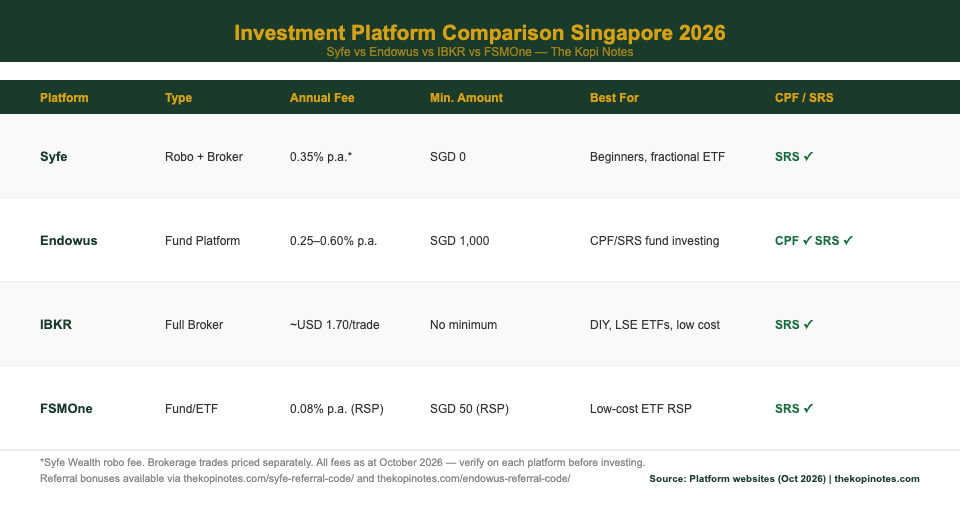
Your platform choice determines your annual costs, investment options, and how easy it is to maintain consistent investing habits. Here is how the main platforms compare for Singapore residents in 2026:
| Platform | Type | Best For | Annual Fee | CPF / SRS |
|---|---|---|---|---|
| Syfe Brokerage | Robo + Broker | Beginners; fractional ETF investing | 0.35% (Wealth) | SRS ✓ |
| Endowus | Fund Platform | CPF and SRS fund investing | 0.25–0.60% p.a. | CPF ✓ SRS ✓ |
| IBKR | Full Broker | DIY investors; LSE ETFs (VWRA, CSPX) | ~USD 1.70/trade | SRS ✓ |
| FSMOne | Fund/ETF Platform | Low-cost ETF RSP; unit trusts | 0.08% p.a. (RSP) | SRS ✓ |
Source: Platform websites as at October 2026. Fees may vary — always verify the current fee schedule on each platform’s website before investing. Use code SRPRFFFCD for Syfe and P0544985 for FSMOne for sign-up benefits.
Which platform to start with? If you are a complete beginner, Syfe offers the lowest friction — SGD 0 minimum, fractional investing, and a curated selection of ETF portfolios you can set and forget. Use the Syfe referral code SRPRFFFCD for a fee waiver on your first few months. For investors who want to use CPF OA or SRS funds in diversified fund portfolios, Endowus (referral code 2V343) is the most CPF-integrated platform in Singapore. For self-directed investors building a larger portfolio in LSE-listed ETFs like VWRA or CSPX, Interactive Brokers (IBKR) offers the lowest per-trade cost — especially effective when your portfolio exceeds SGD 20,000 and you are buying in lump sums rather than monthly small amounts. Use our FSMOne referral code P0544985 if you prefer FSMOne’s ETF RSP for low monthly amounts.
Step 5: Save Tax with the Supplementary Retirement Scheme (SRS)
The SRS is one of the most underused tax levers available to Singapore residents. Under the scheme, you can contribute up to SGD 15,300 per year (Singapore citizens and PRs) into an SRS account at DBS, UOB, or OCBC, and deduct the full contribution amount from your taxable income for that year.
Worked tax saving example (2026):
- At a 22% marginal tax rate (chargeable income above SGD 120,000): a full SGD 15,300 SRS top-up saves you SGD 3,366 in tax
- At 11.5% marginal rate (SGD 80,001–120,000): the saving is SGD 1,760 per year
- At 7% marginal rate (SGD 30,001–40,000): the saving is SGD 1,071 per year
The tax relief applies in the Year of Assessment following your contribution, so a top-up made by 31 December 2026 reduces your 2027 income tax bill. Money in SRS is not idle — you can invest it in ETFs, unit trusts, S-REITs, Singapore Savings Bonds, or fixed deposits directly from your SRS account via participating platforms.
At the SRS withdrawal age (currently 63), only 50% of SRS withdrawals are taxable. If you spread withdrawals across 10 years post-retirement, many retirees pay zero or near-zero tax on their SRS funds entirely. Use our Singapore retirement calculator to model how annual SRS contributions affect your projected retirement income.
Step 6: Start Investing with Dollar-Cost Averaging (DCA)
Dollar-cost averaging (DCA) means investing a fixed amount at regular intervals — typically monthly — regardless of whether markets are up or down. It is the most practical strategy for salaried Singapore investors because it aligns naturally with how most people earn: a monthly paycheck that arrives on a fixed date.
Why DCA consistently outperforms trying to time the market:
- Automatic price discipline: When ETF prices are low, your fixed monthly amount buys more units. When prices are high, you buy fewer. This naturally averages down your cost per unit over time without requiring any market prediction.
- Removes paralysis: It eliminates the common “should I invest now or wait for a correction?” question. You invest on a fixed schedule. Full stop.
- Forces long-term discipline: The primary driver of investor returns is staying invested for long enough — and a regular automated RSP makes that the path of least resistance.
Worked example: A Singapore investor contributing SGD 500 per month into VWRA via an RSP for 20 years, assuming a 7% average annual return (below VWRA’s historical average), would accumulate approximately SGD 260,000 — on total contributions of just SGD 120,000. The remaining SGD 140,000 is compound growth working silently in the background.
Most platforms in Singapore — Syfe, FSMOne, and Endowus — support automatic monthly Regular Savings Plans (RSPs) so you configure the investment once and it runs without further intervention. This is the single most powerful habit for Singapore investors starting their journey.
Step 7: Monitor, Review, and Stay the Course
Once you are invested, the temptation is to check your portfolio daily and react to market news. Resist this. Long-term investing rewards patience and consistency, not activity and reaction. Studies consistently show that investors who check their portfolios less frequently make fewer emotional decisions and achieve better long-term outcomes.
Annual portfolio review checklist for Singapore investors:
- Rebalance if allocation has drifted: If your target was 80% equities and 20% bonds/cash and equities have grown to 90%, sell a portion of equities and buy bonds or SSBs to restore your target. Most robo-advisers do this automatically — it is one of the underrated benefits of platforms like Syfe and Endowus.
- Step up contributions when income grows: As your salary increases with career progression, increase your monthly DCA amount proportionally. Even an additional SGD 100 per month makes a material compounding difference over 20 years.
- Maximise your SRS by 31 December: If tax savings are a priority, ensure your SRS contribution for the year reaches SGD 15,300 before year-end. This is a guaranteed return (the tax saving) that is not dependent on market performance.
- Review beneficiary nominations: CPF funds do not follow your will — they follow your CPF nomination. Review and update CPF nominations annually, especially after major life events (marriage, divorce, birth of child).
The biggest risk for most Singapore investors is not market volatility — it is panic-selling during a downturn and locking in losses. A practical self-check: if a 25–30% portfolio drop would cause you genuine financial stress or the urge to exit entirely, your equity allocation is too high for your actual risk tolerance. Adjust your asset allocation until you can genuinely hold through a bear market — that is the version of your portfolio that will actually perform over the long term.
This article is part of The Kopi Notes’ investing pillar series. For income-focused investing in Singapore, see our best S-REITs in Singapore 2026 guide. For ETF-specific investing via the London Stock Exchange, see our Singapore REIT ETF guide. Not financial advice.
Frequently Asked Questions
How much money do I need to start investing in Singapore?
You can start investing in Singapore with as little as SGD 50–100 per month via a Regular Savings Plan (RSP) on platforms like FSMOne or Syfe. IBKR has no minimum account balance, though each ETF unit on the London Stock Exchange typically costs SGD 80–300+. The more important question than “how much” is starting consistently — SGD 200 per month invested for 25 years at a 7% average return grows to approximately SGD 160,000, on total contributions of just SGD 60,000.
What is the best investment for beginners in Singapore?
For most Singapore beginners, a single global equity ETF like VWRA (Vanguard FTSE All-World, LSE) or CSPX (iShares Core S&P 500, LSE) is the most practical starting point for long-term wealth building. These offer diversified exposure across hundreds to thousands of companies with a low expense ratio (0.07–0.22% p.a.). For money needed within 1–5 years, Singapore Savings Bonds (currently ~2.45% p.a., Oct 2026) are the best risk-free option. The two-step approach — SSBs for near-term goals, global ETF for long-term — covers most beginners’ core investing needs.
Do I pay tax on investment gains or dividends in Singapore?
Singapore has no capital gains tax and no dividend tax for individual investors. Profits from selling shares or ETFs are tax-free. Dividends from Singapore companies and most ETFs are also tax-free in your hands. The main exception is US-sourced dividends received through US-domiciled ETFs like VOO or VT, which are subject to a 30% US withholding tax deducted at source — which is why most Singapore investors prefer Ireland-domiciled UCITS ETFs listed on the London Stock Exchange, where the withholding tax is only 15% under the Ireland–US tax treaty.
Can I invest using my CPF OA funds in Singapore?
Yes, CPF OA funds can be invested under the CPF Investment Scheme (CPFIS) in approved unit trusts, Singapore Exchange (SGX)-listed ETFs, shares, and other products. However, the CPF OA already earns a guaranteed 2.5% per annum, so any investment you make with OA funds needs to realistically outperform 2.5% after all fees — and many CPFIS products historically have not met this bar. If you want to invest CPF money in quality global equity funds, Endowus (referral code 2V343) is currently the primary platform that allows CPF OA investing into diversified, low-cost fund portfolios including Dimensional and Vanguard funds.
What is the SRS and should I open one in 2026?
The Supplementary Retirement Scheme (SRS) is a voluntary government scheme that lets Singapore citizens and PRs contribute up to SGD 15,300 per year (foreigners: SGD 35,700) and deduct the full amount from taxable income. At a 22% marginal tax rate, the maximum annual saving is SGD 3,366 — a guaranteed return that is not subject to market risk. Money in SRS can be invested in stocks, ETFs, unit trusts, and Singapore Savings Bonds. If you are earning above SGD 80,000 a year and have not yet opened an SRS account, doing so before 31 December 2026 is one of the highest-certainty financial moves available to you.
How do I start investing in Singapore step by step?
The seven steps for a Singapore beginner are: (1) Define your financial goal and time horizon; (2) Build a 3–6 month emergency fund in a high-yield savings account; (3) Understand your investment options — CPF, T-bills, SSBs, global ETFs, and S-REITs; (4) Open an investment account on a suitable platform (Syfe for beginners, Endowus for CPF/SRS, IBKR for self-directed ETF investing); (5) Open an SRS account if you earn above SGD 80,000 per year and maximise your annual contribution; (6) Start a monthly RSP into a diversified global ETF like VWRA and automate it; (7) Review annually, rebalance if needed, and avoid reacting to short-term market movements.
Ready to Start Investing in Singapore?
Open your first investment account today and put your money to work. Use our referral links for exclusive sign-up bonuses and fee waivers.
This article was researched with the help of AI. While we strive to keep all information accurate and up to date, there may be errors. If you notice any discrepancies, please contact us.