Endowment Plan Riders Singapore 2026
Which Add-Ons Are Actually Worth Paying For?Disclosure: This article is for informational purposes only and does not constitute financial advice. Consult a licensed financial adviser before making insurance decisions. Data verified as at 30 October 2026.
When shopping for an endowment plan in Singapore, your insurer will often offer optional riders — add-on benefits you can attach to your base policy for an extra premium. But are they worth paying for?
This guide breaks down the five most common endowment plan riders available in Singapore, what each one covers, how much they typically cost, and — critically — whether you’re better off buying standalone coverage instead.
Key takeaway: For most Singaporeans, keeping your endowment plan “pure” and buying standalone term life and critical illness coverage separately is more cost-efficient. But there are scenarios where specific riders make sense.
Table of Contents
What Are Endowment Plan Riders?
A rider is an optional add-on benefit attached to a base insurance policy. Riders allow you to customise your coverage beyond the basic death and maturity benefits of the endowment plan itself.
Key facts about riders in Singapore:
- Riders must typically be added at policy inception
- Some insurers allow riders to be added at specific policy anniversaries, but not always
- Each rider carries its own separate premium, added on top of your base endowment premium
- Riders are regulated by the Monetary Authority of Singapore (MAS) under the Insurance Act
- If you surrender your base endowment plan, the riders are typically cancelled too
Important caveat: Riders are generally only available on longer-term endowment plans (5 years or more). Short-term plans from banks (1-3 year DBS, OCBC, Tiq plans) do not offer riders.
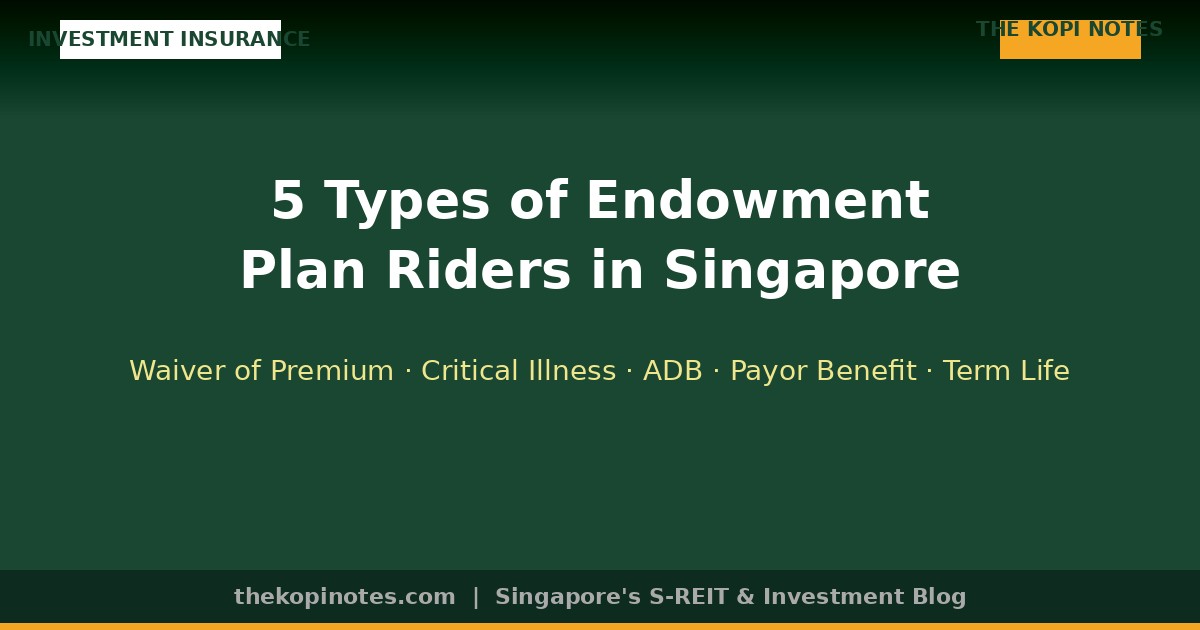
5 Common Types of Endowment Plan Riders in Singapore
1. Waiver of Premium (WoP) Rider
What it does: If you die, become totally and permanently disabled (TPD), or are diagnosed with a specified critical illness, future premiums on your endowment plan are waived. Your policy continues in force — you continue to earn bonuses (for participating plans) and receive the full maturity payout — without paying another cent.
Why it matters: Without this rider, if you become disabled and cannot work, you would need to keep paying premiums or risk surrendering the policy — often at a significant loss in early years.
Best for: Policyholders who depend heavily on employment income to fund long-term endowment premiums.
2. Payor Benefit Rider
What it does: This rider is specifically designed for children’s endowment plans (education savings plans). It waives premiums if the parent or guardian (the “payor”) — not the insured child — dies, becomes TPD, or is diagnosed with a critical illness.
How it differs from WoP: The WoP rider covers the life insured. The Payor Benefit rider covers the payor — usually the parent funding the premiums. This ensures the child’s education fund stays intact if the parent can no longer pay.
Best for: Parents buying endowment plans to fund their children’s university education.
3. Critical Illness (CI) Rider
What it does: Pays an additional lump sum benefit on top of your endowment’s base sum assured if you are diagnosed with a covered critical illness. Typically covers the 37 critical illnesses defined under the LIA Singapore standard CI definitions, including cancer, heart attack, and stroke.
Note: Some plans offer early-stage CI riders that trigger on early-stage conditions (e.g., early-stage cancer), paying a smaller benefit (typically 25-50% of the sum insured).
Best for: Policyholders who want CI coverage but haven’t yet purchased a standalone CI plan.
4. Accidental Death Benefit (ADB) Rider
What it does: Pays an additional death benefit only if death is caused by an accident. Natural causes, illness, or suicide are typically excluded.
Cost: Usually the cheapest rider — often S$5-20 per S$10,000 of additional coverage per year.
Best for: Individuals in higher-risk occupations seeking basic additional protection at minimal cost.
5. Term Life Rider
What it does: Attaches a pure term life insurance component to your endowment plan. If you die during the rider’s term, an additional lump sum is paid on top of the endowment’s death benefit. Unlike the endowment itself, the term life rider has no cash or surrender value — it is pure protection.
Cost: A 30-year-old non-smoker might pay S$200-400 per year for S$200,000 of additional term coverage.
Best for: Policyholders wanting to increase their total death benefit cost-effectively without buying a separate term life policy.
Which Insurers Offer Endowment Riders in Singapore?
| Plan Type | Riders Available? | Examples |
|---|---|---|
| Short-term bank endowments (1-3 yrs) | No | DBS Savvy Endowment, OCBC 2-yr plan, Tiq Fixed Plans |
| Long-term participating endowments (10-25 yrs) | Yes | Prudential PRUFlexicash, AIA Guaranteed Protect Plus, Great Eastern Great Wealth Multiplier |
| Education/children’s endowments | Yes (Payor Benefit) | Manulife ReadyBuilder, AIA Education Plus |
Key insight: Riders are primarily a feature of longer-term, life-insurer-issued endowment policies. Short-term bank endowments are capital preservation tools — rider options don’t exist for these products.
How Much Do Riders Cost?
Rider premiums are charged separately from your base endowment premium. As a general guide:
- Waiver of Premium rider: Typically 5-15% of your base endowment premium. For a S$3,000/year endowment, this might add S$150-450/year.
- Payor Benefit rider: Typically S$100-300/year for a parent aged 30-40 on a children’s plan.
- Critical Illness rider: S$200-800/year for S$100,000 CI coverage, depending on age and health.
- Accidental Death Benefit rider: Often S$50-150/year for S$50,000-100,000 additional ADB.
- Term Life rider: S$150-600/year for S$200,000 coverage at age 30-40.
Important: Rider premiums for CI and term life may be stepped — increasing as you age. Always check whether your rider premiums are level or stepped before committing.

Riders vs Standalone Coverage: Which Is Better?
Standalone Coverage: Usually More Flexible and Efficient
Pros of buying standalone CI/term life separately:
- Portability: Standalone policies continue even if you surrender your endowment plan. Riders tied to your endowment disappear the moment you surrender the base policy.
- Flexibility: You can increase or decrease coverage independently without affecting your endowment plan.
- Better coverage terms: Dedicated CI plans often cover more conditions and offer multi-pay, early-stage, or cancer-specific variants that endowment riders typically don’t match.
When Riders Have a Slight Edge
- Single application: One underwriting process for both the endowment and the rider — convenient if you have minor health conditions.
- Waiver of Premium is unique: The WoP rider ensures your long-term savings plan stays funded if you become disabled or critically ill — standalone products don’t replicate this exactly.
Bottom line: The Waiver of Premium rider is often the most justifiable rider to add, as it protects the plan itself from lapsing. For CI and death coverage, standalone policies generally offer better value and flexibility.
When Riders Actually Make Sense
- You have a pre-existing condition that makes standalone CI/term life uninsurable at standard rates. A CI rider bundled with an endowment may be your best option.
- You’re a parent funding a 15-20 year children’s education endowment. The Payor Benefit rider protects the child’s education fund against the payor’s death/disability — a distinct coverage gap that standalone products don’t fill exactly.
- You have a large gap between your endowment’s death benefit and your family’s protection needs. A term life rider bridges this gap at relatively low cost.
- You’re buying a long-term participating endowment (15+ years). The Waiver of Premium rider provides a safety net ensuring your endowment doesn’t lapse if you face an unforeseen health crisis.
Key Questions to Ask Before Adding a Rider
- What are the rider’s exact trigger conditions? How many CI conditions are covered?
- Is the rider premium level or stepped? A rider that seems affordable at 30 may become expensive at 50.
- What happens to the rider if I surrender the base policy early? In almost all cases, the rider terminates and you lose all premiums paid.
- Can I add this rider later? If not, you must decide at inception.
- Does the rider duplicate coverage I already have? If you already have a robust standalone CI plan, a CI rider may be redundant.
Related Reading
Frequently Asked Questions
Can I add a rider to my endowment plan after it has started?
This depends on your insurer and plan. Some allow riders to be added at specific policy anniversaries, but most riders must be added at policy inception. Check your policy contract or ask your financial adviser.
What happens to my rider if I surrender my endowment plan early?
Surrendering the base endowment policy terminates any attached riders immediately. You lose all future rider benefits and do not receive a refund of rider premiums paid. This is a key reason standalone insurance coverage is generally more flexible.
Is the Waiver of Premium rider worth it for a long-term endowment plan?
Generally yes, especially for longer-term plans (10+ years). If you become TPD or critically ill and cannot work, the WoP rider ensures your endowment stays funded and you still receive the full maturity payout. The cost is typically 5-15% of your base premium — a small price for protecting a long-term savings commitment.
Do short-term endowment plans (1-3 years) have riders?
No. Short-term endowment plans from banks (DBS, OCBC, UOB, Tiq by Etiqa) are capital-guaranteed savings products and do not offer insurance riders. Riders are only available on longer-term participating endowment plans from traditional life insurers such as AIA, Prudential, Great Eastern, Manulife, or NTUC Income.
Should I buy a CI rider or a standalone critical illness plan?
For most Singaporeans, a standalone critical illness plan is the better choice. Standalone plans offer more flexibility (multi-pay CI, early-stage CI), higher coverage limits, and continue even if you surrender your endowment plan. A CI rider is mainly better if you have a pre-existing health condition that makes standalone CI underwriting difficult.
What is the Payor Benefit rider and who needs it?
The Payor Benefit rider waives premiums on children’s endowment plans if the parent or guardian paying the premiums (the “payor”) dies, becomes TPD, or is diagnosed with a critical illness. Parents buying long-term children’s education endowment plans should seriously consider this rider, as it protects the child’s savings even if the parent can no longer contribute.
Get Free Insurance Advice
Speak with a licensed insurance advisor. No obligation, no cost.
By submitting this form, you agree to our Privacy Policy.
This article was researched with the help of AI. While we strive to keep all information accurate and up to date, there may be errors. If you notice any discrepancies, please contact us.