Endowment Plan Nomination Singapore 2026: Statutory vs Trust Guide
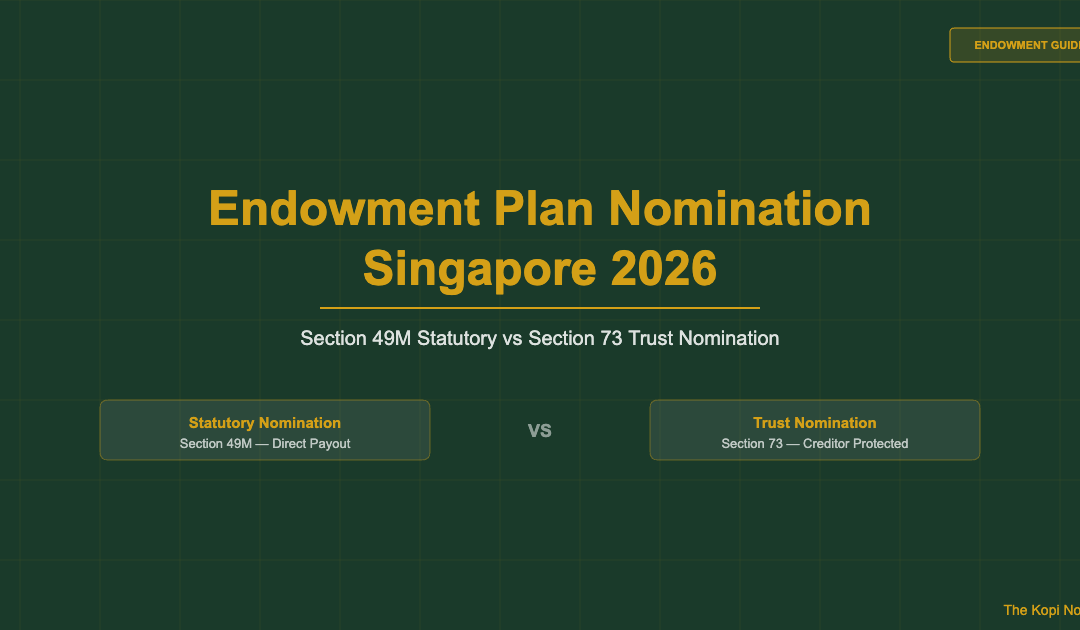
An endowment plan nomination in Singapore ensures your policy payout reaches your intended beneficiaries directly — without going through probate. Under the Insurance Act, you can make a Statutory Nomination (Section 49M) for a direct, estate-free payout to your spouse, children, or parents; or a Trust Nomination under Section 73 of the Conveyancing and Law of Property Act that adds creditor protection. Without a valid nomination, your death benefit falls into your estate and may take 6–18 months to distribute.
Not financial or legal advice. All information is for educational reference only. Consult a licensed financial adviser or lawyer for your specific situation. Data as at October 2026.
Table of Contents
What Is Endowment Plan Nomination?
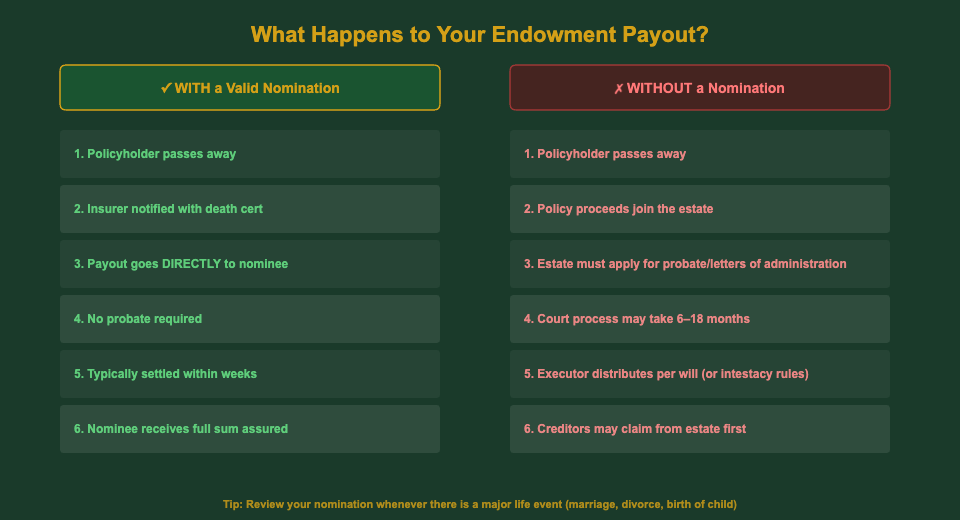
A nomination is a formal instruction to your insurer specifying who should receive your endowment plan’s death benefit (and sometimes maturity proceeds) when you pass away. Without it, the payout forms part of your estate and must go through Singapore’s probate process — a court-supervised distribution procedure that can take many months and cost thousands of dollars in legal fees.
Nomination applies to life insurance and endowment policies. In Singapore, two distinct legal frameworks govern how this works: the Insurance Act (Cap. 142) for Statutory Nomination, and the Conveyancing and Law of Property Act (Cap. 61) for Trust Nomination. They differ significantly in scope, flexibility, and the protection they offer your beneficiaries.
For Singapore investors building passive income Singapore portfolios, ensuring your endowment plan has a valid nomination is as important as choosing the right policy in the first place.
Types of Nomination in Singapore
Singapore law provides two nomination routes for life insurance and endowment policies. Each has distinct legal effects, so choosing the right one depends on your family situation, estate planning goals, and whether creditor protection is a concern.
| Feature | Statutory Nomination (S.49M) | Trust Nomination (S.73) |
|---|---|---|
| Eligible nominees | Spouse, children, parents only | Any person, including non-family |
| Part of estate? | No | No |
| Creditor protection | Limited — creditors may still have claims | Strong — proceeds protected from estate creditors |
| Revocable? | Yes, by policyholder anytime | Irrevocable without trustee consent |
| Trustee required? | No | Yes — named trustee manages the proceeds |
Source: Insurance Act (Cap. 142); Conveyancing and Law of Property Act (Cap. 61), Singapore, as at October 2026.

Statutory Nomination (Section 49M Insurance Act)
A Statutory Nomination under Section 49M of the Insurance Act is the most common type of nomination for endowment plan holders in Singapore. When you make a statutory nomination and then pass away, the policy proceeds are paid directly to your nominated beneficiaries — outside your estate, without going through probate.
Key rules for statutory nomination:
- You may only nominate your spouse, children, and parents as statutory nominees.
- The nominee does not receive the money as your personal representative — they receive it as a beneficiary in their own right.
- The payout bypasses your will and your estate entirely.
- If your nominee is a minor (under 18), the insurer will hold the funds until the child comes of age, unless a trustee is named.
- You can revoke or change a statutory nomination at any time without the nominee’s consent.
One important limitation: a statutory nomination does not fully protect the proceeds from creditors in all circumstances. Certain creditors may still pursue claims depending on the situation. For robust creditor protection, a Trust Nomination is stronger.
Trust Nomination (Section 73 Conveyancing and Law of Property Act)
A Trust Nomination under Section 73 of the Conveyancing and Law of Property Act creates a trust over your policy proceeds in favour of your nominated beneficiaries. This is a more powerful arrangement that provides stronger creditor protection — once you make a trust nomination, the policy proceeds are held on trust and are not available to your estate’s creditors.
Key features of a trust nomination:
- You can nominate any person — not just family members. This includes friends, extended relatives, or even charities.
- You must appoint at least one trustee to manage the trust proceeds if all beneficiaries are minors.
- The nomination is generally irrevocable without the consent of the trustees.
- The proceeds are protected from claims by your creditors — a key advantage if you run a business or have outstanding debts.
- A trust nomination supersedes any conflicting instructions in your will for this policy.
For business owners or self-employed individuals seeking financial protection, pairing a trust-nominated endowment plan with a well-structured investment portfolio on platforms like Syfe referral code and sign-up bonus or Endowus referral code creates a comprehensive financial safety net.
How to Nominate Your Beneficiary
Nominating a beneficiary for your endowment plan is straightforward. Here is the standard process for most Singapore insurers:
- Complete a nomination form: Request the nomination form from your insurer or financial adviser. Most insurers also offer this via their online portals.
- Specify the nomination type: Indicate whether you want a Statutory Nomination (S.49M) or Trust Nomination (S.73). If in doubt, consult a licensed financial adviser.
- Name your nominees and their share percentages: Specify each nominee’s full name, NRIC/passport number, relationship to you, and the percentage of proceeds they will receive (must total 100%).
- Appoint a trustee (if required): For trust nominations or if any nominee is a minor, name a trustee who is at least 21 years old.
- Sign and submit: Sign in the presence of a witness (who must not be a nominee) and return the completed form to your insurer.
- Retain a copy: Keep a copy of the acknowledgement from your insurer, and inform your trustee/next-of-kin of its existence.
There is generally no fee for making a nomination, though some insurers may charge an administrative fee for trust nominations.
| Nomination Type | Best Suited For | Typical Use Case |
|---|---|---|
| Statutory (S.49M) | Most individuals | Simple family payout — spouse or children receive directly |
| Trust (S.73) | Business owners, debtors | Protect proceeds from creditors; nominate non-family |
| No nomination | Not recommended | Proceeds form part of estate; delayed distribution |
Source: MAS Singapore, insurer guidelines, as at October 2026.
Planning your retirement alongside your protection needs? Use our Singapore retirement calculator to estimate how much your endowment plan fits into your overall retirement income.
What Happens Without a Nomination?
If you do not have a valid nomination on your endowment plan at the time of your death, the policy proceeds become part of your estate. This triggers the following sequence:
- Your next-of-kin or executor must apply to the court for a Grant of Probate (if there is a will) or Letters of Administration (if there is no will).
- The court process typically takes 6–18 months for straightforward estates, and longer for contested or complex ones.
- Legal and professional fees reduce the amount ultimately received by your beneficiaries.
- If you have outstanding debts, creditors have a claim against your estate — potentially reducing what your family receives.
- Your Intestate Succession Act directs distribution if there is no valid will — this may not align with your wishes.
This is particularly relevant for parents with young children. Without a nomination or will, your children’s share is held by the Public Trustee until they turn 21, and your surviving spouse may not automatically receive everything. You can also link your endowment plan strategy to other passive income vehicles — explore our guide on FSMOne referral code for investment account options.
Nomination vs Will: Key Differences
Many policyholders assume their will covers everything, including their endowment plan proceeds. This is a critical misconception. A valid nomination (statutory or trust) overrides the instructions in your will for that specific policy. Here is how they differ:
- Will: Governs your estate — property, bank accounts, investments not under nomination or joint tenancy. Takes effect after probate.
- Nomination (S.49M): Overrides your will for the nominated policy. Proceeds pass directly to nominees outside your estate — no probate required.
- Trust Nomination (S.73): Creates an independent trust. Completely outside your estate, with stronger creditor protection. Your will cannot override it.
The practical implication: if your will says “leave all assets to my wife” but your endowment plan has a statutory nomination naming your parents from a decade ago (never updated), your parents — not your wife — will receive the payout. This is why regular reviews of your nomination are essential.
When to Review Your Nomination
Your nomination is only as current as the last time you updated it. Life changes frequently, and a nomination made years ago may no longer reflect your wishes. Review and update your nomination after any of these life events:
- Marriage: A statutory nomination is automatically revoked upon marriage. You must make a new nomination after getting married.
- Divorce: A statutory nomination to your former spouse is automatically revoked upon divorce under Singapore law.
- Birth of a child: You may wish to add or adjust the share your children receive.
- Death of a nominee: If a nominee predeceases you, you must update the nomination to name a replacement.
- Significant change in financial circumstances: For example, if you take on significant business debts, switching from a statutory to a trust nomination may better protect your family.
Most insurers make it easy to update your nomination online or via their customer service centres. Make it an annual habit alongside your other financial reviews.
Frequently Asked Questions
What is the difference between a statutory nomination and a trust nomination for an endowment plan?
Does my will override my endowment plan nomination?
What happens to my endowment plan payout if I die without a nomination in Singapore?
Can I change or revoke my endowment plan nomination?
Who can be nominated under Section 49M of the Insurance Act?
Does a trust nomination protect my endowment plan from creditors?
Start Building Your Financial Safety Net Today
Securing your endowment plan nomination is just one piece of a comprehensive financial plan. Grow your wealth with Singapore’s top investment platforms.
Get Free Insurance Advice
Speak with a licensed insurance advisor. No obligation, no cost.
By submitting this form, you agree to our Privacy Policy.
This article was researched with the help of AI. While we strive to keep all information accurate and up to date, there may be errors. If you notice any discrepancies, please contact us.