CapitaLand Ascendas REIT Share Price: NAV Discount & Fair Value Analysis (2026)
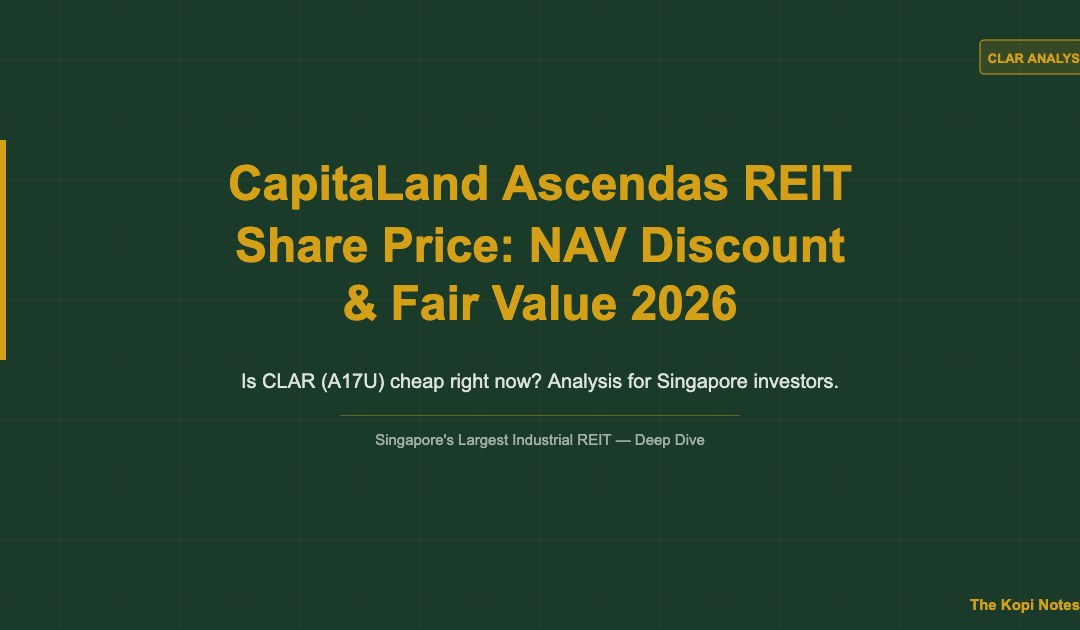
Singapore’s largest industrial REIT — a deep-dive into CLAR’s price vs NAV, fair value, and whether it’s a buy at current levels.
CapitaLand Ascendas REIT (SGX: A17U), or CLAR, is Singapore’s largest industrial REIT, with a portfolio of over 228 properties across 9 countries including Singapore, Australia, the US, and the UK. As at October 2026, CLAR trades at approximately S$2.08 per unit against a reported NAV of S$1.72 — a 21% premium. Investors considering CLAR today need to weigh this premium against a forward yield of ~7.2% and the REIT’s resilient industrial and data centre exposure.
Not financial advice. All figures are for educational reference only. Data as at October 2026 unless noted.
Table of Contents
Contents — Click to expand
- What Is CapitaLand Ascendas REIT?
- Key Metrics at a Glance
- Share Price vs NAV: Is CLAR Trading at a Premium or Discount?
- Fair Value Calculation: What Is CLAR Worth?
- Dividend Yield and DPU History
- CLAR vs Industrial REIT Peers: Yield Comparison
- Portfolio Quality and Geographic Diversification
- Risks to Consider Before Investing
- Is CLAR a Buy, Hold, or Sell at Current Prices?
- Frequently Asked Questions
What Is CapitaLand Ascendas REIT?
CapitaLand Ascendas REIT (SGX: A17U), commonly referred to as CLAR or Ascendas REIT, is Singapore’s oldest and largest industrial REIT. It was listed in November 2002 and is sponsored by CapitaLand Investment Limited, one of Asia’s largest real estate investment managers.
CLAR’s portfolio spans over 228 properties valued at approximately S$16.9 billion as at mid-2026. The portfolio is diversified across four key sub-sectors: business space and life sciences, logistics, industrial, and data centres. Geographically, the REIT has a presence in Singapore (~55% by asset value), Australia (~21%), the United States (~12%), the United Kingdom and Europe (~12%), and a growing data centre component in India and South Korea.
The REIT is managed by Ascendas Funds Management (S) Ltd, a wholly-owned subsidiary of CapitaLand Investment. It is listed on the SGX Mainboard and is a component of key indices including the FTSE Straits Times Index (STI), MSCI Singapore Index, and the GPR APREA Composite REIT Index.
For Singapore investors looking for exposure to passive income in Singapore via industrial real estate, CLAR has long been the benchmark choice — given its scale, diversification, and institutional-grade portfolio quality.
Key Metrics at a Glance
| Metric | Value (Oct 2026) |
|---|---|
| SGX Ticker | A17U |
| Share Price | S$2.08 |
| NAV Per Unit | S$1.72 |
| Price-to-NAV (P/B) | 1.21x |
| Market Capitalisation | ~S$9.4 billion |
| Annualised DPU (FY2026 est.) | ~S$0.1502 per unit |
| Dividend Yield (at S$2.08) | ~7.2% |
| Gearing Ratio | ~38.2% |
| Weighted Avg Debt Maturity | ~3.8 years |
| No. of Properties | 228+ |
| Portfolio Valuation | ~S$16.9 billion |
| Sponsor | CapitaLand Investment Ltd |
Source: CapitaLand Ascendas REIT 1H 2026 Financial Results; SGX filings. Figures as at October 2026. All estimates.
Share Price vs NAV: Is CLAR Trading at a Premium or Discount?
One of the most commonly used valuation metrics for REITs is the Price-to-NAV (or Price-to-Book) ratio — the relationship between a REIT’s market share price and its underlying net asset value per unit. A ratio above 1.0x means the market is willing to pay a premium over the book value of the REIT’s assets.
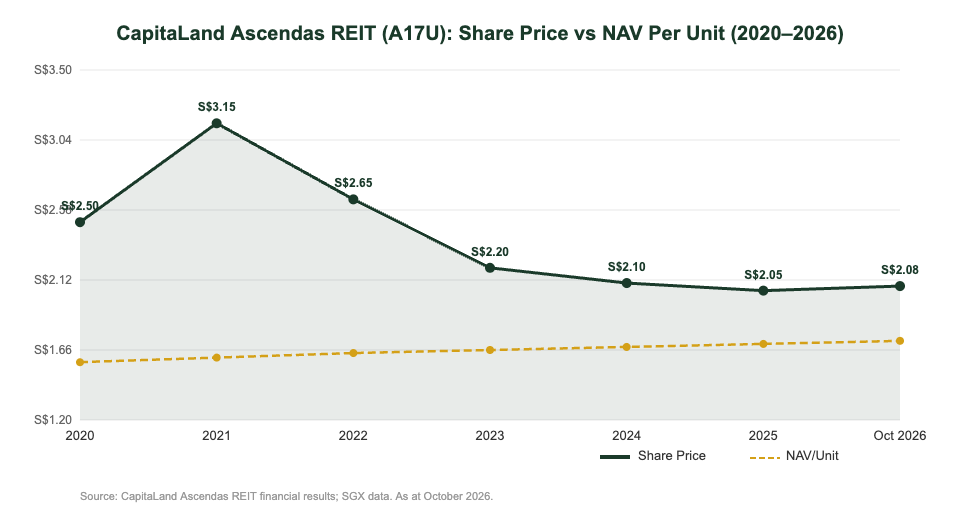
As at October 2026, CLAR trades at approximately S$2.08, against a reported NAV of S$1.72 per unit — implying a Price-to-NAV of 1.21x, or a 21% premium to book value. Historically, CLAR commanded an even higher premium: in 2021, the share price peaked near S$3.15, representing close to 2.0x NAV as investor enthusiasm for industrial real estate soared.
The premium has compressed significantly since the 2022 rate-hike cycle began. Higher interest rates directly impact REITs in two ways: (1) increased borrowing costs reduce distributable income, and (2) investors demand higher yields, which means lower prices. CLAR’s price declined from its 2021 highs to current levels that represent a more rational valuation — though still at a modest premium to NAV.
For context: Singapore investors following the best S-REITs in Singapore 2026 guide would note that industrial REITs typically trade at higher P/NAV multiples than retail or commercial REITs — reflecting their superior earnings visibility, longer leases, and lower tenant default risk.
Fair Value Calculation: What Is CLAR Worth?
For a REIT like CLAR, the most commonly used fair value methodology for retail investors is the Dividend Discount Model (DDM) and the NAV-multiple approach. Let’s apply both.
Method 1: NAV Multiple Approach
CLAR’s long-run average P/NAV ratio (2016–2026) is approximately 1.35x. At the current NAV of S$1.72, this implies a fair value of:
Fair Value (NAV method) = S$1.72 × 1.35 = S$2.32
This suggests the current price of ~S$2.08 is approximately 10% below its long-run fair value — implying limited upside but a reasonable margin of safety.
Method 2: Yield-Based Valuation
If we assume a target yield of 6.5% for a high-quality industrial REIT (consistent with CLAR’s peer group premium), and a stabilised DPU of S$0.1502:
Fair Value (yield method) = S$0.1502 ÷ 0.065 = S$2.31
Both methodologies converge around S$2.30–S$2.35 as a reasonable fair value estimate, implying approximately 10–13% upside from current levels — plus the ~7.2% dividend yield while you wait.
Worked Example for a Singapore Investor:
A Singapore investor holding 10,000 units of CLAR at S$2.08 (cost: S$20,800) would receive approximately S$1,502 per year in DPU (S$0.1502 × 10,000 units). If CLAR re-rates to S$2.31, that same position would be worth S$23,100 — a S$2,300 capital gain plus S$1,502 in distributions, for a total return of approximately 18.3% in one year.
Dividend Yield and DPU History
CLAR distributes its income semi-annually, typically in February/March and August/September each year. The REIT has a policy of distributing at least 90% of its taxable income.
| Financial Year | DPU (S¢) | Yield (at year-end price) |
|---|---|---|
| FY2021 | 15.26¢ | 4.8% |
| FY2022 | 15.40¢ | 5.8% |
| FY2023 | 15.11¢ | 6.9% |
| FY2024 | 14.94¢ | 7.1% |
| FY2025 | 15.01¢ | 7.3% |
| FY2026 (est.) | 15.02¢ | 7.2% |
Source: CapitaLand Ascendas REIT annual reports, SGX filings. FY2026 DPU is an estimate based on 1H 2026 results. Yields calculated at end-of-year share prices.
The key observation is that while DPU has been essentially flat (and even slightly declining) since FY2022, the yield has risen sharply as the share price has fallen. This is a classic “falling knife vs rising yield” dynamic in REIT investing. For income-focused investors, the yield is now more attractive than it has been in years — but it comes with the caveat that DPU growth has stalled amid higher borrowing costs.
Investors building a retirement income portfolio can use our Singapore retirement calculator to project how CLAR’s DPU compounds over a 10-to-20-year holding period, accounting for reinvested distributions.
CLAR vs Industrial REIT Peers: Yield Comparison
How does CLAR’s yield stack up against Singapore’s other major industrial and commercial REITs? The chart below compares estimated 2026 forward yields across the peer group.
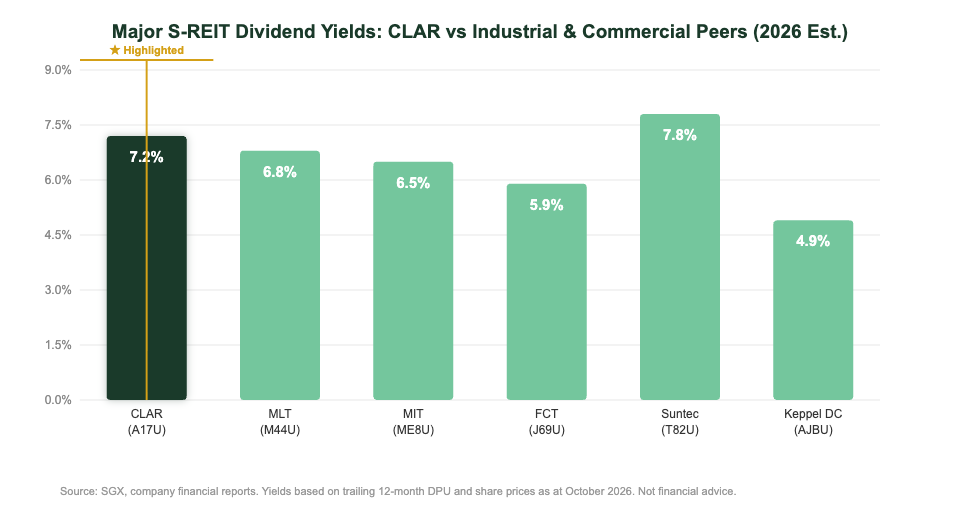
CLAR’s ~7.2% forward yield sits in the middle of the peer pack — below Suntec REIT (~7.8%) but above Keppel DC REIT (~4.9%). The yield premium over Keppel DC reflects CLAR’s more diversified and slightly lower-growth profile, while the discount to Suntec reflects CLAR’s better portfolio quality and occupancy track record.
Portfolio Quality and Geographic Diversification
One of CLAR’s key investment merits is the quality and diversification of its portfolio. The REIT does not rely on any single tenant, market, or sub-sector — a critical factor in stress-testing its DPU resilience.
| Country/Region | % of Portfolio Value | Key Sub-Sectors |
|---|---|---|
| Singapore | 55% | Business parks, hi-tech, logistics |
| Australia | 21% | Logistics, business parks |
| USA | 12% | Data centres, life sciences |
| UK & Europe | 12% | Business parks, data centres |
Source: CapitaLand Ascendas REIT 1H 2026 Financial Results presentation.
Importantly, CLAR’s Singapore portfolio boasts an occupancy rate of approximately 92–93%, underpinned by strong demand from logistics operators, technology companies, and life sciences tenants. The data centre component — spread across Singapore, the US, and Europe — provides an additional growth vector as AI-driven computing demand accelerates.
For investors interested in how CLAR compares to specialist data centre plays, our detailed analysis of the Singapore REIT ETF guide provides broader context on S-REIT sector allocation.
Risks to Consider Before Investing
No investment is without risk. Before committing capital to CLAR, Singapore investors should consider the following key risks:
1. Interest Rate Risk: CLAR’s gearing is approximately 38.2%. While manageable relative to the MAS’s 50% gearing limit, higher interest rates increase refinancing costs and can compress DPU. Approximately 75% of CLAR’s debt is on fixed rates as at 1H 2026, which provides near-term protection, but floating rate exposure still creates uncertainty.
2. Currency Risk: With ~45% of its portfolio outside Singapore, CLAR is exposed to AUD, USD, GBP, EUR, and other currency movements. A strengthening SGD can reduce the translated value of overseas income. Currency hedging partially mitigates this, but it is not complete.
3. Valuation Premium Risk: CLAR currently trades at 1.21x P/NAV. If the premium compresses back to 1.0x (i.e., the share price falls to ~S$1.72), investors would face a ~17% capital loss before considering distributions received. Premium compression typically occurs during market selloffs or when interest rates rise sharply.
4. DPU Growth Stagnation: CLAR’s DPU has been largely flat since FY2022, as interest cost increases have offset rental income growth. Until borrowing costs ease materially, DPU growth is likely to remain muted.
5. Concentration in Industrial Properties: While diversified within industrial, CLAR has limited exposure to resilient retail-adjacent assets. An industrial property downturn (e.g., from an e-commerce slowdown or manufacturing contraction) would directly impact its core Singapore and Australia portfolio.
Investors looking to diversify their S-REIT exposure beyond industrial can explore options highlighted in our best S-REITs in Singapore 2026 guide, or use the Syfe referral code to invest in a professionally managed REIT portfolio through Syfe REIT+.
Is CLAR a Buy, Hold, or Sell at Current Prices?
Based on the analysis above, here is a structured assessment for Singapore investors:
CLAR is likely a HOLD-to-BUY if:
- You are an income investor seeking a stable ~7.2% yield from Singapore’s highest-quality industrial REIT
- You have a 3-to-5 year time horizon and can withstand near-term price volatility
- You believe interest rates will fall or stabilise, which would unlock DPU growth and potential price re-rating
- You are building a diversified S-REIT portfolio through a platform like FSMOne or a managed solution like Syfe REIT+
Consider alternatives or waiting if:
- You expect interest rates to rise further in 2026-2027, which would pressure REITs across the board
- You need short-term capital preservation — CLAR’s share price can be volatile during market risk-off events
- You seek high DPU growth rather than stable income — CLAR’s DPU is likely to grow only modestly (1-2% per annum) until rates fall meaningfully
At S$2.08 against a fair value of ~S$2.30-2.35, CLAR appears to offer modest upside plus an attractive 7.2% yield. The key catalyst for a re-rating would be a clear rate-cut cycle from the US Fed — which would compress cap rates and allow REIT prices to recover toward their long-run P/NAV averages. Investors can reference our Singapore T-bills 2026 guide to understand how shifting rates affect REIT valuations in a broader context.
Frequently Asked Questions
What is CapitaLand Ascendas REIT's (CLAR) current share price and is it cheap?
As at October 2026, CapitaLand Ascendas REIT (SGX: A17U) trades at approximately S$2.08 per unit. Against a reported NAV of S$1.72, this implies a Price-to-NAV of 1.21x — a modest premium. While the share price has declined significantly from its 2021 peak of ~S$3.15, it is not yet trading at a discount to NAV. Whether it is “cheap” depends on your benchmark: at 1.21x P/NAV, it is below CLAR’s long-run average of ~1.35x, suggesting some margin of safety. At a ~7.2% forward yield, the income case is compelling for long-term investors.
What is CLAR's NAV per unit and how is it calculated?
CLAR’s NAV (Net Asset Value) per unit as at 1H 2026 is approximately S$1.72. This is calculated as the total value of CLAR’s property portfolio (independently valued) plus other assets, minus all liabilities (including borrowings), divided by the total number of units in issue. NAV is reported semi-annually with CLAR’s financial results. A rising NAV indicates that property values are increasing, while a falling NAV reflects declining valuations — common during periods of rising interest rates or property market weakness.
What dividend does CLAR pay and when is the next ex-dividend date?
CapitaLand Ascendas REIT pays distributions semi-annually — approximately February/March (for the 2H distribution) and August/September (for the 1H distribution). The estimated full-year DPU for FY2026 is approximately S$0.1502 per unit (15.02 Singapore cents), implying an annualised yield of ~7.2% at the current price of S$2.08. Investors should check CLAR’s SGX announcements for the exact ex-dividend and payment dates, as these vary slightly each year.
Is CapitaLand Ascendas REIT a good investment for retirement income in Singapore?
CLAR can be a solid component of a retirement income portfolio for Singapore investors, given its ~7.2% yield, institutional-grade portfolio, and CapitaLand sponsorship. However, it is not risk-free — the share price has fallen from S$3.15 in 2021 to ~S$2.08 currently, and DPU growth has stalled in the rising-rate environment. Retirees seeking stability may prefer blending CLAR with Singapore Savings Bonds or T-bills for the lower-risk component of their portfolio. Our Singapore retirement calculator can help model different income allocation scenarios.
How does CLAR compare to Mapletree Industrial Trust (MIT) and Mapletree Logistics Trust (MLT)?
CLAR, MIT, and MLT are all major Singapore industrial REITs, but they differ in focus. CLAR is the largest (~S$16.9 billion portfolio) with the broadest diversification across business parks, logistics, data centres, and life sciences globally. MIT is more focused on business parks and data centres within Singapore and the US. MLT is concentrated on logistics assets across Asia-Pacific. In terms of yield, CLAR (~7.2%) and MLT (~6.8%) are broadly comparable, while MIT (~6.5%) trades at a slight premium reflecting its stronger data centre growth narrative. CLAR’s scale and CapitaLand sponsorship give it superior capital access and portfolio management capacity.
Can I buy CapitaLand Ascendas REIT using CPF or SRS funds?
Yes. CapitaLand Ascendas REIT (A17U) is listed on the SGX Mainboard and is eligible for purchase using CPF Investment Scheme (CPFIS) funds from your CPF Ordinary Account (OA), subject to your CPF Investment Limit (typically 35% of investable savings in OA). It is also eligible for Supplementary Retirement Scheme (SRS) investment. Investors should ensure they invest through an approved CPF Agent Bank or SRS Operator — Endowus is a popular SRS-compatible platform for S-REIT investing. Use the Endowus referral code for a bonus when signing up.
Start Building Your S-REIT Portfolio Today
Use our referral links to sign up for the best platforms for Singapore REIT investors.
This article was researched with the help of AI. While we strive to keep all information accurate and up to date, there may be errors. If you notice any discrepancies, please contact us.